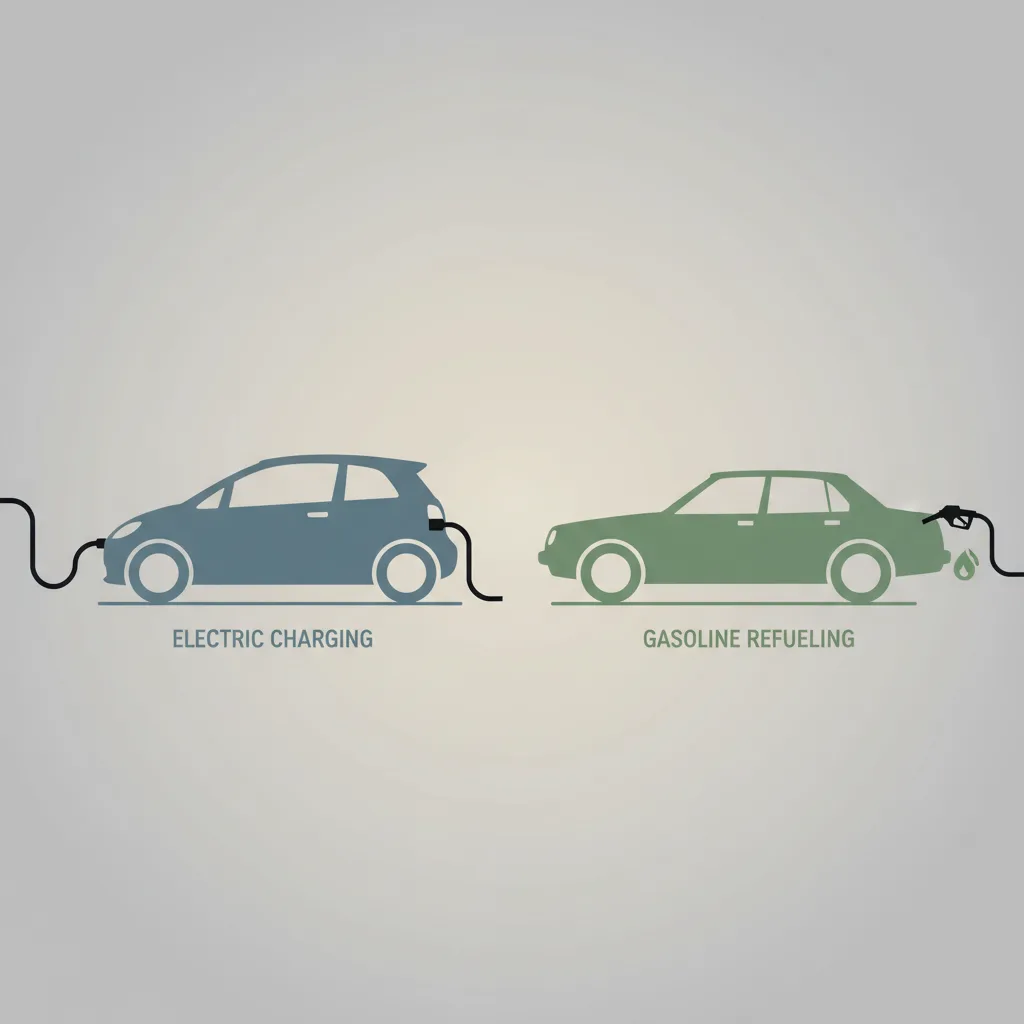
Switching to an electric vehicle vs keeping a gas car
If you act
Switching to EV
46%
If you don't
Keeping a gas car
16%
At least one figure is an indirect estimate, not a measured regret rate. How each figure was built is shown below.
Lifestyle
Last reviewed 2026-04-26
Evidence quality 4.25/5
Eight-dimension review score against the
quality rubric
. Each dimension scored 1–5.
D1 Source verification
5/5
D2 Source authority & independence
4/5
D3 Regret-rate accuracy
2/5
D4 Source comparability
3/5
D5 Gilovich pattern
5/5
D6 Prose quality
5/5
D7 Caveat completeness
5/5
D8 Sample quality
5/5
Average4.25/5
Indirect data: for this decision at least one figure comes from an indirect measure, such as outcomes, satisfaction or intent, or from an editorial estimate, rather than from a direct regret survey. The notes for each side below say how its figure was built.
If you act
Switching to EV
46%
46% of US EV owners want to switch back (intent proxy)
US EV owners, online panel
retrospective, no fixed timeframe
If you don't
Keeping a gas car
16%
16% of US adults are likely to buy an EV next (intent proxy)
US adults, probability-based panel
retrospective, no fixed timeframe
Figure for each choice (the measure is named on the page)
Switching to EVKeeping a gas car
46%16%
Related decisions
Semantically similar decisions — same territory, different trade-offs.
Nearly 46% of American EV owners are “likely” to switch back to a
gas-powered vehicle for their next purchase, as trade press reported
McKinsey’s 2024 Mobility Consumer Pulse survey. McKinsey’s own overview
gives 29% for EV owners globally and names the usual reasons:
public charging that is not yet good enough, high total costs of
ownership, and the strain of long-distance trips. On the other side, only 16% of US adults say they
are likely to buy an EV as their next car, per AAA’s 2025 survey — a
figure that has been falling, not rising. Both figures are intent proxies,
not direct regret measures, which makes the 30-point delta less certain
than it appears.
The McKinsey number deserves heavy caveats. InsideEVs and other analysts
noted that the survey’s “switch back” framing may capture people who want
to add a gas car to their household fleet, not necessarily abandon
electric entirely. The respondent pool skewed toward newer, non-Tesla
owners — people who bought affordable EVs on lease deals but lack home
charging and rely on patchy public networks. J.D. Power’s competing 2025
EVX study found that only 12% of EV owners would consider an ICE
replacement — implying action regret closer to 12%, not 46%.
The 2026 J.D. Power study raised BEV repurchase intent to 96%, leaving only about 4% who would not consider another EV. The gulf between 46% wanting to “switch back”
and the 4-12% who won’t consider another EV or lean toward ICE suggests the McKinsey question is
measuring something broader than pure regret.
The asymmetry may also be transient. Early adoption of any technology
produces higher buyer’s remorse because infrastructure, pricing, and
product quality are still maturing. Gas cars benefit from a century of
sunk-cost infrastructure that makes inaction nearly frictionless. If
charging networks densify and battery costs continue falling, the action-
regret rate will likely compress. For now, the data says what it says:
most gas-car owners feel no pull toward EVs, and a large minority of EV
owners express interest in returning to gas — though whether that
constitutes regret or merely flexibility remains genuinely unclear.
Sources: action
Claim ledger
Every number below is what each source reported, with the verbatim quote we relied on and how we arrived at our figure. Click any link to verify directly.
1/4 sources independently verified verbatim against the cited source
[1]McKinsey & Company — Mobility Consumer Pulse 2024: Overview (McKinsey Center for Future Mobility; third-party-hosted copy of the PDF)
Primary study
29% of EV owners globally were (very) likely to switch back to an internal-combustion vehicle, mostly citing public charging, total cost of ownership and long-distance driving
Excerpt
“"29% of EV owners globally likely to switch back to ICE, mostly because of difficulties with charging [...] Share of EV owners (very) likely to switch back to ICE [...] Reasons to switch back to ICE Global respondents: Charging infrastructure in public not yet good enough for me; Total costs of ownership too high; Driving patterns on long distance trips too much impacted."
”
Source data from
2024-06-18
Accessed
2026-04-26
Calculation
McKinsey Mobility Consumer Pulse 2024. The extract above gives the global figure of 29% and the three reasons, and shows the measure as "(very) likely", a pooled category, not "very likely" alone. The US figure of 46% used as the headline here comes from the trade-press report listed below, which the extract does not confirm; the sample size of 4,112 is carried over from earlier notes and is not shown in the extract. This measures switching intent, not regret directly — some respondents may want to add a gas car while keeping their EV, not abandon electric entirely.
[2]InsideEVs — Are Half Of EV Owners Really 'Switching Back' To Gas? It's Complicated.
News article
The 46% figure includes new EV owners who lack home charging, bought non-Tesla EVs with weaker charging networks, and may be considering adding a gas car rather than fully abandoning EVs
Excerpt
“"Those new owners surveyed are, increasingly, moving away from the profile that long-defined the EV life: upper-income or wealthy, probably a single-family homeowner and probably buying a Tesla. Instead, they're buying from other brands at more affordable prices, often enticed by aggressive leasing and financing deals for EVs. But that also means that they're living without Tesla's robust and reliable fast-charging network (until it's open to all drivers, anyway ); may live in apartments without easy access to charging; and are less willing to put up with the kinds of EV-related headaches that many early adopters took in stride."
”
Source data from
2024-06-25
Accessed
2026-04-26
Calculation
InsideEVs contextual analysis. Notes that "switch back" may include adding a gas vehicle to the household fleet rather than pure abandonment. The McKinsey methodology was not fully disclosed, and the question wording may conflate fleet diversification with outright regret.
[3]Autobody News — Survey: 46% of U.S. EV Owners 'Likely' to Switch Back to Fuel-Powered Vehicle
News article
A McKinsey survey found 46% of responding U.S. EV drivers likely to purchase an ICE vehicle next
Excerpt
“"A survey by global management consulting firm McKinsey & Co. found 46% of responding U.S. EV drivers are likely to purchase an ICE vehicle next."
”
Source data from
2024-06-21
Accessed
2026-11-04
Calculation
Trade-press report on the McKinsey Mobility Consumer Pulse 2024. It attributes the 46% to U.S. EV drivers, which the extract of the McKinsey PDF listed above shows only as a chart value without country labels. It is secondary reporting and adds no independent measurement.
[4]J.D. Power — 2025 U.S. Electric Vehicle Experience (EVX) Ownership Study
Verified
Primary study
94% of BEV owners are likely to consider purchasing another BEV; only 12% likely to consider replacing EV with ICE
Excerpt
“"94% of pure EV (BEV) owners are likely to consider purchasing another BEV for their next vehicle. Only 12% of BEV owners are likely to consider replacing their EV with an internal combustion engine-powered vehicle during their next purchase."
”
Source data from
2025-03-12
Accessed
2026-04-26
Verification
Excerpt independently re-fetched and confirmed word-for-word against the cited source during our grounding audit.
Calculation
J.D. Power 2025 EVX Ownership Study provides a contradicting data point. The 12% ICE-switch rate vs McKinsey's 46% likely reflects differences in question wording, sample composition, and what "switch back" means. J.D. Power's 2026 study raised BEV repurchase intent to 96%. The true action-regret rate likely falls between 12% and 46% depending on how strictly one defines "regret."
Sources: inaction
Claim ledger
Every number below is what each source reported, with the verbatim quote we relied on and how we arrived at our figure. Click any link to verify directly.
2/2 sources independently verified verbatim against the cited source
[1]AAA — AAA: Americans Slow to Adopt Electric Vehicles
Verified
Primary study
Only 16% of US adults said they were 'very likely' or 'likely' to purchase an EV as their next vehicle; 63% said they were 'unlikely' or 'very unlikely'
Excerpt
“"Only 16% of U.S. adults report being “very likely” or “likely” to purchase a fully electric vehicle (EV) as their next car, … The percentage of consumers indicating they would be “unlikely” or “very unlikely to purchase an EV rose from 51% to 63%, the highest since 2022"
”
Source data from
2025-06-12
Accessed
2026-04-26
Verification
Excerpt independently re-fetched and confirmed word-for-word against the cited source during our grounding audit.
Calculation
AAA survey conducted March 6-10, 2025, probability-based panel representative of US households, N = 1,128. The 16% "likely to buy EV" figure is an upper-bound proxy for inaction regret among gas-car keepers — it captures aspiration toward switching, not regret per se. The true inaction-regret rate is likely lower because stated purchase intent overstates actual switching behavior.
[2]Gallup — EV Ownership Ticks Up, but Fewer Nonowners Want to Buy One
Verified
Reference source
Only 44% of US adults say they are 'seriously considering or might consider' buying an EV, down from 55% in 2023; 48% say they do not intend to buy one
Excerpt
“"less than half of adults, 44%, now say they are either seriously considering or might consider buying an EV in the future, down from 55% in 2023, while the proportion not intending to buy one has increased from 41% to 48%. … Sixty-one percent of lower-income Americans say they would not buy an EV, up 18 percentage points from 43% in 2023,"
”
Source data from
2024-04-08
Accessed
2026-04-26
Verification
Excerpt independently re-fetched and confirmed word-for-word against the cited source during our grounding audit.
Calculation
Gallup annual tracking poll. The declining EV interest corroborates the AAA finding that most gas-car owners are content with their choice. Among non-owners, interest has fallen 7 points year-over-year, suggesting inaction regret is not intensifying.
Caveats
PROXY WARNING: Neither rate is a direct regret measurement. The McKinsey 46% captures stated intent to "switch back," which conflates outright regret with fleet diversification — some respondents may simply want to add a gas car while keeping their EV. The AAA 16% captures purchase likelihood, not regret; most gas-car owners who are content simply never think about EVs at all. Competing surveys sharply contradict the McKinsey figure: J.D. Power's 2025 EVX study found 94% of EV owners would consider buying another EV (only 12% considering ICE switch), and their 2026 study raised that to 96%. The discrepancy likely stems from question wording, sample composition (McKinsey's panel included many first-time, non-Tesla owners without home charging), and whether "switch back" means "abandon EVs entirely" or "add a gas car." The action-dominance finding is unusual in the Gilovich literature and may reflect a transitional technology moment rather than a stable long-term regret pattern. Both figures should be read as intent proxies, not direct regret measures. Survey data are drawn exclusively from United States samples; satisfaction and regret rates in countries with different institutional structures — consumer norms, charging infrastructure build-out, fuel taxes, and EV incentive structures — may differ substantially.