Negotiating a car price vs accepting the dealer's first offer
If you act
Negotiating the price
No direct measurement
If you don't
Accepting the dealer's first offer
23%
At least one figure is an indirect estimate, not a measured regret rate. How each figure was built is shown below.
Financial
Last reviewed 2026-05-11
Evidence quality 4.13/5
Eight-dimension review score against the
quality rubric
. Each dimension scored 1–5.
D1 Source verification
5/5
D2 Source authority & independence
4/5
D3 Regret-rate accuracy
2/5
D4 Source comparability
3/5
D5 Gilovich pattern
5/5
D6 Prose quality
5/5
D7 Caveat completeness
5/5
D8 Sample quality
4/5
Average4.13/5
Indirect data: for this decision at least one figure comes from an indirect measure, such as outcomes, satisfaction or intent, or from an editorial estimate, rather than from a direct regret survey. The notes for each side below say how its figure was built.
If you act
Negotiating the price
No direct measurement
No source states a figure for this side, so none is shown.
US and UK car buyers who attempted price negotiation
retrospective, no fixed timeframe
If you don't
Accepting the dealer's first offer
23%
23% of car buyers say overpaying is their single worst car-buying mistake
US adults who purchased a car
retrospective, no fixed timeframe
Figure for each choice (the measure is named on the page)
Negotiating the priceAccepting the dealer's first offer
No direct measurement23%
Related decisions
Semantically similar decisions — same territory, different trade-offs.
Figure for each choice (the measure is named on the page)
Investing savings in cryptocurrencyStaying in traditional assets
46%16%
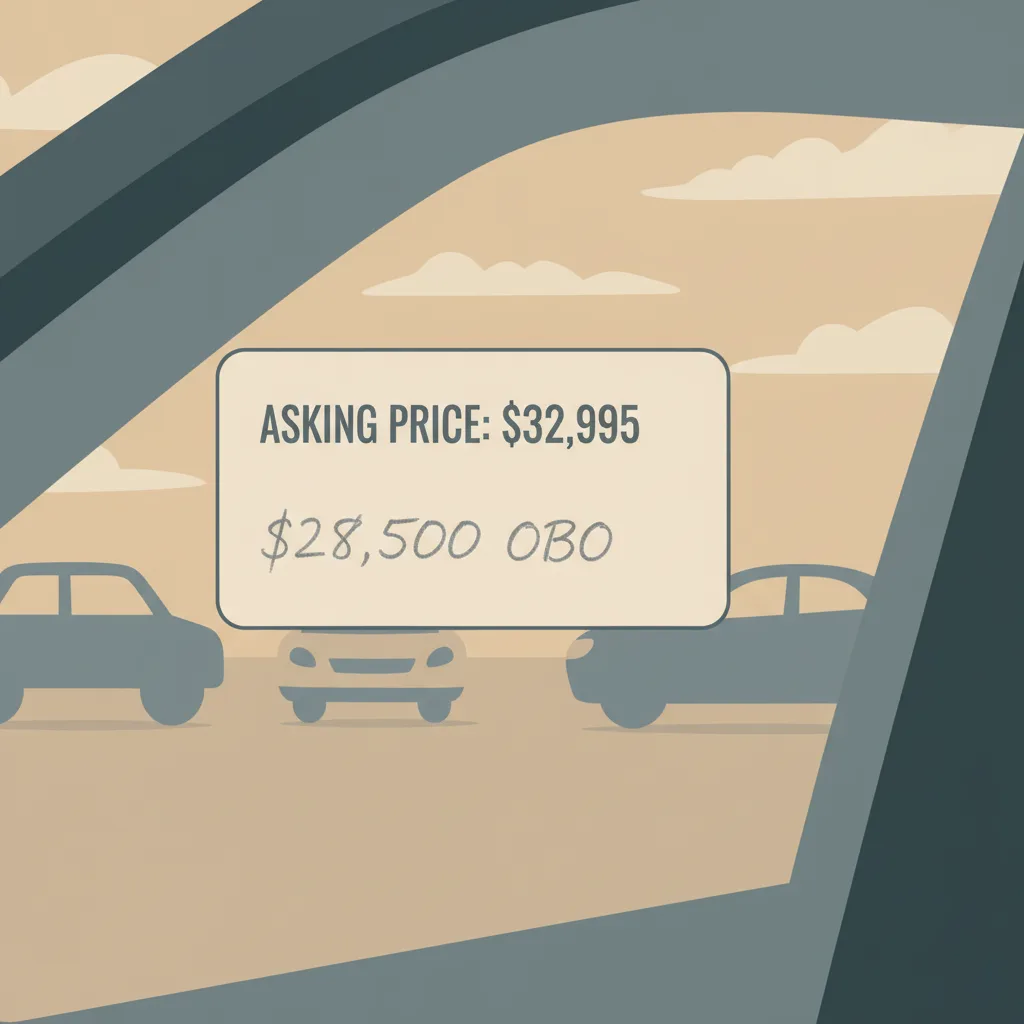
Among used-car buyers who attempted to negotiate, 83% succeeded in paying less than the asking price, with a median saving of $900 — roughly 8% off the sticker — according to a Consumer Reports survey of 1,006 US buyers. An Ipsos survey of 1,005 US adults found that 23% of car buyers named overpaying as their single worst mistake in the car-buying process, ranking it ahead of not doing enough research (20%), buying the wrong car (14%), and buying from an untrustworthy source (14%). The LendingTree car-regrets survey (n=1,919) separately found that 8% of recent buyers specifically regret not shopping around for a better deal — a narrower, more direct measure of negotiation regret.
The caveats are real. Market conditions shift the leverage dramatically: during the 2021–2022 inventory shortage, used-car prices spiked well above pre-pandemic levels and dealers routinely added markups above MSRP, making negotiation nearly impossible for popular models. In a surplus market — the environment most buyers will encounter across their lifetime — the leverage returns to the buyer. The Ipsos regret figure (23%) almost certainly conflates depreciation disappointment with negotiation failure; buyers who timed their purchase during a price peak, negotiated well, and still watched the car lose value quickly would also report this regret. The CarGurus UK data shows 53% of buyers find negotiation uncomfortable — a real barrier that suppresses attempts — but discomfort during the process does not reliably translate into regret about having tried.
Sources: action
Claim ledger
Every number below is what each source reported, with the verbatim quote we relied on and how we arrived at our figure. Click any link to verify directly.
1/2 sources independently verified verbatim against the cited source
[1]Consumer Reports — Why Haggling for Your Next Car Really Pays
Verified
Reference source
70% of used-car buyers haggled, succeeding 83% of the time, saving a median of $900 (8% off asking price)
Excerpt
“"70 percent of used-car buyers haggled over the price, succeeding in getting a better deal 83 percent of the time. … The median was $900, or 8 percent less than the asking price."
”
Source data from
2023-01-01
Accessed
2026-05-11
Verification
Excerpt independently re-fetched and confirmed word-for-word against the cited source during our grounding audit.
Calculation
Consumer Reports survey of n=1,006 US adults who purchased a used car in the past five years. The 83% success rate among negotiators implies 17% failed to improve the price. Even among those who failed, they were no worse off than non-negotiators. Low post-negotiation regret is estimated from the inverse: the majority who succeeded saved real money (median $900), the minority who failed got the same price they would have accepted anyway. No action-regret figure is shown: the failure rate (17%) overstates regret, because failed negotiators lose nothing, as they pay the same price as non-negotiators.
[2]CarGurus UK — Car Negotiation Tips — Consumer Survey
Reference source
53% of car buyers found negotiating 'too uncomfortable'; among successful negotiators, average savings were £896 (~$1,100)
Excerpt
“"Fewer than a third of car buyers (29%) always try to negotiate. 53% found negotiating too uncomfortable. Among those who did negotiate successfully, the average saving was £896."
”
Source data from
2023-05-01
Accessed
2026-05-11
Calculation
CarGurus UK commissioned survey of n=2,000 UK motorists, May 2023. The discomfort figure (53%) represents anxiety during the process, not post-purchase regret. UK negotiation norms differ from US; the discomfort rate is used as a proxy upper bound for action-side regret, acknowledging the methodological mismatch. The savings figure (£896) contextualizes stakes: real money is on the table, which suppresses retrospective regret even when the process was uncomfortable.
Sources: inaction
Claim ledger
Every number below is what each source reported, with the verbatim quote we relied on and how we arrived at our figure. Click any link to verify directly.
1/2 sources independently verified verbatim against the cited source
[1]Ipsos — Top Car Buyer Regrets Include Overpaying for a New Car and Not Doing Enough Research
Verified
Reference source
23% of car buyers say overpaying for a new car that quickly depreciated was their single worst mistake
Excerpt
“"roughly a quarter (23%) say that their worst mistake when purchasing a car was overpaying for a new car that quickly depreciated … One in five (20%) say that their worst mistake was not doing enough research."
”
Source data from
2009-01-01
Accessed
2026-05-11
Verification
Excerpt independently re-fetched and confirmed word-for-word against the cited source during our grounding audit.
Calculation
Ipsos online panel survey of n=1,005 US adults ages 18+, January 2009. Margin of error ±3.1 percentage points. The question asked respondents to identify their single worst car-buying mistake. "Overpaying for a new car that quickly depreciated" encompasses both depreciation timing and price negotiation failure; it is the closest available US survey data linking car purchase regret to price paid. Because the question conflates depreciation and negotiation failure, the 23% figure is an upper bound for negotiation-specific regret. No more recent US survey with comparable methodology on car-price- specific regret was identified. Used as the inaction-regret rate.
[2]LendingTree — Car Regrets Survey: Nearly 4 in 10 Who Bought a Car in the Past Year Have Regrets
Reference source
8% of recent car buyers specifically regret not shopping around for a better deal
Excerpt
“"Nearly 4 in 10 who bought a car in the past year have regrets. Top regrets include wrong make/model (14%), bought an unaffordable car (10%), and not shopping around for a better car deal (8%)."
”
Source data from
2021-12-01
Accessed
2026-05-11
Calculation
LendingTree survey of n=1,919 US car owners conducted via Qualtrics, December 2021. The 8% figure is the direct measurement of "not shopping around for a better deal" as a reported regret — the closest available operationalization of not-negotiating regret. Because shopping around and price negotiation are related but not identical, and because this question allows multiple regrets while Ipsos forced a single worst mistake, the two figures are not directly comparable. The 23% Ipsos upper bound and 8% LendingTree lower bound bracket the inaction-regret range. We use 0.23 as the conservative estimate of stated regret about overpaying.
Caveats
PROXY MEASUREMENTS THROUGHOUT. No survey directly asks: "Did you fail to negotiate the car price, and do you regret it?" The 23% inaction figure (Ipsos 2009) conflates depreciation regret with negotiation regret; some buyers who overpaid did negotiate, and some who underpaid did not. The Ipsos data is also 16 years old and predates the COVID-era inventory shortage (2021–2022), during which most buyers paid above MSRP regardless of negotiating skill. The action side has no direct measurement; the Consumer Reports 17% failure-to-improve rate is only a proxy for it, not a regret survey. Edmunds data (Q3 2024) shows new-vehicle buyers now average $1,744–$1,884 below MSRP — the stakes are real and growing. The CarGurus discomfort figure (53% found negotiating uncomfortable) is a process measure, not a retrospective regret measure, and comes from a UK sample that may understate negotiation norms in the US. The action side has no direct measurement, so no calibrated comparison between the two sides is possible. Market conditions matter: in a hot inventory market (e.g., 2021–2022), dealers rarely negotiated and buyers had little leverage; in a buyer's market (e.g., post-2023), negotiation is far more feasible.