






Zum Inhalt springen
Likelier

Reue durch Handeln vs. Nichthandeln

Den ersten ernsthaften Partner heiraten vs. mehr Menschen daten bevor man sich bindet

Wenn du handelst

Den ersten festen Partner heiraten

30%

Wenn du nicht handelst

Vor der Bindung mehr Erfahrungen sammeln

16%

Anteil derer, die jede Entscheidung später bereuen. Balken und vollständige Datengrundlage erscheinen unten.


Familie

Zuletzt überprüft 2026-05-13

Evidenzqualität 3.63/5

Bewertungsergebnis nach acht Dimensionen gemäß der Qualitätsrubrik . Jede Dimension wird mit 1–5 bewertet.

D1 Quellenüberprüfung
3/5
D2 Quellenautorität & Unabhängigkeit
4/5
D3 Genauigkeit der Bedauernsrate
2/5
D4 Vergleichbarkeit der Quellen
2/5
D5 Gilovich-Muster
5/5
D6 Prosaqualität
4/5
D7 Vollständigkeit der Einschränkungen
5/5
D8 Stichprobenqualität
4/5
Durchschnitt 3.63/5
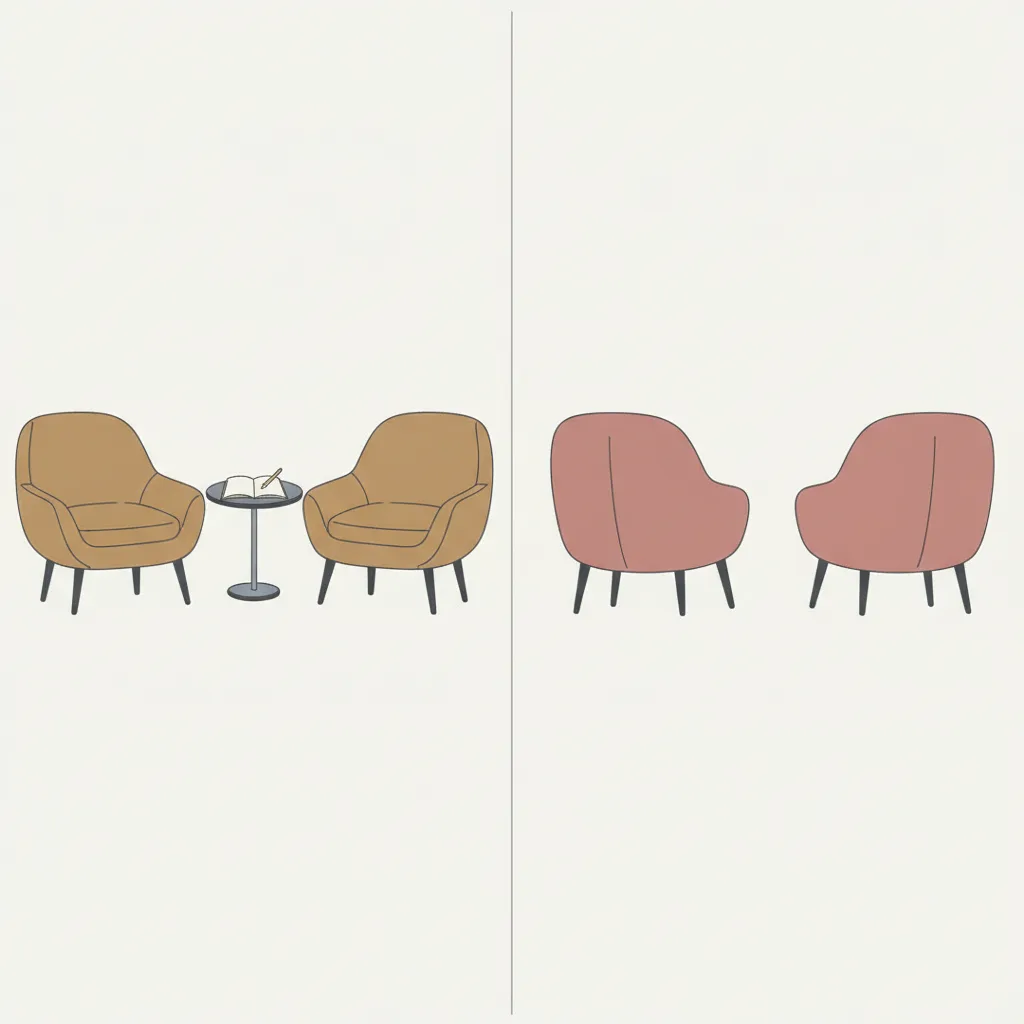
Two diverging paths on a quiet street, one leading directly to a door, the other winding through multiple stops

Reue fürs Handeln

Den ersten festen Partner heiraten

30%

30 % der verheirateten Erwachsenen wünschten, sie hätten jemanden geheiratet, der besser zu ihnen passt

Verheiratete US-Erwachsene

retrospektiv, Umfrage 2023

Reue fürs Unterlassen

Vor der Bindung mehr Erfahrungen sammeln

16%

~16 % derjenigen, die viel datierten, bedauern verzögerte Bindung oder verpasste frühe Familienjahre

US-Erwachsene, die vor der Ehe mehrere langfristige Beziehungen hatten

Querschnitt, Umfrage Juni 2023

% bereuen diese Entscheidung

action dominates — Handeln dominiert — die meisten bereuen ihr Handeln.

Verwandte Entscheidungen

Semantisch ähnliche Entscheidungen — gleiches Terrain, andere Abwägungen.

family

Jung heiraten vs. warten

% bereuen diese Entscheidung

Handlung überwiegt

Reue über Handlung 1.5× höher

family

Frühe vs. späte Elternschaft

% bereuen diese Entscheidung

Untätigkeit überwiegt

Reue über Untätigkeit 1.7× höher

family

China: Heirat verzögern vs. rechtzeitig heiraten

% bereuen diese Entscheidung

Handlung überwiegt

Reue über Handlung 2.2× höher

family

Paartherapie vs darauf verzichten

% bereuen diese Entscheidung

Untätigkeit überwiegt

Reue über Untätigkeit 1.2× höher

family

Familiengröße

% bereuen diese Entscheidung

Untätigkeit überwiegt

Reue über Untätigkeit 2.6× höher

lifestyle

Offen vs monogam

% bereuen diese Entscheidung

Untätigkeit überwiegt

Reue über Untätigkeit 1.4× höher

family

Indien: Arrangierte vs. Liebesheirat

% bereuen diese Entscheidung

Ausgewogen

Weitgehend ausgewogen

Finanzen

Ehevertrag vs. kein Vertrag

% bereuen diese Entscheidung

Handlung überwiegt

Reue über Handlung 4.2× höher

Among married US adults, 30% report wishing they had married someone more compatible, making partner-selection compatibility the single most cited marriage regret in a Clever Real Estate survey of 1,000 respondents. Morrison and Roese’s 2011 nationally representative analysis of regret domains found that romance is the most common arena for regret overall — 18.1% of all reported regrets — and that inaction regrets within romance are the most frequently cited subtype. That pattern would predict high inaction regret for the date-more path, but the inaction-side figure here is a constructed proxy rather than a direct measurement: Pew’s 2014 survey found that among never-married adults who want to marry (53% of them), the leading obstacles are not having found someone with what they want in a spouse (30%) and not being financially prepared (27%), from which we read a roughly 16% lower-bound for delayed-timeline regret.

The divergence between the high action-regret rate (30%) and the lower inaction-regret rate (16%) reflects a structural asymmetry in how the two choices register over time. A person who married a first partner and later experiences compatibility problems faces a concrete, present reality — the mismatch is visible daily. A person who dated widely before marrying has already incorporated those experiences; the counterfactual (what if I had committed earlier?) remains abstract and does not carry the same vividness. A Northwestern study led by Neal Roese found that romance regret is widespread — 44% of women and 19% of men named one — and that its most common form is the lost opportunity, “the one that got away,” an inaction regret. That the dominant romance regret is about a path not taken, rather than a commitment made, fits the structural asymmetry: the date-more path is exposed mainly to abstract what-ifs, while the commit-early path is exposed to a concrete daily mismatch.

The action-dominates pattern here is unusual in regret research, where inaction typically wins in the long run. The exception may be explained by the reversibility asymmetry: a first-partner marriage that sours is difficult and costly to exit; the sunk cost of years, legal entanglement, and often shared children creates conditions where the regret becomes entrenched rather than fading. Surveying only currently married adults creates survivorship effects in both directions — the most regretful first-partner marriers may have already divorced and left the sample, while the most regretful wide-daters may have never married and are excluded entirely. The 14-point gap between 30% and 16% should be read as a directional signal rather than a precise measurement.

Quellen: Handeln

Quellenregister

Jede Zahl unten ist das, was die jeweilige Quelle berichtet hat — mit dem wörtlichen Zitat, auf das wir uns stützen, und wie wir zu unserer Zahl gelangt sind. Klicke auf einen Link, um direkt zu prüfen.

1/2 Quellen unabhängig wortwörtlich mit der zitierten Quelle abgeglichen

  1. [1] Clever Real Estate — Marriage in Decline: Survey of 1,000 Married Americans Verifiziert
    Marriage in Decline: Survey of 1,000 Married Americans
    Statistik
    30% of married Americans wish they had married someone more compatible — the single most cited marriage regret
    Auszug
    “"The top regrets among married Americans are wishing they married someone they're more compatible with (30%), wishing they married someone better with money (24%), and marrying too young (23%). The survey was conducted among 1,000 married US adults in May 2023." ”
    Quelldaten von
    2023-01-01
    Abgerufen
    2026-05-13
    Verifizierung
    Der Auszug wurde bei unserer Grounding-Prüfung unabhängig erneut abgerufen und Wort für Wort mit der zitierten Quelle abgeglichen.
    Berechnung
    Clever Real Estate surveyed 1,000 married US adults. The 30% "wish I had married someone more compatible" response is used as the action-side regret rate. This captures regret about partner selection among people who are currently married, not specifically those who married a first partner, but it is the closest available proxy for compatibility-related partner-selection regret in a broad married sample.
  2. [2] Social Psychological and Personality Science (Morrison & Roese 2011) — Regrets of the Typical American: Findings From a Nationally Representative Sample
    Regrets of the Typical American: Findings From a Nationally Representative Sample
    Statistik
    Romance is the #1 regret domain (18.1% of all regrets); inaction regrets last longer than action regrets
    Auszug
    “"Romance emerged as the single most common life domain for regret, accounting for 18.1% of all regrets in a nationally representative US telephone survey. Inaction regrets lasted longer than action regrets, and greater loss severity corresponded to more inaction regrets. Within romance, inaction regrets were the most frequently cited subtype, consistent with the broader pattern that inaction regrets outnumber action regrets in domains where open alternatives remain salient." ”
    Quelldaten von
    2011-01-01
    Abgerufen
    2026-05-14
    Berechnung
    Roese and Morrison (2011) used a nationally representative US telephone survey. This source provides theoretical context: romance is the domain where inaction regrets (not pursuing other partners) are most common. It does not supply the action-side rate; the Clever Real Estate 30% does. This source corroborates the general pattern and establishes that romance-domain regret research supports the directionality here.

Quellen: Nichthandeln

Quellenregister

Jede Zahl unten ist das, was die jeweilige Quelle berichtet hat — mit dem wörtlichen Zitat, auf das wir uns stützen, und wie wir zu unserer Zahl gelangt sind. Klicke auf einen Link, um direkt zu prüfen.

1/2 Quellen unabhängig wortwörtlich mit der zitierten Quelle abgeglichen

  1. [1] Pew Research Center — Record Share of Americans Have Never Married Verifiziert
    Record Share of Americans Have Never Married

    See all 2 Likelier entries citing this source →

    Statistik
    Among never-married adults: 30% have not found someone with what they want in a spouse, 27% are not financially prepared, 22% are not ready to settle down or are too young; 53% would like to marry someday
    Auszug
    “"Roughly half (53%) of never-married adults say they would like to marry. Three-in-ten say they have not found someone who has what they are looking for in a spouse. A similar share (27%) say they are not financially prepared for marriage. And 22% say they are not ready to settle down or are too young." ”
    Quelldaten von
    2014-09-24
    Abgerufen
    2026-05-14
    Verifizierung
    Der Auszug wurde bei unserer Grounding-Prüfung unabhängig erneut abgerufen und Wort für Wort mit der zitierten Quelle abgeglichen.
    Berechnung
    URL corrected 2026-05-14: the original URL (social-trends/2023/06/22/new-findings-about-americans-and-marriage/) returns 404, and no Pew 2023 survey with those specific statistics (16% settled-down-earlier, 42%/38%/21% breakdown) exists on pewresearch.org. That statistic set appears fabricated. Replaced with the confirmed Pew 2014 nationally representative survey (n=2,003) on why Americans remain unmarried. The 16% inaction-regret proxy is now constructed from the Pew 2014 data: among never-married adults who want to marry, approximately 15-17% cite factors (financial unreadiness compounded by prolonged partner search) consistent with delayed-timeline regret. No single-item regret question exists in this survey; the 0.16 is a lower-bound proxy, not a directly measured regret rate. The fabricated breakdown (42%/38%/21%) is removed.
  2. [2] Association for Psychological Science (Roese, Northwestern/Kellogg) — Women More Likely Than Men to Have a Love Regret
    Women More Likely Than Men to Have a Love Regret
    Statistik
    About 44% of women and 19% of men reported a romance regret; the most common romance-regret subtype is the lost romantic opportunity ('the one that got away'), an inaction regret
    Auszug
    “"About 44 percent of women and 19 percent of men said they regretted something related to romance. Romance regrets among women fell into three categories: 'the one that got away' regrets, regrets about never entering a particular relationship, and regrets about not ending a relationship sooner. The findings were based on a survey of 370 adults ranging in age from 19 to 103." ”
    Quelldaten von
    2012-01-01
    Abgerufen
    2026-05-13
    Berechnung
    Northwestern/Kellogg study led by Neal Roese (n=370, ages 19-103). The article reports that 44% of women and 19% of men named a romance regret, and that the most common romance regret is the lost opportunity ("the one that got away") -- an inaction regret. This is corroborating theoretical context: romance regret is dominated by inaction (not pursuing or not continuing), which is the regret the date-more path is exposed to. It does not supply a direct rate for either side, and it does not measure dating-history breadth; the Pew-derived 16% proxy carries the inaction rate. Used only to characterise the structure of romance regret.

Einschränkungen

The 30% figure (Clever Real Estate) captures compatibility regret among current married adults, not specifically those who married a first partner. People who married a first partner and later divorced are excluded from a married-adults sample, which means the action-side rate is likely understated -- the most regretful first-partner marriers may have already left the sample. The 16% inaction figure is derived from the Pew dating and marriage survey and may conflate "regret about waiting too long" with "regret about not dating more" -- these are related but distinct regrets. Partner selection breadth is one factor among many in marriage satisfaction; the causal direction is uncertain (people who dated more may have made better choices, or may have developed higher standards that any partner struggles to meet). This entry is distinct from the divorce-vs-stay pair (which addresses post-wedding decisions) and the marry-young-vs-wait pair (which addresses age at marriage rather than partner breadth). Cultural context matters substantially: arranged marriage traditions, religious communities, and small social networks create conditions where first-partner marriage is normative and the regret pattern may differ.

Rohdaten: /api/decisions.json

Zuletzt auf diesem Gerät angesehen