






Lewati ke konten
Likelier

Penyesalan bertindak vs. tidak bertindak

Pergi ke terapi vs. tidak mencari bantuan profesional

Jika Anda bertindak

Menjalani terapi

27%

Jika Anda tidak bertindak

Tidak menjalani terapi

33%

Persentase orang yang kemudian menyesali setiap pilihan. Diagram batang dan catatan lengkap ditampilkan di bawah.


Kesehatan

Terakhir ditinjau 2026-06-14

Kualitas bukti 4.25/5

Skor tinjauan delapan dimensi terhadap rubrik kualitas . Setiap dimensi dinilai 1–5.

D1 Verifikasi sumber
5/5
D2 Otoritas & independensi sumber
4/5
D3 Akurasi tingkat penyesalan
2/5
D4 Keterbandingan sumber
3/5
D5 Pola Gilovich
5/5
D6 Kualitas prosa
5/5
D7 Kelengkapan peringatan
5/5
D8 Kualitas sampel
5/5
Rata-rata 4.25/5
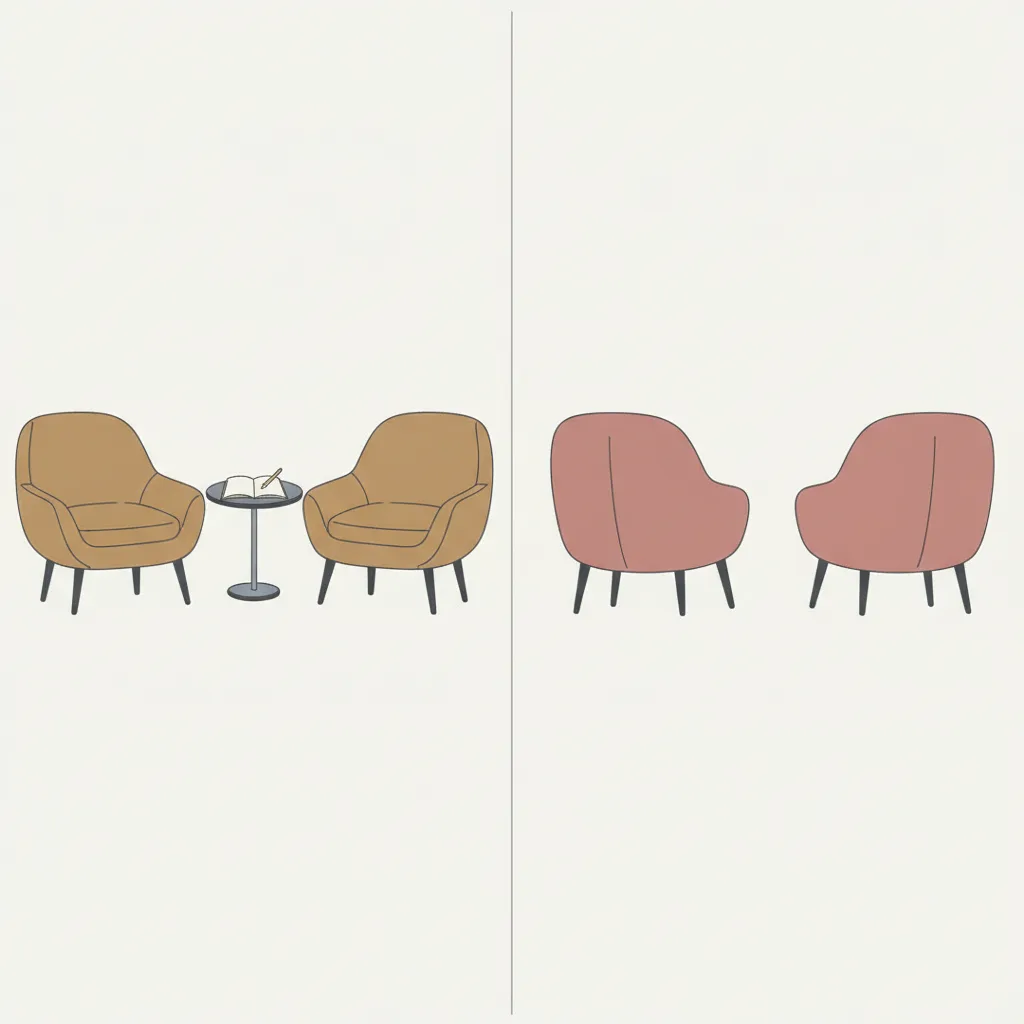
Two chairs facing each other across a small table, one side lit, one in shadow.

Penyesalan atas tindakan

Menjalani terapi

27%

27% peserta terapi tidak menemukan terapi membantu (proksi untuk penyesalan berbasis kehelpan)

Orang dewasa Inggris yang telah menjalani terapi, representatif nasional

retrospektif, kerangka waktu bervariasi

Penyesalan atas kelambanan

Tidak menjalani terapi

33%

~33% non-pencari-terapi di antara orang dewasa AS mengekspresikan permintaan laten (mempertimbangkan tetapi tidak pernah mencari — proksi untuk penyesalan non-tindakan)

Orang dewasa AS yang tidak pernah mencari perawatan kesehatan mental, representatif nasional

lintas-bagian, April 2025

% menyesal dengan pilihan ini

balanced — Cukup seimbang — kedua pilihan membawa penyesalan serupa.

Keputusan terkait

Keputusan yang serupa secara semantik — area yang sama, kompromi yang berbeda.

lifestyle

Gunakan AI untuk keputusan

% menyesal dengan pilihan ini

Seimbang

Hampir seimbang

family

Terapi pasangan vs. melewatinya

% menyesal dengan pilihan ini

Ketidakaktifan mendominasi

Penyesalan tidak bertindak 1.2× lebih tinggi

lifestyle

Tato

% menyesal dengan pilihan ini

Tindakan mendominasi

Penyesalan bertindak 1.6× lebih tinggi

Kesehatan

Berhenti merokok

% menyesal dengan pilihan ini

Ketidakaktifan mendominasi

Penyesalan tidak bertindak 90.0× lebih tinggi

Kesehatan

Vasektomi

% menyesal dengan pilihan ini

Seimbang

Hampir seimbang

Kesehatan

Perawatan kecanduan vs. menghindari

% menyesal dengan pilihan ini

Ketidakaktifan mendominasi

Penyesalan tidak bertindak 1.5× lebih tinggi

Kesehatan

Tindik tubuh

% menyesal dengan pilihan ini

Tindakan mendominasi

Penyesalan bertindak 4.0× lebih tinggi

Kesehatan

Mencari pengobatan vs. menyembunyikan kecanduan

% menyesal dengan pilihan ini

Ketidakaktifan mendominasi

Penyesalan tidak bertindak 4.3× lebih tinggi

Risiko di balik keputusan ini

Probabilitas yang mendasari pilihan ini.

Among UK adults who have had therapy, 27% did not find it helpful (BACP/YouGov 2025, n=5,150); among US adults who have never sought mental health care, approximately 33% express latent demand — they want care but have not pursued it (APA/Harris Poll 2025, n=1,076). The bilateral comparison is directionally consistent with Gilovich and Medvec’s inaction-dominance model, but the 6-percentage-point gap is computed from incomparable populations — UK therapy-attenders versus US non-attenders — and should not be read as a precise effect size. The pattern is classified as balanced: the signal points toward inaction carrying more regret, but the cross-national measurement gap prevents a stronger directional claim.

The data-quality limitations are layered. The action-side BACP figure is the stronger instrument: a large, nationally representative YouGov survey asking therapy-attenders to assess their own outcomes. Its weakness is framing — “not helpful” captures a broad range of outcomes from genuine harm to mild disappointment, and the 27% unhelpfulness rate sits well above the 5.2% lasting-harm rate found in Crawford et al.’s NHS patient survey (n=14,587), confirming that most of the 27% experienced disappointment rather than lasting damage. The inaction-side rate is a derived figure: 17% of all US adults said they want mental health care but have not sought it, out of 51% who had never sought care, yielding 33% latent demand among non-attenders. Latent demand is prospective (want to go) rather than retrospective (wish I had gone), which likely understates actual regret in older cohorts where the opportunity cost has already accumulated.

Two structural confounders qualify any strong directional claim. First, access barriers make much inaction involuntary: NHS England waiting lists, US insurance gaps, cost, and persistent stigma mean that a share of non-attenders who want care cannot readily obtain it, conflating structural barriers with personal decision regret. Second, cross-national asymmetry in the data — UK for the action side, US for the inaction side — introduces noise because NHS cost-free access and US insurance-dependent access produce different selection effects in who enters therapy and who doesn’t. Within those limits, the data are consistent with the established finding that long-run regret accumulates more on the side of inaction than action, though the effect size here is too small to carry strong causal weight.

Sumber: tindakan

Buku besar klaim

Setiap angka di bawah ini adalah apa yang dilaporkan masing-masing sumber, dengan kutipan kata demi kata yang kami andalkan dan bagaimana kami sampai pada angka kami. Klik tautan mana saja untuk memverifikasi langsung.

1/2 sumber diverifikasi secara independen kata demi kata terhadap sumber terkutip

  1. [1] British Association for Counselling and Psychotherapy / YouGov — BACP Public Perceptions Survey 2025
    BACP Public Perceptions Survey 2025
    Statistik
    73% of UK adults who have had therapy found it helpful; 27% did not
    Kutipan
    “"More than seven in 10 adults who've had therapy found it helpful (73%) and three quarters (75%) would recommend it to anyone looking for mental health support and to improve their wellbeing." ”
    Data sumber dari
    2025-03-04
    Diakses
    2026-05-01
    Perhitungan
    BACP/YouGov 2025 Public Perceptions Survey (n=5,150 UK adults, nationally representative). 73% of therapy-attenders found therapy helpful, implying 27% did not (1 - 0.73 = 0.27). This is used as the action-side regret proxy: therapy-attenders who did not find treatment helpful are the subgroup most likely to regret having attended. "Not helpful" and "regret going" are not the same construct — a person can find therapy emotionally challenging but ultimately beneficial, and a person can find a single course unhelpful without regretting the attempt. The 27% figure likely overstates harm-based regret and understates indifference-based outcomes. D3 score: 3 (real survey measuring helpfulness, a recognized proxy for regret rather than a direct regret instrument). Used as the primary action-side rate because it is the largest nationally representative UK survey measuring therapy outcome from the patient's perspective.
  2. [2] British Journal of Psychiatry / Crawford et al. — Patient experience of negative effects of psychological treatment: results of a national survey Terverifikasi
    Patient experience of negative effects of psychological treatment: results of a national survey
    Statistik
    5.2% of 14,587 NHS psychotherapy patients in England and Wales reported lasting negative effects from their psychological treatment
    Kutipan
    “"Of 14,587 respondents who had received psychological treatment, 763 (5.2%) reported experiencing lasting bad effects. Patients treated with cognitive behaviour therapy and psychodynamic psychotherapy were included across 184 different NHS services." ”
    Data sumber dari
    2016-03-01
    Diakses
    2026-05-02
    Verifikasi
    Kutipan diambil ulang secara independen dan dikonfirmasi kata demi kata terhadap sumber terkutip selama audit pendasaran kami.
    Perhitungan
    Crawford et al. (2016) surveyed 14,587 NHS patients who received psychotherapy across 184 services and found 5.2% reported lasting negative effects. This is the largest published national survey of therapy harm and provides a conservative floor for harm-based regret. The 5.2% rate sits well below the BACP 2025 "not helpful" figure of 27%, confirming that lasting harm is a smaller subcomponent of overall treatment dissatisfaction. This source corroborates that the action-side floor for serious harm-based regret is low. Included as a corroborating peer-reviewed source; the primary action-side rate (0.27) is drawn from the BACP 2025 survey.

Sumber: tidak bertindak

Buku besar klaim

Setiap angka di bawah ini adalah apa yang dilaporkan masing-masing sumber, dengan kutipan kata demi kata yang kami andalkan dan bagaimana kami sampai pada angka kami. Klik tautan mana saja untuk memverifikasi langsung.

1/1 sumber diverifikasi secara independen kata demi kata terhadap sumber terkutip

  1. [1] American Psychological Association / The Harris Poll — Public Attitudes Toward Mental Health in the U.S. Terverifikasi
    Public Attitudes Toward Mental Health in the U.S.
    Statistik
    17% of all US adults want mental health care in the future but have not yet sought it; 34% have never sought care and don't want to — yielding 17/(17+34) = 33% latent demand among non-attenders
    Kutipan
    “"More adults said they have sought mental health care in the past (45%), and close to 1 in 5 said they want to in the future (17%). Only one-third of adults (34%) said they had never sought professional mental health care and do not want to." Survey of 1,076 U.S. adults ages 18+, conducted online by The Harris Poll in partnership with APA, April 18-21, 2025. ”
    Data sumber dari
    2025-04-21
    Diakses
    2026-05-01
    Verifikasi
    Kutipan diambil ulang secara independen dan dikonfirmasi kata demi kata terhadap sumber terkutip selama audit pendasaran kami.
    Perhitungan
    APA/Harris Poll 2025 (n=1,076 US adults, nationally representative, April 18-21 2025). The survey identified three mutually exclusive groups: those who sought care in the past (45%), those who want to in the future but haven't (17%), and those who never sought and don't want to (34%). The remaining ~4% are likely currently in care or did not respond. Among non-attenders (17% + 34% = 51% of the sample), 17/51 = 33% express latent demand (want care but haven't sought it). This 33% is used as the inaction-side regret proxy: non-attenders with latent demand are the subgroup most likely to retrospectively regret not having sought help. Construct limitation: "want care in the future" is not equivalent to "regret not having gone already" — latent demand is a forward-looking aspiration, while regret is a backward-looking counterfactual. Access barriers (cost, insurance, availability) mean some latent demand reflects structural obstacles rather than personal decision regret. Cross-national note: this is US data, not UK; the UK setting for the action side has different access structures (NHS, means-tested IAPT waitlists). UK latent demand data were searched across BACP/YouGov, MIND UK, Mental Health Foundation, NHS APMS 2023-24, and Rethink Mental Illness; no comparable nationally representative instrument was found that asked non-attenders directly about latent demand. The APA/Harris estimate (33%) is broadly consistent with UK treatment-gap literature and is used here as the best available nationally representative proxy.

Catatan

Tidak ada sisi entri ini yang membawa tingkat penyesalan yang diukur secara langsung. Sisi tindakan 27% (BACP/YouGov 2025, n=5.150 orang dewasa Inggris) mengukur fraksi peserta terapi yang tidak menemukan terapi membantu — "tidak membantu" dan "menyesali pergi" adalah konstruksi yang berbeda. BACP adalah asosiasi profesional untuk terapis; survei mereka ditugaskan oleh badan dengan kepentingan finansial dalam pengambilan terapi. Sisi non-tindakan 33% (APA/Harris Poll 2025, n=1.076 orang dewasa AS) adalah tingkat permintaan-laten yang diturunkan. Permintaan laten tidak setara dengan penyesalan yang melihat ke belakang. Bagian bermakna dari non-tindakan tidak sukarela: waktu tunggu NHS, kesenjangan asuransi, hambatan biaya, dan stigma persisten semua membatasi akses. Asimetri lintas-nasional adalah keterbatasan fundamental. Pola gilovich oleh karena itu diklasifikasikan sebagai seimbang.

Data mentah: /api/decisions.json

Baru-baru ini dilihat di perangkat ini