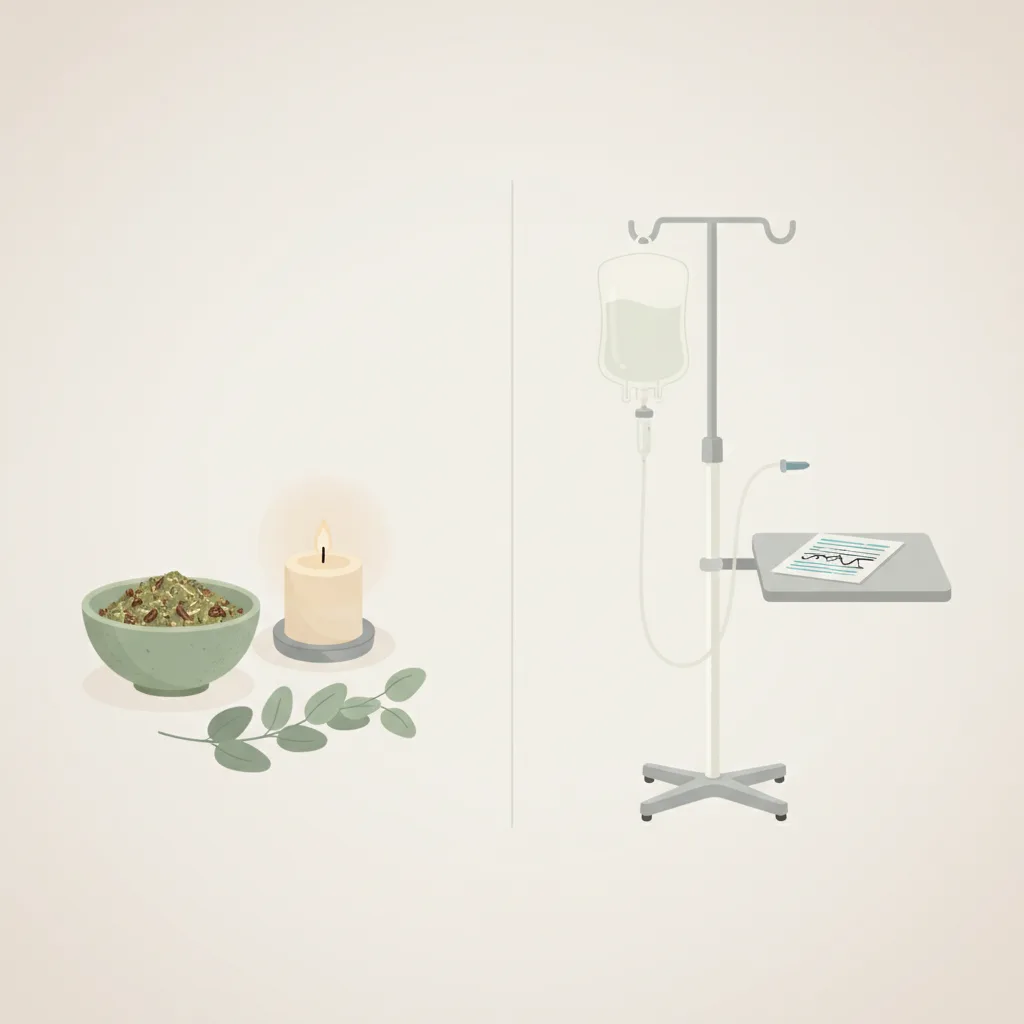
Percentage dat later spijt heeft van elke keuze. De balken en het volledige overzicht staan hieronder.
Gezondheid
Laatst beoordeeld 2026-05-04
Kwaliteit van bewijs 3.75/5
Beoordelingsscore op acht dimensies volgens de
kwaliteitsrubriek
. Elke dimensie krijgt een score van 1 tot 5.
D1 Bronverificatie
3/5
D2 Autoriteit en onafhankelijkheid van bronnen
4/5
D3 Nauwkeurigheid van spijtcijfer
3/5
D4 Vergelijkbaarheid van bronnen
4/5
D5 Gilovich-patroon
5/5
D6 Prozakwaliteit
4/5
D7 Volledigheid van voorbehouden
4/5
D8 Steekproefkwaliteit
3/5
Gemiddelde3.75/5
Spijt van handelen
Beginnen met dialyse
19%
~19% van de patiënten met onderhoudsdialyse heeft spijt van hun beslissing om met dialyse te beginnen; de spijt concentreert zich bij oudere patiënten met veel comorbiditeit, waar het overlevingsvoordeel het kleinst is
Volwassenen ≥75 met eindstadium nierziekte die dialyse startten, vooral diegenen met hoge comorbiditeitslast (Davison 2010; Morton et al. 2012)
Bijna geen spijt: in een enquête over gedeelde besluitvorming had 0% van de patiënten die voor conservatieve zorg kozen nog twijfels over de beslissing (versus 17% van de dialysepatiënten)
Volwassenen ≥75 met ESRD die conservatieve behandeling met palliatieve ondersteuning kozen (Murtagh et al. 2011; Davison et al. kwalitatieve studies)
retrospectief; patiënt- en surrogaatgerapporteerd
% betreurt deze keuze
Beginnen met dialyseConservatieve (niet-dialytische) behandeling kiezen
19%5,0%
action dominates — Handelen domineert — de meesten hebben spijt dat ze handelden.
Gerelateerde keuzes
Semantisch vergelijkbare keuzes — zelfde terrein, andere afwegingen.
For elderly patients over 75 with end-stage renal disease and high comorbidity burden, dialysis and conservative management (symptom-focused non-dialytic care) are genuinely contested alternatives. Da Silva-Gane et al.’s 2012 CJASN study of 170 patients with advanced kidney failure found an adjusted median survival of 1317 days on haemodialysis versus 913 days on conservative kidney management — about a 13-month advantage — with broadly comparable life-satisfaction scores. Murtagh et al.’s 2007 study of 129 patients aged 75 and over found that this survival advantage narrows sharply with comorbidity and is lost altogether in patients with high comorbidity scores, especially ischaemic heart disease. Against that modest, burden-laden benefit, Saeed et al.’s 2019 survey of 423 maintenance dialysis patients found that nearly 19% regretted their decision to start dialysis — driven by treatment burden (three weekly sessions of three to four hours each, strict dietary and fluid restrictions, fatigue) set against the perceived benefit in the context of functional status and life goals. Regret is concentrated in exactly the elderly, high-comorbidity group where the survival benefit is smallest.
The conservative management pathway, when supported by adequate palliative and symptom care, shows consistently high decision satisfaction. In Verberne et al.’s 2019 survey of patients choosing dialysis or conservative care, none of the 23 conservative-care patients still had doubts about their treatment decision, compared with 17% of the dialysis patients, and 91% of conservative-care patients were satisfied with the decision. The conservative-care sample is small, so the near-zero figure should be read as directional rather than precise, but the direction is consistent across the literature: patients who arrive at conservative management through an informed, shared decision-making process rarely regret it.
The action-dominates pattern in this entry reflects a specific, bounded population: elderly, frail, high-comorbidity ESRD patients. For younger patients or those with lower comorbidity burden, dialysis provides substantially greater survival benefit and the regret distribution would look very different. The dominant predictor of regret on both sides is decision quality — whether patients received adequate information about prognosis, treatment burden, and alternatives without time pressure, and whether their own values and priorities were elicited. The difference between well-counselled and poorly-counselled decisions is larger than the intrinsic difference between dialysis and conservative management. The clinical implication is that the decision conversation — not just the decision — is the intervention most likely to reduce regret.
Bronnen: handelen
Bronnenverantwoording
Elk getal hieronder is wat elke bron rapporteerde, met het letterlijke citaat waarop we ons baseerden en hoe we tot ons cijfer kwamen. Klik op een link om rechtstreeks te verifiëren.
2/3 bronnen onafhankelijk woordelijk geverifieerd tegenover de geciteerde bron
[1]Clinical Nephrology — Patients' perspectives on dialysis decision-making and end-of-life care
Geverifieerd
Vakgenoten-beoordeeld
Nearly 19% of maintenance dialysis patients regretted their decision to start dialysis (Saeed et al., n=423 surveyed)
Fragment
“"Nearly 19% of respondents regretted their decision to start dialysis."
”
Brongegevens van
2019-05-01
Geraadpleegd
2026-06-30
Verificatie
Fragment onafhankelijk opnieuw opgehaald en woord voor woord bevestigd tegenover de geciteerde bron tijdens onze onderbouwingsaudit.
Berekening
Saeed F, Sardar MA, Davison SN, Murad H, Duberstein PR, Quill TE. Clin Nephrol 2019;91(5):294-300 (PMID 30663974). Cross-sectional survey of 423 maintenance dialysis patients (Cleveland, OH). Directly measured dialysis decisional regret: nearly 19% regretted starting dialysis. This 19% is used as the action-side regret_rate. Regret is higher in elderly/high-comorbidity subgroups, where the survival benefit of dialysis is most modest; for younger, healthier ESRD patients regret would be lower.
[2]Clinical Journal of the American Society of Nephrology (CJASN) — Quality of Life and Survival in Patients with Advanced Kidney Failure Managed Conservatively or by Dialysis
Vakgenoten-beoordeeld
Adjusted median survival advantage of dialysis over conservative kidney management was ~404 days (~13 months); quality-of-life and life-satisfaction scores were broadly comparable between groups (Da Silva-Gane et al., n=170)
Fragment
“"Adjusted median survival from recruitment was 1317 days in HD patients ... and 913 days in CKM patients."
”
Brongegevens van
2012-12-01
Geraadpleegd
2026-06-30
Berekening
Da Silva-Gane M, Wellsted D, Greenshields H, Norton S, Chandna SM, Farrington K. Clin J Am Soc Nephrol 2012;7(12):2002-2009 (PMC3513739). Prospective study of 170 patients with advanced kidney failure choosing dialysis or conservative kidney management (CKM). Adjusted median survival 1317 days (HD) vs 913 days (CKM) — a ~13-month advantage for dialysis, with comparable life-satisfaction scores. The modest, burden-laden survival benefit explains why a meaningful minority of dialysis starters (Saeed: ~19%) come to regret the decision. This study measures survival/QoL, not regret directly.
[3]National Kidney Foundation — Hemodialysis
Geverifieerd
Gerenommeerde referentie
Standard in-center hemodialysis is administered 3 times per week, with each session lasting 3 to 4 hours
Fragment
“"Treatments at a dialysis center are usually done 3 times a week, each taking 3 to 4 hours to complete."
”
Brongegevens van
2024-04-26
Geraadpleegd
2026-07-03
Verificatie
Fragment onafhankelijk opnieuw opgehaald en woord voor woord bevestigd tegenover de geciteerde bron tijdens onze onderbouwingsaudit.
Berekening
National Kidney Foundation patient-education page, last updated 2024-04-26. Cited as the basis for the in-center treatment schedule (3 sessions/week, 3-4 hours each) referenced in the body prose as treatment-burden context for why a meaningful minority of dialysis starters (Saeed et al. 2019: ~19%) regret the decision. Background/context only; not used in regret_rate arithmetic.
Bronnen: niet handelen
Bronnenverantwoording
Elk getal hieronder is wat elke bron rapporteerde, met het letterlijke citaat waarop we ons baseerden en hoe we tot ons cijfer kwamen. Klik op een link om rechtstreeks te verifiëren.
1/2 bronnen onafhankelijk woordelijk geverifieerd tegenover de geciteerde bron
[1]BMC Nephrology — Older patients' experiences with a shared decision-making process on choosing dialysis or conservative care for advanced chronic kidney disease: a survey study
Vakgenoten-beoordeeld
Of patients who chose conservative care, 0/23 (0%) reported lingering doubts about their treatment decision (vs 12/70, 17%, of dialysis patients; P=0.03); 91% of conservative-care patients were satisfied with the decision
Fragment
“"Do you still have doubts about your treatment decision? 12/70 (17%) 0/23 (0%) 0.03"
”
Brongegevens van
2019-07-01
Geraadpleegd
2026-06-30
Berekening
Verberne WR, et al. BMC Nephrol 2019;20:264 (PMC6635995). Survey study of 99 patients (75 dialysis, 24 conservative care). Directly measured decision doubt and satisfaction: 0/23 (0%) of conservative-care patients still had doubts about their treatment decision versus 17% of dialysis patients (P=0.03); satisfaction with the decision was 91% (CC) vs 87% (dialysis). Conservative-care patients reported the lowest decisional regret of the two groups — the basis for a near-zero inaction-side regret rate among those who chose conservative care after shared decision-making.
[2]Nephrology Dialysis Transplantation — Dialysis or not? A comparative survival study of patients over 75 years with chronic kidney disease stage 5
Geverifieerd
Vakgenoten-beoordeeld
In patients ≥75 with CKD stage 5, the survival advantage of dialysis over conservative care narrows sharply with comorbidity and is lost in those with high comorbidity scores, especially ischaemic heart disease (Murtagh et al., n=129)
Fragment
“"However, this survival advantage was lost in those patients with high comorbidity scores, especially when the comorbidity included ischaemic heart disease."
”
Brongegevens van
2007-07-01
Geraadpleegd
2026-06-30
Verificatie
Fragment onafhankelijk opnieuw opgehaald en woord voor woord bevestigd tegenover de geciteerde bron tijdens onze onderbouwingsaudit.
Berekening
Murtagh FEM, Marsh JE, Donohoe P, Ekbal NJ, Sheerin NS, Harris FE. Nephrol Dial Transplant 2007;22(7):1955-1962 (PMID 17412702). Retrospective survival comparison of 129 patients ≥75 with CKD stage 5 (52 dialysis, 77 conservative). 1- and 2-year survival 84%/76% (dialysis) vs 68%/47% (conservative); the survival advantage of dialysis was lost in high-comorbidity / ischaemic-heart-disease patients. This is the clinical context for why elderly high-comorbidity patients can reasonably choose conservative care with low regret. Measures survival, not regret directly.
Kanttekeningen
Dit item geldt specifiek voor oudere patiënten (≥75) met een hoge comorbiditeitslast, waar de keuze dialyse-versus-conservatief klinisch werkelijk omstreden is. Voor jongere patiënten of patiënten met een lagere comorbiditeitslast biedt dialyse een aanzienlijk groter overlevingsvoordeel en minder spijt. De ~19% spijt aan de actiezijde (Saeed et al. 2019, alle patiënten met onderhoudsdialyse) onderschat het cijfer voor de subgroep van ouderen met veel comorbiditeit, waar de verhouding tussen behandellast en voordeel het minst gunstig is; de bijna-nul spijt aan de inactiezijde (Verberne et al. 2019, n=23) komt uit een kleine steekproef conservatieve zorg en moet als richtinggevend, niet precies, worden gelezen. Conservatieve zorg vereist toegang tot goede palliatieve/symptoomondersteuning; zonder adequate ondersteuning zou het spijtpercentage aan de inactiezijde hoger zijn. Beslissingskwaliteit (adequate informatie, geen tijdsdruk, duidelijke inventarisatie van waarden) is de dominante voorspeller van spijt aan beide zijden — het verschil tussen goed en slecht begeleide patiënten is groter dan het verschil tussen dialyse en conservatieve zorg op zich. Het gilovich_pattern (action_dominates) weerspiegelt de specifieke populatie: oudere, kwetsbare ESRD-patiënten met veel comorbiditeit. Voor de bredere ESRD-populatie zou het patroon anders zijn (lagere spijt over dialyse, actiepatroon omgekeerd).