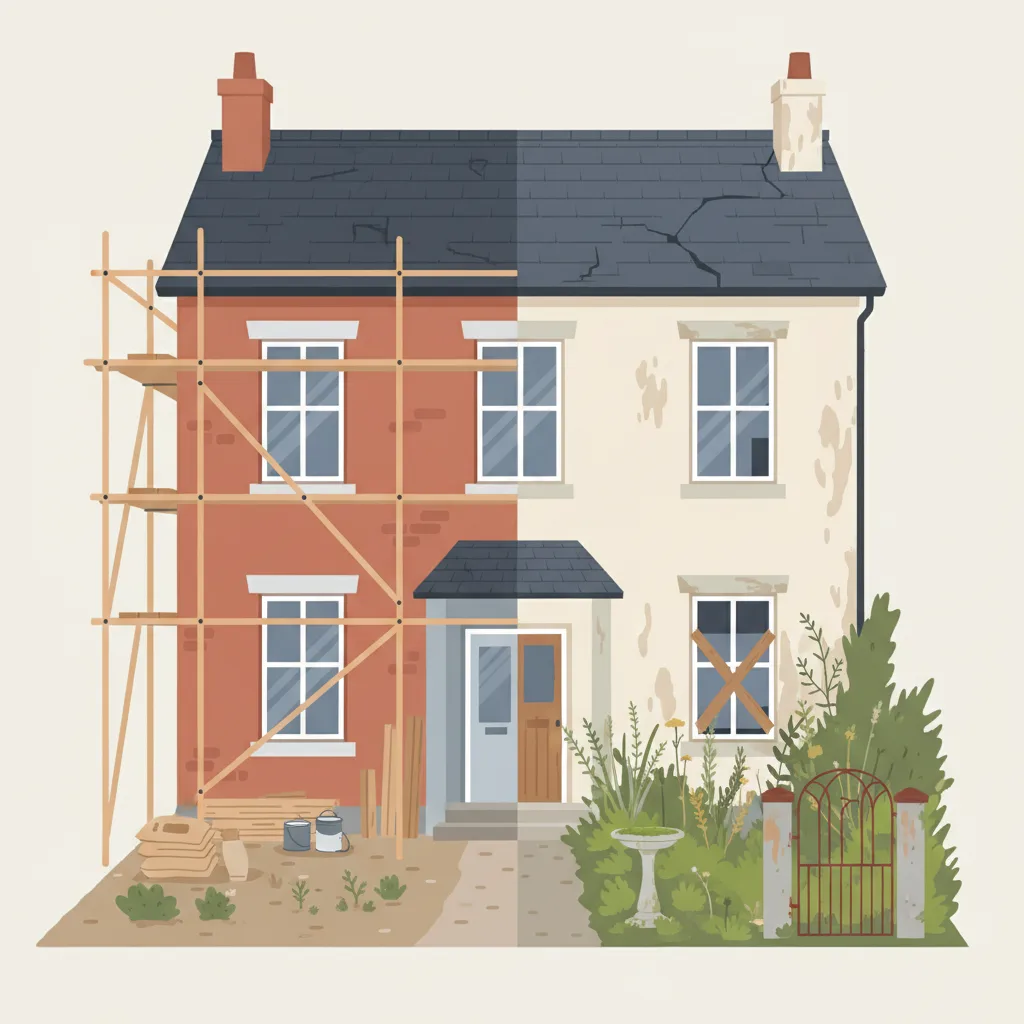
Dữ liệu đại diện — không có cuộc khảo sát trực tiếp nào về sự hối tiếc cho quyết định này. Tỷ lệ được lấy từ điểm hài lòng và dữ liệu rào cản tiếp cận thay vì câu hỏi trực tiếp về sự hối tiếc. Xem cảnh báo bên dưới.
Hối hận vì hành động
Từ bỏ điều kiện kiểm tra
47%
47% người mua đã bỏ qua điều kiện kiểm định nhà hối tiếc về quyết định đó
Người mua nhà Mỹ đã chuyển nhà giữa 2020 và 2023
hồi cứu, chuyển 2020–2023
Hối hận vì không hành động
Giữ vững quyền kiểm tra
15%
không có khảo sát trực tiếp nào đo lường điều này; con số ~15% là ước lượng thay thế của tác giả, được giới hạn bởi 18% người cho biết các lời đề nghị bị từ chối làm tăng thêm khó khăn và 31% người đã đưa ra từ 3 lời đề nghị trở lên (sự bực bội, không phải mức hối tiếc đo được)
Người mua nhà Mỹ trong thị trường cạnh tranh duy trì điều kiện
hồi cứu, mua 2023–2025
% hối tiếc về lựa chọn này
Từ bỏ điều kiện kiểm traGiữ vững quyền kiểm tra
47%15%
action dominates — Hành động chiếm ưu thế — hầu hết hối tiếc vì đã hành động.
Quyết định liên quan
Các quyết định tương tự về mặt ngữ nghĩa — cùng lĩnh vực, đánh đổi khác nhau.
Thương lượng hóa đơn viện phíTrả đúng số tiền ghi trên hóa đơn
5,0%38%
Không hành động chiếm ưu thế
Hối tiếc vì không hành động cao hơn 7.6×
Waiving a home inspection contingency became a common tactic in the 2020–2022 housing frenzy: buyers dropped the clause to make their offers more appealing in multi-bid situations. A 2023 survey of 1,000 Americans who had moved since 2020 found that 15% waived a home inspection — and of those, 47% came to regret it. The mechanism is predictable: inspections exist to surface hidden defects (structural issues, failing HVAC, water damage, electrical hazards) that sellers are not always required to disclose. Clever Real Estate’s 2025 annual buyer survey (n=986) found that 44% of recent buyers discovered undisclosed problems after moving in, a figure that has held steady across three years of surveys regardless of whether buyers had an inspection.
This entry is unusual in the dataset: the action-regret rate substantially exceeds the inaction-regret estimate, reversing the typical pattern. Most negotiation and risk-taking decisions generate more regret from inaction than action, because the unchosen path is idealized over time. Here, buyers who waived inspection took a real, specific risk — purchasing a property sight-unseen for major defects — and a large fraction paid for it. The buyers who held firm on inspection rights and eventually bought a different home did face friction (Clever Real Estate 2025 finds the median buyer made two offers before one was accepted, and 31% made three or more), but the market normalization of multiple-offer sequences means that holding out is not an outlier experience. It is the typical path.
The limitations are meaningful. The 47% figure comes from a survey commissioned by a home services company (All Star Home), and full methodology was not disclosed; the selection of buyers who moved during 2020–2023 oversamples a period of unusually intense bidding competition. NAR Realtors Confidence Index data shows inspection waivers peaked at roughly 30% of transactions in mid-2022 and have since receded to 13–23% as the market cooled; in today’s market, most buyers can include inspection contingencies without significant competitive disadvantage. The 15% inaction-regret estimate is a proxy with no direct survey equivalent. Forty-five percent of sellers who rejected contingent offers and held out for cleaner bids ultimately settled for lower prices (Clever Real Estate 2023) — suggesting that buyers who held contingencies often prevailed anyway, which further suppresses inaction regret in hindsight.
Nguồn: hành động
Sổ cái xác nhận
Mỗi con số dưới đây là những gì mỗi nguồn đã báo cáo, cùng với trích dẫn nguyên văn mà chúng tôi dựa vào và cách chúng tôi đưa ra con số của mình. Nhấp vào bất kỳ liên kết nào để xác minh trực tiếp.
1/2 nguồn được xác minh độc lập đúng từng chữ so với nguồn được trích dẫn
[1]Pennsylvania Association of Realtors (citing All Star Home survey) — Why Americans Regret Moving Since 2020
Nguồn tham khảo
15% of movers waived a home inspection; of those who waived, 47% regret forgoing one
Trích đoạn
“"15% of movers waived a home inspection. Of those who waived, 47% regret forgoing a home inspection."
”
Dữ liệu nguồn từ
2023-01-01
Truy cập
2026-05-11
Tính toán
All Star Home commissioned survey of n=1,000 Americans who moved between 2020 and 2023, published 2023 via Pennsylvania Association of Realtors. The 47% regret figure is the direct and only published US survey statistic specifically isolating regret among buyers who waived inspection — it is not a proxy. Caveat: All Star Home is a home services brand, not an independent research firm; full methodology (panel, margin of error, sampling frame) was not disclosed in the secondary source. Used as the best available direct measurement with appropriate uncertainty noted in caveats.
[2]Clever Real Estate — Home Buyer Report 2023
Đã xác minh
Nguồn tham khảo
33% of 2022–2023 buyers feel remorse about the upkeep their home needs (up from 25% in 2022); 39% said the seller was not upfront about how much maintenance the home would need
Trích đoạn
“"One-third of buyers (33%) feel remorse about the upkeep their home needs, compared to 25% in 2022." "Purchasing a home that requires too much maintenance is the most common regret — especially when 39% of buyers said the seller was not upfront about how much maintenance the home would need."
”
Dữ liệu nguồn từ
2023-04-13
Truy cập
2026-05-11
Xác minh
Trích đoạn đã được tải lại độc lập và xác nhận đúng từng chữ so với nguồn được trích dẫn trong quá trình kiểm định căn cứ của chúng tôi.
Tính toán
Clever Real Estate annual homebuyer sentiment survey, n=1,000 US adults who purchased a home in 2022–2023, fielded April 12–13, 2023. Does not include a direct "regret waiving inspection" question, but the 33% upkeep-remorse rate and the 39% who said the seller was not upfront about maintenance are contextual corroboration: post-purchase problem discovery is the primary mechanism through which inspection-waiver regret materializes. (The 2023 report does not publish an inspection-waiver rate or a post-move problem-discovery rate; those figures — 13% waived, 44% discovered undisclosed problems — come from Clever's 2025 wave, n=986, and are cited separately on the inaction side and in the prose.) Used to support the structural claim that skipping inspection creates measurable downstream regret, not as the primary regret rate source.
Nguồn: không hành động
Sổ cái xác nhận
Mỗi con số dưới đây là những gì mỗi nguồn đã báo cáo, cùng với trích dẫn nguyên văn mà chúng tôi dựa vào và cách chúng tôi đưa ra con số của mình. Nhấp vào bất kỳ liên kết nào để xác minh trực tiếp.
1/2 nguồn được xác minh độc lập đúng từng chữ so với nguồn được trích dẫn
[1]Clever Real Estate — Home Buyer Survey 2025
Nguồn tham khảo
50% of 2023–2025 buyers made two or more offers; 31% made three or more; 18% reported rejected offers added difficulty
Trích đoạn
“"50% of buyers made two or more offers before acceptance. 31% made three or more. 18% made four or more. 18% reported rejected offers added difficulty to their purchase."
”
Dữ liệu nguồn từ
2025-05-11
Truy cập
2026-05-11
Tính toán
Clever Real Estate annual homebuyer sentiment survey, n=986 US adults who purchased a home in 2023–2025, fielded April 28–May 11, 2025. The median buyer made two offers before acceptance — meaning losing a house is the expected experience, not an outlier. That structural normality suppresses regret about individual lost bids. The 15% inaction-regret estimate is a proxy: it is bounded below by the 18% who reported rejected offers "added difficulty" (a frustration measure, not regret) and above by the 31% who made 3+ offers (indicating repeated friction). No direct "do you regret not waiving your inspection to win a bid?" question was identified in any published US survey. The 15% estimate reflects the typical outcome: the buyer who held contingencies and eventually bought a different home with inspection in place.
[2]Clever Real Estate — Home-Selling Trends: Successes and Struggles Heading Into 2024
Đã xác minh
Nguồn tham khảo
45% of sellers rejected an offer, only to then settle for a lower price (Clever survey of 1,000 people who sold a home in 2022 and 2023)
Trích đoạn
“"45% of sellers rejected an offer, only to then settle for a lower price." "a new Clever survey of 1,000 people who sold a home in 2022 and 2023"
”
Dữ liệu nguồn từ
2023-10-23
Truy cập
2026-05-11
Xác minh
Trích đoạn đã được tải lại độc lập và xác nhận đúng từng chữ so với nguồn được trích dẫn trong quá trình kiểm định căn cứ của chúng tôi.
Tính toán
Clever Real Estate 2023 Home-Selling Report, survey of n=1,000 US adults who sold a home in 2022–2023, fielded October 19–23, 2023. The seller-side finding (45% rejected an offer and then settled for a lower price) is structurally corroborating for buyers who held contingencies and eventually won: sellers often accept contingent offers rather than wait for a cleaner offer that never comes. This weakens the claim that holding contingencies necessarily means losing to another buyer, and supports the lower inaction-regret estimate. (Prior revision mis-attributed this figure to Clever's Home Buyer Report 2023, which does not contain it; re-anchored to the correct Home-Selling report where the 45% statistic appears verbatim.)
Lưu ý
The 47% action-regret figure (All Star Home / PAR, 2023) is the only published US survey that directly measures inspection-waiver regret. The surveying organization is a home services brand, not an independent polling firm; full methodology was not disclosed in the secondary source, which introduces real uncertainty about sample composition, panel selection, and question wording. The 15% inaction-regret figure is a proxy estimate with no direct survey equivalent — no published study asks "do you regret holding your inspection contingency?" The Clever Real Estate 2023/2025 data on multiple-offer experience is used structurally (losing houses is normal and expected) rather than as a direct measurement of regret. NAR Realtors Confidence Index data shows inspection-waiver rates peaked at ~30% of transactions in June 2022 during the competitive pandemic market and have since declined to 13–23%; the 47% regret figure was derived from a cohort covering 2020–2023, which is skewed toward the era when waiving was most common and market conditions were most extreme. Buyers who waived inspections and bought perfectly functioning homes do not appear in regret statistics — the 47% regret rate is the rate among waiver-takers, not among all buyers who experienced a competitive market. This entry describes a specific competitive-market tactic, not a universal negotiating choice; in most buyer's markets, inspection contingencies are standard and accepted without competitive pressure to waive them.