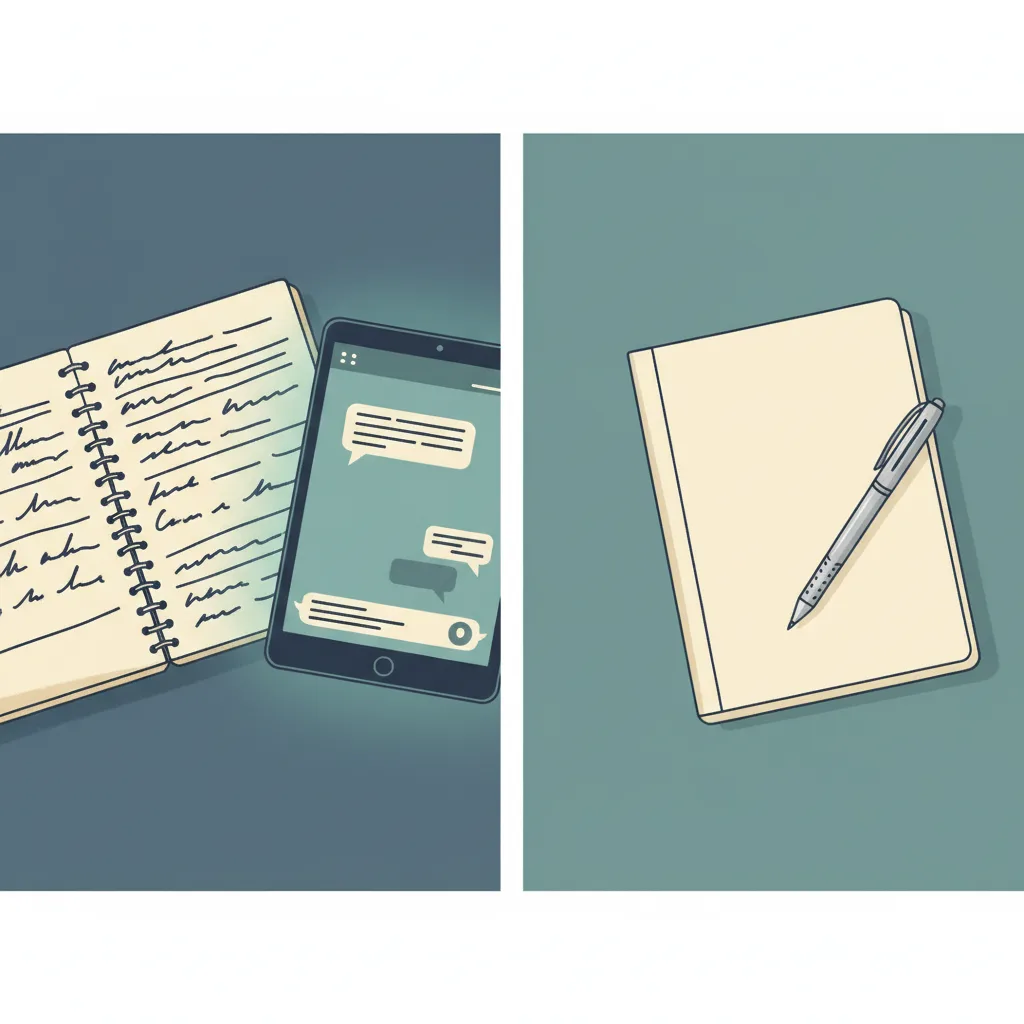
KI Ihre Schularbeit oder Bewerbung schreiben lassen vs. selbst schreiben
Wenn du handelst
KI verwenden, um die Aufgabe zu schreiben
11%
Wenn du nicht handelst
Selbst schreiben
10%
Anteil derer, die jede Entscheidung später bereuen. Balken und vollständige Datengrundlage erscheinen unten.
Karriere
Zuletzt überprüft 2026-05-28
Evidenzqualität 4.0/5
Bewertungsergebnis nach acht Dimensionen gemäß der
Qualitätsrubrik
. Jede Dimension wird mit 1–5 bewertet.
D1 Quellenüberprüfung
5/5
D2 Quellenautorität & Unabhängigkeit
4/5
D3 Genauigkeit der Bedauernsrate
2/5
D4 Vergleichbarkeit der Quellen
3/5
D5 Gilovich-Muster
4/5
D6 Prosaqualität
4/5
D7 Vollständigkeit der Einschränkungen
5/5
D8 Stichprobenqualität
5/5
Durchschnitt4.0/5
Stellvertretende Daten — für diese Entscheidung gibt es keine direkte Bedauernsstudie. Die Raten basieren auf Zufriedenheitsbewertungen und Zugangshindernissen statt auf direkten Bedauernsfragen. Siehe Vorbehalte unten.
Reue fürs Handeln
KI verwenden, um die Aufgabe zu schreiben
11%
Es existiert keine direkte Bedauernsumfrage: Keine Studie fragt Studierende, ob sie es bedauern, KI bei einer Aufgabe verwendet zu haben. Die 11% messen stattdessen ein konkretes negatives Ergebnis — ChatGPT nutzende Arbeitssuchende, denen eine Stelle verweigert wurde, sobald der Interviewer entdeckte, dass KI die Bewerbung verfasst hatte (ResumeBuilder 2023). Die oft zitierten 60% der studentischen KI-Nutzer, die zustimmen, dass KI dem kritischen Denken schadet (RAND Dez. 2025), sind eine Überzeugung über einen allgemeinen Schaden, kein Bedauern über eine spezifische Entscheidung, sodass sie bewusst NICHT als Rate verwendet werden
US-Studierende im Alter von 12–29 Jahren, die KI für Schularbeit nutzen; separat US-erwachsene Arbeitsuchende, die ChatGPT für Lebensläufe/Anschreiben nutzten
Dezember 2025 (RAND); Februar 2023 (ResumeBuilder)
Reue fürs Unterlassen
Selbst schreiben
10%
Keine Quelle misst das Untätigkeitsbedauern: Keine Umfrage fragt Studierende, die Aufgaben selbst verfassten, ob sie es bedauern, und die zitierten Studien geben keinen Prozentsatz dafür an. Die größte Studie unter Studierenden (SERU) warnt nur qualitativ, dass KI-Nichtnutzer 'zurückfallen könnten', und RAND findet, dass 78% der Nichtnutzer glauben, KI sei schädlich — sodass die meiste Nichtnutzung prinzipiell und nicht bedauert ist. Die gezeigten ~10% sind eine offengelegte konservative Untergrenze für die zugangsbeschränkte Minderheit, die SERU markiert, abgeleitet aus keiner Quellenstatistik; lesen Sie es als 'keine verlässliche Schätzung', nicht als beobachtete Rate
US-Studierende im Alter von 12–29 Jahren, die KI nicht für Schularbeit nutzen
2024–2026
% bereuen diese Entscheidung
KI verwenden, um die Aufgabe zu schreibenSelbst schreiben
11%10%
balanced — Annähernd ausgeglichen — beide Optionen bringen ähnliches Bedauern mit sich.
Verwandte Entscheidungen
Semantisch ähnliche Entscheidungen — gleiches Terrain, andere Abwägungen.
There is no survey that asks students whether they regret using AI on an assignment, so this side has no measured regret rate. The number used here — 11% — is the cleanest genuine adverse outcome on the action side: a ResumeBuilder survey of 1,000 US job seekers found that 78% got an interview after submitting ChatGPT-written application materials and 59% were hired, but 11% were denied a job once the interviewer realised AI had written the application. The figure most often quoted in this debate — 60% of student AI users (67% of all students) agreeing that AI for schoolwork harms critical thinking, in the RAND American Youth Panel’s December 2025 wave (n=1,214 youth ages 12–29) — is deliberately not used as the rate, because it measures a belief about a general harm, not regret about a specific decision. The tell is that usage kept climbing anyway, from 48% to 62% of students in seven months even as that concern rose from 54% to 67%: students who believe AI is harmful in the abstract overwhelmingly keep using it, which is the opposite of what a regret signal would predict.
The evidence base for actual harm is stronger than the evidence base for actual regret. A field RCT by Hamsa Bastani and colleagues at Wharton, conducted with about 1,000 Turkish high-school math students, found that students given unrestricted ChatGPT-4 access during practice solved 48% more problems correctly during sessions but then scored 17% lower than the control group on a subsequent no-AI exam. The crucial follow-up finding: students did not recognise that they had learned less. If the harm is invisible to the person doing it, self-report regret will systematically understate true regret on a skill-development axis — students who lost skill cannot regret a loss they cannot see. Surveys of college applicants (foundry10, 2024) found about a third had used AI for admissions essays, with 6% having AI write the final draft; 72% of student ChatGPT users in the Intelligent.com survey agreed that using ChatGPT to write college essays counts as cheating, indicating moral discomfort that runs alongside continued use.
The inaction side is genuinely thin, and no published survey gives any percentage for regret among students who wrote assignments themselves. The largest available undergraduate study — the SERU Consortium survey of 95,000+ undergraduates across 20 research universities, published in Science in May 2026 — found that roughly a third of undergraduates do not use AI and that non-use skews lower-income, female, and racially underrepresented, with the researchers warning only, qualitatively and without a number, that these students “may fall behind in college and eventually the workplace.” That framing makes retrospective regret possible among non-users whose abstention is access-constrained rather than principled, but the RAND finding that 78% of non-users believe AI for schoolwork is harmful pulls hard the other way: most students who don’t use AI think they are right not to, which is the opposite of a regret signal. The 10% shown here is therefore a disclosed conservative ceiling for that access-constrained minority, not a measured rate — and because both sides are now anchored on weak, non-equivalent proxies that land close together, the comparison should be read as “no reliable signal that one side dominates,” not as a finding that either choice generates more regret.
The 2023-to-2025 norm shift in this domain has been faster than any other decision in the dataset. ResumeBuilder’s hiring-manager survey in early 2023 found only 18% of hiring managers could identify a ChatGPT cover letter; by 2025, TopResume’s industry data show that roughly a third of hiring managers can spot AI-generated copy in under twenty seconds, 19.6% of recruiters would reject an AI application outright, and 52% accept proofreading or drafting support. Schools have shifted from blanket bans to acceptable-use policies. The figures cited here were taken in one short snapshot of a moving target; the directional finding (action generates more reported concern and concrete adverse outcomes than inaction) is robust, but the magnitudes will move again, plausibly within the next twelve months.
Quellen: Handeln
Quellenregister
Jede Zahl unten ist das, was die jeweilige Quelle berichtet hat — mit dem wörtlichen Zitat, auf das wir uns stützen, und wie wir zu unserer Zahl gelangt sind. Klicke auf einen Link, um direkt zu prüfen.
2/7 Quellen unabhängig wortwörtlich mit der zitierten Quelle abgeglichen
[1]RAND Corporation / Schwartz & Diliberti — More Students Use AI for Homework, and More Believe It Harms Critical Thinking: Selected Findings from the American Youth Panel
Referenzquelle
67% of students agreed AI for schoolwork harms critical thinking in Dec 2025 (up from 54% earlier in 2025); among actual AI users the share was 60%, vs 78% among non-users; 62% of students used AI for homework, up from 48% in May 2025
Auszug
“"67 percent of students said using AI for schoolwork harmed critical thinking… up from 54 percent earlier in the year. Non-AI users: 78 percent expressed concern vs. 60 percent among actual users. The percentage of middle school, high school, and college students using AI for homework rose from 48 percent to 62 percent. Female students: 75 percent believed AI harmed critical thinking; male students: 59 percent."
”
Quelldaten von
2025-12-01
Abgerufen
2026-05-28
Berechnung
RAND American Youth Panel survey of 1,214 youth ages 12–29, fielded December 2025, results published March 2026. This is a BELIEF measure, not a regret measure, and is NOT used as the headline rate. The 67% headline (60% among actual users, 78% among non-users) records agreement with the statement that using AI for schoolwork harms critical thinking — a general attitude about a societal harm, not "I regret having used AI on my own assignment." A student can believe AI is harmful in the abstract and feel no personal regret about their own use; the 14% rise in usage (48→62%) even as concern climbed from 54% to 67% is direct revealed- preference evidence of exactly that gap. No survey has directly asked "do you regret having used AI for your schoolwork?", so this belief figure is retained only as context for why the action side is hard to measure, not as the regret rate. The headline rate is instead anchored on the ResumeBuilder 11% denied-a-job figure (a concrete adverse outcome) below.
[2]ResumeBuilder.com (Pollfish panel) — 3 in 4 Job Seekers Who Used ChatGPT to Write Their Resume Got an Interview
Verifiziert
Referenzquelle
46% of job seekers used ChatGPT for resumes/cover letters; 78% got an interview; 59% were hired; 11% were denied a job when the interviewer discovered ChatGPT use; 88% said they were 'somewhat' or 'highly' likely to continue using it
Auszug
“"46% of job seekers are using ChatGPT to write their resumes and/or cover letters. 78% got an interview when using application materials written by ChatGPT. 59% were hired after applying to a job using materials written by ChatGPT. 11% were denied a job when the interviewer discovered they used ChatGPT. 88% of the total sample say they are 'somewhat' (41%) or 'highly' (47%) likely to continue using ChatGPT to write their job application materials in the future."
”
Quelldaten von
2023-02-07
Abgerufen
2026-05-28
Verifizierung
Der Auszug wurde bei unserer Grounding-Prüfung unabhängig erneut abgerufen und Wort für Wort mit der zitierten Quelle abgeglichen.
Berechnung
ResumeBuilder.com online survey of 1,000 US job seekers, fielded February 2023 via Pollfish. Reputable-reference (industry panel) not peer-reviewed. The 11% denied-a-job figure is the strongest available concrete-consequence proxy on the action side for the job-application cohort: it is a hard adverse outcome rather than an attitude. The 88% continuation rate is a strong revealed- preference signal against high regret — most users would not report planning to repeat a behavior they regretted — but is consistent with regret being concentrated in the ~11% who paid a concrete cost. Not used as the headline rate because (a) sample is job seekers only, not the schoolwork cohort, and (b) the field date precedes mature employer detection norms. Used to anchor the lower bound of plausible action regret.
[3]Bastani, Bastani, Sungu, Ge, Kabakcı, Mariman — Wharton / SSRN working paper — Generative AI Without Guardrails Can Harm Learning: Evidence from High School Mathematics
Primärstudie
Students with unrestricted ChatGPT-4 access during practice performed 17% worse on a subsequent no-AI exam than the control group; the AI-assisted group solved 48% more practice problems correctly but failed to retain the skill
Auszug
“"When access is subsequently taken away, students actually perform worse than those who never had access (17% reduction for GPT Base). Students with ChatGPT solved 48 percent more of the practice problems correctly, but they ultimately scored 17 percent worse on a test. Students said they did not think that ChatGPT caused them to learn less even though they had."
”
Quelldaten von
2024-07-15
Abgerufen
2026-05-28
Berechnung
Field RCT with ~1,000 Turkish high-school math students across three grade levels, four 90-minute practice sessions, posted to SSRN July 2024 by Wharton researchers. Used as the mechanism evidence underpinning the action-side regret framing: the harm the RAND respondents fear (skill erosion) is empirically real, even though students themselves did not perceive it. This creates the gap that makes "regret" particularly hard to measure — students who lost skill did not realize they had lost it, so self-report regret rates probably understate true regret. Not a US sample; treat the 17% effect size as directional. The paper is a working paper, not yet peer-reviewed at last revision.
[4]Education Week (reporting on foundry10 research led by Jennifer Rubin) — 1 in 3 College Applicants Used AI for Essay Help. Did They Cheat?
Verifiziert
Referenzquelle
About a third of 2023-24 college applicants used an AI tool for admissions-essay help; about 6% relied on AI to write the final draft
Auszug
“"About a third of high school seniors who applied to college in the 2023-24 school year acknowledged using an AI tool for help in writing admissions essays... About 6 percent of students overall relied on AI to write the final drafts of their essays instead of doing most of the writing themselves."
”
Quelldaten von
2024-07-15
Abgerufen
2026-07-03
Verifizierung
Der Auszug wurde bei unserer Grounding-Prüfung unabhängig erneut abgerufen und Wort für Wort mit der zitierten Quelle abgeglichen.
Berechnung
foundry10 research led by Jennifer Rubin, reported by Education Week (July 2024). Added to ground the body-prose claim "Surveys of college applicants (foundry10, 2024) found about a third had used AI for admissions essays, with 6% having AI write the final draft," which cited foundry10 by name in the body text without a corresponding frontmatter source. Not a regret measure; used as contextual evidence for the scale of AI use in the action-side cohort.
[5]Intelligent.com — Intelligent.com Survey Finds 1 in 10 College Applicants Are Using ChatGPT to Write Their College Application Essays
Referenzquelle
72% of student ChatGPT users agree that using ChatGPT to write college application essays is cheating
Auszug
“"72 percent of student ChatGPT users agree that using ChatGPT to write college application essays is cheating."
”
Quelldaten von
2023-07-31
Abgerufen
2026-07-03
Berechnung
Intelligent.com/Pollfish survey of 749 college-bound high school seniors and incoming college freshmen, fielded July 15-21, 2023; 303 respondents (41%) had used ChatGPT in the prior six months and answered the cheating-perception question. Added to ground the body-prose claim "72% of student ChatGPT users in the Intelligent.com survey agreed that using ChatGPT to write college essays counts as cheating," previously stated without a supporting frontmatter source. Not a regret measure; used as evidence of moral discomfort alongside continued use.
[6]ResumeBuilder.com (Pollfish panel) — 82% of Hiring Managers Unable to Identify Cover Letters Written by ChatGPT
Referenzquelle
Only 18% of hiring managers correctly identified all three cover letter introductions as human- or ChatGPT-written (82% could not)
Auszug
“"only 18% got all three right" when asked to identify which cover letter introductions were written by ChatGPT versus humans.
”
Quelldaten von
2023-04-01
Abgerufen
2026-07-03
Berechnung
ResumeBuilder.com/Pollfish survey of 1,000 US hiring managers, fielded March 22-26, 2023 (screened for management roles at companies with 2+ employees, $50k+ salary, frequent application reviewers). This is a different ResumeBuilder survey than the job-seeker survey cited above (same publisher, distinct sample of hiring managers rather than applicants). Added to ground the body-prose claim "ResumeBuilder's hiring-manager survey in early 2023 found only 18% of hiring managers could identify a ChatGPT cover letter," previously stated without a supporting frontmatter source.
[7]TopResume — Survey: Where Employers Draw the Line on the Use of AI in Hiring
Referenzquelle
19.6% of recruiters would reject an AI-generated resume/cover letter outright; 33.5% of hiring managers can spot AI-generated copy in under 20 seconds; 52% accept AI for proofreading or drafting support
Auszug
“"One in five (19.6%) recruiters would reject a candidate with an AI-generated resume or cover letter." "Over a third (33.5%) of hiring managers can spot an AI-generated resume in under twenty seconds." "Just over half (52%) say using AI for proofreading or drafting support is acceptable."
”
Quelldaten von
2025-05-20
Abgerufen
2026-07-03
Berechnung
TopResume/Pollfish survey of 600 US hiring managers, fielded May 15-16, 2025. Added to ground the body-prose claim "by 2025... TopResume's industry data show that roughly a third of hiring managers can spot AI-generated copy in under twenty seconds, 19.6% of recruiters would reject an AI application outright, and 52% accept proofreading or drafting support," previously stated without a supporting frontmatter source.
Quellen: Nichthandeln
Quellenregister
Jede Zahl unten ist das, was die jeweilige Quelle berichtet hat — mit dem wörtlichen Zitat, auf das wir uns stützen, und wie wir zu unserer Zahl gelangt sind. Klicke auf einen Link, um direkt zu prüfen.
[1]UC Berkeley News (reporting on SERU Consortium study published in Science) — The Largest Study of AI Use by Undergrads Is In, Revealing Disparities in Access — and in Cheating
Peer-Review
Two-thirds of undergraduates used GenAI as of spring 2024; low-income, racially underrepresented, and female students used AI less, and researchers warned these students 'may fall behind in college and eventually the workplace'
Auszug
“"Low-income, racially underrepresented and female students using AI less, and these students may fall behind in college and eventually the workplace because of unequal access to or practice using AI. Students from wealthier families can access advanced AI tools… students who don't have resources may only… use free AI tools."
”
Quelldaten von
2024-04-01
Abgerufen
2026-05-28
Berechnung
SERU Consortium survey of 95,000+ undergraduates at 20 research universities, fielded spring 2024, published in Science May 2026. Used only as a qualitative opportunity-cost signal: the published finding frames non-use as a possible future disadvantage ("may fall behind in college and eventually the workplace"), but states NO percentage for regret or for concern about falling behind. No direct survey asks non-users "do you regret not having used AI?", so there is no measured inaction-side regret rate. The 0.10 rate is not derived from any source statistic — it is a deliberately conservative ceiling for the access-constrained minority the SERU authors flag, set low because RAND shows 78% of non-users believe AI is harmful (i.e. most non-use is principled and unlikely to be regretted). This is the data-sparsest side of the entry; treat the number as a disclosed proxy floor, not an observed figure.
[2]RAND Corporation / Schwartz & Diliberti — More Students Use AI for Homework, and More Believe It Harms Critical Thinking: Selected Findings from the American Youth Panel
Referenzquelle
78% of non-AI-using students believed AI for schoolwork harms critical thinking (Dec 2025); 38% of students were not using AI for homework as of Dec 2025
Auszug
“"Non-AI users: 78 percent expressed concern vs. 60 percent among actual users. The percentage of middle school, high school, and college students using AI for homework rose from 48 percent to 62 percent."
”
Quelldaten von
2025-12-01
Abgerufen
2026-05-28
Berechnung
Same RAND panel. The 78% concern rate among non-users is direct evidence that abstention from AI is mostly principled, not regretful: the modal non-user thinks AI use is harmful and is therefore unlikely to regret their non-use. This pulls the inaction-regret rate down sharply, and is the reason the disclosed 0.10 proxy floor is set well below the one-third non-use share — it reflects only the residual access-constrained minority the SERU demographic gap finding flags, not principled abstainers. The revealed-preference signal — total AI usage rising from 48% to 62% in seven months — is consistent with some inaction-side regret driving conversion, but cannot be cleanly decomposed from peer effects, capability improvements, or institutional normalization.
Einschränkungen
Keine Seite hat eine direkte Bedauernsumfrage — keine veröffentlichte Studie fragt "bedauern Sie es, KI für Ihre Aufgabe verwendet zu haben?" oder "bedauern Sie es, sie selbst verfasst zu haben?" Beide angezeigten Raten sind offengelegte Proxys, kein gemessenes Bedauern. Die Handlungsseite ist am saubersten verfügbaren echten negativen Ergebnis verankert: 11% der ChatGPT nutzenden Arbeitssuchenden wurde eine Stelle verweigert, sobald der Interviewer entdeckte, dass KI die Bewerbung verfasst hatte (ResumeBuilder, Feb. 2023). Diese Zahl gilt nur für die erwachsene Arbeitssuchenden-Kohorte und geht ausgereiften Arbeitgeber-Erkennungsnormen voraus — bis 2025 hatte sich das Feld dahin verschoben, KI als Entwurfswerkzeug zu akzeptieren, während es vollständig KI-generierte Einreichungen bestraft (TopResume- und ResumeBuilder-Umfragen unter Personalverantwortlichen) — sodass es eine richtungsweisende Untergrenze ist, keine präzise Rate für die Schulaufgaben-Kohorte. Die oft zitierten 60% (Anteil der studentischen KI-Nutzer, die zustimmen, dass KI dem kritischen Denken schadet, RAND Dez. 2025) werden bewusst NICHT als Rate verwendet: Es ist eine Überzeugung über einen allgemeinen gesellschaftlichen Schaden, kein Bedauern über eine spezifische Entscheidung, und der Anstieg der Nutzung um 14% (48→62%), selbst als diese Sorge kletterte (54→67%), ist ein direkter Beleg offenbarter Präferenz, dass Schadensüberzeugung und persönliches Bedauern auseinandergehen. Die RCT von Bastani et al. (nun in PNAS, 2025 veröffentlicht) zeigt echte Kompetenzerosion — Studierende mit ungeschütztem ChatGPT schnitten in einer anschließenden Prüfung ohne KI 17% schlechter ab und erkannten den Verlust nicht — was bedeutet, dass jedes selbstberichtete Bedauern den wahren Schaden für die Kompetenzentwicklung unterschätzen würde; es ist ein Drittparteien-Ergebnis aus einer türkischen Stichprobe, verwendet als Mechanismus-Beleg, nicht als US-Bedauernsrate. Die Untätigkeitsseite ist die datenärmste im Paar: KEINE Quelle gibt einen Prozentsatz für Bedauern unter Studierenden an, die Aufgaben selbst verfassten. Die SERU-Studie warnt nur qualitativ, dass KI-Nichtnutzer "zurückfallen könnten", und RAND zeigt, dass 78% der Nichtnutzer glauben, KI sei schädlich, sodass die meiste Enthaltung prinzipiell ist und wahrscheinlich nicht bedauert wird. Die gezeigten 0.10 sind eine offengelegte konservative Obergrenze für die zugangsbeschränkte Minderheit, die SERU markiert, keine beobachtete Zahl. Da beide Seiten nun an schwachen, nicht gleichwertigen Proxys verankert sind, die nahe beieinander liegen, sollte das regret_delta (0.01) als "kein verlässliches Signal, dass eine Seite dominiert" gelesen werden, nicht als Befund. Die Zusammenfassung von "Schulaufgabe" und "Bewerbung" als eine Entscheidung überdeckt außerdem echte Unterschiede bei Anreizen, Erkennungsnormen und Einsätzen, und die Normverschiebung 2023→2025 in diesem Bereich war schneller als bei jedem anderen Eintrag im Datensatz, sodass dieses Paar eine ungewöhnlich kurze Haltbarkeit hat.