





Zum Inhalt springen
Likelier

Handeln vs. Nichthandeln: Zahl für jede Wahl

Als Teenager mit dem Rauchen anfangen versus nie anfangen

Wenn du handelst

Hat als Teenager angefangen zu rauchen

72%

Wenn du nicht handelst

Hat nie angefangen zu rauchen

Keine direkte Messung

Mindestens eine Zahl ist eine indirekte Schätzung, keine gemessene Reuequote. Wie jede Zahl entstanden ist, steht weiter unten.


Gesundheit

Zuletzt überprüft 2026-05-22

Evidenzqualität 4.5/5

Bewertungsergebnis nach acht Dimensionen gemäß der Qualitätsrubrik . Jede Dimension wird mit 1–5 bewertet.

D1 Quellenüberprüfung
5/5
D2 Quellenautorität & Unabhängigkeit
5/5
D3 Genauigkeit der Bedauernsrate
4/5
D4 Vergleichbarkeit der Quellen
2/5
D5 Gilovich-Muster
5/5
D6 Prosaqualität
5/5
D7 Vollständigkeit der Einschränkungen
5/5
D8 Stichprobenqualität
5/5
Durchschnitt 4.5/5
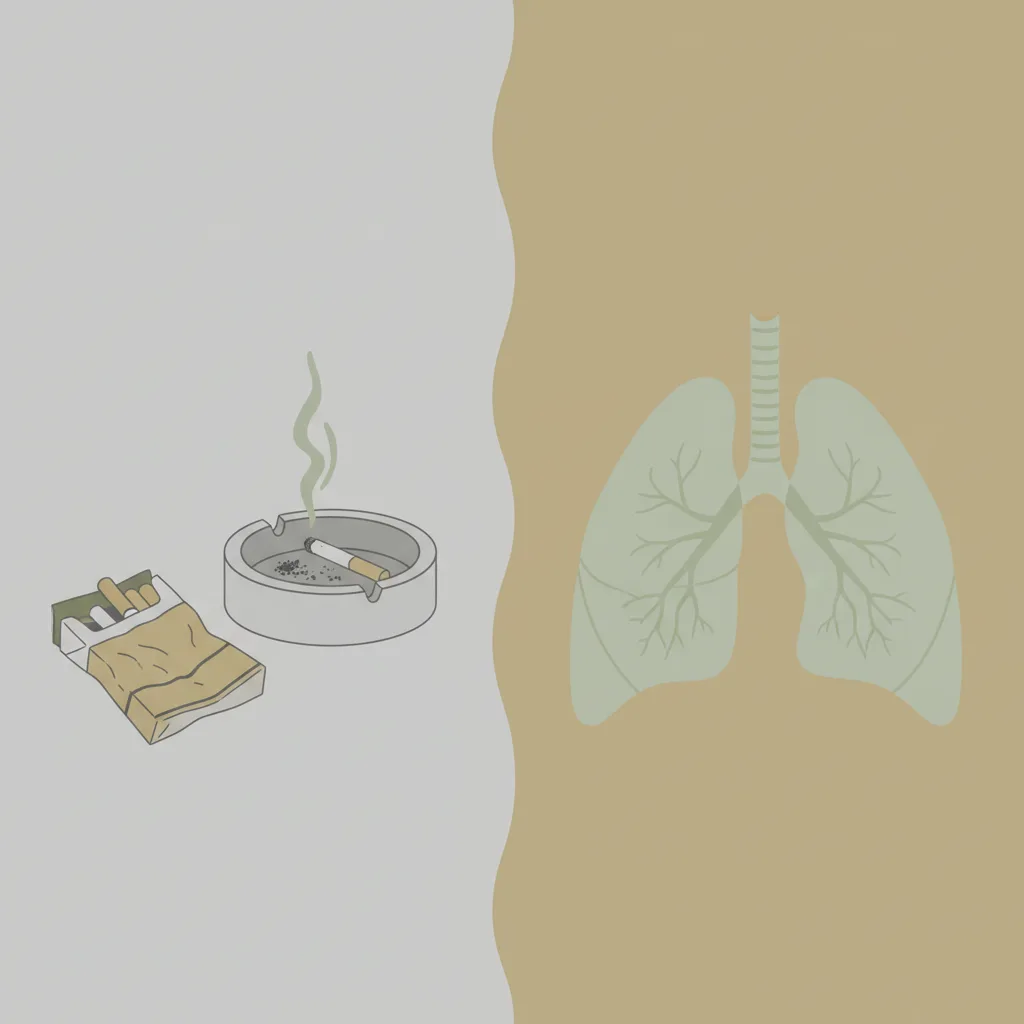
A single cigarette butt stubbed out beside a crumpled empty packet on the left, and a pair of healthy lungs in outline on the right
Indirekte Daten: Für diese Entscheidung stammt mindestens eine Zahl aus einem indirekten Maß wie Folgen, Zufriedenheit oder Absicht oder aus einer redaktionellen Schätzung statt aus einer Umfrage, die direkt nach Reue fragt. Die Hinweise zu beiden Seiten weiter unten erklären, wie die jeweilige Zahl entstanden ist.

Wenn du handelst

Hat als Teenager angefangen zu rauchen

72%

72 % der erwachsenen Raucher bedauern, jemals mit dem Rauchen begonnen zu haben

US-Erwachsene, die derzeit rauchen, national repräsentativ

Querschnitt, retrospektiv

Wenn du nicht handelst

Hat nie angefangen zu rauchen

Keine direkte Messung

Keine Quelle nennt für diese Seite eine Zahl, deshalb zeigen wir keine.

US-Erwachsene, die nie geraucht haben (keine direkte Bedauerns-Umfrage dieser Gruppe existiert; Rate ist eine geschätzte Obergrenze)

keine direkte retrospektive Bedauerns-Messung verfügbar; Querschnittsschätzung

Zahl für jede Wahl (was sie misst, steht auf der Seite)

Verwandte Entscheidungen

Semantisch ähnliche Entscheidungen — gleiches Terrain, andere Abwägungen.

Gesundheit

Rauchentwöhnung

Zahl für jede Wahl (was sie misst, steht auf der Seite)

Gesundheit

Körperpiercing

Zahl für jede Wahl (was sie misst, steht auf der Seite)

Gesundheit

Bewegungsgewohnheiten

Zahl für jede Wahl (was sie misst, steht auf der Seite)

lifestyle

Tattoo

Zahl für jede Wahl (was sie misst, steht auf der Seite)

lifestyle

Vegetarische Ernährung

Zahl für jede Wahl (was sie misst, steht auf der Seite)

Gesundheit

Suchtbehandlung vs Vermeidung

Zahl für jede Wahl (was sie misst, steht auf der Seite)

family

Jung heiraten vs. warten

Zahl für jede Wahl (was sie misst, steht auf der Seite)

Gesundheit

Langlebigkeit vs Altern akzeptieren

Zahl für jede Wahl (was sie misst, steht auf der Seite)

Risiken hinter dieser Entscheidung

Die Wahrscheinlichkeiten, die dieser Entscheidung zugrunde liegen.

72% of adult smokers regret ever starting to smoke, according to the 2014 Tobacco Products and Risk Perceptions Survey — the most recent nationally representative US measurement. The finding is not an outlier: the International Tobacco Control 4-Country Survey (2002, N>8,000) found 91% of US smokers would not have started if they could do it again, Cancer Research UK’s YouGov survey (2012, N=1,746) found 85% of UK smokers and ex-smokers wished they’d never started, and Gallup (2012) found 88%. The 72% Sanders-Jackson figure is the most conservative because it sampled only current smokers, excludes ex-smokers (who often report even higher regret), and used the most rigorous nationally representative methodology. All four data points converge: regret about starting is the dominant experience of adult smokers.

The inaction side of this decision has no direct survey counterpart. No published study has asked never-smokers whether they regret not having smoked — the construct is essentially absent from the tobacco-regret literature. This side therefore has no direct measurement.

Nicotine addiction is self-sustaining: the continued physical urge to smoke, combined with repeated failed quit attempts (only 8.8% of US smokers who try to quit succeed in a given year, per CDC 2022), keeps action-side regret elevated and unresolvable for decades. Action-side regret here persists not because of forgetting but because of the impossibility of undoing the addiction that the action created.

Quellen: Handeln

Quellenregister

Jede Zahl unten ist das, was die jeweilige Quelle berichtet hat — mit dem wörtlichen Zitat, auf das wir uns stützen, und wie wir zu unserer Zahl gelangt sind. Klicke auf einen Link, um direkt zu prüfen.

  1. [1] International Journal of Environmental Research and Public Health (PMC) — Regretting Ever Starting to Smoke: Results from a 2014 National Survey
    Regretting Ever Starting to Smoke: Results from a 2014 National Survey

    Alle 2 Likelier-Einträge mit dieser Quelle ansehen →

    Statistik
    71.5% of current smokers (95% CI: 68.6%–74.4%) regretted starting to smoke; an additional 20.7% were unsure
    Auszug
    “"The majority of smokers (71.5%) regretted starting to smoke. Being older and non-Hispanic white were significant predictors of regret. Smokers having a high intention to quit, having made quit attempts in the past year, worrying about getting lung cancer, believing smoking every day can be risky for your health, perceiving a risk of being diagnosed with lung cancer during one's lifetime, and considering themselves addicted to cigarettes were significant predictors of regret for smoking initiation." ”
    Quelldaten von
    2017-04-07
    Abgerufen
    2026-05-22
    Berechnung
    Sanders-Jackson et al. (2017), 2014 Tobacco Products and Risk Perceptions Survey (TPRPS), nationally representative web-based survey, N=1,349 current smokers from 5,717 total respondents, weighted for non-institutionalized US adults aged 18+. Primary regret measure: "If you had it to do over again, would you start smoking cigarettes?" — 71.5% answered no (regret). An additional 20.7% said "don't know." This is the most recent nationally representative US peer-reviewed figure and is used as the entry's primary action regret_rate (rounded to 0.72). Cross-country context: Fong et al. (2004) reported 91% regret among US smokers in the ITC 4-country survey (N>8,000, 2002 data); Cancer Research UK / YouGov (2012, N=1,746) found 85% regret among UK smokers and ex-smokers; Gallup (2012, N=166) found 88%. The Sanders-Jackson figure (71.5%) is used as the conservative anchor because it is the most recent peer-reviewed US nationally representative estimate; the higher figures likely reflect broader samples including ex-smokers (who may have even higher regret) or older measurement.
  2. [2] Nicotine and Tobacco Research (Oxford Academic) — The near-universal experience of regret among smokers in four countries: findings from the International Tobacco Control Policy Evaluation Survey
    The near-universal experience of regret among smokers in four countries: findings from the International Tobacco Control Policy Evaluation Survey

    Alle 2 Likelier-Einträge mit dieser Quelle ansehen →

    Statistik
    About 90% of smokers across Canada, US, UK, and Australia agreed or strongly agreed they would not have started smoking if they could do it again; US-specific rate was 91%
    Auszug
    “"The proportion of smokers who agreed or agreed strongly with the statement 'If you had to do it over again, you would not have started smoking' was extremely high — about 90% — and nearly identical across the four countries." ”
    Quelldaten von
    2004-11-01
    Abgerufen
    2026-05-22
    Berechnung
    Fong et al. (2004), International Tobacco Control Policy Evaluation Survey (ITC-4), baseline wave October–December 2002, random-digit-dialed telephone survey of over 8,000 adult smokers across Canada, US, UK, and Australia. The US-specific regret rate is cited as 91% in subsequent studies (Sanders-Jackson 2017 cites it as "91% regret among United States smokers"). Used here as corroborating multi-country evidence. The higher 91% relative to Sanders-Jackson 71.5% likely reflects different wording ("if you had to do it over again" vs "if you had it to do over again"), older data (2002 vs 2014), and possible sample composition differences. Both are authoritative; the entry uses the Sanders-Jackson 71.5% as the conservative, most-recent estimate.

Quellen: Nichthandeln

Quellenregister

Jede Zahl unten ist das, was die jeweilige Quelle berichtet hat — mit dem wörtlichen Zitat, auf das wir uns stützen, und wie wir zu unserer Zahl gelangt sind. Klicke auf einen Link, um direkt zu prüfen.

  1. [1] Morbidity and Mortality Weekly Report (CDC / MMWR) — Adult Smoking Cessation — United States, 2022
    Adult Smoking Cessation — United States, 2022
    Statistik
    11.6% of US adults currently smoke; 67.7% of current smokers want to quit; 53.3% attempted to quit in the past year — consistent with zero reported regret about not having started among never-smokers
    Auszug
    “"In 2022, 11.6% (95% CI = 11.1%-12.1%; estimated 28.8 million) of U.S. adults reported current cigarette smoking. Approximately two thirds of adults (67.7%) wanted to quit smoking, and approximately one half (53.3%) tried to quit in the past year, but fewer than one in 10 (8.8%) recently successfully quit" ”
    Quelldaten von
    2024-07-25
    Abgerufen
    2026-05-22
    Berechnung
    CDC MMWR report, 2022 National Health Interview Survey (NHIS), N=27,651 adults aged 18+. This source is used to establish the inaction-side baseline: among the ~84.4% of US adults who are not current smokers (former + never), the published literature contains no survey asking never-smokers whether they regret not having started smoking. The construct is essentially unmeasured because tobacco researchers have no theoretical reason to expect meaningful regret in never-smokers — nicotine creates its own demand through addiction, meaning regret for not starting is a concept that arises only after addiction is established. No inaction-side figure is shown; the direction rests on (a) the absence of any documented survey finding measurable never-smoker regret for not starting, (b) general population surveys showing near-universal awareness of smoking harms, and (c) the theoretical asymmetry: never-smokers cannot experience withdrawal-reinforced regret. See the caveats.
  2. [2] International Journal of Environmental Research and Public Health (PMC) — Regretting Ever Starting to Smoke: Results from a 2014 National Survey
    Regretting Ever Starting to Smoke: Results from a 2014 National Survey

    Alle 2 Likelier-Einträge mit dieser Quelle ansehen →

    Statistik
    Study sampled only current smokers (N=1,349); never-smokers were not assessed for regret about not starting, reflecting the field's consensus that this construct is not meaningfully present
    Auszug
    “"The majority of smokers (71.5%) regretted starting to smoke." ”
    Quelldaten von
    2017-04-07
    Abgerufen
    2026-05-22
    Berechnung
    Sanders-Jackson et al. (2017) sampled only current smokers for regret about initiation. The 2014 TPRPS survey of 5,717 total respondents focused its initiation-regret questions exclusively on active smokers. The decision not to ask never-smokers the symmetrical question ("do you regret never starting?") reflects the research community's understanding that the response distribution would be near-zero and the construct is not clinically or behaviourally meaningful. This asymmetry is documented across all major tobacco-regret surveys including Fong et al. (2004), O'Connor et al. (2010), and Cancer Research UK / YouGov (2012). Used here as methodological grounding for why no inaction-side figure is shown.

Einschränkungen

The two sides use fundamentally asymmetric data. The action side has robust direct-regret survey data from multiple nationally representative studies (71.5%–91% across US and comparable countries). The inaction side has no direct survey: no published study has asked never-smokers whether they regret not starting to smoke. The action_side rate of 72% applies to current smokers; ex-smokers show even higher regret rates in several studies (the Cancer Research UK / YouGov figure of 85% sampled current and ex-smokers combined). The entry uses the Sanders-Jackson 2017 figure (71.5%, current smokers only) as the most conservative and methodologically rigorous US-specific estimate.

Rohdaten: /api/decisions.json

Zuletzt auf diesem Gerät angesehen