Evidence quality 4.25/5
Eight-dimension review score against the quality rubric . Each dimension scored 1–5.
- D1 Source grounding
- 4/5
- D2 Source authority
- 5/5
- D3 Arithmetic
- 5/5
- D4 Uncertainty
- 4/5
- D5 Scope
- 4/5
- D6 Prose
- 4/5
- D7 Perception honesty
- 3/5
- D8 Caveat completeness
- 5/5
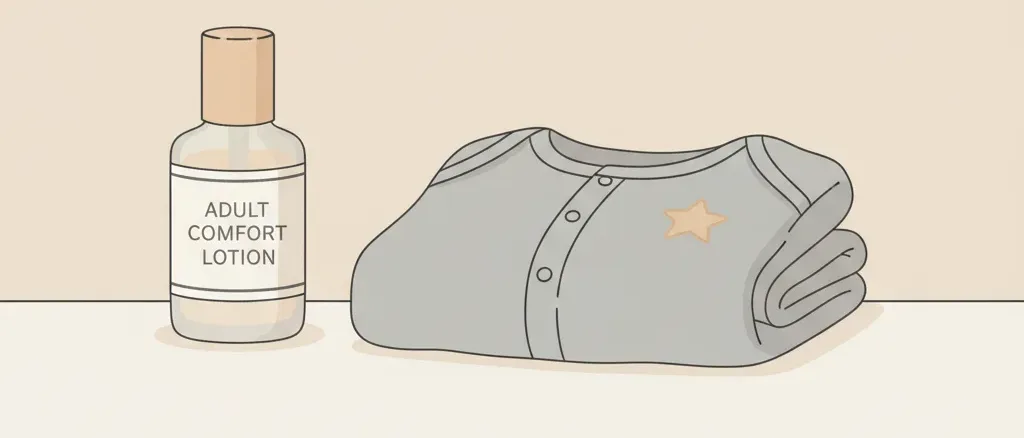
No single study has quantified the probability of a healthy full-term infant being seriously harmed by an ordinary adult consumer product applied to their skin during caregiving. That gap is not reassurance — it is a surveillance deficit. The FDA does not require pre-market clinical safety testing of cosmetic ingredients for infants specifically, and voluntary adverse-event reporting captures only a fraction of actual reactions. What the evidence does provide is a clear mechanistic case for why the under-six-month window deserves more caution than most parents apply: neonatal stratum corneum is up to 30% thinner than adult skin, transepidermal water loss runs measurably higher through at least twelve months of age, and the surface-area-to-body-weight ratio of a newborn is roughly three times that of an adult — meaning the same topical product delivers a higher systemic dose per kilogram in an infant than in the adult for whom it was formulated.
The sharpest concern sits with chemical UV filters. A 2020 randomized clinical trial in JAMA found that all six chemical sunscreen ingredients tested — avobenzone, oxybenzone, octocrylene, homosalate, octisalate, and octinoxate — exceeded the FDA’s 0.5 ng/mL systemic absorption threshold on day 1 after a single application to 75% of body surface area in healthy adults. For oxybenzone the single-application geometric-mean peak was 94 ng/mL (lotion), rising to 258 ng/mL — over 500 times the threshold — under the trial’s maximal-use protocol of four applications a day for four days. These are adults with mature, intact skin. The AAP’s guidance to keep infants under six months out of direct sunlight and rely on shade and protective clothing first — reaching for sunscreen only on small areas such as the face when shade and clothing are unavailable — and its preference for mineral-only products (zinc oxide, titanium dioxide) for older infants, tracks this absorption concern: zinc oxide and titanium dioxide particles sit on the skin surface and are not systemically absorbed, whereas chemical filters are. This distinction matters practically. It also explains why the “use baby sunscreen instead” advice is load-bearing for the under-six-month window — and why the adult laundry detergent on baby clothes concern, while real in principle, lands in different territory: allergic contact dermatitis from laundry detergent residue occurs in fewer than 1% of patch-test patients even in adults, and routine machine washing reduces residue concentrations substantially.
The absence of a headline probability here reflects what the literature actually contains. There is robust mechanism evidence that infant skin is more permeable, that chemical sunscreens are absorbed in adults, and that products applied to infant skin enter the bloodstream. What is absent is a surveillance study tracking outcomes when adult consumer products are used on healthy infants during ordinary caregiving. The documented cases of serious topical harm in neonates involve medical-grade products at far higher per-dose exposures. For ordinary adult products, the practical guidance reduces to: keep infants under six months out of direct sun with shade and clothing first, using sunscreen only on small areas such as the face when shade and protective clothing are not available; mineral sunscreen from six months onward; and fragrance-free wherever feasible to reduce allergen load on a skin barrier that is still developing. The risk is real, non-uniform across product types, and not zero — but it cannot be assigned a number without fabricating one.
Related tidbits
No reliable rate exists for serious harm to a baby from adult skincare or laundry products. Trials show chemical sunscreen filters cross even adult skin into the bloodstream, and infant skin is more permeable, but the surveillance data to make that an outcome rate is missing.
Claim ledger
Every number below is what each source reported, with the verbatim quote we relied on and how we arrived at our figure. Click any link to verify directly.
4/5 sources independently verified verbatim against the cited source
-
[1] JAMA (Journal of the American Medical Association) — Matta et al., 2020 — Effect of Sunscreen Application on Plasma Concentration of Sunscreen Active Ingredients: A Randomized Clinical Trial
Effect of Sunscreen Application on Plasma Concentration of Sunscreen Active Ingredients: A Randomized Clinical Trial- Statistic
All 6 chemical UV filters tested exceeded the FDA systemic absorption threshold of 0.5 ng/mL on day 1 after a single application in healthy adults; oxybenzone reached a geometric-mean Cmax of 94.2 ng/mL (lotion) after a single application and 258.1 ng/mL (lotion) under maximal-use conditions (4 applications/day for 4 days); sunscreen applied to 75% of body surface area (area outside normal swimwear) at 2 mg/cm2 per application- Excerpt
“"Geometric mean maximum plasma concentrations of all 6 active ingredients were greater than 0.5 ng/mL, and this threshold was surpassed on day 1 after a single application for all active ingredients." ”
- Source data from
- 2020-01-21
- Accessed
- 2026-05-21 · archived copy
- Calculation
- This randomized trial in 48 healthy adults demonstrates that chemical UV filters in commercially available sunscreens are systemically absorbed at concentrations exceeding FDA safety thresholds even in adults with mature, intact skin. Given that infant skin is substantially more permeable than adult skin (Rahma & Lane 2022; Choi 2025), the transdermal dose in infants using adult chemical sunscreen would be expected to be higher per kilogram of body weight. The trial measures absorption, not harm outcomes; the 0.5 ng/mL FDA threshold is a trigger for additional safety testing, not a known toxicity threshold. Used here to establish biological plausibility for systemic chemical exposure in the scenario that poses the highest documented concern. The trial protocol applied sunscreen to 75% of body surface area (2 mg/cm2 per application) under a maximal-use schedule of 4 applications/day for 4 days — grounds the body-text detail on application coverage.
-
[2] Pharmaceutics (MDPI) — Rahma & Lane, 2022 — Skin Barrier Function in Infants: Update and Outlook Verified
Skin Barrier Function in Infants: Update and Outlook- Statistic
Preterm newborn skin is up to 50× more permeable to alcohol and up to 1,000× more permeable to salicylates than full-term newborn skin; infant TEWL is significantly higher than adult (p < 0.01) through at least 12 months of age- Excerpt
“"In an in vitro permeability study the skin of preterm newborns was shown to be more permeable to alcohol (up to 50 fold) and salicylates (up to 1000 fold) compared with full-term newborns." ”
- Source data from
- 2022-02-17
- Accessed
- 2026-05-21 · archived copy
- Verification
- Excerpt independently re-fetched and confirmed word-for-word against the cited source during our grounding audit.
- Calculation
- Provides the mechanistic basis for why topical chemical exposure carries a higher systemic dose per kilogram in infants than in adults. Permeability data from in vitro skin models; the 50-fold and 1,000-fold figures compare preterm to full-term newborns, not to adults directly. The adult-to-full-term-infant gradient is smaller but still clinically significant: TEWL (a permeability proxy) runs significantly above adult levels through at least 12 months and normalizes toward adult function by about 2 years. Cannot be converted to a harm probability without clinical outcome data.
-
[3] Allergy, Asthma & Immunology Research — Choi, 2025 — Skin Barrier Function in Neonates and Infants Verified
Skin Barrier Function in Neonates and Infants- Statistic
Neonatal epidermis is up to 20% thinner and stratum corneum up to 30% thinner than in adults; neonatal and infant skin is thinner, more permeable, and less developed, making it more vulnerable to irritants, infections, and dehydration- Excerpt
“"Neonatal and infant skin is thinner, more permeable, and less developed, which makes it more vulnerable to irritants, infections, and dehydration." ”
- Source data from
- 2025-01-15
- Accessed
- 2026-05-21 · archived copy
- Verification
- Excerpt independently re-fetched and confirmed word-for-word against the cited source during our grounding audit.
- Calculation
- Corroborates the permeability data in Rahma & Lane 2022 with structural measurements of neonatal vs. adult skin thickness. Confirms that the barrier normalizes toward adult function by approximately 2 years of age, establishing the under-6-month window as the period of highest concern for topical chemical absorption. Not a harm-rate source.
-
[4] American Academy of Pediatrics (HealthyChildren.org) — Sun Safety Verified
Sun Safety- Statistic
AAP recommends keeping babies under 6 months out of direct sunlight and using shade and protective clothing first, applying sunscreen only to small areas (such as the face) when shade and clothing are not available; mineral-only (zinc oxide, titanium dioxide) sunscreen is preferred for children 6+ months- Excerpt
“"Keep babies younger than 6 months out of direct sunlight. Find shade under a tree, an umbrella, or the stroller canopy." "For babies younger than 6 months: Use sunscreen on small areas of the body, such as the face, if protective clothing and shade are not available." ”
- Source data from
- 2023-05-01
- Accessed
- 2026-05-21 · archived copy
- Verification
- Excerpt independently re-fetched and confirmed word-for-word against the cited source during our grounding audit.
- Calculation
- AAP policy guidance, not a harm-rate study. The AAP prioritizes shade and protective clothing over sunscreen for babies under 6 months and advises applying sunscreen only to small exposed areas (such as the face) when shade and clothing are not available — the shade-first ordering establishes that the under-6-month sunscreen-absorption concern is treated as clinically significant by the leading US pediatrics authority (an earlier blanket "no sunscreen under 6 months" phrasing has since been softened to this fallback allowance). The AAP distinction between mineral sunscreens (zinc oxide, titanium dioxide — which sit on the skin surface and are not systemically absorbed) and chemical filters (oxybenzone, octocrylene et al. — which are absorbed) is the key practical distinction for this entry.
-
[5] Agency for Toxic Substances and Disease Registry (ATSDR/CDC) — Principles of Pediatric Environmental Health: How Are Newborns, Infants, and Toddlers Exposed To and Affected by Toxicants? Verified
Principles of Pediatric Environmental Health: How Are Newborns, Infants, and Toddlers Exposed To and Affected by Toxicants?- Statistic
The ratio of a newborn's skin surface area to body weight is approximately three times greater than that of an adult (citing Guzelian et al. 1992)- Excerpt
“"The ratio of the newborn's skin surface area to body weight is approximately three times greater than that of an adult [Guzelian et al. 1992]." ”
- Source data from
- 2023-05-25
- Accessed
- 2026-07-03 · archived copy
- Verification
- Excerpt independently re-fetched and confirmed word-for-word against the cited source during our grounding audit.
- Calculation
- ATSDR pediatric environmental health case-study text, citing Guzelian et al. 1992, establishes the newborn-to-adult surface-area-to-body-weight ratio used in the body text to explain why a given topical dose delivers a higher per-kilogram systemic exposure in infants than in adults. Grounds that figure at "approximately three times" rather than an uncited "2.3 times."