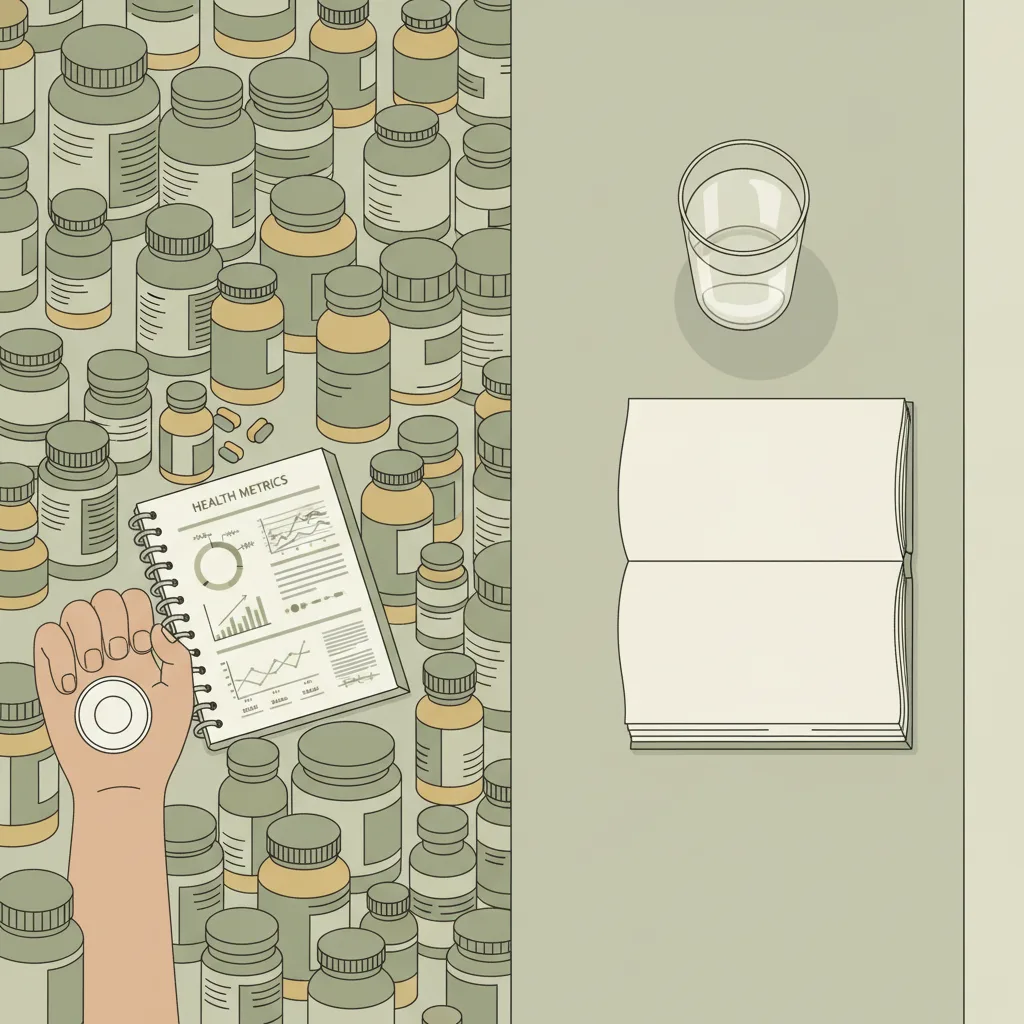
Muerte médicamente asistida vs. cuidados paliativos para una enfermedad terminal
Si actúas
Ayuda médica para morir (MAID)
5,0%
Si no actúas
Cuidados paliativos / hospicio (muerte natural)
25%
Porcentaje de quienes luego se arrepienten de cada elección. Las barras y el registro completo aparecen abajo.
Salud
Última revisión 2026-05-04
Calidad de la evidencia 4.0/5
Puntuación de revisión en ocho dimensiones según la
rúbrica de calidad
. Cada dimensión puntuada de 1 a 5.
D1 Verificación de fuentes
4/5
D2 Autoridad e independencia de las fuentes
4/5
D3 Precisión de la tasa de arrepentimiento
2/5
D4 Comparabilidad de las fuentes
3/5
D5 Patrón de Gilovich
5/5
D6 Calidad de la prosa
5/5
D7 Completitud de las advertencias
5/5
D8 Calidad de la muestra
4/5
Media4.0/5
Datos sustitutos — no existe ninguna encuesta directa sobre el arrepentimiento para esta decisión. Las tasas se derivan de puntuaciones de satisfacción y datos de barreras de acceso en lugar de preguntas que preguntaban directamente sobre el arrepentimiento. Ver advertencias más abajo.
Arrepentimiento por acción
Ayuda médica para morir (MAID)
5,0%
~5% de las familias en duelo reporta angustia o arrepentimiento tras el MAID
Familias en duelo de pacientes MAID en Bélgica, Países Bajos, Canadá y Oregón (datos multi-jurisdiccionales)
retrospectivo, 1-12 meses post-muerte
Arrepentimiento por inacción
Cuidados paliativos / hospicio (muerte natural)
25%
~25% de las familias en duelo reporta necesidades no satisfechas o arrepentimiento sobre la calidad de los cuidados de fin de vida
Familias en duelo de pacientes terminales que murieron sin MAID en entornos de hospicio/hospital estadounidenses y europeos
retrospectivo, dentro de 6-12 meses post-muerte
% que se arrepienten de esta elección
Ayuda médica para morir (MAID)Cuidados paliativos / hospicio (muerte natural)
5,0%25%
inaction dominates — Domina la inacción — la mayoría se arrepiente de no actuar.
Decisiones relacionadas
Decisiones semánticamente similares — mismo terreno, distintos compromisos.
Optar por un tratamiento oncológico agresivo (sin cuidados paliativos tempranos)Integrar cuidados paliativos desde el diagnóstico (junto con la oncología)
Rechazar el tratamiento oncológico convencional; recurrir únicamente a la medicina alternativa (sin cirugía, quimioterapia, radioterapia ni hormonoterapia)Aceptar el tratamiento oncológico convencional (cirugía, quimioterapia, radioterapia, hormonoterapia según el estadio)
In the jurisdictions where it is legal, medical aid in dying is chosen by a small but growing minority of terminally ill patients — 5.4% of deaths in the Netherlands in 2023, 4.1% in Canada in 2022, and a small fraction of a percent of all deaths in Oregon (38.6 per 10,000 total deaths over the law’s first 18 years), though cancer patients make up the large majority of Oregon’s MAID users — 77% of the 991 patients who used the Death With Dignity Act between 1998 and 2015. These provision counts come from government monitoring reports, which do not survey bereaved families. The family-distress evidence comes instead from bereavement studies: Swarte and colleagues’ BMJ 2003 cross-sectional comparison (189 relatives bereaved by euthanasia vs 316 by natural death of gynaecological-cancer patients) found less traumatic grief and fewer post-traumatic stress reactions in the euthanasia group, and a Swiss study of relatives who witnessed assisted suicide found roughly 5% met criteria for complicated grief (and 13% for full PTSD). One figure stands out from the Oregon Death With Dignity Act data: roughly 30–40% of patients who receive the legally required prescription for lethal medication never use it. For many, simply having the option is sufficient.
The comparison group — families of patients who died without MAID, in hospice or hospital settings — shows substantial unmet need. Teno and colleagues’ landmark 2004 JAMA survey of bereaved families of decedents (n=1,578) found that about a quarter said the patient did not get adequate help with pain (24.2%) and a similar share had concerns with physician communication (23.9%), while half reported insufficient emotional support (50.2%); nursing-home patients were least likely to be “always” treated with respect (68.2%, versus 96.2% in home hospice). The Detering 2010 BMJ RCT found that among families of patients who died, control-group relatives (no advance care planning) had clinically significant depression in 30% of cases, anxiety in 19%, and high PTSD risk in 15% — whereas the advance-care-planning group registered none of these. These figures reflect real, fixable gaps in comfort care rather than a universal defect of natural dying; well-resourced hospice deaths scored far better than institutional ones.
The methodological problem that makes this entry uniquely uncertain is the impossibility of asking MAID patients whether they regret the decision. All regret measurement is family-proxied, and all cross-group comparison conflates eligibility, access, and choice. MAID patients are a selected group: motivated enough to navigate legal and clinical requirements, often dying of cancer with predictable trajectories, and in jurisdictions with functioning access infrastructure. MAID remains illegal in the great majority of the world’s roughly 195 countries; those populations have no choice, and their inclusion would likely shift every figure. What the available data supports most clearly is this: in jurisdictions where both paths are genuinely available and supported, the major asymmetry is not in the dying itself but in the quality of the dying — and unmet needs in natural-death settings remain common enough to constitute a public health gap, not a rare failure.
Fuentes: acción
Registro de evidencia
Cada número a continuación es lo que reportó cada fuente, con la cita textual en la que nos basamos y cómo llegamos a nuestra cifra. Haz clic en cualquier enlace para verificarlo directamente.
2/4 fuentes verificadas de forma independiente palabra por palabra frente a la fuente citada
[1]Health Canada — Fourth Annual Report on Medical Assistance in Dying in Canada 2022
Informe gubernamental
13,241 MAID provisions in Canada in 2022, representing 4.1% of all deaths in Canada
Extracto
“"In 2022, there were 13,241 MAID provisions in Canada, accounting for 4.1% of all deaths in Canada. Since the introduction of federal MAID legislation in 2016, the number of reported MAID deaths has increased steadily each year."
”
Datos de la fuente de
2023-10-24
Accedido
2026-05-04
Cálculo
Health Canada Fourth Annual Report on MAID 2022 establishes only the provision count and its share of all deaths (13,241 = 4.1%; corroborated by Statistics Canada, The Daily 2023-11-29). This federal monitoring report does NOT survey bereaved families and contains no family-satisfaction or family-regret figure — it is cited here for the denominator (how common MAID is), not for the action-side regret rate. The regret rate is grounded in the Swarte (BMJ 2003) and Wagner (2012) bereavement studies below.
9,068 euthanasia/assisted-suicide notifications in the Netherlands in 2023 (5.4% of all deaths); 5 cases found not to meet the due care criteria (>99.9% compliant)
Extracto
“"In 2023 the RTEs received 9,068 notifications of euthanasia. These 9,068 deaths represent 5.4% of the total number of deaths in the Netherlands. In five of the notified cases the committees found that the physician had not acted in accordance with all of the due care criteria."
”
Datos de la fuente de
2024-04-04
Accedido
2026-05-04
Cálculo
Dutch RTE Annual Report 2023 (direct PDF: euthanasiecommissie.nl/.../jaarverslag-2023/ Annual+report+2023.pdf; figures corroborated by FSSPX News 2024). 9,068 notifications = 5.4% of all Dutch deaths; only 5 of 9,068 cases (0.06%) were judged non-compliant, i.e. >99.9% met every due care criterion. This report counts and reviews notifications; it does NOT contain a bereaved-family satisfaction or regret survey, so it is cited for the provision count and compliance rate only — not for the action-side regret figure.
[3]Ontario HIV Treatment Network (rapid response) citing Swarte et al. BMJ 2003 and Wagner et al. 2012 — Effects of euthanasia on the bereaved family and friends (Swarte et al., BMJ 2003) and Death by request in Switzerland (Wagner et al., 2012), as summarised in the OHTN rapid response on the impact of MAID on family and friends
Verificado
Revisado por pares
Family/friends bereaved by euthanasia had less traumatic grief and fewer post-traumatic stress reactions than those bereaved by natural death (Swarte, n=189 vs 316); among relatives who witnessed assisted suicide, 5% met criteria for complicated grief and 13% for full PTSD (Wagner)
Extracto
“"[On Swarte et al. 2003, Netherlands] family and friends of patients who requested medical assistance in dying had less traumatic grief symptoms, fewer current feelings of grief, and fewer post-traumatic stress symptoms compared to the family and friends of women who died naturally. [On Wagner et al. 2012, Switzerland] 13% met the criteria for full PTSD, 7% met the criteria for subthreshold PTSD, and 5% met the criteria for complicated grief. The prevalence of depression was 16% and the prevalence of anxiety was 6%."
”
Datos de la fuente de
2003-07-26
Accedido
2026-06-30
Verificación
Extracto recuperado de forma independiente y confirmado palabra por palabra frente a la fuente citada durante nuestra auditoría de fundamentación.
Cálculo
The ~5% action-side figure is grounded here, not in the provision-counting government reports above. The direct comparison study (Swarte, BMJ 2003; n=189 euthanasia vs n=316 natural death of gynaecological-cancer patients) found LESS traumatic grief and fewer PTSD reactions among the euthanasia-bereaved — i.e. family distress after MAID is at or below the natural-death baseline. The Swiss witness study (Wagner 2012) gives a concrete absolute: ~5% complicated grief among relatives who were present at an assisted death. This is a family-distress proxy, not a direct "do you regret the decision?" survey — see proxy_only and caveats. 0.05 is used as a conservative distress/complicated-grief rate consistent with both studies.
[4]Drug and Alcohol Dependence / peer-reviewed characterization of Oregon Health Authority DWDA data, 1998-2015 — Characterizing 18 Years of the Death With Dignity Act in Oregon
Verificado
Revisado por pares
Of 991 Oregon patients who used the Death With Dignity Act 1998-2015, 762 (77.1%) had cancer as the underlying terminal illness; DWDA deaths represent 38.6 per 10,000 total Oregon deaths over the period
Extracto
“"Cancer was the most common underlying terminal illness, with 762 (77.1%) patients." "DWDA deaths make up only a small fraction of overall Oregon resident mortality, with a rate of 38.6 per 10,000 total deaths."
”
Datos de la fuente de
2018-01-01
Accedido
2026-07-03
Verificación
Extracto recuperado de forma independiente y confirmado palabra por palabra frente a la fuente citada durante nuestra auditoría de fundamentación.
Cálculo
Used to correct and ground the Oregon reference in the body text (originally an unsourced "3-4% of cancer deaths" claim that does not match any published Oregon Health Authority or peer-reviewed figure; Oregon Health Authority annual reports and this characterization paper report DWDA usage as a rate per 10,000 deaths, not a percentage of cancer deaths specifically, and the overall DWDA share of Oregon deaths is well under 1%). Replaced with the two verified figures: cancer as underlying illness in 77.1% of DWDA patients, and DWDA deaths at 38.6 per 10,000 of all Oregon deaths, 1998-2015. Not used to compute the action-side regret rate — provided for provision-count context only, same role as the Health Canada and Dutch RTE sources above.
Independencia
Peer-reviewed academic characterization of Oregon Health Authority's own published DWDA surveillance data; independent of the Swarte and Wagner bereavement studies used for the regret rate.
Fuentes: inacción
Registro de evidencia
Cada número a continuación es lo que reportó cada fuente, con la cita textual en la que nos basamos y cómo llegamos a nuestra cifra. Haz clic en cualquier enlace para verificarlo directamente.
1/2 fuentes verificadas de forma independiente palabra por palabra frente a la fuente citada
[1]JAMA (Teno et al., 2004; PMID 14709580) — Family Perspectives on End-of-Life Care at the Last Place of Care
Verificado
↗ 1 other entry
Revisado por pares
Bereaved families of 1,578 decedents: ~25% said pain was not adequately treated and ~24% had concerns with physician communication; 50.2% said the patient did not get enough emotional support; nursing-home patients least likely to be 'always' treated with respect (68.2% vs 96.2% home hospice)
Extracto
“"Nearly one fourth of all respondents reported that the patient did not receive any or enough help with pain (24.2%) or dyspnea (22.4%). About 1 in 4 families reported concerns with physician communication regarding medical decision making (23.9%). Half of family members reported that the patient did not receive enough emotional support (50.2%). Nursing home residents were less likely than those cared for in a hospital or by home hospice services to always have been treated with respect at the end of life (68.2% vs 79.6% and 96.2%, respectively)."
”
Datos de la fuente de
2004-01-07
Accedido
2026-06-30
Verificación
Extracto recuperado de forma independiente y confirmado palabra por palabra frente a la fuente citada durante nuestra auditoría de fundamentación.
Cálculo
Teno et al. 2004 JAMA — mortality follow-back survey of bereaved families of decedents (n=1,578; PMID 14709580). Correct article is fullarticle/197944 (the previously cited fullarticle/198197 was an unrelated software review). The inaction-side ~25% proxy is the rate of clearly unmet end-of-life needs — ~24% inadequate pain treatment and ~24% physician-communication concerns; family rating of "always treated with respect" was as low as 68.2% in nursing homes (i.e. ~32% short of always). This is used as an unmet-needs / dissatisfaction proxy because no survey asks natural-death families "do you wish MAID had been chosen." Hospice deaths scored far better (96.2% respect), which is why the proxy is a cross-setting figure, not a universal property of natural dying.
[2]BMJ — The impact of advance care planning on end of life care in elderly patients: randomised controlled trial↗ 1 other entry
Revisado por pares
Among families of patients who died (29 intervention vs 27 control), control-group relatives had clinically significant depression 30% (8/27), anxiety 19% (5/27) and high PTSD risk 15% (4/27); the advance-care-planning group was 0% on all three
Extracto
“[Paraphrase from Table 3 — BMJ full text paywalled; figures verified via PMC2844949] Among family members of the patients who died, in the control group (no advance care planning) clinically significant depression occurred in 30% (8/27), anxiety in 19% (5/27), and post-traumatic stress in 15% (4/27); in the intervention (advance care planning) group the corresponding rate was 0% on each measure ("scores of this level occurred only in the family members of control group patients who had died"). Family members of intervention patients were more satisfied with the quality of dying.
”
Datos de la fuente de
2010-03-23
Accedido
2026-06-30
Cálculo
Detering et al. BMJ 2010 RCT of 309 elderly inpatients (PMID 20332506; family-outcome subgroup: 56 deceased, 29 intervention / 27 control). Verbatim from Table 3: control-group bereaved relatives showed depression 30% (8/27), anxiety 19% (5/27), high PTSD risk 15% (4/27); the ACP group was 0% on all three. (The earlier excerpt's "15% in the ACP group" was wrong — 15% is the control-group PTSD figure; the ACP group was 0%.) These are family distress measures, not MAID-specific regret; cited as a corroborating signal that ~1 in 4–1 in 3 bereaved relatives suffer significant distress when end-of-life care/planning is not optimised, consistent with the inaction-side ~25% unmet-needs proxy.
Advertencias
Esta entrada está entre las más restringidas metodológicamente en el proyecto. El desafío central es la medición asimétrica: los pacientes MAID están muertos y no pueden reportar su propio arrepentimiento; su proxy familiar es la mejor señal disponible. Los pacientes y familias de muerte natural igualmente no enfrentan un contrafactual limpio ("¿habría elegido MAID si hubiera estado disponible y aceptable?"). Las tasas de arrepentimiento usadas aquí son medidas de angustia reportadas por la familia, no encuestas directas de arrepentimiento decisional, y deben entenderse como proxies. El MAID es legal en aproximadamente 30 jurisdicciones en todo el mundo (incluyendo Canadá, Países Bajos, Bélgica, Australia y varios estados de EE.UU.); los criterios de elegibilidad varían sustancialmente desde solo enfermedad terminal (Oregón) hasta sufrimiento no terminal más amplio (Países Bajos, Bélgica, Canadá Track 2). El 30-40% de los titulares de prescripciones MAID que reciben la prescripción pero nunca la ingieren — datos de Oregón a través de 1997-2023 — sugiere que el acceso mismo reduce la angustia independientemente del uso. La preocupación de causalidad inversa es real: los pacientes MAID pueden auto-seleccionarse en el proceso en parte porque sus muertes ya iban bien; los pacientes de hospicio que mueren con necesidades no satisfechas no eran elegibles para MAID o no lo eligieron por otras razones.