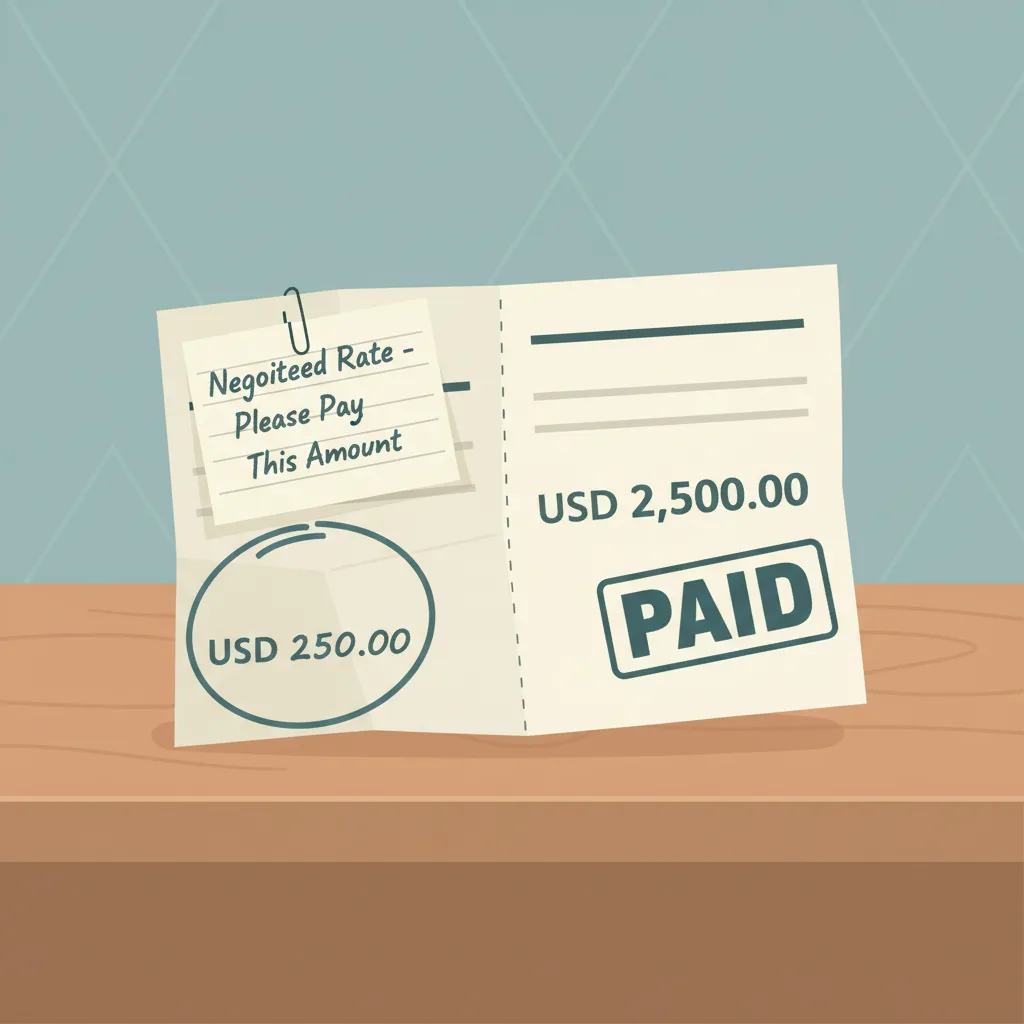
Negociar una factura médica vs pagar el monto indicado en su totalidad
Si actúas
Negociar la factura médica
5,0%
Si no actúas
Pagar el monto indicado en su totalidad
38%
Porcentaje de quienes luego se arrepienten de cada elección. Las barras y el registro completo aparecen abajo.
Financiero
Última revisión 2026-05-11
Calidad de la evidencia 4.5/5
Puntuación de revisión en ocho dimensiones según la
rúbrica de calidad
. Cada dimensión puntuada de 1 a 5.
D1 Verificación de fuentes
5/5
D2 Autoridad e independencia de las fuentes
5/5
D3 Precisión de la tasa de arrepentimiento
2/5
D4 Comparabilidad de las fuentes
4/5
D5 Patrón de Gilovich
5/5
D6 Calidad de la prosa
5/5
D7 Completitud de las advertencias
5/5
D8 Calidad de la muestra
5/5
Media4.5/5
Datos sustitutos — no existe ninguna encuesta directa sobre el arrepentimiento para esta decisión. Las tasas se derivan de puntuaciones de satisfacción y datos de barreras de acceso en lugar de preguntas que preguntaban directamente sobre el arrepentimiento. Ver advertencias más abajo.
Arrepentimiento por acción
Negociar la factura médica
5,0%
~5% de los pacientes que negocian facturas médicas se arrepiente de hacerlo (proxy; el 93% logra al menos éxito parcial)
Adultos estadounidenses que intentaron negociar una factura médica
retrospectivo, sin marco temporal fijo
Arrepentimiento por inacción
Pagar el monto indicado en su totalidad
38%
~38% de los pacientes que pagaron sin negociar probablemente se arrepiente, basado en la brecha de creencia falsa (proxy; el 86% de los no negociadores creía que negociar no ayudaría — cuando de hecho el 62-93% de quienes lo intentan tienen éxito)
Adultos estadounidenses que recibieron una factura médica y no intentaron negociar
retrospectivo, sin marco temporal fijo
% que se arrepienten de esta elección
Negociar la factura médicaPagar el monto indicado en su totalidad
5,0%38%
inaction dominates — Domina la inacción — la mayoría se arrepiente de no actuar.
Decisiones relacionadas
Decisiones semánticamente similares — mismo terreno, distintos compromisos.
Invertir los ahorros en criptomonedasMantenerse en activos tradicionales
46%16%
Acción dominante
Arrepentimiento por acción 2.9× mayor
Among US patients who attempted to negotiate a medical bill, 93% had it reduced or eliminated, according to a 2024 LendingTree survey of 2,016 adults — and 66% received exactly what they requested. A peer-reviewed 2024 JAMA Health Forum study (n=1,135, nationally representative) found that patients who challenged bills achieved a price reduction 61.8% of the time, error correction 73.7% of the time, and some form of financial relief 75.8% of the time. Against this evidence, the same JAMA study found that 86.1% of patients who did not challenge their bill believed negotiation would not make a difference — a systematically false belief that the outcome data consistently refutes. LendingTree (2024) found that 41% of those who had medical debt never attempted to negotiate.
The gap between what non-negotiators believe (it won’t help) and what actually happens to those who try (61–93% success) is the clearest available signal of the opportunity cost of inaction. Medical bill negotiation is unfamiliar territory for most US patients, who tend to treat the stated price as fixed — a reasonable assumption in retail contexts that does not translate to healthcare, where list prices (chargemaster rates) are almost never what insurers pay, cash-pay discounts are standard, and billing departments have significant discretion to reduce, restructure, or forgive balances. Hospitals routinely offer self-pay or prompt-pay discounts off billed charges, and medical debt collectors — who typically buy delinquent accounts for a fraction of face value — have substantial room to settle for less than the stated amount. The stated amount on a medical bill is closer to a starting position than a fixed price.
The data here is almost entirely proxy-based. No survey has asked patients “do you regret not negotiating your medical bill?” — the 38% inaction-regret estimate is derived from the false-belief prevalence, not from a direct regret question. The action-side 5% estimate reflects the small minority who tried and got no reduction, noting that even they paid no more than non-negotiators. The JAMA and LendingTree success-rate figures differ because they sample different populations with different methods; the JAMA figure (62% for price reduction specifically) is more methodologically rigorous but based on a smaller, representative sample. Barriers to negotiation are real: 34% of non-negotiators cited discomfort with reaching out and 25.7% cited lack of time — these are genuine constraints, particularly for patients managing serious illness. Income-based charity care programs can further reduce bills independently of negotiation, which may lower the stakes for lower-income patients who qualify automatically.
Fuentes: acción
Registro de evidencia
Cada número a continuación es lo que reportó cada fuente, con la cita textual en la que nos basamos y cómo llegamos a nuestra cifra. Haz clic en cualquier enlace para verificarlo directamente.
[1]LendingTree — Medical Debt and Bills Survey 2024
Fuente de referencia
93% of patients who negotiated a medical bill had it reduced or eliminated; 59% of those with medical debt had attempted negotiation
Extracto
“"59% of Americans who've had medical debt have negotiated a related bill. 93% of those who negotiated reported at least partial success; 66% received exactly what they requested."
”
Datos de la fuente de
2024-11-01
Accedido
2026-05-11
Cálculo
LendingTree / QuestionPro survey of n=2,016 US consumers ages 18–78, conducted November 6–8, 2024. The 93% partial-success rate is the most striking figure in the medical negotiation literature: among patients who asked for a reduction, only 7% received no improvement at all. The 66% full-success rate (received exactly what they requested) implies the majority of negotiators got their preferred outcome. The 5% action-regret estimate is conservative and based on the inverse of the partial-success rate: even the 7% who got no reduction paid no more than non-negotiators, and the time cost of attempting is typically a single phone call. Actual action-side regret is likely lower than 5% in practice.
[2]JAMA Health Forum — Disparate Patient Advocacy When Facing Unaffordable and Problematic Medical Bills
Revisado por pares
Among patients who challenged a bill: 73.7% achieved error correction, 75.8% received financial relief for unaffordable bills, 61.8% achieved a price reduction specifically
Extracto
“"Of those who challenged for billing errors, 73.7% succeeded. Of those who challenged for unaffordable bills, 75.8% received financial relief. Of those specifically seeking a price reduction, 61.8% achieved a price drop."
”
Datos de la fuente de
2024-08-30
Accedido
2026-05-11
Cálculo
Duffy EL, Frasco MA, Trish E. "Disparate Patient Advocacy When Facing Unaffordable and Problematic Medical Bills." JAMA Health Forum. 2024;5(8):e242744. DOI: 10.1001/jamahealthforum.2024.2744. Nationally representative panel (Understanding America Study), n=1,135 US adults, fielded August–October 2023. This peer-reviewed source independently confirms the high success rate: 62–76% of patients who contacted the billing office got a positive outcome depending on the type of challenge. The 61.8% price-reduction success rate is lower than LendingTree's 93% (partial success) because the JAMA study measures billing-office contact broadly (not all contacts are price negotiations per se) and uses a nationally representative rather than a self-selected panel. Both sources consistently show that attempting negotiation produces positive outcomes far more often than non-negotiators believe.
Fuentes: inacción
Registro de evidencia
Cada número a continuación es lo que reportó cada fuente, con la cita textual en la que nos basamos y cómo llegamos a nuestra cifra. Haz clic en cualquier enlace para verificarlo directamente.
1/2 fuentes verificadas de forma independiente palabra por palabra frente a la fuente citada
[1]JAMA Health Forum — Disparate Patient Advocacy When Facing Unaffordable and Problematic Medical Bills
Verificado
Revisado por pares
86.1% of patients who did not challenge a medical bill said they believed it would not make a difference; actual success rates for those who tried were 62–76%
Extracto
“"55 of non-challengers (86.1%) reported that they did not think it would make a difference. Secondary reasons for not challenging included feeling uncomfortable reaching out (34.0%) and lacking time (25.7%)."
”
Datos de la fuente de
2024-08-30
Accedido
2026-05-11
Verificación
Extracto recuperado de forma independiente y confirmado palabra por palabra frente a la fuente citada durante nuestra auditoría de fundamentación.
Cálculo
Duffy et al., JAMA Health Forum 2024, n=1,135 nationally representative US adults. The 86.1% figure measures the false belief that negotiation is ineffective. This is not a direct regret measurement; it is a belief-gap proxy: the share of non-negotiators whose stated reason for inaction (it won't help) is empirically contradicted by the experience of those who did try (62–76% success rate). The 38% inaction-regret estimate is derived conservatively: it assumes that patients who paid full price, later learned negotiation was possible and often successful, and received no reduction they were eligible for, report some degree of regret. The gap between the 86.1% false-belief rate (how many non-negotiators held an inaccurate assumption) and the 38% regret estimate reflects the fact that learning you held a wrong belief does not automatically translate into regret — some patients may have genuinely lacked time or capacity to negotiate regardless of likelihood of success.
[2]LendingTree — Medical Debt and Bills Survey 2024
Fuente de referencia
41% of Americans who've had medical debt did not attempt to negotiate their bill
Extracto
“"59% of Americans who've had medical debt have negotiated a related bill — meaning 41% did not attempt negotiation."
”
Datos de la fuente de
2024-11-01
Accedido
2026-05-11
Cálculo
LendingTree 2024, n=2,016. The 41% non-negotiation rate defines the inaction population. Combined with the JAMA finding that 86% of non-challengers held false beliefs about effectiveness, and the 62–93% success rate among those who did try, the non-negotiating population is large and operating on systematically inaccurate assumptions. The 38% inaction-regret proxy is conservative relative to the 86% false-belief prevalence, reflecting the gap between "held a wrong belief" and "regrets the outcome."
Advertencias
MEDICIONES PROXY EN TODO. Ninguna encuesta publicada pregunta directamente "¿se arrepiente de no haber negociado su factura médica?". Ambos lados son construcciones proxy: la tasa del 5% de arrepentimiento por acción se deriva del 7% que no recibió reducción (LendingTree 2024); la tasa del 38% de arrepentimiento por inacción se deriva de la prevalencia de creencia falsa entre no negociadores (JAMA 2024). El proxy de creencia falsa es el sustituto metodológicamente más fuerte disponible para una medida directa de arrepentimiento — cuantifica la concepción errónea específica que impulsa la inacción y que los datos de resultados refutan. Sin embargo, una creencia falsa no produce automáticamente arrepentimiento; algunos no negociadores pueden no experimentar arrepentimiento incluso después de saber que la negociación a menudo tiene éxito (porque carecen de energía, no tienen relación continua con el proveedor, o pagaron la factura y siguieron adelante). Las cifras de tasa de éxito de LendingTree (93%) y JAMA (62-76%) difieren sustancialmente porque miden poblaciones diferentes: LendingTree encuestó a personas condicionadas a tener deudas médicas (una población más motivada, financieramente estresada, probablemente reportando éxito parcial más ampliamente) mientras que JAMA usó un panel representativo a nivel nacional y distinguió entre tipos de impugnación (error de facturación vs. asequibilidad vs. reducción de precio). La tasa del 61,8% de éxito de reducción de precio de JAMA es la cifra más relevante y metodológicamente rigurosa para la negociación directa de precios. La negociación de facturas médicas es un proceso en gran parte desconocido para la mayoría de los pacientes estadounidenses; el acceso a ella es desigual por educación, alfabetización en seguros y disponibilidad de tiempo — el 34% de los no negociadores que citaron incomodidad y el 25,7% que citaron falta de tiempo son barreras reales, no inacción irracional. Los programas de atención benéfica y descuento basados en ingresos existen independientemente de la negociación y pueden reducir las apuestas efectivas para pacientes de bajos ingresos.