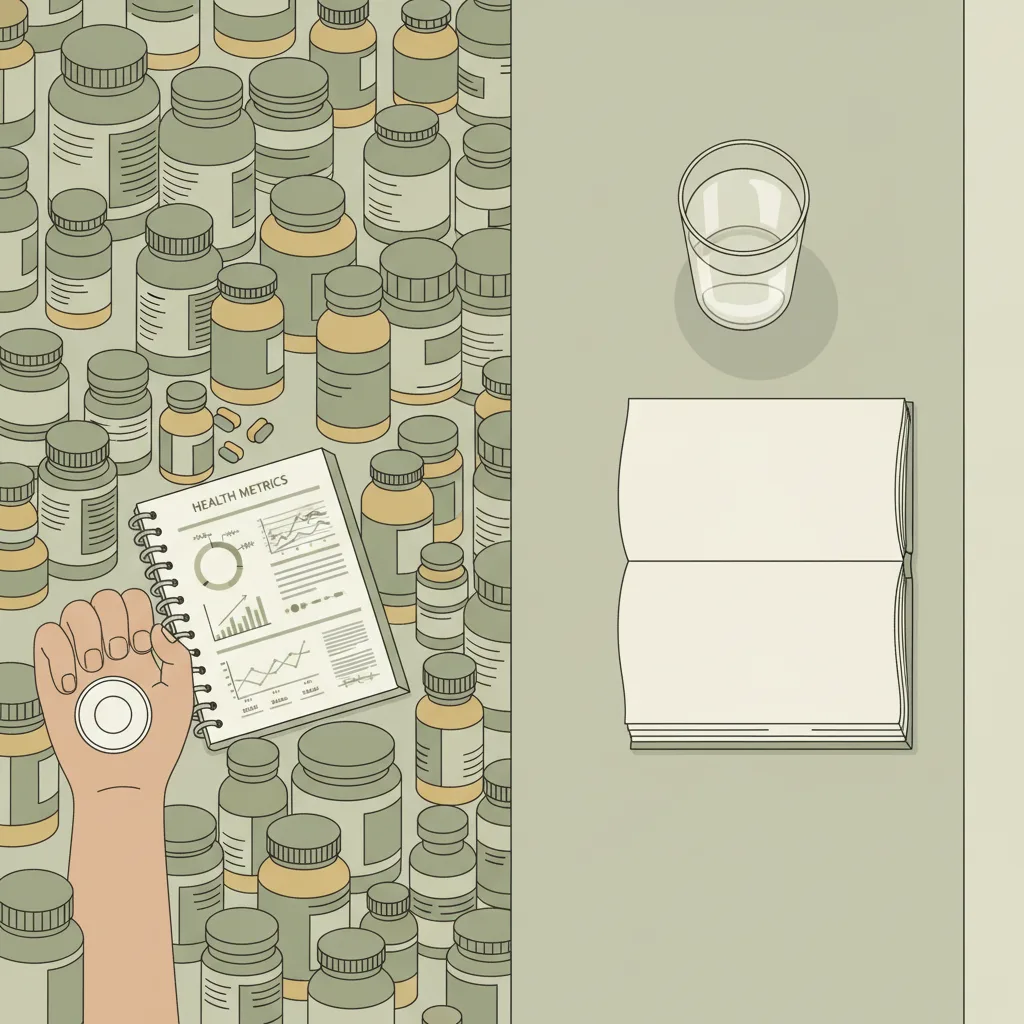
¿Seguir con un fármaco GLP-1 para adelgazar a largo plazo o dejarlo al alcanzar el peso objetivo?
Si actúas
Dejar el fármaco al alcanzar el peso objetivo
55%
Si no actúas
Seguir con el fármaco a largo plazo
56%
Porcentaje de quienes luego se arrepienten de cada elección. Las barras y el registro completo aparecen abajo.
Salud
Última revisión 2026-06-13
Calidad de la evidencia 4.13/5
Puntuación de revisión en ocho dimensiones según la
rúbrica de calidad
. Cada dimensión puntuada de 1 a 5.
D1 Verificación de fuentes
5/5
D2 Autoridad e independencia de las fuentes
4/5
D3 Precisión de la tasa de arrepentimiento
3/5
D4 Comparabilidad de las fuentes
3/5
D5 Patrón de Gilovich
4/5
D6 Calidad de la prosa
5/5
D7 Completitud de las advertencias
4/5
D8 Calidad de la muestra
5/5
Media4.13/5
Datos sustitutos — no existe ninguna encuesta directa sobre el arrepentimiento para esta decisión. Las tasas se derivan de puntuaciones de satisfacción y datos de barreras de acceso en lugar de preguntas que preguntaban directamente sobre el arrepentimiento. Ver advertencias más abajo.
Arrepentimiento por acción
Dejar el fármaco al alcanzar el peso objetivo
55%
El 55% de quienes suspendieron el fármaco en el grupo de obesidad recuperaron algo de peso en un año (proxy de resultado de recuperación de peso —no una encuesta de arrepentimiento declarado; la recuperación neta media fue de solo 0,5% al reiniciar o cambiar de fármaco muchos)
Adults with obesity who stopped injectable semaglutide or tirzepatide 3-12 months after starting
1 year after discontinuation
Arrepentimiento por inacción
Seguir con el fármaco a largo plazo
56%
El 56% de los usuarios de GLP-1 dicen que el fármaco es difícil de costear (proxy actitudinal de carga de coste —no una encuesta de arrepentimiento declarado)
U.S. adults currently or formerly using a GLP-1 drug
ongoing use (surveyed Oct-Nov 2025)
% que se arrepienten de esta elección
Dejar el fármaco al alcanzar el peso objetivoSeguir con el fármaco a largo plazo
Both arms of this decision are reconstructed from outcome and attitude data, not from anyone asking patients whether they regret the choice they made. There is no published regret survey for GLP-1 continuation as of mid-2026, so the numbers here are proxies: weight regain stands in for regret over stopping, and the reported difficulty of paying for the drug stands in for the burden of staying. Read them as the rate at which each path produces the thing people say they wanted to avoid, not as a count of stated regret.
Stopping at goal weight reverses most of the loss for most people. In the STEP-1 trial extension, participants who came off semaglutide regained a mean of two-thirds of their prior weight loss over the following year, and a 2026 meta-regression of six randomized trials put the figure at 60% regained by 52 weeks, plateauing near 75% of the original loss. Real-world data is gentler but points the same way: in a Cleveland Clinic cohort of 7,938 adults with obesity who stopped semaglutide or tirzepatide, 55% gained weight in the year afterward while 45% kept losing or held steady. The trial figures describe how much weight comes back; the 55% is the share of individual stoppers who saw the scale move the wrong way, which is why it, rather than the regain magnitude, anchors the action side.
Staying on carries a different cost, and a large share of long-term users describe it as hard to bear. In KFF’s late-2025 polling, 56% of GLP-1 users said the drug was difficult to afford, a share barely lower among the insured. The burden is concrete enough to end treatment for most people who start: a clinical-practice study found 54.9% discontinued within the first year, with cost or insurance driving 47.6% of those exits and side-effect intolerance another 14.6%. Those discontinuation figures are not folded into the regret rate here, because someone who quits has effectively taken the stopping path rather than the staying one. They establish only that the open-ended expense and tolerability of indefinite use is severe enough to push a majority off within twelve months.
The two proxy rates land almost on top of each other, 55% for stopping and 56% for staying, so the comparison is close to balanced rather than favoring either path. The symmetry is partly an artifact of proxy choice: a magnitude-of-regain framing would tilt the stopping side higher, and a stated-regret survey, if one existed, could move both. What the data does support is narrower and firmer. Stopping usually means regaining most of the loss, and staying usually means an expense a majority find difficult to sustain. Neither path offers a clean exit from the trade-off.
Fuentes: acción
Registro de evidencia
Cada número a continuación es lo que reportó cada fuente, con la cita textual en la que nos basamos y cómo llegamos a nuestra cifra. Haz clic en cualquier enlace para verificarlo directamente.
1/2 fuentes verificadas de forma independiente palabra por palabra frente a la fuente citada
[1]Cleveland Clinic Newsroom — What Happens When Patients Stop Taking GLP-1 Drugs? New Cleveland Clinic Study Reveals Real-World Insights
Verificado
Fuente de referencia
Among the obesity group, 55% gained weight in the year after discontinuation, while 45% kept losing or stayed the same (n=7,938 adults; study published in Diabetes, Obesity and Metabolism, March 2026).
Extracto
“55% gained weight in the year after discontinuation, while 45% kept losing or stayed the same.”
Datos de la fuente de
2026-03-12
Accedido
2026-06-13
Verificación
Extracto recuperado de forma independiente y confirmado palabra por palabra frente a la fuente citada durante nuestra auditoría de fundamentación.
Cálculo
PROXY (no direct regret survey). The active choice is stopping the drug at goal; the regret driver is weight regain. Person-level proxy: of obesity patients who stopped semaglutide/tirzepatide, 55% gained weight in the following year. regret_rate = 0.55 taken directly as the fraction of stoppers who saw their weight move the wrong way. This is an outcome proxy (regain), not a survey of stated regret — the 45% who kept losing or held steady are treated as the not-regretting share. CAVEAT — the proxy likely OVERSTATES regret: the 55% counts anyone who gained ANY weight, but the obesity group's mean net regain was only 0.5% of body weight one year out (vs. 8.4% lost before stopping), because 27% switched drugs, 20% restarted, and 14% continued via lifestyle visits. So "55% gained weight" is the share whose weight ticked up at all, not the share with clinically meaningful regain. Underlying study: Gasoyan et al., Cleveland Clinic, real-world cohort in Ohio and Florida, published in Diabetes, Obesity and Metabolism (March 2026).
Independencia
Reports the Gasoyan/Cleveland Clinic real-world cohort. Independent in mechanism from the trial-extension regain magnitude (STEP-1) cited as supporting context.
[2]Diabetes, Obesity and Metabolism (Wilding et al.) — Weight regain and cardiometabolic effects after withdrawal of semaglutide: The STEP 1 trial extension
Revisado por pares
After withdrawal of semaglutide and lifestyle intervention, participants regained a mean of two-thirds of their prior weight loss over the 1-year off-treatment extension (n=327; weeks 68-120).
Extracto
“After withdrawal of semaglutide and structured lifestyle intervention, participants regained a mean of two-thirds of their prior weight loss in the 1-year off-treatment extension phase.”
Datos de la fuente de
2022-04-19
Accedido
2026-06-13
Cálculo
SUPPORTING CONTEXT for the regain mechanism, NOT the headline rate. This is a magnitude of regain (two-thirds of lost weight, mean 11.6 percentage points regained), not a fraction of people who regret. Used to substantiate that stopping reliably reverses most weight loss. Trial extension subset n=327 over 52 weeks off-treatment.
Independencia
STEP-1 RCT extension. Likely one of the six RCTs pooled in the eClinicalMedicine 2026 meta-regression cited on the inaction side, so the two regain figures are not fully independent.
Fuentes: inacción
Registro de evidencia
Cada número a continuación es lo que reportó cada fuente, con la cita textual en la que nos basamos y cómo llegamos a nuestra cifra. Haz clic en cualquier enlace para verificarlo directamente.
2/2 fuentes verificadas de forma independiente palabra por palabra frente a la fuente citada
[1]KFF (Kaiser Family Foundation) — Poll: 1 in 8 Adults Say They Are Currently Taking a GLP-1 Drug, Even as Half Say the Drugs Are Difficult to Afford
Verificado
Fuente de referencia
About half of GLP-1 users (56%), including 55% of those with insurance, say it was difficult to afford these drugs (nationally representative sample of 1,350 U.S. adults; surveyed Oct 27-Nov 2, 2025).
Extracto
“about half of GLP-1 users (56%), including a similar share among those with insurance (55%), say that it was difficult to afford these drugs.”
Datos de la fuente de
2025-11-14
Accedido
2026-06-13
Verificación
Extracto recuperado de forma independiente y confirmado palabra por palabra frente a la fuente citada durante nuestra auditoría de fundamentación.
Cálculo
PROXY (no direct regret survey). The status-quo choice is staying on the drug long-term; the regret driver is cost, side-effects, and open-ended dependence. Person-level attitudinal proxy: 56% of GLP-1 users say the drug was difficult to afford. regret_rate = 0.56 taken as the share of long-term users bearing a burden they report as hard to sustain. This proxies the cost/dependence burden of staying, not direct regret. Cost is reported as the top reason users give for stopping, which corroborates the burden is real but is treated as supporting context, not double-booked into the rate.
Independencia
Attitudinal survey; independent in source and mechanism from the trial/cohort regain data on the action side.
[2]Obesity (Gasoyan et al.) — Reasons for Discontinuation of Obesity Pharmacotherapy With Semaglutide or Tirzepatide in Clinical Practice
Verificado
Revisado por pares
54.9% of patients discontinued within the first year; among discontinuers, 47.6% cited cost/insurance and 14.6% cited inability to tolerate side effects (n=288 reason-coded; broader cohort 8,184).
Extracto
“137 patients (47.6%) discontinued their medication due to cost or insurance‐related issues”
Datos de la fuente de
2025-10-02
Accedido
2026-06-13
Verificación
Extracto recuperado de forma independiente y confirmado palabra por palabra frente a la fuente citada durante nuestra auditoría de fundamentación.
Cálculo
SUPPORTING CONTEXT for the inaction-side burden, NOT the headline rate. Documents WHY staying long-term is hard: cost/insurance (47.6%) and side-effect intolerance (14.6%) are the leading reasons people leave, and 54.9% discontinue within a year. Deliberately NOT used as the inaction regret_rate, because discontinuers have effectively taken the action (stopping); counting them as 'regret of staying' would double-book them. Used only to establish that the cost/side-effect/dependence burden is severe enough to drive a majority off within a year.
Independencia
Same Gasoyan/Cleveland Clinic research program as the action-side cohort source; complementary (reasons vs. weight outcomes), not an independent confirmation.
Advertencias
proxy_only: neither side has a direct regret-framed survey, so both rates are derived. ACTION side (stopping): regret_rate 0.55 is an outcome proxy = the share of real-world obesity-group stoppers who gained weight within a year (Cleveland Clinic/Gasoyan cohort, n=7,938, published Diabetes Obesity and Metabolism Mar 2026). The trial-extension figures (STEP-1 two-thirds regained; eClinicalMedicine 2026 60% at 1yr, ~75% plateau) describe REGAIN MAGNITUDE, not the fraction of people who regret, and are used only as supporting mechanism context. INACTION side (staying): regret_rate 0.56 is an attitudinal proxy = the share of GLP-1 users who say the drug is difficult to afford (KFF, n=1,350, Oct-Nov 2025); it proxies the cost/dependence burden of indefinite use, not stated regret. Discontinuation rates (54.9% within a year; 47.6% cost-driven) are deliberately NOT used as the inaction rate to avoid double-booking people who, by quitting, took the action path. DEPENDENCE: STEP-1 is very likely one of the six RCTs in the 2026 eClinicalMedicine meta-regression, so those two regain figures are not independent. The near-tie (delta -0.01) is sensitive to proxy choice; a magnitude framing or an actual regret survey could shift it materially. Both sides reflect obesity-indication adult users; type-2-diabetes users showed a lower regain share (44%) and are excluded from the action-side population.