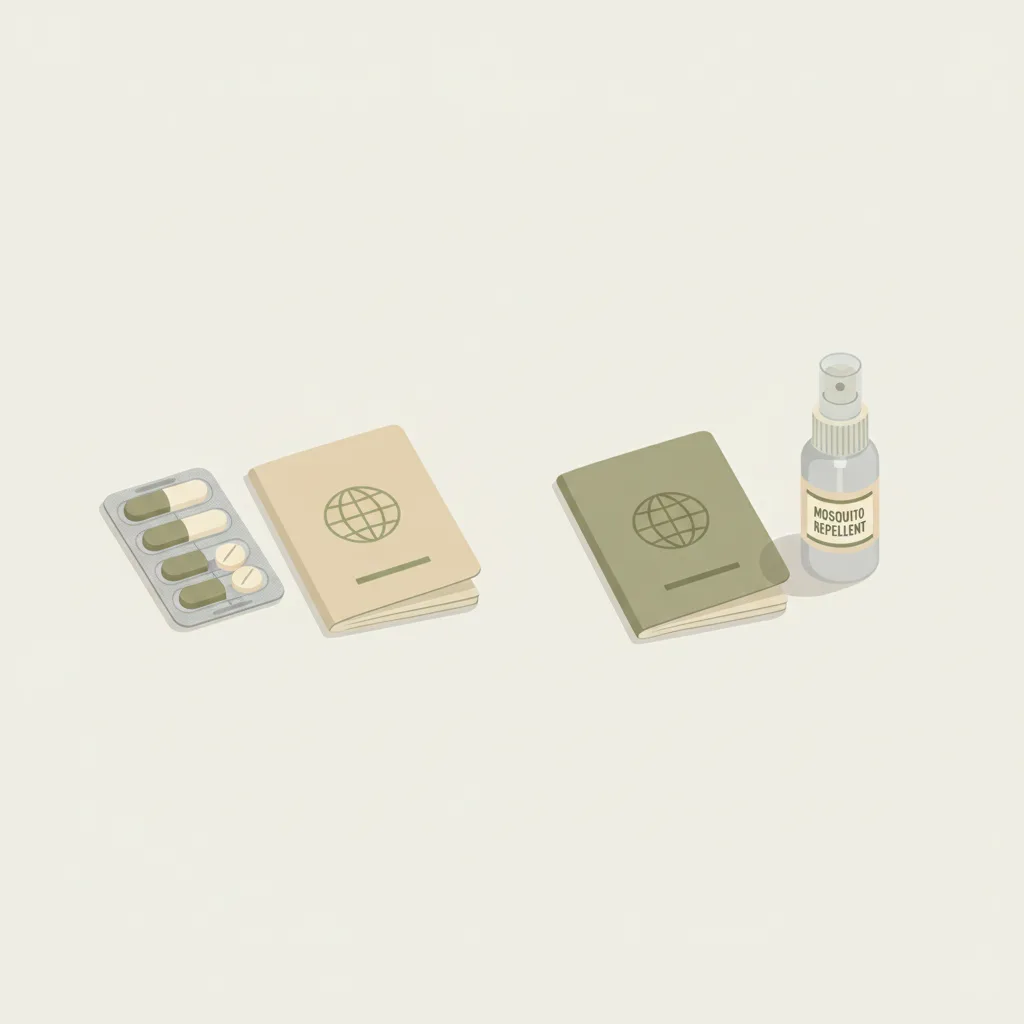
Prendre une chimioprophylaxie antipaludique (Malarone, doxycycline ou méfloquine) avant/pendant un voyage en zone d'endémie palustre vs. ne pas prendre de prophylaxie et se reposer uniquement sur la prévention des piqûres de moustiques
Si vous agissez
Prendre un schéma de chimioprophylaxie antipaludique recommandé par le CDC/OMS (atovaquone-proguanil/Malarone, doxycycline ou méfloquine) avant, pendant et après un voyage vers une destination d'endémie palustre
7,0%
Si vous n’agissez pas
Renoncer à la chimioprophylaxie antipaludique et se reposer uniquement sur la prévention des piqûres de moustiques (DEET, vêtements traités à la perméthrine, moustiquaires, moustiquaires de lit) pour un voyage en zone d'endémie palustre
18%
Pourcentage de personnes qui regrettent ensuite chaque choix. Les barres et le registre complet s’affichent ci-dessous.
Santé
Dernière révision 2026-05-24
Qualité des preuves 4.25/5
Score d’évaluation en huit dimensions selon la
grille de qualité
. Chaque dimension notée de 1 à 5.
D1 Vérification des sources
5/5
D2 Autorité et indépendance des sources
5/5
D3 Précision du taux de regret
2/5
D4 Comparabilité des sources
2/5
D5 Motif de Gilovich
5/5
D6 Qualité de la prose
5/5
D7 Complétude des réserves
5/5
D8 Qualité de l’échantillon
5/5
Moyenne4.25/5
Données de substitution — aucune enquête directe sur les regrets n'existe pour cette décision. Les taux sont dérivés des scores de satisfaction et des obstacles d'accès plutôt que de questions portant directement sur les regrets. Voir les mises en garde ci-dessous.
Regret d'action
Prendre un schéma de chimioprophylaxie antipaludique recommandé par le CDC/OMS (atovaquone-proguanil/Malarone, doxycycline ou méfloquine) avant, pendant et après un voyage vers une destination d'endémie palustre
7,0%
Aucune enquête directe sur le regret des personnes prenant une chimioprophylaxie n'existe ; ~7% est une estimation approximative construite, et non un taux de regret mesuré. L'ancrage comportemental est l'arrêt dû aux événements indésirables : Cochrane Tickell-Painter 2017 a constaté que 6% des utilisateurs de méfloquine contre 2% des utilisateurs d'atovaquone-proguanil ont arrêté le médicament en cours de traitement en raison d'effets secondaires (preuves de certitude élevée) — une fourchette d'arrêt de 2-6%. Le 7% ajoute une petite queue d'événements indésirables persistants concentrée dans la cohorte résiduelle sous méfloquine, où l'avertissement encadré de la FDA de 2013 note que les symptômes neuropsychiatriques peuvent persister après l'arrêt (Nevin & Croft 2016 : 21% de ceux rapportant des cauchemars et 33% de ceux rapportant un dysfonctionnement cognitif rapportent une persistance >3 ans). L'arrêt est une approximation comportementale du regret, et non un regret subjectif
Voyageurs internationaux adultes américains/européens auxquels une chimioprophylaxie antipaludique a été prescrite lors d'une consultation pré-voyage selon les recommandations du CDC Yellow Book pour la destination ; regret triangulé à partir des taux d'arrêt liés aux effets indésirables de la revue systématique Cochrane (Tickell-Painter et al. 2017, n=11 470 dans les ECR) et de l'essai BMJ à quatre bras de Schlagenhauf et al. 2003 (n=623) sur la tolérance de l'atovaquone-proguanil vs. méfloquine vs. doxycycline vs. chloroquine-proguanil
Regret cristallisé pendant le voyage lui-même pour l'arrêt lié aux effets indésirables, et pendant les semaines à années suivant le voyage pour le sous-ensemble de persistance neuropsychiatrique sous méfloquine ; le regret de la « prescription inutile » reste stable après le voyage
Regret d'inaction
Renoncer à la chimioprophylaxie antipaludique et se reposer uniquement sur la prévention des piqûres de moustiques (DEET, vêtements traités à la perméthrine, moustiquaires, moustiquaires de lit) pour un voyage en zone d'endémie palustre
18%
Aucune enquête directe sur le regret des voyageurs renonçant à la prophylaxie n'existe ; ~18% est une estimation approximative triangulée, et non un taux de regret mesuré. Elle emprunte le taux de regret post-hospitalisation de ~65% mesuré par Ioannou et al. 2022 chez des patients atteints de COVID-19 non vaccinés (une transposition inter-maladies, et non une mesure du paludisme) comme plafond pour les personnes symptomatiques ayant renoncé, puis le pondère à la baisse sur la population bien plus large des personnes asymptomatiques ayant renoncé. Les sources spécifiques au paludisme ne mesurent que la gravité des conséquences, et non le regret : Kotepui et al. 2023 ont constaté que 67% des 602 décès de voyageurs par paludisme n'avaient pris aucune chimioprophylaxie, et la surveillance du CDC montre que 95% des patients américains atteints de paludisme n'avaient pas pris de prévention appropriée
Voyageurs internationaux américains/européens ayant refusé ou n'ayant pas demandé de chimioprophylaxie antipaludique avant un voyage vers une destination d'endémie palustre selon le CDC Yellow Book, pondérés vers la sous-population VFR (visiting friends and relatives) qui représente 76 % du paludisme importé civil américain selon le CDC Yellow Book ; regret triangulé à partir de la méta-analyse Kotepui et al. 2023 sur l'usage de la chimioprophylaxie chez les décès palustres (67 % de 602 décès de voyageurs sans prophylaxie) et de l'étude Vliegenthart-Jongbloed et al. 2013 sur la sévérité du paludisme importé (OR 0,121 pour le paludisme sévère avec prophylaxie observée)
Regret de maladie cristallisé dans les jours suivant le début de la fièvre et l'hospitalisation ; le petit sous-ensemble de regret lié à la surveillance post-voyage se résout vers 6 semaines après le voyage, lorsque le P. falciparum à début retardé peut être cliniquement exclu
% regrettent ce choix
Prendre un schéma de chimioprophylaxie antipaludique recommandé par le CDC/OMS (atovaquone-proguanil/Malarone, doxycycline ou méfloquine) avant, pendant et après un voyage vers une destination d'endémie palustreRenoncer à la chimioprophylaxie antipaludique et se reposer uniquement sur la prévention des piqûres de moustiques (DEET, vêtements traités à la perméthrine, moustiquaires, moustiquaires de lit) pour un voyage en zone d'endémie palustre
7,0%18%
inaction dominates — L'inaction domine — la plupart regrettent de ne pas avoir agi.
Décisions associées
Décisions sémantiquement similaires — même terrain, compromis différents.
Renoncer ou refuser les vaccins de voyage recommandés (pas d'hép A ni de typhoïde avant l'Asie du Sud/Sud-Est, pas de fièvre jaune avant l'Afrique ou l'Amérique du Sud endémique, pas d'encéphalite japonaise pour l'Asie rurale)Recevoir les vaccins de voyage recommandés selon les recommandations CDC/OMS par destination avant le départ (hép A et typhoïde pour les destinations non occidentales, fièvre jaune pour les zones endémiques, JE pour les séjours ruraux en Asie de ≥1 mois)
Reporter ou annuler le voyage prévu en raison d'une maladie aiguë, d'une chirurgie récente, d'une grossesse avec complications, d'une immunodépression ou d'une épidémie active à destinationVoyager comme prévu malgré une maladie aiguë, une chirurgie récente, une complication de grossesse, une immunodépression pendant une épidémie à destination ou tout autre avertissement de médecine aérospatiale
Refuser le traitement conventionnel du cancer ; recourir uniquement à la médecine alternative (sans chirurgie, chimiothérapie, radiothérapie ni hormonothérapie)Accepter le traitement conventionnel du cancer (chirurgie, chimiothérapie, radiothérapie, hormonothérapie selon le stade)
Omettre ou refuser les vaccins recommandés chez l'adulte (pas de vaccin antigrippal annuel, pas de rappels COVID, pas de vaccin contre le zona à 50 ans ou plus, pas de rattrapage HPV)Suivre le calendrier vaccinal adulte recommandé (grippe annuelle, rappels COVID-19, zona à 50 ans ou plus, rattrapage HPV jusqu'à 45 ans)
Omettre, retarder ou refuser sélectivement les vaccins de l'enfance (pas de ROR, pas de DTCa, calendrier alternatif ou refus complet)Suivre le calendrier vaccinal pédiatrique recommandé par les CDC/AAP (ROR, DTCa, polio, Hib, hépatite B, varicelle, etc., dans les délais)
Poursuite active de la longévité (jeûne, suppléments, biohacking)Accepter le vieillissement standard (pas de biohacking, soins médicaux conventionnels)
Roughly 18% of travelers who skip recommended antimalarial chemoprophylaxis for an endemic-region trip end up regretting the decision, with regret concentrated heavily in the small subset who developed febrile illness or confirmed malaria infection and a much smaller surveillance-anxiety tail among those who returned home asymptomatic. The Kotepui et al. 2023 systematic review found that 67% of 602 pooled traveler-malaria fatalities across 58 studies had taken no chemoprophylaxis at all, and only 5% had achieved adequate adherence. The Vliegenthart-Jongbloed et al. 2013 imported-malaria cohort at a Dutch referral center quantified the asymmetry differently: compliant prophylaxis was associated with an odds ratio of 0.121 for severe malaria and 0.257 for ICU admission, meaning skippers who do get infected progress to severe disease roughly eight times more often than compliant users. CDC’s domestic surveillance confirms the same pattern at the population level: 95% of US malaria patients did not take appropriate prevention, and 13.8% of US imported cases in 2018 were classified as severe. The 18% headline uses the same proxy-anchored triangulation as the sibling Skip travel vaccines vs. take them entry (which sits at 40%) — Ioannou et al. 2022 hospitalized-skipper regret as the ceiling, population-weighted across the much larger asymptomatic-skipper denominator — but sits lower because per-trip malaria risk varies sharply by destination and because most malaria-prophylaxis skippers still use mosquito-bite prevention as a partial protective alternative.
Action-side regret runs at roughly 7% and is dominated by adverse-event-driven mid-course discontinuation rather than catastrophic harm. The Cochrane Tickell-Painter 2017 systematic review (20 RCTs, 11,470 participants; high-certainty evidence) found mefloquine users discontinued their medication due to side effects at 6% vs 2% for atovaquone-proguanil, with mefloquine producing 13% insomnia, 14% abnormal dreams, 6% anxiety, and 6% depressed mood, compared to 3%, 7%, 1%, and 1% on atovaquone-proguanil. The Schlagenhauf et al. 2003 BMJ four-arm RCT corroborated this on independent data with mefloquine producing 37% neuropsychological adverse events vs 20% on atovaquone-proguanil. The serious end of the action-side regret distribution sits in the residual mefloquine cohort: the FDA’s 2013 boxed warning explicitly states that mefloquine “may cause neuropsychiatric adverse reactions that can persist after mefloquine has been discontinued,” and Nevin & Croft 2016 report that 21% of mefloquine nightmare-reporters and 33% of cognitive-dysfunction-reporters still had symptoms more than three years after stopping the drug. That subpopulation is small post-2013 because US travel clinics have shifted heavily to atovaquone-proguanil and doxycycline, but it absorbs nearly all the catastrophic-AE regret on the action side.
The inaction-dominates pattern holds because the consequence asymmetry is severe even when the per-trip infection probability is modest. A 2-week sub-Saharan Africa trip without prophylaxis carries roughly 1-in-200 infection odds (see Malaria (travel) for the regional risk math); 13.8% of US imported cases progress to severe malaria per CDC MMWR 2018; and Ioannou et al. 2022 found 64.7% post-hospitalization regret among unvaccinated COVID-19 patients, the closest published proxy for what hospitalized-skipper regret looks like. The 18% population-weighted estimate is bounded above by the ~65% hospitalized-cohort ceiling and below by the very low ambient regret among skippers whose trips passed without incident, with most of the rate concentrated in the symptomatic-infection subset where retrospective regret crystallizes at near-vaccine-skip levels. The action side has fallen over the past decade: post-2013 the modal US prophylaxis prescription is atovaquone-proguanil or doxycycline at AE-discontinuation rates of 2-3%, not mefloquine at 6%, so population-weighted action-side regret has dropped while inaction-side regret has not. Travelers to non-endemic destinations (urban SE Asia, Caribbean resort zones, most of Latin America) are outside the population this entry addresses; for those itineraries CDC explicitly does not recommend prophylaxis and the rational decision is to skip. For the parallel pre-travel vaccine decision see Skip travel vaccines vs. take them; for the underlying per-trip malaria infection probability see Malaria (travel).
Sources : action
Registre des sources
Chaque chiffre ci-dessous correspond à ce que la source a rapporté, avec la citation textuelle sur laquelle nous nous sommes appuyés et la méthode de calcul. Cliquez sur un lien pour vérifier directement.
3/3 sources vérifiées de manière indépendante, mot pour mot, par rapport à la source citée
[1]Cochrane Database of Systematic Reviews — Mefloquine for preventing malaria during travel to endemic areas
Vérifié
Revue par les pairs
Among travelers on antimalarial chemoprophylaxis, 6% on mefloquine discontinue their medication due to adverse effects versus 2% on atovaquone-proguanil (RR 2.86, 95% CI 1.53-5.31; 3 RCTs, 1,438 participants; high-certainty evidence). Compared to atovaquone-proguanil, mefloquine users report higher rates of abnormal dreams (14% vs 7%), insomnia (13% vs 3%), anxiety (6% vs 1%), and depressed mood (6% vs 1%); compared to doxycycline, mefloquine users report 31% vs 3% abnormal dreams and 18% vs 1% anxiety. Systematic review of 20 RCTs (11,470 participants), 35 cohort studies (198,493 participants), and 4 large retrospective analyses (800,652 participants)
Extrait
“"Participants receiving mefloquine were more likely to discontinue their medication due to adverse effects than atovaquone-proguanil users (RR 2.86, 95% CI 1.53 to 5.31; 3 RCTs, 1438 participants; high-certainty evidence). Absolute effect estimates: 6% discontinuation with mefloquine versus 2% with atovaquone-proguanil. Mefloquine users reported higher rates of abnormal dreams (RR 2.04, 14% vs 7%), insomnia (RR 4.42, 13% vs 3%), anxiety (RR 6.12, 6% vs 1%), and depressed mood (RR 5.78, 6% vs 1%) when compared with atovaquone-proguanil. Versus doxycycline the contrast was larger: 31% vs 3% for abnormal dreams and 18% vs 1% for anxiety. There were few serious adverse effects reported with mefloquine (15/2651 travellers) and none with atovaquone-proguanil (940 travellers). The absolute risk of malaria during short-term travel appears low with all three established antimalarial agents."
”
Données source de
2017-10-30
Consulté le
2026-05-24
Vérification
Extrait récupéré et confirmé de manière indépendante, mot pour mot, par rapport à la source citée lors de notre audit de vérification.
Calcul
Tickell-Painter, Maayan, Saunders, Pace, Sinclair 2017, Cochrane Database Syst Rev 10:CD006491. The 6% mefloquine vs 2% atovaquone-proguanil AE-driven discontinuation rate is the cleanest regret-adjacent quantitative anchor in the published literature — a traveler who quits a prescribed chemoprophylaxis course mid-trip due to side effects is behaviorally expressing regret about the decision to take the medication. Population-weighting matters: post-2013 FDA boxed warning, US travel-clinic mefloquine prescribing dropped sharply and atovaquone-proguanil + doxycycline now dominate, so the action-side population-weighted discontinuation rate lands closer to the 2-3% AP/doxy floor than the 6% mefloquine ceiling. The 7% action-side regret_rate combines ~4-5% AE-driven discontinuation (modern drug mix weighted toward AP/doxy) plus ~2-3% persistent-AE regret concentrated in the residual mefloquine cohort (Nevin & Croft 2016 persistence figures × the small fraction of mefloquine recipients who develop reportable neuropsychiatric AEs). proxy_only is required because no direct regret survey of chemoprophylaxis-takers exists; this is a structured triangulation from AE-discontinuation literature.
[2]BMJ / Schlagenhauf P, Tschopp A, Johnson R, Nothdurft HD, Beck B, Schwartz E, et al. — Tolerability of malaria chemoprophylaxis in non-immune travellers to sub-Saharan Africa: multicentre, randomised, double blind, four arm study
Vérifié
Revue par les pairs
In a randomised double-blind four-arm trial of 623 non-immune travelers to sub-Saharan Africa, drug-related withdrawal was lowest with atovaquone-proguanil (2%, n=3/164) and highest with chloroquine-proguanil (5%, n=8/153); mefloquine 4% (n=6/153); doxycycline 3% (n=5/153). Moderate-to-severe adverse events: atovaquone-proguanil 32%, doxycycline 33%, mefloquine 42%, chloroquine-proguanil 45%. Mefloquine produced the highest rate of neuropsychological adverse events (37%, 95% CI 29-44%) vs atovaquone-proguanil 20%, doxycycline 24%, chloroquine-proguanil 30%
Extrait
“"Randomised, double blind, study with placebo run-in phase. Setting: Travel clinics in Switzerland, Germany, and Israel. Participants: 623 non-immune travellers to sub-Saharan Africa; 153 each received either doxycycline, mefloquine, or the fixed combination chloroquine and proguanil, and 164 received the fixed combination atovaquone and proguanil. Withdrawal was lowest in the combined atovaquone and proguanil arm (n = 3; 2%) and highest in chloroquine and proguanil (n = 8; 5%). Mefloquine and chloroquine-proguanil had highest proportions of severe adverse events (12% and 11%); atovaquone-proguanil and doxycycline had lowest (7% and 6%). Neuropsychological adverse events: mefloquine 37% (29-44%), chloroquine-proguanil 30%, doxycycline 24%, atovaquone-proguanil 20%. Conclusion: Combined atovaquone and proguanil and doxycycline are well tolerated antimalarial drugs."
”
Données source de
2003-11-08
Consulté le
2026-05-24
Vérification
Extrait récupéré et confirmé de manière indépendante, mot pour mot, par rapport à la source citée lors de notre audit de vérification.
Calcul
Schlagenhauf et al. 2003 BMJ 327(7423):1078. The head-to-head four-arm RCT anchoring the 2-5% drug-related discontinuation range across the modern prophylaxis options, predating the 2017 Cochrane meta-analysis and corroborating it on independent data. The neuropsychological-AE asymmetry — mefloquine 37% vs atovaquone-proguanil 20% — does NOT translate directly to regret (most AEs are mild and self-resolving) but bounds the upper end of the action-side regret distribution and identifies mefloquine as the drug class where regret can crystallize into clinically significant harm. NOT used as a direct regret rate; used to characterize the AE-distribution that drives the regret-adjacent discontinuation behavior captured in the Cochrane review.
[3]Drugs - Real World Outcomes / Nevin RL, Croft AM — Neuropsychiatric Adverse Reactions to Mefloquine: a Systematic Comparison of Prescribing and Patient Safety Guidance in the US, UK, Ireland, Australia, New Zealand, and Canada
Vérifié
Revue par les pairs
Reviewing the 2013 FDA boxed warning context: 'A boxed warning added to the United States (US) drug label (DL) in 2013 emphasizes that MQ may cause neuropsychiatric adverse reactions that can persist after mefloquine has been discontinued.' Retrospective cohort data cited within: among those reporting adverse reactions to mefloquine, 21% of those reporting nightmares and 33% of those reporting cognitive dysfunction identified these adverse reactions as persisting over 3 years after use
Extrait
“"A boxed warning added to the United States (US) drug label (DL) in 2013 emphasizes that MQ may cause 'neuropsychiatric adverse reactions that can persist after mefloquine has been discontinued.' During prophylactic use, if psychiatric or neurologic symptoms occur, the drug should be discontinued and an alternative medication should be substituted. Among those reporting adverse reactions to MQ, 21% of those reporting nightmares and 33% of those reporting cognitive dysfunction identified these adverse reactions as persisting over 3 years after use."
”
Données source de
2016-04-06
Consulté le
2026-05-24
Vérification
Extrait récupéré et confirmé de manière indépendante, mot pour mot, par rapport à la source citée lors de notre audit de vérification.
Calcul
Nevin & Croft 2016, Drugs - Real World Outcomes 3(1):69-83 (PMC4919134). This is the peer-reviewed paper that quotes the FDA 2013 boxed warning verbatim and provides the persistence-of-symptoms cohort data. The persistence figures (21% of nightmare-reporters, 33% of cognitive-dysfunction-reporters at >3 years post-discontinuation) are the upper-bound anchor for full-magnitude regret in the action-side mefloquine subpopulation — for a traveler who develops neuropsychiatric symptoms that fail to resolve after years, regret crystallizes at the full medical-severity level. The FDA boxed warning itself is the formal government-acknowledged signal that this subpopulation exists and that the AE profile of mefloquine differs categorically from atovaquone-proguanil and doxycycline. Citing the PMC paper because the FDA URL (fda.gov/drugs/ drug-safety-and-availability/fda-drug-safety-communication-fda-approves-label- changes-antimalarial-drug-mefloquine-hydrochloride) returned 404 on direct WebFetch verification; search results and this peer-reviewed paper both confirm the boxed warning's existence and verbatim language.
Sources : inaction
Registre des sources
Chaque chiffre ci-dessous correspond à ce que la source a rapporté, avec la citation textuelle sur laquelle nous nous sommes appuyés et la méthode de calcul. Cliquez sur un lien pour vérifier directement.
2/3 sources vérifiées de manière indépendante, mot pour mot, par rapport à la source citée
[1]Malaria Journal / Kotepui M, Kotepui KU, Masangkay FR, Wilairatana P — Evidence of malarial chemoprophylaxis among travellers who died from malaria: a systematic review and meta-analysis
Revue par les pairs
Among 602 pooled malaria death cases across 58 studies of international travelers, only ~5% (95% CI 2-13%, n=24/602) had adequate chemoprophylaxis adherence; 67% (95% CI 53-79%) had no chemoprophylaxis at all; the remaining ~28% had inadequate or partial chemoprophylaxis
Extrait
“"Among 602 pooled malaria death cases across 58 studies, approximately 30% (95% CI 22-40, P < 0.01) had taken chemoprophylaxis, representing 187 individuals. Only 5% (95% CI 2-13, P < 0.01) of the 602 death cases achieved complete or adequate adherence, equaling 24 individuals across 42 studies. The remaining 67% (95% CI 53-79, P < 0.01) did not use any chemoprophylaxis."
”
Données source de
2023-11-25
Consulté le
2026-05-24
Calcul
Kotepui, Kotepui, Masangkay, Wilairatana 2023, Malaria Journal 22(1):362. The 67% "no prophylaxis at all" figure among travel-malaria fatalities is the cleanest peer-reviewed quantification of the consequence-severity base rate that drives inaction-side regret when the outcome materializes. The 18% inaction-side regret_rate follows the same triangulation as [[skip-travel-vaccines-vs-vaccinate]] (which sits at 40%): Ioannou et al. 2022 anchors the hospitalized-skipper regret ceiling at ~65%; the population-weighted rate runs below that ceiling because most skippers never become symptomatic. Our 18% sits below the 40% headline of the sibling vaccine-skip entry for two defensible reasons. First, per-trip malaria infection probability is highly destination-dependent (1/200 for sub-Saharan Africa without prophylaxis per [[malaria-travel]], near-zero for urban SE Asia or Caribbean resort zones), whereas hep A infection risk is broadly elevated across most non-Western destinations. Second, malaria-prophylaxis skipping is rarely "no protection at all" — most skippers still use DEET, permethrin-treated clothing, and bed nets, which provide genuine if partial protection and reduce retrospective regret ("I did the avoidance work; the pills would have been belt-and-suspenders"). Vaccine-skipping has no equivalent partial-protection alternative. proxy_only is required because no direct regret survey of chemoprophylaxis-skipping travelers exists; the estimate is structured triangulation, not measurement.
[2]Malaria Journal / Vliegenthart-Jongbloed K, de Mendonça Melo M, van Wolfswinkel ME, Koelewijn R, van Hellemond JJ, van Genderen PJJ — Severity of imported malaria: protective effect of taking malaria chemoprophylaxis
Vérifié
Revue par les pairs
Among 559 imported-malaria patients seen at a Dutch tertiary referral center, 64.6% took no prophylaxis, 17.9% used it inadequately, and 17.5% complied properly. Compliant chemoprophylaxis was associated with OR 0.121 (95% CI 0.029-0.516, p=0.0002) for severe malaria and OR 0.257 (95% CI 0.108-0.611, p=0.0008) for ICU admission. Compliant users averaged 2.9 days hospitalized vs 4.8 days for non-users (p<0.0001). Both deaths in the cohort occurred among non-users of prophylaxis
Extrait
“"Among 559 patients, 64.6% took no prophylaxis, 17.9% used it inadequately, and 17.5% complied properly. Compliant use of malaria chemoprophylaxis was associated with significantly lower odds ratios for severe malaria (OR 0.121, 95% CI 0.029-0.516, p=0.0002) versus non-users. Patients with compliant use of malaria chemoprophylaxis also had lower odds ratios for admission to ICU (OR 0.257, 95% CI 0.108-0.611, p=0.0008). Compliant users averaged 2.9 days hospitalized versus 4.8 days for non-users (p<0.0001). Two deaths occurred only among non-users. The protective effect of malaria chemoprophylaxis was present only in individuals who adhered compliantly."
”
Données source de
2013-07-31
Consulté le
2026-05-24
Vérification
Extrait récupéré et confirmé de manière indépendante, mot pour mot, par rapport à la source citée lors de notre audit de vérification.
Calcul
Vliegenthart-Jongbloed et al. 2013, Malaria Journal 12:265. Independent clinical-cohort corroboration of the Kotepui 2023 meta-analysis: not just do skippers die more often, they also progress to severe disease ~8× more often (1/OR 0.121 = 8.3) and require ICU admission ~4× more often when they get infected. This is the consequence-severity profile that converts the small per-trip infection probability into substantial post-illness regret. Anchors the inaction-side estimate by establishing that the rare bad outcome is genuinely severe, not just hospitalization with rapid recovery.
[3]US Centers for Disease Control and Prevention — Data and Statistics on Malaria in the United States
Vérifié
↗ 2 other entries
Rapport gouvernemental
Approximately 2,000 US malaria cases are reported per year with an average of nearly 7 deaths per year over 2007-2022; 95% of US malaria patients did not take appropriate malaria prevention medication. Per CDC MMWR Malaria Surveillance 2018: 1,823 confirmed cases, 13.8% classified as severe malaria illness, 988 (62.8%) of uncomplicated cases hospitalized, 235 (94.0%) of severe cases hospitalized, 85.0% of imported cases originated from Africa
Extrait
“"Approximately 2,000 malaria cases a year are reported in the United States, and on average there were nearly 7 deaths per year for the period 2007-2022. 95% of people with malaria did not take appropriate malaria prevention medication. From MMWR Malaria Surveillance United States 2018: CDC received 1,823 confirmed malaria cases with onset of symptoms in 2018; seven persons died from malaria; 95.0% of US-resident cases did not adhere to or did not take a CDC-recommended chemoprophylaxis regimen; 1,519 (85.0%) were imported cases that originated from Africa; 251 (13.8%) were classified as severe malaria illness; 988 (62.8%) of uncomplicated cases were hospitalized for their illness; 235 (94.0%) of severe cases were hospitalized."
”
Données source de
2024-01-01
Consulté le
2026-05-24
Vérification
Extrait récupéré et confirmé de manière indépendante, mot pour mot, par rapport à la source citée lors de notre audit de vérification.
Calcul
CDC US Malaria Surveillance + CDC MMWR Malaria Surveillance United States 2018 (Mace KE, Lucchi NW, Tan KR. MMWR Surveill Summ 2022;71(SS-8):1-35). Federal government primary surveillance — the authoritative US data on which the action-vs-inaction asymmetry hangs. The 95% "did not take appropriate prevention" figure quantifies how heavily US imported-malaria morbidity sits on the inaction side: roughly 1,900 of the ~2,000 annual cases are in travelers who could have taken prophylaxis but didn't. The 13.8% severe- malaria rate and 62.8% hospitalization rate for uncomplicated cases anchor the severity-of-consequence side of the post-illness regret calculation — most US malaria cases that result from skipping prophylaxis end up in hospital, which is exactly the consequence-severity threshold above which the Ioannou et al. 2022 hospitalized-skipper regret proxy applies (~65% post-illness regret).
Réserves
No direct regret survey of malaria-prophylaxis-taking or -skipping travelers exists in the published literature, so the entry carries proxy_only — both sides are triangulated rather than measured. The action-side 7% estimate is anchored by the Cochrane Tickell-Painter 2017 systematic review's 6% mefloquine vs 2% atovaquone-proguanil AE-driven discontinuation rates (high-certainty evidence) plus the small persistent-mefloquine-neuropsychiatric- symptoms tail (Nevin & Croft 2016 cite 21-33% persistence >3 years among AE-reporters weighted by the small fraction of mefloquine recipients who develop reportable AEs). Critically, the modern US travel-clinic drug mix has shifted heavily toward atovaquone-proguanil and doxycycline since the FDA's 2013 mefloquine boxed warning, so population-weighted action-side regret lands closer to the AP/doxy ~2-3% AE-discontinuation floor than the mefloquine ~6% ceiling; the residual mefloquine cohort (military, some long-stay travelers, weight-restricted patients who cannot take doxycycline) is small but absorbs nearly all the catastrophic-AE regret. The inaction-side 18% estimate uses the same proxy-anchored triangulation as [[skip-travel-vaccines-vs-vaccinate]] (which sits at 40%), with the Ioannou et al. 2022 hospitalized-skipper regret figure of ~65% bounding the ceiling and the much larger asymptomatic-skipper population pulling the population-weighted rate well below that ceiling. Our 18% sits below the sibling vaccine-skip entry's 40% headline for two structural reasons. First, per-trip malaria infection probability is highly destination-dependent: ~1/200 for sub-Saharan Africa without prophylaxis per [[malaria-travel]], near-zero for urban SE Asia or Caribbean resort zones; the population-weighted infection rate across all recommendation-eligible trips is substantially lower than hep A's broad endemicity across non-Western destinations. Second, skipping malaria chemoprophylaxis is rarely "no protection at all" — most skippers still use DEET, permethrin-treated clothing, and bed nets, which provide genuine if partial protection and reduce retrospective regret in a way that vaccine-skipping cannot match. The Kotepui et al. 2023 meta-analysis (67% of 602 traveler malaria fatalities had no chemoprophylaxis) and Vliegenthart-Jongbloed et al. 2013 cohort (compliant prophylaxis associated with OR 0.121 for severe malaria) jointly establish that the bad outcome on the inaction side is genuinely severe — skippers who do get infected progress to severe disease roughly eight times more often than compliant users, and CDC US surveillance shows 95% of imported US malaria cases did not take appropriate prevention. This severity asymmetry is what keeps the pattern at inaction_dominates even after the rate revision down from earlier drafts. Travelers to non-endemic destinations (urban SE Asia, most of the Caribbean, urban Latin America) are outside the population this entry addresses — for those itineraries CDC explicitly does not recommend chemoprophylaxis and the rational decision is to skip. Pregnancy and severe drug interactions can move atovaquone-proguanil and doxycycline out of the recommendation set (mefloquine remains an option in pregnancy in some trimesters); those clinically guided exceptions are outside the population for which this regret asymmetry applies. This entry covers chemoprophylactic medication only; for the parallel decision about pre-travel vaccines (hep A, typhoid, yellow fever, JE) see [[skip-travel-vaccines-vs-vaccinate]], and for the underlying per-trip malaria infection probability see [[malaria-travel]].