

Lewati ke konten
Likelier

Penyesalan bertindak vs. tidak bertindak

Melakukan transplantasi rambut vs. hidup dengan kerontokan rambut

Jika Anda bertindak

Melakukan transplantasi rambut

5,0%

Jika Anda tidak bertindak

Hidup dengan kerontokan rambut (tanpa transplantasi)

25%

Persentase orang yang kemudian menyesali setiap pilihan. Diagram batang dan catatan lengkap ditampilkan di bawah.


Kesehatan

Terakhir ditinjau 2026-05-10

Kualitas bukti 4.0/5

Skor tinjauan delapan dimensi terhadap rubrik kualitas . Setiap dimensi dinilai 1–5.

D1 Verifikasi sumber
5/5
D2 Otoritas & independensi sumber
4/5
D3 Akurasi tingkat penyesalan
2/5
D4 Keterbandingan sumber
3/5
D5 Pola Gilovich
5/5
D6 Kualitas prosa
5/5
D7 Kelengkapan peringatan
5/5
D8 Kualitas sampel
3/5
Rata-rata 4.0/5
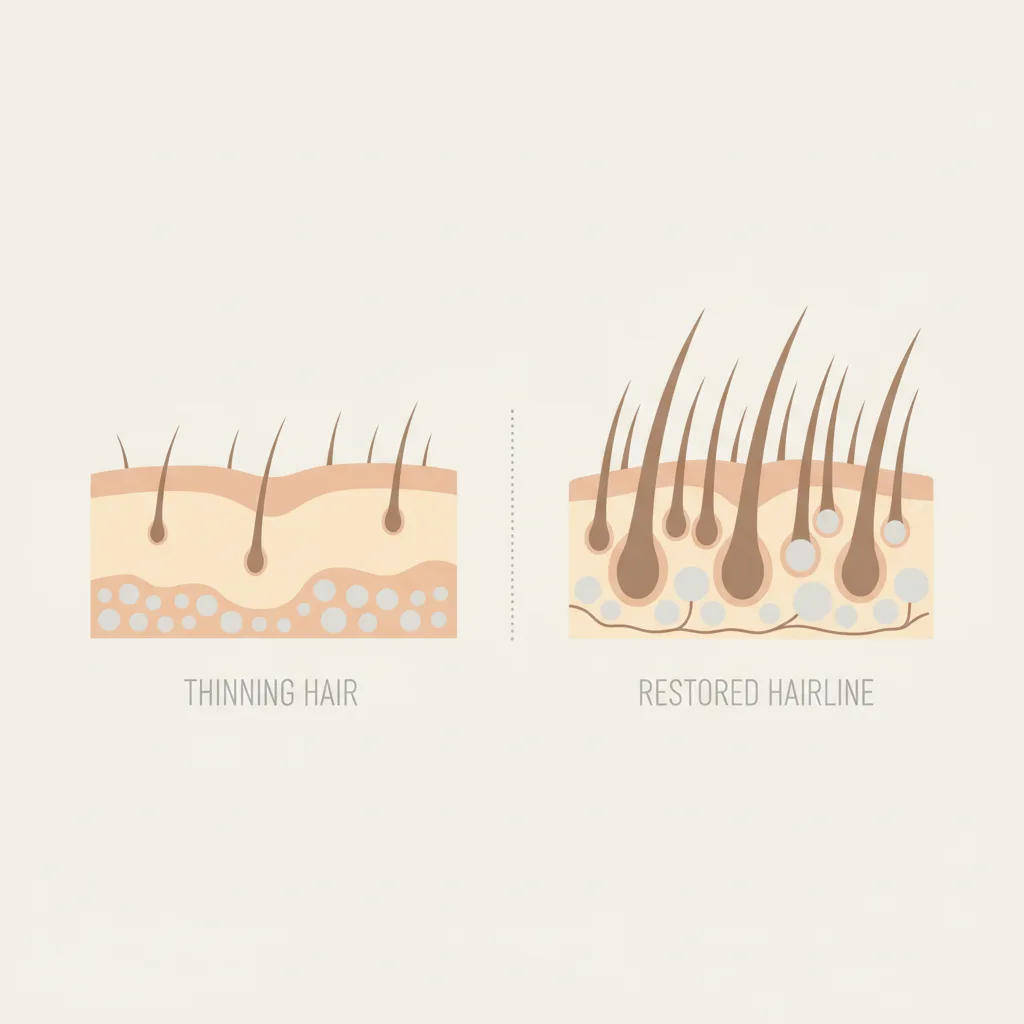
Two scalp cross-sections side by side, one with thinning follicles, the other with dense restored hairline.
Data proksi — tidak ada survei penyesalan langsung untuk keputusan ini. Tingkat diturunkan dari skor kepuasan dan data hambatan akses daripada pertanyaan yang langsung menanyakan tentang penyesalan. Lihat peringatan di bawah.

Penyesalan atas tindakan

Melakukan transplantasi rambut

5,0%

~5% tidak puas (rentang 2-15% berdasarkan kualitas klinik)

Pasien alopecia androgenetik pria menjalani transplantasi FUE, studi klinis

12 bulan pasca-prosedur

Penyesalan atas kelambanan

Hidup dengan kerontokan rambut (tanpa transplantasi)

25%

~25% (proksi: pria dengan AGA mengalami kesusahan psikologis sedang-hingga-berat dari rambut yang tidak dirawat)

Pria dengan alopecia androgenetik, survei multinasional

lintas-bagian; rambut yang sedang berlangsung

% menyesal dengan pilihan ini

inaction dominates — Tidak bertindak mendominasi — sebagian besar menyesali karena tidak bertindak.

Keputusan terkait

Keputusan yang serupa secara semantik — area yang sama, kompromi yang berbeda.

lifestyle

Tato

% menyesal dengan pilihan ini

Tindakan mendominasi

Penyesalan bertindak 1.6× lebih tinggi

Kesehatan

Tindik tubuh

% menyesal dengan pilihan ini

Tindakan mendominasi

Penyesalan bertindak 4.0× lebih tinggi

Kesehatan

Pembesaran payudara

% menyesal dengan pilihan ini

Seimbang

Hampir seimbang

Kesehatan

Korea: operasi kosmetik vs. menolak

% menyesal dengan pilihan ini

Tindakan mendominasi

Penyesalan bertindak 4.0× lebih tinggi

Kesehatan

Operasi kosmetik

% menyesal dengan pilihan ini

Seimbang

Hampir seimbang

Kesehatan

Brazilian Butt Lift (BBL)

% menyesal dengan pilihan ini

Seimbang

Hampir seimbang

Kesehatan

Kejar umur panjang vs terima penuaan

% menyesal dengan pilihan ini

Ketidakaktifan mendominasi

Penyesalan tidak bertindak 1.5× lebih tinggi

Kesehatan

Operasi mata LASIK

% menyesal dengan pilihan ini

Ketidakaktifan mendominasi

Penyesalan tidak bertindak 6.3× lebih tinggi

Among men who undergo follicular unit extraction (FUE) hair transplantation at accredited centers, clinical studies consistently find high satisfaction: a PMC-indexed study of 152 patients reported 98% good or satisfactory results at 12 months, with only 1.97% classified as poor outcomes. A larger study of 875 male AGA patients found satisfaction with appearance rising by over 30 points on standardized scales post-operatively. The picture darkens at lower-quality clinics — ISHRS census data indicate 5.4% of patients seek repair surgery from a different physician due to prior dissatisfaction, and independent reports place density-related disappointment at 10—15% where donor supply is inadequate or technique substandard. A conservative central estimate of ~5% action regret sits between the clinical-study floor and the repair-surgery rate.

On the inaction side, the psychological literature is unambiguous: untreated androgenetic alopecia carries a substantial and persistent quality-of-life burden. A multinational European study of 729 men with AGA found that 62% believed hair loss could diminish self-esteem — with 43% citing lost attractiveness, 42% baldness fears and 21% depression — yet fewer than 10% were actively pursuing treatment. A 2024 mixed-methods survey found men with AGA scoring life satisfaction at 5.70 against a national norm of 7.38 — a gap that persists for years. No published survey directly asks untreated men whether they regret not having a hair transplant, so the inaction rate (25%) is a proxy anchored to severe-distress prevalence among non-treating men.

The Gilovich inaction-dominates pattern is directionally plausible here: the decision not to pursue transplantation leaves an open counterfactual (“what if I had done it when my pattern was stabilizing?”) that the mind can sustain indefinitely, while the decision to pursue surgery — if performed at a qualified center with realistic expectations — tends to close the counterfactual with a positive outcome. The main caveat is selection: surgery patients in clinical studies are pre-screened for candidacy, whereas psychosocial burden studies sample all men with AGA regardless of transplant eligibility. The ~20-point gap in proxied rates should be read as directional evidence of inaction dominance, not a precise regret differential.

Sumber: tindakan

Buku besar klaim

Setiap angka di bawah ini adalah apa yang dilaporkan masing-masing sumber, dengan kutipan kata demi kata yang kami andalkan dan bagaimana kami sampai pada angka kami. Klik tautan mana saja untuk memverifikasi langsung.

1/2 sumber diverifikasi secara independen kata demi kata terhadap sumber terkutip

  1. [1] Journal of Pharmacy and Bioallied Sciences (PMC) — Clinical Outcome and Safety Profile of Patients Underwent Hair Transplantation Surgery by Follicular Unit Extraction Terverifikasi
    Clinical Outcome and Safety Profile of Patients Underwent Hair Transplantation Surgery by Follicular Unit Extraction
    Statistik
    98.03% of patients reported good or satisfactory results at 12 months; 1.97% reported poor results
    Kutipan
    “"Clients' remarks noted at the end on one year revealed 86.18% as good results, 11.84% as satisfactory and 1.97% as poor results." ”
    Data sumber dari
    2021-11-23
    Diakses
    2026-05-10
    Verifikasi
    Kutipan diambil ulang secara independen dan dikonfirmasi kata demi kata terhadap sumber terkutip selama audit pendasaran kami.
    Perhitungan
    Prospective study of 152 male androgenetic alopecia patients undergoing FUE transplantation (July 2017 -- February 2018). Satisfaction assessed at 12-month follow-up. "Poor results" (1.97%) is used as the floor for action-side dissatisfaction. We apply a 5% estimate rather than the 1.97% floor because: (a) this single-center study likely selects motivated patients with adequate donor hair; (b) ISHRS census data indicates 5.4% of patients seek repair surgery from a different physician due to prior dissatisfaction; (c) independent estimates place dissatisfaction from unmet density expectations at 10--15%. A 5% central estimate sits conservatively between the clinical study floor and ISHRS repair-seeking rate. "Poor results" is a technical outcome measure, not a direct regret question -- see caveats.
  2. [2] Journal of Cosmetic Dermatology — The relationship between self-esteem and hair transplantation satisfaction in male androgenetic alopecia patients
    The relationship between self-esteem and hair transplantation satisfaction in male androgenetic alopecia patients
    Statistik
    Satisfaction with appearance rose by 30.25 points post-operatively (p<0.05); self-esteem increased 1.56 points; n=875 completers
    Kutipan
    “"[Paraphrase from abstract -- full text paywalled] Among 875 male AGA patients completing 9-month follow-up, postoperative self-esteem scores increased significantly (RSES +1.56 points, p<0.05) and satisfaction with appearance rose by 30.25 points (p<0.05). Patients with low pre-operative self-esteem trended toward worse postoperative satisfaction." ”
    Data sumber dari
    2019-04-01
    Diakses
    2026-05-10
    Perhitungan
    Large-sample prospective study (n=875 completers of 1,106 enrolled). Used as secondary corroboration that the vast majority of patients experience meaningful satisfaction improvement. The finding that low pre-operative self-esteem predicts worse outcomes is relevant to interpreting aggregate satisfaction rates -- clinical populations screened by surgeons for realistic expectations will outperform unscreened estimates.

Sumber: tidak bertindak

Buku besar klaim

Setiap angka di bawah ini adalah apa yang dilaporkan masing-masing sumber, dengan kutipan kata demi kata yang kami andalkan dan bagaimana kami sampai pada angka kami. Klik tautan mana saja untuk memverifikasi langsung.

  1. [1] Current Medical Research and Opinion — The psychosocial impact of hair loss among men: a multinational European study
    The psychosocial impact of hair loss among men: a multinational European study
    Statistik
    62% of men believed hair loss could diminish self-esteem; 43% reported concern about lost attractiveness, 42% baldness fears, 21% depression; <10% were currently pursuing treatment (75% never had)
    Kutipan
    “"Among 1536 respondents, 729 (47%) reported hair loss. Over 70% considered hair important to their image and 62% believed hair loss could diminish self-esteem. Concerns included lost attractiveness (43%), baldness fears (42%), aging (37%), social impact (22%) and depression (21%). Fewer than 10% were currently pursuing treatment; 75% had never pursued it." ”
    Data sumber dari
    2005-10-01
    Diakses
    2026-05-10
    Perhitungan
    Telephone survey of 1,536 European men aged 18-45 (Germany, France, Italy, Spain, UK), of whom 729 (47%) reported experiencing hair loss. The study reports that 62% believed hair loss could diminish self-esteem, with 43% citing lost attractiveness, 42% baldness fears and 21% depression, while fewer than 10% were currently pursuing treatment. We use ~25% as a conservative proxy for persistent inaction regret among untreated men, anchored to the cluster of severe-distress responses (21% depression, plus the much larger share reporting diminished self-esteem) among the ~90% who are not pursuing treatment. This is a proxy -- the study does not directly ask whether men regret not getting a hair transplant. (Note: the widely cited "25% find hair loss extremely upsetting / 65% modest-to-moderate distress" figures originate from Cash 1992, J Am Acad Dermatol, not from this 2005 multinational survey; they are therefore not quoted here.)
  2. [2] Skin Health and Disease (Wiley / PMC) — The psychosocial impact of alopecia in men: A mixed-methods survey study
    The psychosocial impact of alopecia in men: A mixed-methods survey study
    Statistik
    56-57% of men with alopecia reported depleted confidence and wellbeing; life satisfaction 5.70 vs national norm 7.38
    Kutipan
    “"56--57% of participants reported depleted confidence and wellbeing related to their alopecia... Life satisfaction: 5.91 (AA) and 5.70 (AGA) vs. 7.38 national norm. Happiness: 5.79 (AA) and 5.50 (AGA) vs. 7.30 national norm." ”
    Data sumber dari
    2024-09-30
    Diakses
    2026-05-10
    Perhitungan
    Mixed-methods survey of men with alopecia areata and androgenetic alopecia (2024). Wellbeing scores substantially below national norms corroborate the persistent psychological burden captured in the 2005 European study. Used as corroborating evidence that untreated hair loss carries lasting quality-of-life cost, supporting a non-trivial inaction-regret proxy. Not a direct regret measure.

Catatan

Tidak ada tingkat yang berasal dari pertanyaan penyesalan langsung. Sisi tindakan (5%) adalah perkiraan konservatif yang diambil dari ukuran hasil klinis — "hasil buruk" pada 12 bulan dalam studi klinis yang diawasi (1,97%), tingkat operasi-perbaikan yang dilaporkan ISHRS (5,4%), dan perkiraan independen ketidakpuasan kepadatan (10-15%). Angka tersebut mewakili pasien yang memiliki pasokan donor yang memadai dan ekspektasi realistis; hasil di klinik berkualitas rendah atau tidak terakreditasi jauh lebih buruk. Sisi non-tindakan (25%) adalah proksi yang berjangkar pada proporsi pria yang melaporkan rambut mereka sebagai "sangat mengganggu" sambil tidak mengejar pengobatan (survei Eropa, n=729 dengan AGA). "Sangat mengganggu" tidak sinonim dengan "menyesali tidak mendapatkan transplantasi". Delta (-0,20) mencerminkan dominasi non-tindakan. Pola Gilovich dominasi-non-tindakan secara directional plausibel.

Data mentah: /api/decisions.json

Baru-baru ini dilihat di perangkat ini