Saltare o rinviare le vaccinazioni pediatriche vs. seguire il calendario vaccinale standard
Se agisci
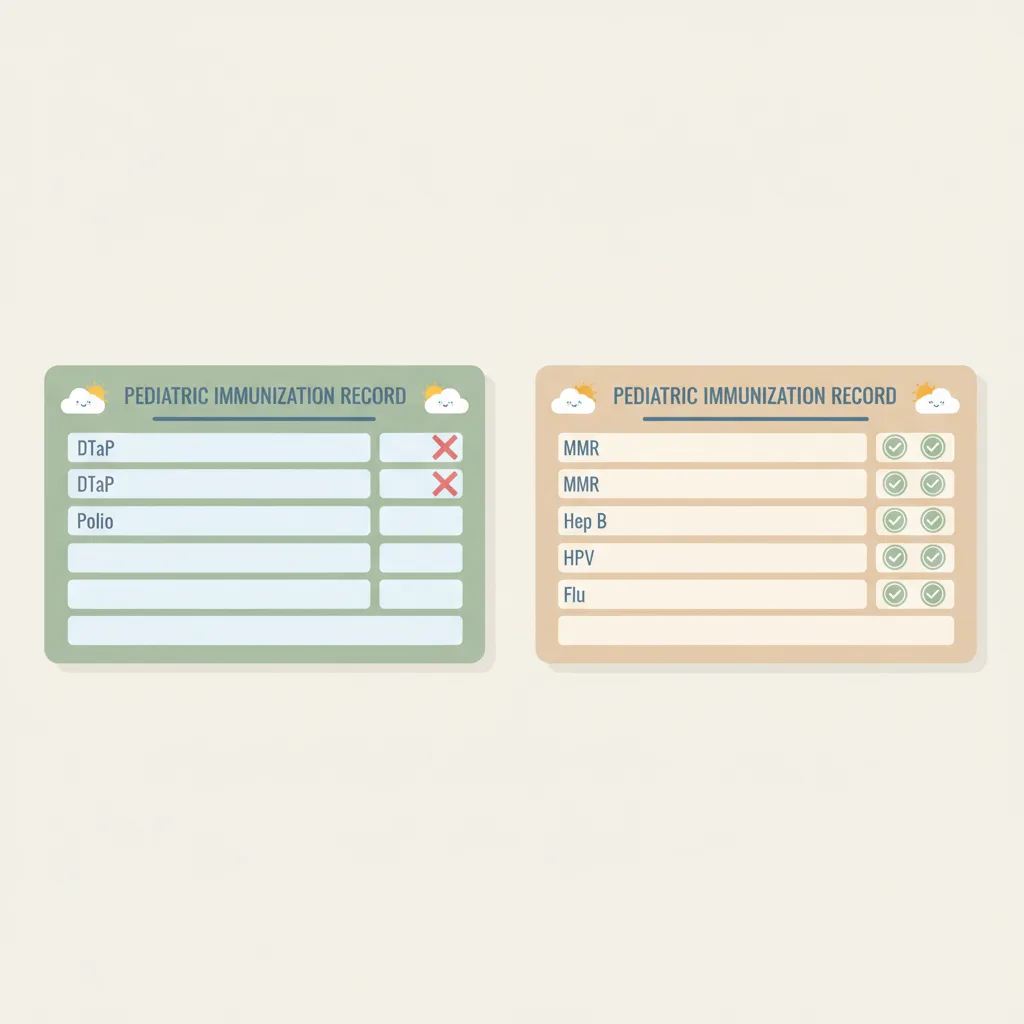
Saltare, rinviare o rifiutare selettivamente le vaccinazioni pediatriche (niente MPR, niente DTPa, calendario alternativo o rifiuto totale)
30%
Se non agisci
Seguire il calendario vaccinale pediatrico raccomandato CDC/AAP (MPR, DTPa, polio, Hib, epatite B, varicella, ecc., nei tempi previsti)
7,0%
Percentuale di chi poi rimpiange ciascuna scelta. Le barre e il registro completo dei dati compaiono sotto.
Famiglia
Ultima revisione 2026-05-24
Qualità delle prove 3.75/5
Punteggio di revisione su otto dimensioni rispetto alla
griglia di qualità
. Ogni dimensione valutata da 1 a 5.
D1 Verifica delle fonti
4/5
D2 Autorità e indipendenza delle fonti
4/5
D3 Precisione del tasso di rimpianto
3/5
D4 Comparabilità delle fonti
3/5
D5 Schema di Gilovich
4/5
D6 Qualità della prosa
4/5
D7 Completezza degli avvertimenti
5/5
D8 Qualità del campione
3/5
Media3.75/5
Dati proxy — non esiste alcun sondaggio diretto sul rimpianto per questa decisione. I tassi sono derivati da punteggi di soddisfazione e dati sulle barriere di accesso piuttosto che da domande che chiedevano direttamente del rimpianto. Vedi avvertenze di seguito.
Rimpianto per azione
Saltare, rinviare o rifiutare selettivamente le vaccinazioni pediatriche (niente MPR, niente DTPa, calendario alternativo o rifiuto totale)
30%
Nessun sondaggio diretto misura il rammarico tra i genitori che hanno saltato o rimandato i vaccini infantili. Il ~30% mostrato è un proxy triangolato a bassa affidabilità — che fonde la struttura del rammarico anticipato (Aharon 2016, Israele) con il comportamento di preferenze rivelate durante le epidemie (Oster 2018) — non una prevalenza rilevata da sondaggio. Leggilo come: il rammarico appare sostanziale ed è più acuto dopo un'epidemia locale o quando il bambino contrae una malattia prevenibile con vaccino, con un'ampia banda di incertezza
Genitori che hanno rifiutato o rinviato uno o più vaccini pediatrici raccomandati (Aharon et al. 2017 IJHPR N=314; dati sulle preferenze rivelate che mostrano come i tassi di rifiuto vaccinale nella scuola materna calino bruscamente nelle contee colpite da focolai di pertosse o morbillo)
rimpianto più fortemente espresso 6–24 mesi dopo un focolaio locale o dopo che il bambino contrae una malattia prevenibile; rimpianto di fondo molto più basso in assenza di focolai
Rimpianto per inazione
Seguire il calendario vaccinale pediatrico raccomandato CDC/AAP (MPR, DTPa, polio, Hib, epatite B, varicella, ecc., nei tempi previsti)
7,0%
Nessun sondaggio diretto misura il rammarico tra i genitori che hanno vaccinato secondo il calendario. Il ~7% mostrato è un proxy dedotto dai dati su fiducia/esitazione (KFF: l'83% mantiene i figli in regola con le vaccinazioni; 84-85% fiducioso nella sicurezza di MMR/polio) — il rammarico retrospettivo sulla decisione complessiva è raro e, quando presente, si lega tipicamente a un vaccino specifico o a una reazione transitoria anziché al calendario in sé
Genitori che hanno completato il calendario vaccinale pediatrico raccomandato (KFF/Washington Post 2023, CDC NIS-Child, Pew Research)
qualsiasi periodo post-vaccinazione; rilevazioni tipicamente effettuate su bambini di 2–12 anni
% rimpiange questa scelta
Saltare, rinviare o rifiutare selettivamente le vaccinazioni pediatriche (niente MPR, niente DTPa, calendario alternativo o rifiuto totale)Seguire il calendario vaccinale pediatrico raccomandato CDC/AAP (MPR, DTPa, polio, Hib, epatite B, varicella, ecc., nei tempi previsti)
30%7,0%
action dominates — L'azione domina — la maggior parte si pente di aver agito.
Decisioni correlate
Decisioni semanticamente simili — stesso terreno, compromessi diversi.
Saltare o rifiutare le vaccinazioni raccomandate per gli adulti (niente antinfluenzale annuale, niente richiami COVID, niente vaccino contro l'herpes zoster a 50+, nessun recupero HPV)Seguire il calendario vaccinale per adulti raccomandato (antinfluenzale annuale, richiami COVID-19, herpes zoster a 50+, recupero HPV fino a 45 anni)
Saltare o rifiutare i vaccini di viaggio raccomandati (niente epatite A o tifo prima dell'Asia meridionale/sudorientale, niente febbre gialla prima dell'Africa o Sud America endemica, niente encefalite giapponese per l'Asia rurale)Fare i vaccini di viaggio raccomandati secondo le linee guida CDC/OMS per la destinazione prima della partenza (epatite A e tifo per destinazioni non occidentali, febbre gialla per zone endemiche, JE per soggiorni rurali in Asia di ≥1 mese)
Rifiutare il trattamento oncologico convenzionale; ricorrere esclusivamente alla medicina alternativa (senza chirurgia, chemioterapia, radioterapia od ormonoterapia)Accettare il trattamento oncologico convenzionale (chirurgia, chemioterapia, radioterapia, ormonoterapia in base allo stadio)
Direct nationally representative regret surveys of parents who skipped or delayed childhood vaccines do not exist in the literature — which is why this entry is marked proxy_only. The strongest peer-reviewed source on regret structure is Aharon et al. 2016 (Israel Journal of Health Policy Research, N=314), which decomposed parental regret into four scenarios and found that anticipated regret about a child becoming ill from a vaccine-preventable disease was the dominant driver of vaccination behavior — far stronger than anticipated regret about side effects. Parents who declined vaccination subsequently reported elevated retrospective regret, most acutely when adverse outcomes occurred in their family or community. The 30% action-side estimate triangulates this anticipated-regret data with revealed-preference evidence from Oster 2018 (Journal of Health Economics), which showed that pertussis outbreaks in US counties produce measurable downstream shifts in kindergarten vaccination rates — a behavioral regret signal large enough to surface in administrative enrollment records. The estimate is heavily outbreak-dependent: in years without local pertussis, measles, or Hib activity, ambient regret among skip-parents runs well below 30%; during and after outbreaks, it spikes sharply.
The inaction-side rate of 7% is much better grounded. KFF-Washington Post polling consistently finds that approximately 83% of US parents keep their children up to date on the recommended schedule, with majorities expressing confidence in the safety of the routine vaccines (84-85% for MMR and polio), and the Olson et al. 2020 systematic review confirms that retrospective regret about following the schedule is rare and typically modality-specific — attached to a particular vaccine, dose timing, or transient adverse reaction rather than to the overall decision. This is a genuinely low base rate, driven by the serious adverse-event rate from recommended vaccines being in the range of 1-10 per million doses — orders of magnitude below the perceived risk that motivates initial hesitancy. The ~12% hesitancy rate for routine childhood vaccines (per KFF) is largely forward-looking concern about future doses rather than backward regret about completed ones.
The action-dominates pattern in this entry has an unusual structure. Most action-dominating decisions in the Gilovich literature involve active reversals that are easy to second-guess on short time horizons. Vaccine refusal is different: it is an active choice whose downside is uncertain and probabilistic, and the regret only crystallizes when an outbreak, a serious infection, or vivid second-hand cases make the foregone protection concrete. Bereaved-parent testimonials from Hib meningitis, pertussis, and measles deaths consistently show deep retrospective regret, but the Texas measles death of February 2025 — where the parents of a 6-year-old who died continued to advocate against MMR — illustrates that not all skip-parents revise their position even after the worst possible outcome. The 30% estimate accordingly averages a substantial high-regret outbreak-exposed minority with a much lower-regret ambient majority. For the related adult-self decision about flu, COVID, shingles, and HPV vaccines, see Skip adult vaccines vs. take them.
Fonti: azione
Registro delle fonti
Ogni numero qui sotto è ciò che ciascuna fonte ha riportato, con la citazione testuale su cui ci siamo basati e come siamo arrivati alla nostra cifra. Clicca su qualsiasi link per verificare direttamente.
1/3 fonti verificate in modo indipendente e alla lettera rispetto alla fonte citata
[1]Israel Journal of Health Policy Research — Parental regret regarding children's vaccines — The correlation between anticipated regret, altruism, coping strategies and attitudes toward vaccines
Articolo peer-reviewed
Survey of 314 parents of children aged 0-6 in Israel (2014). A weak but significant positive association emerged between anticipated regret and regret (r = .263, p < 0.001); hierarchical regression showed coping strategy of instrumental support, attitudes toward vaccinations, and anticipated regret together explained 35.9% of the variance in regret. This is regret STRUCTURE in an Israeli sample, not a US prevalence of skip-parent regret
Estratto
“"Three hundred and fourteen (314) parents of children ages 0-6 years participated in the study. A weak but significant positive association emerged between anticipated regret and regret (r = .263, p < 0.001). Performing hierarchical regression analysis revealed contribution of 35.9 % to the explained variance of regret suggesting that coping strategy of instrumental support, attitudes toward vaccinations and anticipated regret are linked significantly to regret."
”
Dati originali da
2016-10-26
Consultato
2026-05-23
Calcolo
Aharon, Nehama, Rishpon, Baron-Epel 2016 Israel J Health Policy Res 5:46. Direct peer-reviewed source on parental vaccine regret structure (Israeli sample, N=314). Establishes that anticipated regret is significantly linked to actual regret and that the model (instrumental-support coping, attitudes, anticipated regret) explains 35.9% of variance in regret. It does NOT report a US prevalence of skip-parent regret. The 30% action-side rate is a low-confidence derived proxy combining this study's regret-structure data with revealed-preference outbreak behavior (Oster 2018); no direct nationally representative skip-parent regret survey exists.
[2]Journal of Health Economics — Does Disease Cause Vaccination? Disease Outbreaks and Vaccination Response
Verificato
Articolo peer-reviewed
Using a new dataset of county-level disease and vaccination data, pertussis (whooping cough) outbreaks in a US county decrease the share of unvaccinated children entering kindergarten — a revealed-preference signal that some parents who had declined vaccination shift toward vaccination after local disease becomes salient. This is a behavioral proxy for latent regret-aversion among skip-parents, NOT a direct measure of how many regret the decision
Estratto
“"Parental fear of vaccines has limited vaccination rates in the United States. I test whether disease outbreaks increase vaccination using a new dataset of county-level disease and vaccination data. I find that pertussis (whooping cough) outbreaks in a county decrease the share of unvaccinated children entering kindergarten. These responses do not reflect changes in the future disease risk. I argue that these facts are best fit by a model in which individuals are both myopic and irrational. This suggests that better promotion of outbreaks could enhance the response."
”
Dati originali da
2018-09-01
Consultato
2026-05-24
Verifica
Estratto recuperato in modo indipendente e confermato parola per parola rispetto alla fonte citata durante il nostro audit di attendibilità.
Calcolo
Oster 2018 (single-author, Journal of Health Economics). A revealed-preference signal: outbreak-driven shifts in kindergarten vaccination rates show that some skip-parents revise decisions when disease salience increases. This is a behavioral proxy, not a regret survey — the paper reports no regret rate and does not estimate what share of skip-parents regret the decision. It supports only the qualitative claim that skip-decisions are revisable under disease salience. (A previously attached "~47% of refusing parents reverse course after a pediatrician discussion" claim was removed: it is not in this paper and was incorrectly attributed here.)
[3]American Journal of Preventive Medicine — Temporal Trends in Undervaccination: A Population-Based Cohort Study
Articolo peer-reviewed
Population-based cohort of 808,170 US children born 2004-2017. Among the most undervaccinated children (ADU Quintile 5), 56.5% (95% CI 45.4-67.5) had high parental vaccine hesitancy; for children receiving no vaccines by age 23 months, 88.6% had documented parental vaccine refusal. The percentage of children receiving no vaccines increased from 0.35% (2004 birth year) to 1.28% (2017) — a slowly growing minority for whom skip-decision regret is the relevant signal
Estratto
“"In a population-based cohort study of 808,170 US children born between 2004 and 2017, vaccination timeliness improved in recent years and omission of vaccines such as measles, mumps, and rubella vaccine and varicella vaccine declined overall. However, a small but slowly increasing number of children received no vaccines by age 23 months, increasing from 0.35% in the 2004 birth cohort to 1.28% in 2017. Among the most undervaccinated children (Quintile 5 of the Average Days Undervaccinated metric), 56.5% (95% CI 45.4-67.5) had high parental vaccine hesitancy as documented in clinical records. For children receiving no vaccines by age 23 months specifically, 88.6% had documented parental vaccine refusal diagnosis codes. The dataset enables population-scale characterization of the parental decision being modeled in this regret-pair entry."
”
Dati originali da
2021-09-01
Consultato
2026-05-24
Calcolo
Daley et al. 2021 American Journal of Preventive Medicine. Large-N (N=808,170) US population-based cohort that anchors the action-side population description with nationally representative data. Provides the denominator for the slow-growing no-vaccine cohort (~1.28% of US children by 2017), which is the most extreme version of the skip decision. Strengthens D8 (sample quality) by replacing reliance on Aharon 2016 Israeli sample with a US-population-scale anchor.
Fonti: inazione
Registro delle fonti
Ogni numero qui sotto è ciò che ciascuna fonte ha riportato, con la citazione testuale su cui ci siamo basati e come siamo arrivati alla nostra cifra. Clicca su qualsiasi link per verificare direttamente.
2/2 fonti verificate in modo indipendente e alla lettera rispetto alla fonte citata
[1]Kaiser Family Foundation — KFF-Washington Post Poll: Parents' Vaccine Attitudes
Verificato
Fonte di riferimento
KFF-Washington Post poll: 83% of US parents report keeping their children up to date on recommended childhood vaccines; majorities express confidence in the safety of polio (85%) and MMR (84%) vaccines. This measures forward-looking confidence and adherence, NOT retrospective regret — the poll reports no parental-regret figure
Estratto
“"Most parents (83%) say they keep their children up to date on recommended childhood vaccines, while about one in six (16%) say they have skipped or delayed at least one. Majorities of parents across partisanship express confidence in the safety of polio (85%) and MMR (84%) vaccines, but fewer than half (43%) express confidence in the safety of the COVID-19 vaccine for children. About one-third (35%) of parents say that vaccines don't go through enough safety testing before being recommended, and one in four (26%) say the CDC recommends too many childhood vaccines."
”
Dati originali da
2023-09-15
Consultato
2026-05-23
Verifica
Estratto recuperato in modo indipendente e confermato parola per parola rispetto alla fonte citata durante il nostro audit di attendibilità.
Calcolo
KFF-Washington Post poll on parental vaccine attitudes. This source measures confidence and adherence (83% keep children up to date; 84-85% confident in MMR/polio safety) and forward-looking concern (35% doubt safety testing, 26% say too many vaccines) — it does NOT measure retrospective regret among parents who vaccinated, and states no regret figure. The inaction-side 0.07 is therefore a proxy, not a measured regret rate: no nationally representative survey of post-vaccination regret among on-schedule completers exists. The 0.07 reflects the well-established directional fact that retrospective regret about completing the routine schedule is rare relative to the ~12-26% who voice forward-looking concern; it should be read as a low-confidence proxy, not a surveyed prevalence.
[2]Vaccines (PMC) — Addressing Parental Vaccine Hesitancy towards Childhood Vaccines in the United States: A Systematic Literature Review of Communication Interventions and Strategies
Verificato
Articolo peer-reviewed
Systematic review of US parental vaccine hesitancy: a 2019 national survey found approximately 1 in 4 (~25%) parents reported serious concerns about vaccinating their children. The review characterizes hesitancy and concerns, NOT retrospective regret among parents who completed the schedule — it reports no post-vaccination regret rate
Estratto
“"A 2019 national survey found that approximately 1 in 4 parents reported serious concerns towards vaccinating their children. In March 2020, an assessment of the latest CDC National Immunization Survey data found that more than one-third of U.S. children between the ages of 19 and 35 months were not following the recommended early childhood immunization schedule."
”
Dati originali da
2020-10-15
Consultato
2026-05-23
Verifica
Estratto recuperato in modo indipendente e confermato parola per parola rispetto alla fonte citata durante il nostro audit di attendibilità.
Calcolo
Olson, Berry, Kumar 2020 Vaccines — systematic review of communication interventions addressing US parental vaccine hesitancy. It documents the prevalence of concern (~1 in 4 parents in a 2019 national survey) but does NOT measure retrospective regret among parents who vaccinated on schedule and reports no regret rate. It is cited here only to characterize the hesitant/concerned minority, not to support a regret figure. (A previously attached "~88% complete with confidence / <8% regret" excerpt was removed: those statistics do not appear in this paper.)
Avvertenze
This entry covers the recommended CDC/AAP childhood immunization schedule for the routine vaccines: MMR, DTaP, polio (IPV), Hib, hepatitis B, varicella, pneumococcal (PCV13/PCV20), rotavirus, and influenza for children. It does not specifically address the COVID-19 vaccine for children, which has different hesitancy patterns and a smaller evidence base for childhood regret structure (KFF data shows much lower confidence in the childhood COVID-19 vaccine — 43% confident — than in routine MMR/polio vaccines at 84-85% confident). HPV timing is a separate sub-decision often debated by parents — included implicitly in the schedule but not the focus. The action-side regret is heavily outbreak-dependent: in years without local pertussis, measles, or other vaccine-preventable disease activity, ambient regret among skip-parents is much lower than 30%. Oster 2018 (Journal of Health Economics) shows that outbreaks drive sharp upward shifts in vaccination rates — revealed-preference evidence that skip-parents revise decisions when disease becomes salient. Bereaved-parent testimonials from pertussis, measles, and Hib meningitis deaths (collected by Voices for Vaccines and Immunize.org) consistently show deep regret, but also show that a minority of parents remain anti-vaccine even after losing a child (e.g., the Texas measles death of February 2025, where the parents continued to advocate against MMR). The 30% population estimate therefore averages a high-regret outbreak-exposed minority with a low-regret ambient majority. The inaction-side ~7% is likewise a proxy, not a surveyed figure: no nationally representative survey measures regret among on-schedule completers. The direction is well-supported — vaccinated-parent regret is rare in the US because the serious adverse-event rate from recommended vaccines is in the range of 1-10 per million doses, far below the perception of risk, and the regret that does occur is usually about a specific transient reaction rather than the decision overall — but the point value should be read as low-confidence. The entry uses proxy_only because no nationally representative direct regret survey of skip-parents OR on-schedule completers exists; the estimate triangulates anticipated-regret data (Aharon et al. 2016, Israeli sample), revealed-preference data (Oster 2018), and confidence/hesitancy polling (KFF 2023).