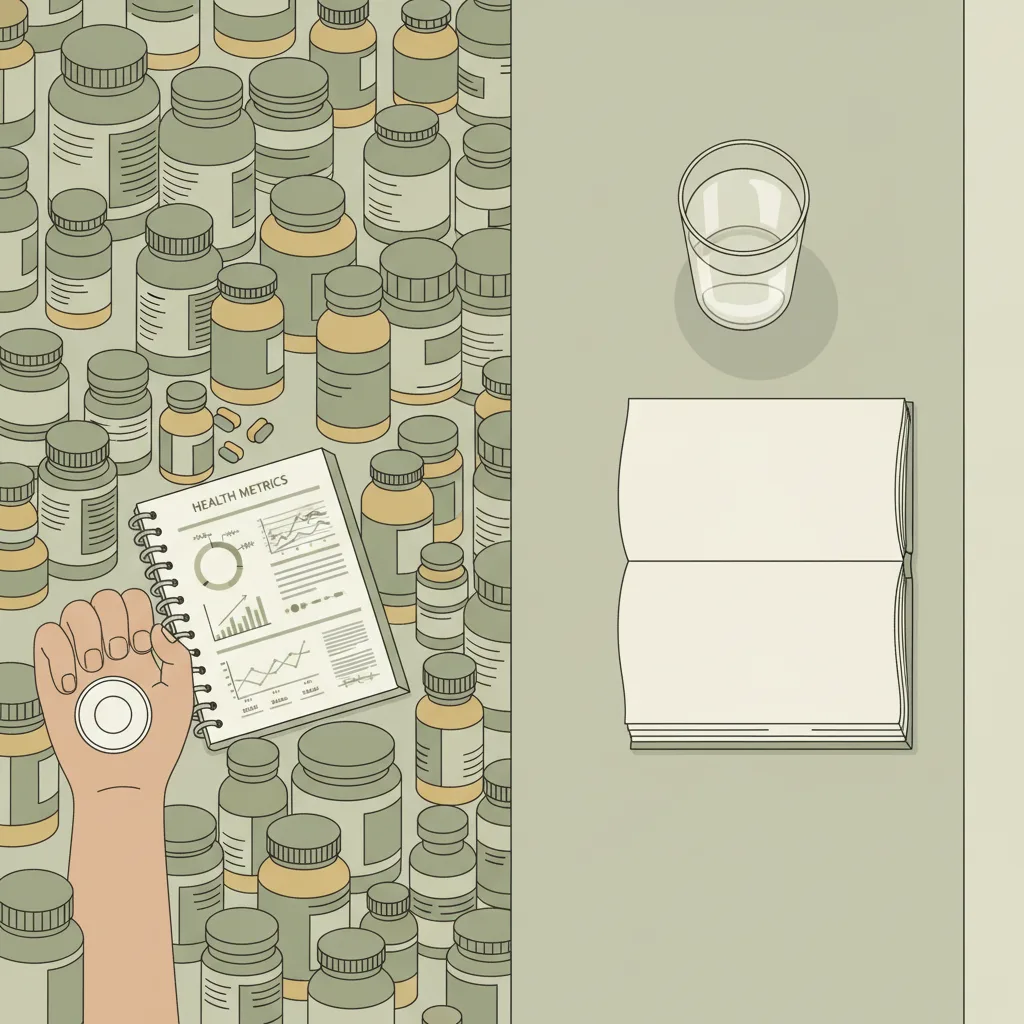
Among 449 young breast cancer survivors, 25.2% regretted inactions
specifically — not seeking information sooner, not getting second opinions,
not being more proactive about their own care (Friedman et al. 2011). That
figure is the inaction-specific rate: 42.5% of the sample expressed any
regret, and of those, 59.2% pointed to inactions (42.5% × 59.2% = 25.2%).
Brewer et al.’s meta-analysis of 81 studies (N = 45,618) across vaccination,
screening, and other health domains confirmed the direction: anticipated
inaction regret correlated with actual health behavior at r = 0.29 and with
intentions at r = 0.52.
On the action side, a meta-analysis of 14 studies covering 17,883 localized
prostate cancer patients found that 20% reported significant decision
regret about their treatment choice, measured with the validated Decision
Regret Scale (Fanshawe et al. 2023). The regret clusters around side effects —
sexual dysfunction, urinary incontinence, bowel problems — that follow
aggressive treatment of cancers that may never have become life-threatening.
Active surveillance patients reported the lowest regret (13%), while surgery
and radiotherapy patients hovered near 18–19%. A separate 15-year follow-up
of 934 men in the population-based Prostate Cancer Outcomes Study put the
overall figure at 14.6% (Hoffman et al. 2017). This is the best-quantified
cost of early diagnosis: roughly one in five to one in seven patients wish,
in retrospect, they had chosen differently.
The gap is narrower than it first appears. Prostate cancer screening is the
single most contested domain in the overdiagnosis debate — roughly 60% of
PSA-detected cancers may be overdiagnosed — so the 20% action-regret
figure is arguably an upper bound for early diagnosis in general. The
corrected inaction-specific rate (25.2%, not the previously stated 42.5%)
comes from a sample of young women with an aggressive cancer subtype, where
the consequences of delay are stark and visible. The revised delta (-0.052)
indicates a slight tilt toward inaction regret rather than a dramatic 2:1
ratio. For genuinely indolent conditions detected only by screening, the
calculus may reverse entirely. The directional finding — that health
inaction generates more long-term regret than health action — is supported
across the literature, but the magnitude depends heavily on what you are
being screened for and how likely the disease is to matter.
Bronnen: handelen
Bronnenverantwoording
Elk getal hieronder is wat elke bron rapporteerde, met het letterlijke citaat waarop we ons baseerden en hoe we tot ons cijfer kwamen. Klik op een link om rechtstreeks te verifiëren.
3/3 bronnen onafhankelijk woordelijk geverifieerd tegenover de geciteerde bron
[1]European Urology Open Science — Decision Regret in Patients with Localised Prostate Cancer: A Systematic Review and Meta-analysis
Geverifieerd
Vakgenoten-beoordeeld
Pooled 20% (95% CI 16–23%) of patients reported significant decision regret across 14 studies
Fragment
“"Significant decision regret was present in a pooled 20% (95% confidence interval 16–23) of patients across 14 studies and 17,883 patients. Regret was lower in active surveillance (13%), with little difference between radiotherapy (19%) and prostatectomy (18%)."
”
Brongegevens van
2023-03-01
Geraadpleegd
2026-04-26
Verificatie
Fragment onafhankelijk opnieuw opgehaald en woord voor woord bevestigd tegenover de geciteerde bron tijdens onze onderbouwingsaudit.
Berekening
Fanshawe et al. 2023 meta-analysis of 14 studies using the Decision Regret Scale. The 20% pooled estimate captures regret from overdiagnosis, overtreatment, and side effects (sexual dysfunction, urinary incontinence) following early detection via PSA screening. Used as proxy for the broader cost of early diagnosis and aggressive treatment.
[2]Journal of Clinical Oncology — Treatment Decision Regret Among Long-Term Survivors of Localized Prostate Cancer: Results From the Prostate Cancer Outcomes Study
Geverifieerd
Vakgenoten-beoordeeld
14.6% expressed treatment decision regret at 15 years
Fragment
“"Overall, 14.6% expressed treatment decision regret: 8.2% of those whose disease was managed conservatively, 15.0% of those who received surgery, and 16.6% of those who underwent radiotherapy."
”
Brongegevens van
2017-07-12
Geraadpleegd
2026-04-26
Verificatie
Fragment onafhankelijk opnieuw opgehaald en woord voor woord bevestigd tegenover de geciteerde bron tijdens onze onderbouwingsaudit.
Berekening
Hoffman et al. 2017. Prostate Cancer Outcomes Study, population-based cohort of 934 men followed for 15 years. The 14.6% overall figure is lower than the meta-analytic pooled 20%, likely because the longer follow-up selects survivors who have had time to rationalize their decision.
[3]Reviews in Urology / Andriole et al. — Overdiagnosis of Prostate Cancer
Geverifieerd
Vakgenoten-beoordeeld
Using ERSPC (European Randomized Study of Screening for Prostate Cancer) data, Welch and Black estimated that 60% of PSA screen-detected prostate cancers were overdiagnosed
Fragment
“"Using ERSPC data, Welch and Black estimated that 60% of such screen-detected cancers were overdiagnosed."
”
Brongegevens van
2012-09-01
Geraadpleegd
2026-07-03
Verificatie
Fragment onafhankelijk opnieuw opgehaald en woord voor woord bevestigd tegenover de geciteerde bron tijdens onze onderbouwingsaudit.
Berekening
Andriole GL et al., Reviews in Urology 2012;14(3-4) (PMC3540879), reviewing Welch HG & Black WC, "Overdiagnosis in Cancer," J Natl Cancer Inst 2010;102(9):605-613. The 60% figure is the upper end of published PSA-detected prostate cancer overdiagnosis estimates (other estimates in the literature range from ~20% to 50%); cited here as context for why the 20% action-side decision-regret figure (Fanshawe et al. 2023) is plausibly an upper bound rather than an underestimate for early diagnosis in general. Not used in regret_rate arithmetic.
Bronnen: niet handelen
Bronnenverantwoording
Elk getal hieronder is wat elke bron rapporteerde, met het letterlijke citaat waarop we ons baseerden en hoe we tot ons cijfer kwamen. Klik op een link om rechtstreeks te verifiëren.
[1]Psycho-Oncology / PMC — Post-Treatment Regret Among Young Breast Cancer Survivors
Vakgenoten-beoordeeld
42.5% of 449 young breast cancer survivors expressed regret; of those, 59.2% regretted inactions
Fragment
“"The majority (59.2%) of participants who expressed regret did so over inactions ('I wish I had…', 'I would have…') as opposed to actions. Many women wished they had been more proactive in their care with respect to seeking information and having a better understanding of long-term effects and side effects of their treatment options."
”
Brongegevens van
2011-01-01
Geraadpleegd
2026-04-26
Berekening
Friedman et al. 2011. Study of 449 young breast cancer survivors. 42.5% (191 of 449) expressed any regret. Of those who expressed regret, 59.2% regretted inactions (delayed screening, not seeking information sooner) rather than actions. Inaction-specific rate: 42.5% × 59.2% = 25.2% of the full sample regretted inactions. The prior entry incorrectly used 42.5% (total regret) as the inaction rate; the correct inaction-specific figure is 25.2%.
[2]Health Psychology — Anticipated Regret and Health Behavior: A Meta-Analysis
Vakgenoten-beoordeeld
Anticipated inaction regret predicted health behavior (r = 0.29, p < .001) and intentions (r = 0.52) across 81 studies
Fragment
“"Greater anticipated regret from not engaging in a behavior (i.e., inaction regret) predicted stronger intentions and behavior. Anticipated inaction regret has a stronger and more stable association with health behavior than previously thought."
”
Brongegevens van
2016-09-01
Geraadpleegd
2026-04-26
Berekening
Brewer et al. 2016 meta-analysis of 81 studies (N = 45,618). Demonstrates that across vaccination, screening, and other health domains, anticipated inaction regret consistently exceeds action regret. The correlation with actual health behavior is r = 0.29 (not r = 0.52, which is the correlation with intentions). The r = 0.29 figure is the relevant behavioral predictor; r = 0.52 applies to intention formation only. Both are statistically significant (p < .001).
Kanttekeningen
De actie- en inactiecijfers komen uit verschillende klinische populaties: een meta-analyse van gelokaliseerde prostaatkanker-patiënten (vooral oudere mannen) versus een studie van jonge borstkanker-overlevers. Het 20% actie-spijt-cijfer is specifiek voor behandelingsbeslissing-spijt na PSA-gedetecteerde kanker — het overdrijft waarschijnlijk spijt voor vroege diagnose in het algemeen, aangezien prostaatkanker-screening het meest betwiste gebied is van het overdiagnose-debat. Het inactie-specifieke percentage (25,2%) is afgeleid van Friedman et al.: 42,5% van de steekproef uitte enige spijt, en 59,2% van die spijt ging over inacties (42,5% × 59,2% = 25,2%). De vorige vermelding gebruikte ten onrechte het totaal van 42,5% als het inactie-percentage. De Brewer-meta-analyse toont dat verwachte inactie-spijt correleert met daadwerkelijk gezondheidsgedrag bij r = 0,29 (niet r = 0,50, wat de intenties-correlatie is), en biedt convergerend bewijs dat de richting robuust is over gezondheidsgedragingen. De herziene delta (−0,052) suggereert dat de kloof tussen actie- en inactie-spijt smaller is dan eerder gesteld — vroege diagnose draagt significante spijt-kosten (overbehandeling-bijwerkingen) die gedeeltelijk inactie-spijt compenseren. Mensen met werkelijk indolente aandoeningen — alleen gedetecteerd vanwege screening — kunnen netto schade ervaren van vroege diagnose zonder een corresponderende inactie-spijt-contrafactueel.