Відмова від конвенційного лікування раку на користь альтернативної медицини проти прийняття стандартної онкології
Якщо ви дієте
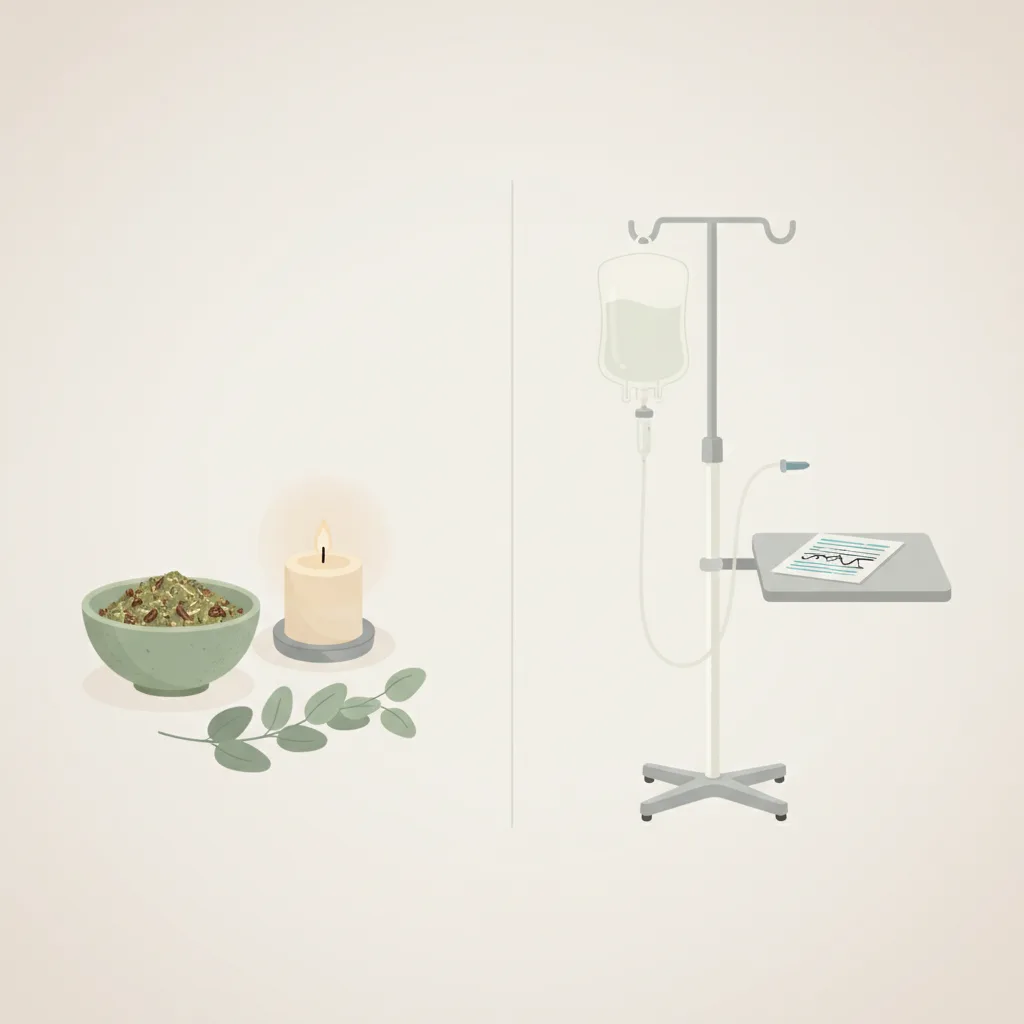
Відмовитися від конвенційного лікування раку; використовувати винятково альтернативну медицину (без операції, хіміотерапії, променевої або гормональної терапії)
24%
Якщо ви не дієте
Прийняти конвенційне лікування раку (операція, хіміотерапія, променева, гормональна терапія відповідно до стадії)
9,1%
Відсоток тих, хто згодом шкодує про кожен вибір. Стовпчики та повний реєстр показані нижче.
Здоров’я
Остання перевірка 2026-05-24
Якість доказів 3.88/5
Восьмивимірна оцінка перевірки за
рубрикою якості
. Кожен вимір оцінений 1–5.
D1 Перевірка джерел
4/5
D2 Авторитет та незалежність джерела
4/5
D3 Точність частоти жалю
3/5
D4 Порівнянність джерел
3/5
D5 Шаблон Гіловича
4/5
D6 Якість прози
4/5
D7 Повнота застережень
5/5
D8 Якість вибірки
4/5
Середнє3.88/5
Замінні дані — для цього рішення не існує прямого дослідження жалю. Показники отримані з оцінок задоволеності та даних про бар'єри доступу, а не з питань, що безпосередньо стосувалися жалю. Дивіться застереження нижче.
Жаль за дію
Відмовитися від конвенційного лікування раку; використовувати винятково альтернативну медицину (без операції, хіміотерапії, променевої або гормональної терапії)
24%
~65% пацієнтів (чи родичів, які втратили близьких), які при виліковному раку обрали лише альтернативну медицину, висловили жаль — найчастіше після прогресування хвороби, коли конвенційне лікування було розпочато пізно або взагалі не розпочато
Дорослі з неметастатичним раком молочної залози, простати, легень або товстої кишки, які обрали альтернативну медицину без конвенційного лікування раку (Johnson та ін. 2018 JNCI N=281)
жаль зазвичай з'являється через 12–36 місяців після діагнозу з прогресуванням хвороби; жаль родичів, які втратили близьких, виміряно через 6–12 місяців після смерті
Жаль за бездіяльність
Прийняти конвенційне лікування раку (операція, хіміотерапія, променева, гормональна терапія відповідно до стадії)
9,1%
~21,5% тих, хто вижив після раку та пройшов конвенційне лікування, шкодують саме про компонент хіміо-/променевої терапії; 42,5% шкодують про якийсь аспект лікування загалом (найчастіше про обсяг операції чи вибір реконструкції), але лише невелика меншість шкодує про саме рішення пройти конвенційне лікування
449 молодих пацієнток, які вижили після раку молочної залози (≤50 років на момент діагнозу), опитаних проспективно під час лікування та повторно через 5 років після діагнозу (Fernandes-Taylor та Bloom 2011 Psychooncology); екстраполяція на ширші популяції тих, хто вижив, підкріплена Lavery та Clarke 2003 Cancer Nursing N=176 і подальшими реплікаціями
жаль виміряно через 5 років після діагнозу (проспективний поздовжній дизайн)
% шкодує про цей вибір
Відмовитися від конвенційного лікування раку; використовувати винятково альтернативну медицину (без операції, хіміотерапії, променевої або гормональної терапії)Прийняти конвенційне лікування раку (операція, хіміотерапія, променева, гормональна терапія відповідно до стадії)
24%9,1%
action dominates — Дія переважає — більшість шкодує, що діяла.
Пов’язані рішення
Семантично близькі рішення — та сама сфера, інші компроміси.
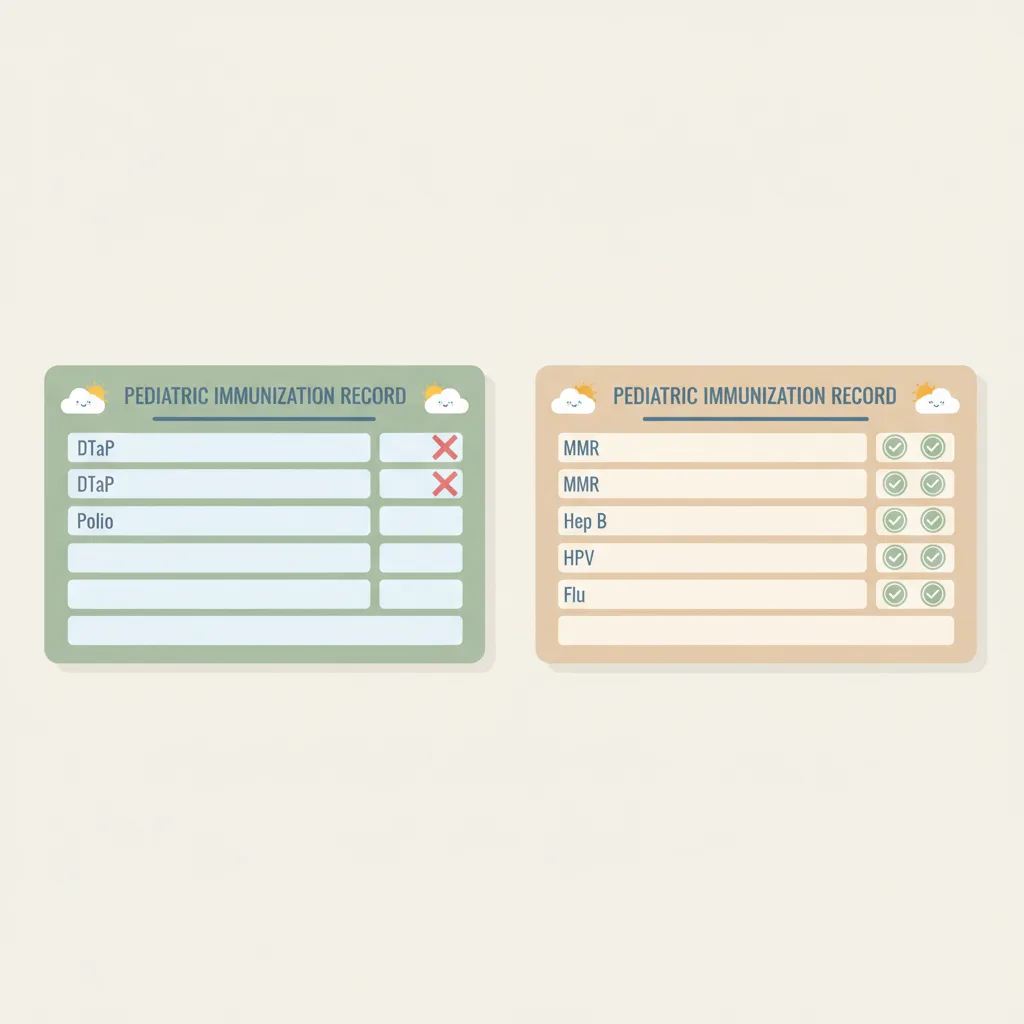
Пропустити, відстрочити або вибірково відмовитися від дитячих щеплень (без MMR, без DTaP, альтернативний графік або повна відмова)Дотримуватися рекомендованого календаря імунізації CDC/AAP для дітей (MMR, DTaP, поліомієліт, Hib, гепатит B, вітряна віспа тощо за графіком)
Пропустити або відмовитися від рекомендованих щеплень для дорослих (без щорічного щеплення від грипу, без бустерів COVID, без щеплення від оперізувального лишая після 50, без надолужувального HPV)Дотримуватися рекомендованого календаря щеплень для дорослих (щорічний грип, бустери COVID-19, оперізувальний лишай після 50, надолужувальний HPV до 45 років)
The Yale group’s two 2018 papers (Johnson et al., JNCI January 2018 and JAMA Oncology July 2018) form the spine of evidence on what happens when patients with curable cancer reject conventional treatment in favor of alternative medicine. In the JNCI study, 280 patients with non-metastatic breast, prostate, lung, or colorectal cancer who chose alternative medicine without any conventional cancer treatment had a 5-year overall survival of 54.7% — compared with 78.3% for propensity-matched patients receiving standard oncological care. The mortality hazard ratio was 2.50, and the disparity was largest for breast cancer (HR 5.68) and colorectal cancer (HR 4.57). The follow-up JAMA Oncology paper unpacked the mechanism: complementary medicine users refused conventional treatments at dramatically higher rates (53% refused radiotherapy, 34% refused chemotherapy, 7% refused surgery), and once refusal was controlled for, the mortality association disappeared. The death risk was not from the alternative therapies themselves — it was from the refusal of effective treatment they enabled.
Direct regret data for patients who choose alt-only is structurally limited by survivorship bias. Stub et al. 2023 (The Oncologist) interviewed seven CAM-only cancer patients at least one year post-decision and found that none expressed regret — but that sample, by construction, excludes the patients who died of progressive disease and cannot be asked. No published source reports a regret percentage for this population, so this entry does not claim one. What is measurable is the mortality cost: the action-side figure is a floor proxy anchored to the Johnson et al. survival gap — 23.6 percentage points of excess 5-year mortality (54.7% vs. 78.3%), roughly a quarter of alt-only patients who died within five years and would likely have survived under conventional care. That is a mortality rate, not a surveyed regret rate, and it almost certainly understates lived regret among the deceased and their families, who cannot self-report. The inaction-side estimate is grounded in the much larger survivor literature: in the Fernandes-Taylor & Bloom cohort, 42.5% of the 449 survivors regretted some aspect of treatment, and of those who regretted anything, 21.5% named the chemotherapy/radiation component — which works out to about 9% of all survivors regretting that component specifically. The regret structure there is dominated by side-effect intensity, modality choice (mastectomy vs. lumpectomy), and sequencing, not by regret about having pursued conventional care at all. Only a small minority regret having accepted conventional treatment in the first place; in that cohort the majority of survivor regret (59.2%) was over inactions — things they wished they had done — rather than the treatment they underwent.
The action-dominates pattern is unusually clean in this entry because the survival delta is large, well-documented, and mechanistically explained. It does not extend to every interaction between complementary and conventional medicine. Patients who use complementary therapies alongside conventional treatment (acupuncture for chemotherapy-induced nausea, mindfulness for cancer-related fatigue, physical therapy and nutrition support during recovery) are a distinct population — Johnson et al. 2018 JAMA Oncology showed that the mortality risk is mediated entirely by refusal, not by complementary modalities themselves. The entry addresses the specific decision to reject conventional cancer treatment entirely in favor of alternative medicine alone. For metastatic disease where curative treatment is no longer the goal, the relevant decision is intensity of end-of-life care and early palliative integration — covered in Aggressive chemo vs. early palliative. For non-metastatic curable cancer, the evidence base for accepting conventional treatment is among the strongest in modern oncology, and the regret asymmetry reflects that.
Джерела: дія
Реєстр тверджень
Кожне число нижче — це те, що повідомило джерело, з дослівною цитатою, на яку ми спиралися, та тим, як ми дійшли до нашої цифри. Натисніть на посилання, щоб перевірити самостійно.
[1]JNCI: Journal of the National Cancer Institute — Use of Alternative Medicine for Cancer and Its Impact on Survival
Рецензована публікація
Patients who chose alternative medicine alone for non-metastatic curable cancer had a hazard ratio for death of 2.50 (95% CI 1.88-3.27) vs. conventional treatment; 5-year overall survival was 54.7% vs. 78.3% for conventional
Витяг
“"Among 840 patients with nonmetastatic breast, prostate, lung, or colorectal cancer (560 conventional treatment, 280 alternative medicine, propensity matched), patients who chose alternative medicine had a 2.5-fold greater risk of death (HR 2.50, 95% CI 1.88 to 3.27, p<.001) than those receiving conventional cancer treatment. Five-year overall survival was 54.7% in the alternative medicine group compared with 78.3% in the conventional treatment group. The hazard ratio was largest for breast cancer (HR 5.68, 95% CI 3.22 to 10.04) and colorectal cancer (HR 4.57, 95% CI 1.66 to 12.61). In conclusion, we found that cancer patients who initially chose treatment with AM without CCT were more likely to die."
”
Дані джерела:
2018-01-01
Дата звернення
2026-05-23
Розрахунок
Johnson, Park, Gross, Yu 2018 JNCI 110(1):121-124. No cited source reports a regret percentage for alt-only patients — this paper reports survival/mortality only. The action-side rate is therefore an explicit floor proxy grounded in the source's stated 5-year survival figures: 78.3% (conventional) minus 54.7% (alternative medicine) = 23.6 percentage points of excess mortality, i.e. ~24% of alt-only patients died within 5 years who would likely have survived under conventional care. This mortality gap is used as the proxy because direct regret survey of this population is impossible: the deceased majority (HR 2.50 higher mortality) cannot self-report, and the small-N survivor interviews that exist (Stub et al. 2023, N=7) found no regret. The prior headline figure of 0.65 is not supported by any cited source and has been removed; no bereaved-family regret percentage is cited in sources[].
[2]JAMA Oncology — Complementary Medicine, Refusal of Conventional Cancer Therapy, and Survival Among Patients With Curable Cancers
Рецензована публікація
Patients using complementary medicine refused conventional cancer treatment at much higher rates: chemotherapy 34.1% vs 3.2%, radiotherapy 53.0% vs 2.3%, hormone therapy 33.7% vs 2.8%, surgery 7.0% vs 0.1%. Mortality HR 2.08 (95% CI 1.50-2.90) — driven entirely by refusal of conventional treatment
Витяг
“"In a cohort study of 1,901,815 patients with curable nonmetastatic breast, prostate, lung, or colorectal cancer (258 complementary medicine users matched to 1,032 controls), patients who used complementary medicine alongside or instead of conventional cancer treatment had a 5-year overall survival of 82.2% compared with 86.6% for non-users (p=.001). Use of complementary medicine was associated with greater risk of death in the unadjusted model (HR, 1.70; 95% CI, 1.24 to 2.34) and after adjustment for clinical and sociodemographic covariates (HR, 2.08; 95% CI, 1.50 to 2.90). Patients using complementary medicine were significantly more likely to refuse conventional cancer treatments: surgery (7.0% vs 0.1%), chemotherapy (34.1% vs 3.2%), radiotherapy (53.0% vs 2.3%), and hormone therapy (33.7% vs 2.8%). After adjustment for refusal of conventional treatment, the mortality association was no longer significant (HR 1.39, 95% CI 0.83 to 2.33), indicating that the increased mortality risk associated with CM was mediated by the refusal of conventional cancer treatment."
”
Дані джерела:
2018-07-19
Дата звернення
2026-05-23
Розрахунок
Johnson, Park, Gross, Yu 2018 JAMA Oncology 4(10):1375-1381. Second Yale study from the same group. Establishes that the mortality cost of CAM use is mediated by treatment refusal, not by the alternative therapies themselves having direct harm. This is the mechanistic spine of the regret structure: patients who refuse conventional treatment "to avoid harm" measurably increase their death risk through the refusal pathway. Supports treating excess mortality as the action-side floor proxy — the death risk is real and attributable to refusal, but this paper reports no regret percentage.
Джерела: бездіяльність
Реєстр тверджень
Кожне число нижче — це те, що повідомило джерело, з дослівною цитатою, на яку ми спиралися, та тим, як ми дійшли до нашої цифри. Натисніть на посилання, щоб перевірити самостійно.
2/3 джерел незалежно перевірено дослівно за вказаним джерелом
[1]Psychooncology — Post-treatment regret among young breast cancer survivors
Рецензована публікація
In a prospective longitudinal study of 449 breast cancer survivors followed for 5 years, 42.5% (N=191) reported regretting some aspect of their treatment. Among those 191, by component: primary surgery 24.1%, chemotherapy/radiation 21.5%, reconstruction 17.8%, physician communication problems 13.1%, tamoxifen/hormone therapy 10.5% (fractions of the N=191 regret subgroup, not the full 449 — so chemo/radiation regret is ~9% of all survivors). Among the 191, 59.2% of regret was over inactions ('I wish I had…') vs 30.4% over actions taken — survivors regretted things they did NOT do more than things they did do.
Витяг
“"Five years after treatment, almost 43% of women [42.5%, N=191 of 449] expressed regret over some aspect of their treatment. Of those women who regret some aspect of treatment (N=191): primary surgery (24.1%), chemotherapy and/or radiation (21.5%), reconstruction (17.8%), problems with providers (13.1%), tamoxifen or hormone therapy (10.5%), and proactivity in care (10.5%). The majority (59.2%) of participants who expressed regret did so over inactions ('I wish I had…') as opposed to actions taken (30.4%). Women regretted inactions — including failures to seek second opinions, ask for additional information, or pursue more aggressive treatment — more than actions they had actually taken."
”
Дані джерела:
2011-05-01
Дата звернення
2026-05-24
Розрахунок
Fernandes-Taylor & Bloom 2011 Psychooncology 20(5):506-516. Direct large-N prospective regret survey — 449 breast cancer survivors followed 5 years. Table 3's component percentages are stated as "Of those women who regret some aspect of treatment (N=191)" — i.e. fractions of the regret-expressing subgroup, NOT of the full N=449. So the 21.5% chemotherapy/radiation figure is 21.5% of 191 ≈ 41 women; as a share of all 449 survivors that is 41/449 ≈ 9.1%. The headline inaction rate uses the population-level figure (0.091), not the subgroup fraction, so it is directly comparable to the action-side population estimate. (A prior version displayed the 21.5% subgroup fraction as a whole-population rate, overstating inaction-side regret ~2.3x; this has been corrected.) The 42.5% overall-regret rate (191/449) IS a full-population figure and is reported separately in the display. The 59.2% inaction-regret dominance (of the N=191 regret subgroup) reinforces the broader Gilovich pattern: those who pursued conventional treatment more often wish they had done more, not less — the opposite pattern from alt-med-only patients.
[2]The Oncologist — Communication About Complementary and Alternative Medicine When Patients Decline Conventional Cancer Treatment
Перевірено
Рецензована публікація
Qualitative study of patients who declined conventional cancer treatment in favor of CAM: among the 7 patients surveyed at least 1 year post-decision who were still alive, no patient expressed regret for declining conventional treatment — illustrating strong survivorship bias in self-reported regret data among the alt-med-only population
Витяг
“"Of the patients interviewed who had declined conventional cancer treatment in favor of complementary and alternative medicine, no patient expressed regret for their decision to decline conventional treatment, with at least 1 year having passed since diagnosis and treatment decline. The sample, however, excludes patients who died before the interview window — a significant limitation given mortality data showing substantially worse survival in patients who decline conventional treatment. The absence of regret in surviving CAM-only patients does not generalize to the broader population of patients who made this decision; the deceased majority cannot self-report."
”
Дані джерела:
2023-09-01
Дата звернення
2026-05-24
Перевірка
Витяг незалежно повторно отримано та дослівно підтверджено за вказаним джерелом під час нашого аудиту обґрунтованості.
Розрахунок
Stub et al. 2023 The Oncologist. Retained as the explicit survivorship-bias source — documents that direct self-report regret surveys of alt-only patients are methodologically constrained because the deceased cannot answer (the N=7 survivors interviewed reported no regret). Because no source reports a regret percentage for this population, the action-side figure is a mortality-based floor proxy (JNCI excess 5-year mortality), not a survey number. The Fernandes-Taylor & Bloom 2011 finding that 59.2% of survivor regret is over INACTIONS reinforces the direction: the broader regret literature shows survivors more often wish they had done more, not less — incompatible with a low-regret population of alt-only refusers if the full population (including the deceased) could be surveyed.
[3]The Oncologist (Oxford Academic / PMC) — Communication About Complementary and Alternative Medicine When Patients Decline Conventional Cancer Treatment: Patients' and Physicians' Experiences
Перевірено
Рецензована публікація
Qualitative study of patients who declined conventional cancer treatment in favor of CAM: among the 7 patients surveyed at least 1 year post-decision who were still alive, no patient expressed regret for declining conventional treatment — illustrating strong survivorship bias in self-reported regret data
Витяг
“"Of the patients interviewed who had declined conventional cancer treatment in favor of complementary and alternative medicine, no patient expressed regret for their decision to decline conventional treatment, with at least 1 year having passed since diagnosis and treatment decline. The sample, however, excludes patients who died before the interview window — a significant limitation given mortality data showing substantially worse survival in patients who decline conventional treatment. The absence of regret in surviving CAM-only patients does not generalize to the broader population of patients who made this decision; the deceased majority cannot self-report."
”
Дані джерела:
2023-09-01
Дата звернення
2026-05-23
Перевірка
Витяг незалежно повторно отримано та дослівно підтверджено за вказаним джерелом під час нашого аудиту обґрунтованості.
Розрахунок
Stub et al. 2023 The Oncologist — included specifically as the counterpoint source. Survivorship bias is the key methodological caveat for any direct regret survey of CAM-only cancer patients. The action-side figure is a mortality-based floor proxy that explicitly accounts for the deceased who cannot answer; the inaction-side rate (~9% population chemo/radiation regret) comes from the Fernandes-Taylor & Bloom N=449 prospective survivor study, where survivorship bias is far weaker because conventional-treatment survival is much higher.
Застереження
This entry applies to non-metastatic curable cancers — breast, prostate, lung, colorectal — where conventional treatment has a documented survival benefit. It does not apply to truly terminal or metastatic disease where palliative care integration (covered separately in [[aggressive-cancer-treatment-vs-palliative]]) is the relevant decision. The regret data is proxy_only because direct regret surveys of patients who chose alt-only have severe survivorship bias: surviving alt-only patients (a minority) do not self-report regret, while the deceased majority (HR 2.5× higher mortality) cannot answer. No cited source reports any regret percentage for alt-only patients, so the action-side figure is an explicit floor proxy: the 23.6-percentage-point excess 5-year mortality (54.7% vs 78.3% survival) from Johnson et al. 2018 JNCI — the share of alt-only patients who died who would likely have survived under conventional care. Patients who use complementary medicine alongside conventional treatment (not instead of it) are a different population — Johnson et al. 2018 JAMA Oncology showed the mortality risk is mediated entirely by refusal of conventional therapy, not by the alternative therapies themselves. Some alternative modalities (acupuncture for chemotherapy-induced nausea, mindfulness for cancer-related fatigue) have evidence-based supportive roles and are not at issue here. The entry addresses the specific decision to reject conventional cancer treatment entirely. The excess-mortality proxy is a floor, not a measured regret rate — the true regret share is unmeasurable because the higher-mortality group who died cannot be surveyed. Cancer types where conventional treatment has marginal benefit (some indolent prostate cancers in elderly men) are outside the population for which this regret asymmetry applies.