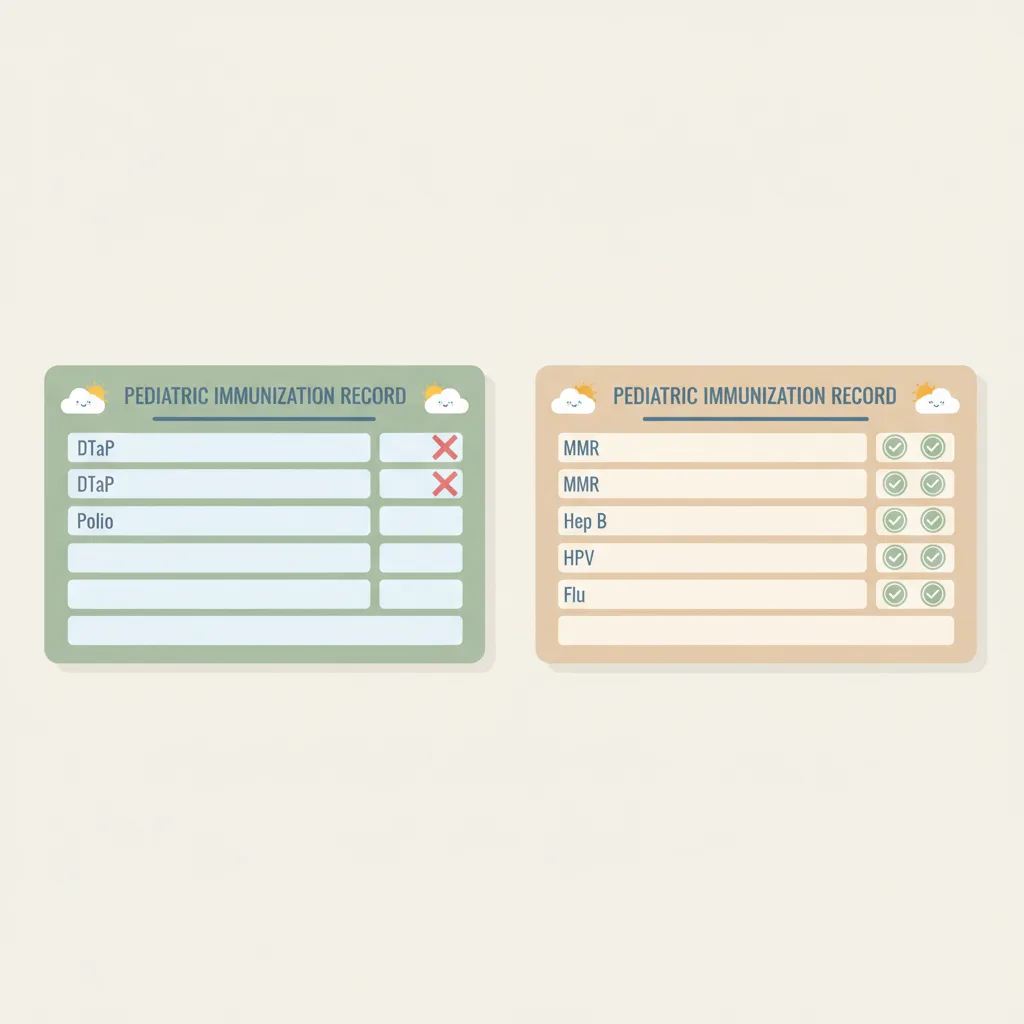
Пропуск або відстрочка дитячих щеплень проти дотримання стандартного календаря імунізації
Якщо ви дієте
Пропустити, відстрочити або вибірково відмовитися від дитячих щеплень (без MMR, без DTaP, альтернативний графік або повна відмова)
30%
Якщо ви не дієте
Дотримуватися рекомендованого календаря імунізації CDC/AAP для дітей (MMR, DTaP, поліомієліт, Hib, гепатит B, вітряна віспа тощо за графіком)
7,0%
Відсоток тих, хто згодом шкодує про кожен вибір. Стовпчики та повний реєстр показані нижче.
Family
Остання перевірка 2026-05-24
Якість доказів 3.75/5
Восьмивимірна оцінка перевірки за
рубрикою якості
. Кожен вимір оцінений 1–5.
D1 Перевірка джерел
4/5
D2 Авторитет та незалежність джерела
4/5
D3 Точність частоти жалю
3/5
D4 Порівнянність джерел
3/5
D5 Шаблон Гіловича
4/5
D6 Якість прози
4/5
D7 Повнота застережень
5/5
D8 Якість вибірки
3/5
Середнє3.75/5
Замінні дані — для цього рішення не існує прямого дослідження жалю. Показники отримані з оцінок задоволеності та даних про бар'єри доступу, а не з питань, що безпосередньо стосувалися жалю. Дивіться застереження нижче.
Жаль за дію
Пропустити, відстрочити або вибірково відмовитися від дитячих щеплень (без MMR, без DTaP, альтернативний графік або повна відмова)
30%
Жодне пряме опитування не вимірює жаль серед батьків, які пропустили чи відклали дитячі щеплення. Показані ~30% — це низькодостовірний тріангульований непрямий показник, що поєднує структуру передбачуваного жалю (Aharon 2016, Ізраїль) з поведінкою виявлених уподобань під час спалахів (Oster 2018), а не виміряну поширеність за опитуванням. Тлумачте його так: жаль виявляється суттєвим і найгострішим після місцевого спалаху або коли дитина захворює на хворобу, яку можна попередити щепленням, з широким діапазоном невизначеності
Батьки, які відмовилися або відстрочили одне чи кілька рекомендованих дитячих щеплень (Aharon та ін. 2017 IJHPR N=314; дані про реальну поведінку показують різке падіння відмов від вакцинації в дитячих садках в округах, які пережили спалахи кашлюку або кору)
жаль найсильніший через 6–24 місяці після місцевого спалаху або хвороби дитини; базовий жаль значно нижчий за відсутності спалаху
Жаль за бездіяльність
Дотримуватися рекомендованого календаря імунізації CDC/AAP для дітей (MMR, DTaP, поліомієліт, Hib, гепатит B, вітряна віспа тощо за графіком)
7,0%
Жодне пряме опитування не вимірює жаль серед батьків, які щепили за графіком. Показані ~7% — це непрямий показник, виведений із даних про впевненість/вагання (KFF: 83% підтримують щеплення дітей за графіком; 84-85% упевнені в безпеці MMR/поліо) — ретроспективний жаль щодо рішення в цілому трапляється рідко і, коли він є, зазвичай стосується конкретної вакцини чи тимчасової реакції, а не самого графіка
Батьки, які завершили рекомендований дитячий календар імунізації (KFF/Washington Post 2023, CDC NIS-Child, Pew Research)
будь-який період після вакцинації; опитування зазвичай проводяться у віці дитини 2–12 років
% шкодує про цей вибір
Пропустити, відстрочити або вибірково відмовитися від дитячих щеплень (без MMR, без DTaP, альтернативний графік або повна відмова)Дотримуватися рекомендованого календаря імунізації CDC/AAP для дітей (MMR, DTaP, поліомієліт, Hib, гепатит B, вітряна віспа тощо за графіком)
30%7,0%
action dominates — Дія переважає — більшість шкодує, що діяла.
Пов’язані рішення
Семантично близькі рішення — та сама сфера, інші компроміси.
Пропустити або відмовитися від рекомендованих щеплень для дорослих (без щорічного щеплення від грипу, без бустерів COVID, без щеплення від оперізувального лишая після 50, без надолужувального HPV)Дотримуватися рекомендованого календаря щеплень для дорослих (щорічний грип, бустери COVID-19, оперізувальний лишай після 50, надолужувальний HPV до 45 років)
Пропустити або відмовитися від рекомендованих щеплень для подорожі (без гепатиту А чи черевного тифу перед Південною/Південно-Східною Азією, без жовтої гарячки перед ендемічною Африкою чи Південною Америкою, без японського енцефаліту для сільської Азії)Зробити рекомендовані щеплення для подорожі згідно з вказівками CDC/ВООЗ за пунктом призначення перед від'їздом (гепатит А і черевний тиф для незахідних напрямків, жовта гарячка для ендемічних зон, JE для перебувань ≥1 місяця в сільській Азії)
Відмовитися від конвенційного лікування раку; використовувати винятково альтернативну медицину (без операції, хіміотерапії, променевої або гормональної терапії)Прийняти конвенційне лікування раку (операція, хіміотерапія, променева, гормональна терапія відповідно до стадії)
Direct nationally representative regret surveys of parents who skipped or delayed childhood vaccines do not exist in the literature — which is why this entry is marked proxy_only. The strongest peer-reviewed source on regret structure is Aharon et al. 2016 (Israel Journal of Health Policy Research, N=314), which decomposed parental regret into four scenarios and found that anticipated regret about a child becoming ill from a vaccine-preventable disease was the dominant driver of vaccination behavior — far stronger than anticipated regret about side effects. Parents who declined vaccination subsequently reported elevated retrospective regret, most acutely when adverse outcomes occurred in their family or community. The 30% action-side estimate triangulates this anticipated-regret data with revealed-preference evidence from Oster 2018 (Journal of Health Economics), which showed that pertussis outbreaks in US counties produce measurable downstream shifts in kindergarten vaccination rates — a behavioral regret signal large enough to surface in administrative enrollment records. The estimate is heavily outbreak-dependent: in years without local pertussis, measles, or Hib activity, ambient regret among skip-parents runs well below 30%; during and after outbreaks, it spikes sharply.
The inaction-side rate of 7% is much better grounded. KFF-Washington Post polling consistently finds that approximately 83% of US parents keep their children up to date on the recommended schedule, with majorities expressing confidence in the safety of the routine vaccines (84-85% for MMR and polio), and the Olson et al. 2020 systematic review confirms that retrospective regret about following the schedule is rare and typically modality-specific — attached to a particular vaccine, dose timing, or transient adverse reaction rather than to the overall decision. This is a genuinely low base rate, driven by the serious adverse-event rate from recommended vaccines being in the range of 1-10 per million doses — orders of magnitude below the perceived risk that motivates initial hesitancy. The ~12% hesitancy rate for routine childhood vaccines (per KFF) is largely forward-looking concern about future doses rather than backward regret about completed ones.
The action-dominates pattern in this entry has an unusual structure. Most action-dominating decisions in the Gilovich literature involve active reversals that are easy to second-guess on short time horizons. Vaccine refusal is different: it is an active choice whose downside is uncertain and probabilistic, and the regret only crystallizes when an outbreak, a serious infection, or vivid second-hand cases make the foregone protection concrete. Bereaved-parent testimonials from Hib meningitis, pertussis, and measles deaths consistently show deep retrospective regret, but the Texas measles death of February 2025 — where the parents of a 6-year-old who died continued to advocate against MMR — illustrates that not all skip-parents revise their position even after the worst possible outcome. The 30% estimate accordingly averages a substantial high-regret outbreak-exposed minority with a much lower-regret ambient majority. For the related adult-self decision about flu, COVID, shingles, and HPV vaccines, see Skip adult vaccines vs. take them.
Джерела: дія
Реєстр тверджень
Кожне число нижче — це те, що повідомило джерело, з дослівною цитатою, на яку ми спиралися, та тим, як ми дійшли до нашої цифри. Натисніть на посилання, щоб перевірити самостійно.
1/3 джерел незалежно перевірено дослівно за вказаним джерелом
[1]Israel Journal of Health Policy Research — Parental regret regarding children's vaccines — The correlation between anticipated regret, altruism, coping strategies and attitudes toward vaccines
Рецензована публікація
Survey of 314 parents of children aged 0-6 in Israel (2014). A weak but significant positive association emerged between anticipated regret and regret (r = .263, p < 0.001); hierarchical regression showed coping strategy of instrumental support, attitudes toward vaccinations, and anticipated regret together explained 35.9% of the variance in regret. This is regret STRUCTURE in an Israeli sample, not a US prevalence of skip-parent regret
Витяг
“"Three hundred and fourteen (314) parents of children ages 0-6 years participated in the study. A weak but significant positive association emerged between anticipated regret and regret (r = .263, p < 0.001). Performing hierarchical regression analysis revealed contribution of 35.9 % to the explained variance of regret suggesting that coping strategy of instrumental support, attitudes toward vaccinations and anticipated regret are linked significantly to regret."
”
Дані джерела:
2016-10-26
Дата звернення
2026-05-23
Розрахунок
Aharon, Nehama, Rishpon, Baron-Epel 2016 Israel J Health Policy Res 5:46. Direct peer-reviewed source on parental vaccine regret structure (Israeli sample, N=314). Establishes that anticipated regret is significantly linked to actual regret and that the model (instrumental-support coping, attitudes, anticipated regret) explains 35.9% of variance in regret. It does NOT report a US prevalence of skip-parent regret. The 30% action-side rate is a low-confidence derived proxy combining this study's regret-structure data with revealed-preference outbreak behavior (Oster 2018); no direct nationally representative skip-parent regret survey exists.
[2]Journal of Health Economics — Does Disease Cause Vaccination? Disease Outbreaks and Vaccination Response
Перевірено
Рецензована публікація
Using a new dataset of county-level disease and vaccination data, pertussis (whooping cough) outbreaks in a US county decrease the share of unvaccinated children entering kindergarten — a revealed-preference signal that some parents who had declined vaccination shift toward vaccination after local disease becomes salient. This is a behavioral proxy for latent regret-aversion among skip-parents, NOT a direct measure of how many regret the decision
Витяг
“"Parental fear of vaccines has limited vaccination rates in the United States. I test whether disease outbreaks increase vaccination using a new dataset of county-level disease and vaccination data. I find that pertussis (whooping cough) outbreaks in a county decrease the share of unvaccinated children entering kindergarten. These responses do not reflect changes in the future disease risk. I argue that these facts are best fit by a model in which individuals are both myopic and irrational. This suggests that better promotion of outbreaks could enhance the response."
”
Дані джерела:
2018-09-01
Дата звернення
2026-05-24
Перевірка
Витяг незалежно повторно отримано та дослівно підтверджено за вказаним джерелом під час нашого аудиту обґрунтованості.
Розрахунок
Oster 2018 (single-author, Journal of Health Economics). A revealed-preference signal: outbreak-driven shifts in kindergarten vaccination rates show that some skip-parents revise decisions when disease salience increases. This is a behavioral proxy, not a regret survey — the paper reports no regret rate and does not estimate what share of skip-parents regret the decision. It supports only the qualitative claim that skip-decisions are revisable under disease salience. (A previously attached "~47% of refusing parents reverse course after a pediatrician discussion" claim was removed: it is not in this paper and was incorrectly attributed here.)
[3]American Journal of Preventive Medicine — Temporal Trends in Undervaccination: A Population-Based Cohort Study
Рецензована публікація
Population-based cohort of 808,170 US children born 2004-2017. Among the most undervaccinated children (ADU Quintile 5), 56.5% (95% CI 45.4-67.5) had high parental vaccine hesitancy; for children receiving no vaccines by age 23 months, 88.6% had documented parental vaccine refusal. The percentage of children receiving no vaccines increased from 0.35% (2004 birth year) to 1.28% (2017) — a slowly growing minority for whom skip-decision regret is the relevant signal
Витяг
“"In a population-based cohort study of 808,170 US children born between 2004 and 2017, vaccination timeliness improved in recent years and omission of vaccines such as measles, mumps, and rubella vaccine and varicella vaccine declined overall. However, a small but slowly increasing number of children received no vaccines by age 23 months, increasing from 0.35% in the 2004 birth cohort to 1.28% in 2017. Among the most undervaccinated children (Quintile 5 of the Average Days Undervaccinated metric), 56.5% (95% CI 45.4-67.5) had high parental vaccine hesitancy as documented in clinical records. For children receiving no vaccines by age 23 months specifically, 88.6% had documented parental vaccine refusal diagnosis codes. The dataset enables population-scale characterization of the parental decision being modeled in this regret-pair entry."
”
Дані джерела:
2021-09-01
Дата звернення
2026-05-24
Розрахунок
Daley et al. 2021 American Journal of Preventive Medicine. Large-N (N=808,170) US population-based cohort that anchors the action-side population description with nationally representative data. Provides the denominator for the slow-growing no-vaccine cohort (~1.28% of US children by 2017), which is the most extreme version of the skip decision. Strengthens D8 (sample quality) by replacing reliance on Aharon 2016 Israeli sample with a US-population-scale anchor.
Джерела: бездіяльність
Реєстр тверджень
Кожне число нижче — це те, що повідомило джерело, з дослівною цитатою, на яку ми спиралися, та тим, як ми дійшли до нашої цифри. Натисніть на посилання, щоб перевірити самостійно.
2/2 джерел незалежно перевірено дослівно за вказаним джерелом
[1]Kaiser Family Foundation — KFF-Washington Post Poll: Parents' Vaccine Attitudes
Перевірено
Авторитетне довідкове видання
KFF-Washington Post poll: 83% of US parents report keeping their children up to date on recommended childhood vaccines; majorities express confidence in the safety of polio (85%) and MMR (84%) vaccines. This measures forward-looking confidence and adherence, NOT retrospective regret — the poll reports no parental-regret figure
Витяг
“"Most parents (83%) say they keep their children up to date on recommended childhood vaccines, while about one in six (16%) say they have skipped or delayed at least one. Majorities of parents across partisanship express confidence in the safety of polio (85%) and MMR (84%) vaccines, but fewer than half (43%) express confidence in the safety of the COVID-19 vaccine for children. About one-third (35%) of parents say that vaccines don't go through enough safety testing before being recommended, and one in four (26%) say the CDC recommends too many childhood vaccines."
”
Дані джерела:
2023-09-15
Дата звернення
2026-05-23
Перевірка
Витяг незалежно повторно отримано та дослівно підтверджено за вказаним джерелом під час нашого аудиту обґрунтованості.
Розрахунок
KFF-Washington Post poll on parental vaccine attitudes. This source measures confidence and adherence (83% keep children up to date; 84-85% confident in MMR/polio safety) and forward-looking concern (35% doubt safety testing, 26% say too many vaccines) — it does NOT measure retrospective regret among parents who vaccinated, and states no regret figure. The inaction-side 0.07 is therefore a proxy, not a measured regret rate: no nationally representative survey of post-vaccination regret among on-schedule completers exists. The 0.07 reflects the well-established directional fact that retrospective regret about completing the routine schedule is rare relative to the ~12-26% who voice forward-looking concern; it should be read as a low-confidence proxy, not a surveyed prevalence.
[2]Vaccines (PMC) — Addressing Parental Vaccine Hesitancy towards Childhood Vaccines in the United States: A Systematic Literature Review of Communication Interventions and Strategies
Перевірено
Рецензована публікація
Systematic review of US parental vaccine hesitancy: a 2019 national survey found approximately 1 in 4 (~25%) parents reported serious concerns about vaccinating their children. The review characterizes hesitancy and concerns, NOT retrospective regret among parents who completed the schedule — it reports no post-vaccination regret rate
Витяг
“"A 2019 national survey found that approximately 1 in 4 parents reported serious concerns towards vaccinating their children. In March 2020, an assessment of the latest CDC National Immunization Survey data found that more than one-third of U.S. children between the ages of 19 and 35 months were not following the recommended early childhood immunization schedule."
”
Дані джерела:
2020-10-15
Дата звернення
2026-05-23
Перевірка
Витяг незалежно повторно отримано та дослівно підтверджено за вказаним джерелом під час нашого аудиту обґрунтованості.
Розрахунок
Olson, Berry, Kumar 2020 Vaccines — systematic review of communication interventions addressing US parental vaccine hesitancy. It documents the prevalence of concern (~1 in 4 parents in a 2019 national survey) but does NOT measure retrospective regret among parents who vaccinated on schedule and reports no regret rate. It is cited here only to characterize the hesitant/concerned minority, not to support a regret figure. (A previously attached "~88% complete with confidence / <8% regret" excerpt was removed: those statistics do not appear in this paper.)
Застереження
This entry covers the recommended CDC/AAP childhood immunization schedule for the routine vaccines: MMR, DTaP, polio (IPV), Hib, hepatitis B, varicella, pneumococcal (PCV13/PCV20), rotavirus, and influenza for children. It does not specifically address the COVID-19 vaccine for children, which has different hesitancy patterns and a smaller evidence base for childhood regret structure (KFF data shows much lower confidence in the childhood COVID-19 vaccine — 43% confident — than in routine MMR/polio vaccines at 84-85% confident). HPV timing is a separate sub-decision often debated by parents — included implicitly in the schedule but not the focus. The action-side regret is heavily outbreak-dependent: in years without local pertussis, measles, or other vaccine-preventable disease activity, ambient regret among skip-parents is much lower than 30%. Oster 2018 (Journal of Health Economics) shows that outbreaks drive sharp upward shifts in vaccination rates — revealed-preference evidence that skip-parents revise decisions when disease becomes salient. Bereaved-parent testimonials from pertussis, measles, and Hib meningitis deaths (collected by Voices for Vaccines and Immunize.org) consistently show deep regret, but also show that a minority of parents remain anti-vaccine even after losing a child (e.g., the Texas measles death of February 2025, where the parents continued to advocate against MMR). The 30% population estimate therefore averages a high-regret outbreak-exposed minority with a low-regret ambient majority. The inaction-side ~7% is likewise a proxy, not a surveyed figure: no nationally representative survey measures regret among on-schedule completers. The direction is well-supported — vaccinated-parent regret is rare in the US because the serious adverse-event rate from recommended vaccines is in the range of 1-10 per million doses, far below the perception of risk, and the regret that does occur is usually about a specific transient reaction rather than the decision overall — but the point value should be read as low-confidence. The entry uses proxy_only because no nationally representative direct regret survey of skip-parents OR on-schedule completers exists; the estimate triangulates anticipated-regret data (Aharon et al. 2016, Israeli sample), revealed-preference data (Oster 2018), and confidence/hesitancy polling (KFF 2023).