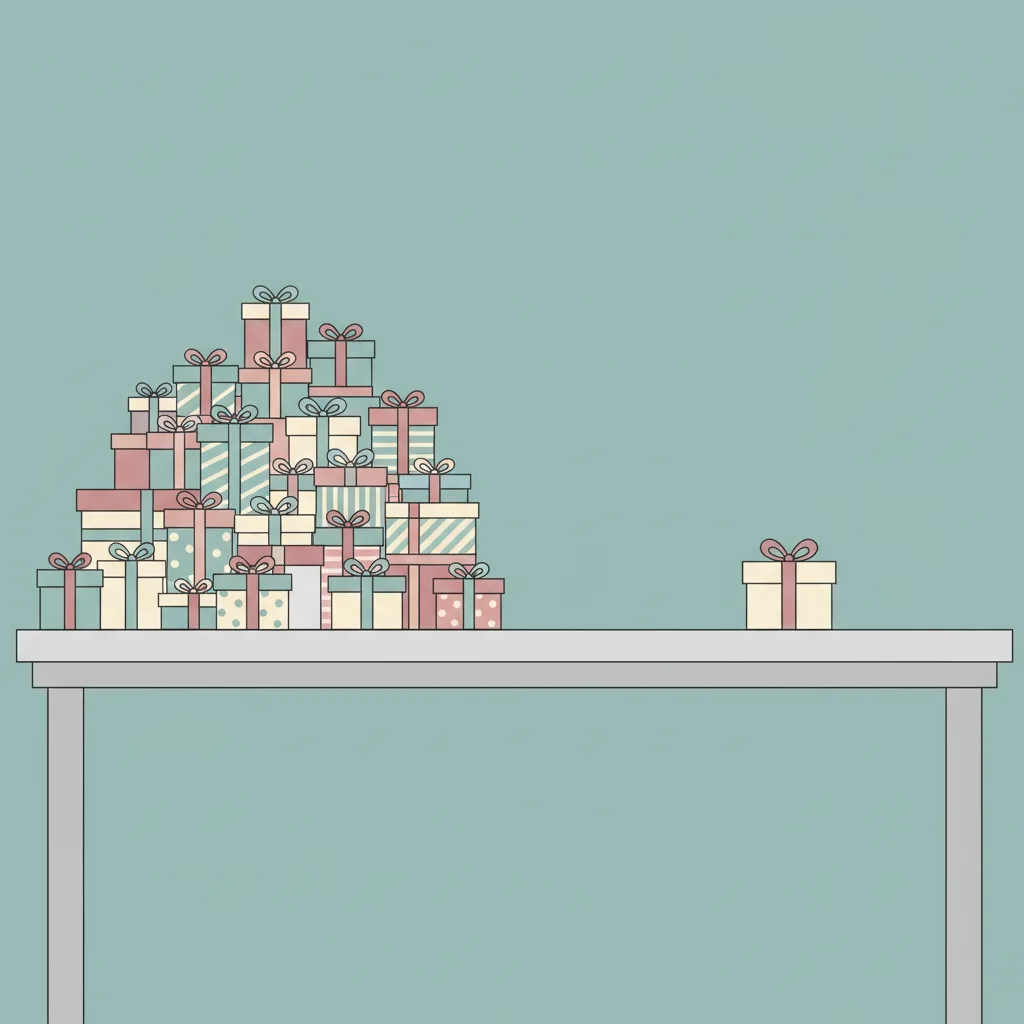
Comprarle a tu nieto (o hijo) cada juguete y regalo que pide vs. contenerse y decir no
Si actúas
Regalar sin medida — rara vez decir que no
40%
Si no actúas
Regalar con moderación — decir que no y respetar los límites de los padres
14%
Porcentaje de quienes luego se arrepienten de cada elección. Las barras y el registro completo aparecen abajo.
Familia
Última revisión 2026-05-05
Calidad de la evidencia 3.88/5
Puntuación de revisión en ocho dimensiones según la
rúbrica de calidad
. Cada dimensión puntuada de 1 a 5.
D1 Verificación de fuentes
4/5
D2 Autoridad e independencia de las fuentes
4/5
D3 Precisión de la tasa de arrepentimiento
3/5
D4 Comparabilidad de las fuentes
4/5
D5 Patrón de Gilovich
5/5
D6 Calidad de la prosa
4/5
D7 Completitud de las advertencias
4/5
D8 Calidad de la muestra
3/5
Media3.88/5
Datos sustitutos — no existe ninguna encuesta directa sobre el arrepentimiento para esta decisión. Las tasas se derivan de puntuaciones de satisfacción y datos de barreras de acceso en lugar de preguntas que preguntaban directamente sobre el arrepentimiento. Ver advertencias más abajo.
Arrepentimiento por acción
Regalar sin medida — rara vez decir que no
40%
40% de los padres dicen que los abuelos son demasiado blandos o indulgentes (proxy)
Padres estadounidenses de niños de 0-18 años que reportaron desacuerdos con un abuelo (subconjunto de muestra nacionalmente representativa n=2.016)
transversal, recolectado enero-febrero 2020
Arrepentimiento por inacción
Regalar con moderación — decir que no y respetar los límites de los padres
14%
14% de los padres dicen que los abuelos son demasiado estrictos o duros (proxy)
Padres estadounidenses de niños de 0-18 años que reportaron desacuerdos con un abuelo (subconjunto de muestra nacionalmente representativa n=2.016)
transversal, recolectado enero-febrero 2020
% que se arrepienten de esta elección
Regalar sin medida — rara vez decir que noRegalar con moderación — decir que no y respetar los límites de los padres
40%14%
action dominates — Domina la acción — la mayoría se arrepiente de actuar.
Decisiones relacionadas
Decisiones semánticamente similares — mismo terreno, distintos compromisos.
Among US parents who report disagreements with a grandparent about child-rearing, 40% attribute those disagreements to grandparents being too soft or lenient, compared with only 14% who say grandparents are too tough, a nearly 3:1 ratio within the same response scale from a C.S. Mott Children’s Hospital National Poll of 2,016 nationally representative US parents fielded in January–February 2020. The asymmetry holds even though the dominant cultural script around grandparenting celebrates indulgence: “spoiling” is often described as a grandparent’s right, yet parents experiencing it in practice flag the leniency direction at three times the rate of the restraint direction. Both rates come from the same survey and the same subset of disagreement-reporting parents, making the cross-group comparison the most direct parallel evidence available on this bilateral question. Neither figure measures grandparent self-regret about their choices; both reflect parental observation of the downstream costs, and are flagged throughout as proxy estimates.
The child-development literature independently supports the direction of this asymmetry. Bredehoft, Mennicke, Potter, and Clarke (1998), writing in the Journal of Family and Consumer Sciences Education, surveyed 730 adults and found that the 124 who self-identified as adult children of overindulgence reported, as a great majority (71%), lasting difficulty as adults knowing what is enough or what is normal, a consequence that persisted long after the material gifts were forgotten. On the developmental side, Dauch, Imwalle, Ocasio, and Metz (2018) published an experiment in Infant Behavior and Development showing that toddlers given access to four toys rather than sixteen played for longer durations and in markedly more sophisticated ways, suggesting that abundance itself displaces the focused engagement that promotes cognitive and attentional development. The restraint literature does not argue that gift refusal has no costs; a grandparent who is consistently tight or withholding creates a different friction, but the outcome evidence clusters more heavily against excess than against moderation.
The Gilovich framework predicts that action regrets (having been too generous, having never said no) are salient and interpersonally costly in the present (parents notice and object), while inaction regrets (having been too restrained) tend to crystallize later and more privately, if at all. The 2.9:1 ratio in parental conflict reports is consistent with this temporal asymmetry. The primary caveat is that the Mott data captures a relational friction between generations, not a direct self-regret measurement by the gift-giving party; grandparents themselves may weight the same behavior differently. Research identifying relational and structural overindulgence as more harmful than pure material excess also suggests the action-side risk may be somewhat overstated when isolated to toy and gift quantity specifically.
Fuentes: acción
Registro de evidencia
Cada número a continuación es lo que reportó cada fuente, con la cita textual en la que nos basamos y cómo llegamos a nuestra cifra. Haz clic en cualquier enlace para verificarlo directamente.
3/3 fuentes verificadas de forma independiente palabra por palabra frente a la fuente citada
[1]C.S. Mott Children's Hospital National Poll on Children's Health, University of Michigan — When parents and grandparents disagree
Verificado
Fuente de referencia
40% of parents say disagreements with grandparents occur because grandparents are too soft on the child; 14% say grandparents are too tough; 6% report major disagreements and 37% minor disagreements
Extracto
“"Among parents who say they have had disagreements with a grandparent about how the grandparent cares for their child, 40% say the disagreements occur because grandparents are too soft on the child, while 14% say grandparents are too tough."
”
Datos de la fuente de
2020-08-17
Accedido
2026-05-04
Verificación
Extracto recuperado de forma independiente y confirmado palabra por palabra frente a la fuente citada durante nuestra auditoría de fundamentación.
Cálculo
C.S. Mott Children's Hospital National Poll on Children's Health (Vol. 36, Issue 5, August 2020). Survey of 2,016 US parents of children ages 0–18, randomly selected and stratified. Among parents who reported disagreements with a grandparent, 40% attributed those disagreements to grandparents being too lenient or soft. This is used as the action-side proxy for regret: parents registering that uninhibited gift-giving and leniency is a problem conflicting with their child-rearing choices. The 40% is not a direct self-report of grandparent regret — it is parental observation of the costs of overindulgence — flagged as "(proxy)".
[2]Journal of Family and Consumer Sciences Education (Bredehoft, Mennicke, Potter & Clarke) — Perceptions attributed by adults to parental overindulgence during childhood
Verificado
Revisado por pares
71% of adult children of overindulgence (ACOs; n=124 self-identified from 730 surveyed) reported difficulty as adults knowing what is enough or what is normal; ACOs simultaneously felt loved, confused, guilty, bad and sad about the overindulgence
Extracto
“"The great majority (71%) of the overindulged subjects reported having difficulty knowing what is enough, or what is normal as adults. ACOs simultaneously felt both positively and negatively about the overindulgence, that is, they felt loved, confused, guilty, bad and sad."
”
Datos de la fuente de
1998-10-01
Accedido
2026-05-04
Verificación
Extracto recuperado de forma independiente y confirmado palabra por palabra frente a la fuente citada durante nuestra auditoría de fundamentación.
Cálculo
Bredehoft, Mennicke, Potter & Clarke (1998), Journal of Family and Consumer Sciences Education, 16(2), 3–17. Survey of 730 subjects; 124 self-identified as adult children of overindulgence (ACO). The 71% figure applies to the ACO subsample (n=124), not to the full 730. This source does not supply the 40% action-rate; it corroborates the direction of harm from overindulgent material gifting by showing that adults retrospectively raised that way report lasting difficulty calibrating sufficiency. The population is different (adult self-report on childhood, not current parental observation), but the convergence supports the action-side framing.
[3]C.S. Mott Children's Hospital National Poll on Children's Health, University of Michigan — Parent efforts to teach children about gratitude
Verificado
Fuente de referencia
58% of US parents of children ages 4–10 worry that they are giving their children too much
Extracto
“"Over half of parents (58%) worry that they are giving their children too much, while 42% say they sometimes are embarrassed by how selfish their child acts."
”
Datos de la fuente de
2021-10-01
Accedido
2026-05-05
Verificación
Extracto recuperado de forma independiente y confirmado palabra por palabra frente a la fuente citada durante nuestra auditoría de fundamentación.
Cálculo
C.S. Mott Children's Hospital National Poll on Children's Health, University of Michigan. N=1,125 parents with at least one child age 4–10, fielded June 2021. The 58% worry-about-over-giving rate documents that concern about material excess is widespread among the parenting generation — even before grandparent gift-giving is layered on top. This source measures worry (a prospective concern), not retrospective regret, and covers parent-to-child giving rather than grandparent-to-grandchild giving. It does not supply the action-side 40% proxy rate; that comes from Mott 2020. It corroborates the cultural prevalence of over-giving concern and provides independent evidence that parents themselves recognise an excess problem in their households, which is relevant context for the grandparent layer of the same dynamic.
Independencia
Independent from Mott 2020 (different survey wave, Vol. 39 Issue 5 vs Vol. 36 Issue 5, different sample frame: parents of children 4–10 vs parents of children 0–18, different topic focus: gratitude vs grandparent disagreements).
Fuentes: inacción
Registro de evidencia
Cada número a continuación es lo que reportó cada fuente, con la cita textual en la que nos basamos y cómo llegamos a nuestra cifra. Haz clic en cualquier enlace para verificarlo directamente.
1/2 fuentes verificadas de forma independiente palabra por palabra frente a la fuente citada
[1]C.S. Mott Children's Hospital National Poll on Children's Health, University of Michigan — When parents and grandparents disagree
Verificado
Fuente de referencia
14% of parents say disagreements with grandparents occur because grandparents are too tough on the child, vs 40% who say grandparents are too soft
Extracto
“"Among parents who say they have had disagreements with a grandparent about how the grandparent cares for their child, 40% say the disagreements occur because grandparents are too soft on the child, while 14% say grandparents are too tough."
”
Datos de la fuente de
2020-08-17
Accedido
2026-05-04
Verificación
Extracto recuperado de forma independiente y confirmado palabra por palabra frente a la fuente citada durante nuestra auditoría de fundamentación.
Cálculo
Same Mott 2020 survey (n=2,016). The 14% who say grandparents are too tough is used as the inaction-side proxy for regret: the share of cases where restraint and limit-setting is itself the source of conflict and parental concern. This is not grandparent self-regret about being too strict; it is parents flagging that restraint has gone too far. Flagged as "(proxy)". The 40%:14% ratio (2.9:1) from the same survey and same response scale makes the comparison directly valid across sides.
[2]Infant Behavior and Development (Dauch, Imwalle, Ocasio & Metz) — The influence of the number of toys in the environment on toddlers' play
Revisado por pares
Toddlers with access to 4 toys (vs 16) showed longer duration of toy play and played in more sophisticated ways; fewer toys led to higher-quality, more sustained engagement
Extracto
“"With fewer toys, participants had fewer incidences of toy play, longer durations of toy play, and played with toys in a greater variety of ways. The findings suggest that an environment with fewer toys may better support toddlers' play."
”
Datos de la fuente de
2018-02-01
Accedido
2026-05-04
Cálculo
Dauch, Imwalle, Ocasio & Metz (2018), Infant Behavior and Development, 50, 78–87. Experimental study with n=36 toddlers ages 18–30 months; each child played under two conditions (4 toys and 16 toys). This source does not supply the 14% inaction rate; it corroborates the developmental case for restraint in gifting by showing that fewer toys produce demonstrably richer play. The finding supports why restrained gift-giving is not costless but is substantially less problematic than excess — the inaction-dominates concern is not supported by child development data.
Advertencias
Ambas tasas provienen de la misma encuesta Mott 2020 (n=2.016) y miden la observación parental del comportamiento de los abuelos, no el autoarrepentimiento de los abuelos sobre sus propias elecciones de regalos. El 40% y el 14% se extraen del subconjunto de padres que reportaron desacuerdos con un abuelo — no de la muestra completa — lo que significa que el denominador es menor y la comparación refleja la dirección del conflicto más que una tasa de prevalencia incondicional. Ninguna cifra es una medición directa de arrepentimiento; ambas están marcadas como «(proxy)». El hallazgo de Bredehoft et al. (1998) de que el 71% de los adultos sobreindulgidos reportan dificultad duradera para calibrar la suficiencia se extrae de una submuestra mucho más pequeña (n=124 ACOs autoidentificados de 730 encuestados), usa autoinforme retrospectivo y cubre todas las formas de sobreindulgencia — no solo regalos materiales. La investigación identifica consistentemente la sobreindulgencia relacional y estructural como más dañina que el exceso material puro. El experimento de Dauch et al. (2018) se restringe a niños pequeños en una sala de juego de laboratorio. Ninguna encuesta a gran escala pregunta a los abuelos directamente «¿lamenta comprar demasiado?» o «¿lamenta ser demasiado restrictivo con los regalos?».