





Saltar al contenido
Likelier

Arrepentimiento por actuar o por no actuar

Adoptar una dieta vegetariana o vegana vs seguir comiendo carne

Si actúas

Hacerse vegetariano/vegano

84%

Si no actúas

Seguir comiendo carne

22%

Porcentaje de quienes luego se arrepienten de cada elección. Las barras y el registro completo aparecen abajo.


Estilo de vida

Última revisión 2026-04-26

Calidad de la evidencia 4.0/5

Puntuación de revisión en ocho dimensiones según la rúbrica de calidad . Cada dimensión puntuada de 1 a 5.

D1 Verificación de fuentes
5/5
D2 Autoridad e independencia de las fuentes
4/5
D3 Precisión de la tasa de arrepentimiento
2/5
D4 Comparabilidad de las fuentes
3/5
D5 Patrón de Gilovich
3/5
D6 Calidad de la prosa
5/5
D7 Completitud de las advertencias
5/5
D8 Calidad de la muestra
5/5
Media 4.0/5
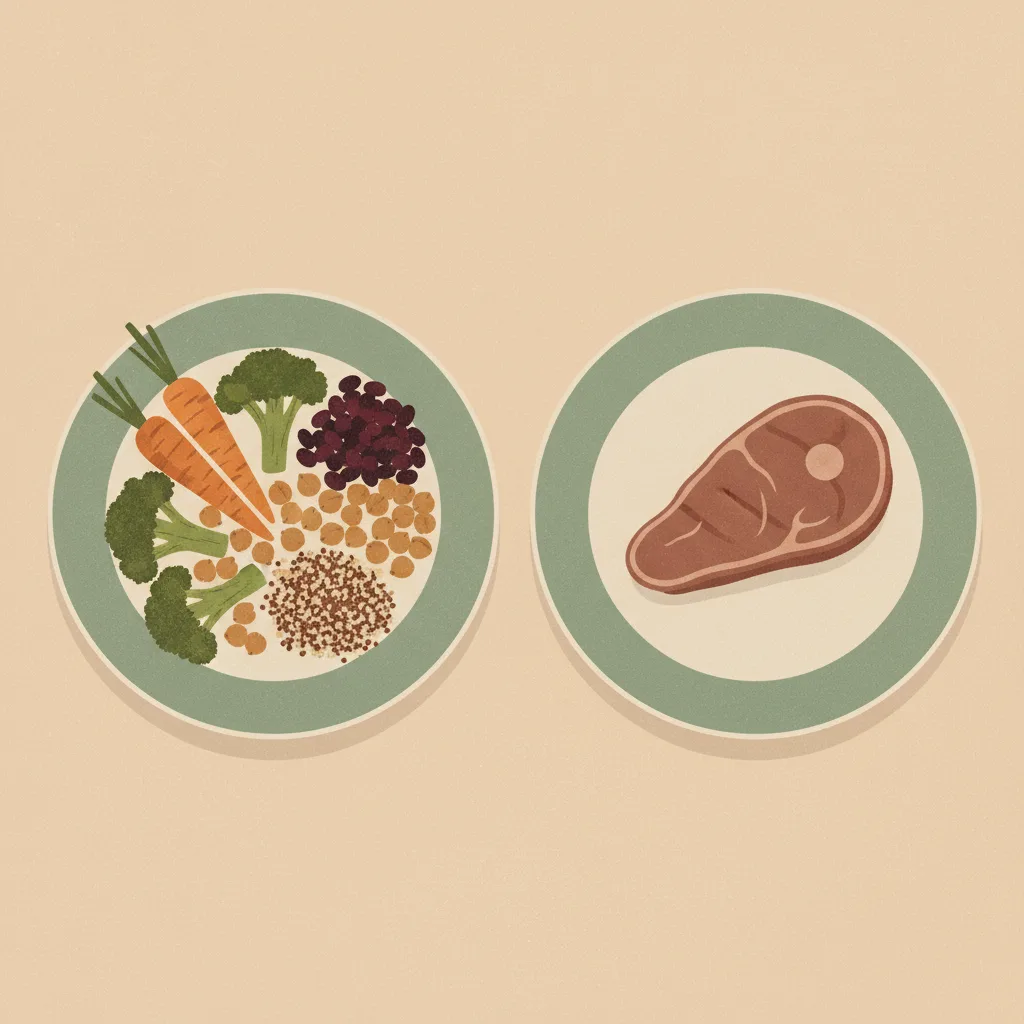
Two plates side by side, one with vegetables and legumes, the other with a cut of meat, both slightly faded.

Arrepentimiento por acción

Hacerse vegetariano/vegano

84%

84% abandonó el vegetarianismo (proxy de abandono — tasa de abandono, no arrepentimiento directo)

Adultos estadounidenses que han intentado el vegetarianismo o veganismo

retrospectivo, sin marco temporal fijo

Arrepentimiento por inacción

Seguir comiendo carne

22%

22% se siente culpable por comer carne todo el tiempo (proxy de culpa — no arrepentimiento directo)

Adultos británicos no veganos, representativo a nivel nacional

retrospectivo, sin marco temporal fijo

% que se arrepienten de esta elección

action dominates — Domina la acción — la mayoría se arrepiente de actuar.

Decisiones relacionadas

Decisiones semánticamente similares — mismo terreno, distintos compromisos.

lifestyle

Quedarse con la mascota o darla en adopción

% que se arrepienten de esta elección

Inacción dominante

Arrepentimiento por inacción 5.7× mayor

lifestyle

Tatuaje

% que se arrepienten de esta elección

Acción dominante

Arrepentimiento por acción 1.6× mayor

Salud

Dejar de fumar

% que se arrepienten de esta elección

Inacción dominante

Arrepentimiento por inacción 90.0× mayor

lifestyle

Ayuno intermitente

% que se arrepienten de esta elección

Acción dominante

Arrepentimiento por acción 2.9× mayor

lifestyle

Eléctrico vs gasolina

% que se arrepienten de esta elección

Acción dominante

Arrepentimiento por acción 2.9× mayor

Salud

Piercing corporal

% que se arrepienten de esta elección

Acción dominante

Arrepentimiento por acción 4.0× mayor

lifestyle

Dejar la religión

% que se arrepienten de esta elección

Inacción dominante

Arrepentimiento por inacción 2.9× mayor

Salud

Longevidad vs aceptar envejecimiento

% que se arrepienten de esta elección

Inacción dominante

Arrepentimiento por inacción 1.5× mayor

The largest study of vegetarian and vegan retention — Faunalytics’ 2014 survey of 11,399 US adults via Harris Interactive — found that 84% of people who adopted a vegetarian or vegan diet eventually returned to eating meat. That number is the action-side proxy shown above, used directly rather than the previously constructed composite. But lapse rate is not regret rate. Crucially, 37% of the lapsed expressed interest in re-adopting, meaning they do not regret the diet itself — they regret stopping it, or faced barriers they could not overcome. A Faunalytics obstacle analysis found that social isolation (84% were not part of any veg community), food access, and meal prep difficulty — not principled rejection of the diet — drove most lapses.

On the other side, a 2022 Vegan Society survey of 2,000 non-vegan UK adults found that 22% report feeling guilty about eating meat all of the time — a persistent-guilt figure we use as the inaction proxy rather than the combined 71% who report guilt “some” or “all” of the time. Persistent guilt maps more closely to a regret-adjacent construct than intermittent discomfort. Cognitive dissonance research (Bastian et al., 2012) shows that meat-related guilt is often resolved through justification strategies — “the guilt persists but produces no corresponding desire to act.” The Vegan Society, as the commissioning body, has an advocacy interest in high guilt numbers.

What the data establishes is that dietary identity is unstable: most people who try vegetarianism quit (though many want to try again), and roughly one in five meat eaters carries persistent guilt about it. The action-dominates pattern reflects an asymmetry between a very high lapse rate and a modest persistent-guilt rate, but readers should note that lapsing conflates genuine dissatisfaction with situational barriers. Both figures are proxies for different constructs (behavioral abandonment vs affective discomfort), so the large delta should be read with caution.

Fuentes: acción

Registro de evidencia

Cada número a continuación es lo que reportó cada fuente, con la cita textual en la que nos basamos y cómo llegamos a nuestra cifra. Haz clic en cualquier enlace para verificarlo directamente.

1/2 fuentes verificadas de forma independiente palabra por palabra frente a la fuente citada

  1. [1] Faunalytics / Harris Interactive — A Summary of Faunalytics' Study of Current and Former Vegetarians and Vegans Verificado
    A Summary of Faunalytics' Study of Current and Former Vegetarians and Vegans
    Estadística
    84% of people who have adopted a vegetarian or vegan diet subsequently abandon it; 53% lasted less than one year; 37% of the lapsed are interested in re-adopting
    Extracto
    “"84% of vegetarians/vegans abandon their diet. About a third (34%) of lapsed vegetarians/vegans maintained the diet for three months or less, and slightly more than half (53%) adhered to the diet for less than one year. The only motivation cited by a majority (58%) of former vegetarians/vegans was health." ”
    Datos de la fuente de
    2014-12-02
    Accedido
    2026-04-26
    Verificación
    Extracto recuperado de forma independiente y confirmado palabra por palabra frente a la fuente citada durante nuestra auditoría de fundamentación.
    Cálculo
    Faunalytics commissioned Harris Interactive to survey 11,399 US adults aged 17+. Of those who had ever identified as vegetarian/vegan, 84% had reverted to eating meat. We use the 84% lapse rate directly as the action-side proxy. This is NOT a regret measure — it counts anyone who tried vegetarianism even briefly as a "former vegetarian." Crucially, 37% of lapsed expressed interest in re-adopting, meaning many lapsed for situational reasons (social isolation, food access) rather than because they regret the decision in principle.
  2. [2] Faunalytics — Bringing Back Former Vegans And Vegetarians: An Obstacle Analysis
    Bringing Back Former Vegans And Vegetarians: An Obstacle Analysis
    Estadística
    Food dissatisfaction is the most common struggle; accessibility and meal preparation time are the primary must-haves for re-adoption
    Extracto
    “"Dissatisfaction with veg*n food is the most common struggle, with nearly half of lapsed veg*ns experiencing cravings, boredom with their veg*n diet, feeling hungry on the diet, and other issues related to food dissatisfaction." ”
    Datos de la fuente de
    2019-10-01
    Accedido
    2026-04-26
    Cálculo
    Faunalytics obstacle analysis of former veg*ns. Confirms that many lapsed for practical/situational reasons (access, time, social isolation) rather than regretting the decision in principle. 84% of former veg*ns were not part of any vegetarian community, and 63% disliked sticking out from the crowd.

Fuentes: inacción

Registro de evidencia

Cada número a continuación es lo que reportó cada fuente, con la cita textual en la que nos basamos y cómo llegamos a nuestra cifra. Haz clic en cualquier enlace para verificarlo directamente.

  1. [1] The Vegan Society / Attest — Younger people feel more guilty about eating meat than older people, Vegan Society research finds
    Younger people feel more guilty about eating meat than older people, Vegan Society research finds
    Estadística
    22% of non-vegan UK adults feel guilty about eating meat all of the time; an additional 49% feel guilty some of the time
    Extracto
    “"49 per cent of respondents felt guilty about eating meat 'some' of the time, while a further 22 per cent felt guilty 'all' of the time. Even amongst those not limiting their consumption of meat and animal products at all, 45 per cent said they felt guilty about it 'some' or 'all' of the time." ”
    Datos de la fuente de
    2022-11-01
    Accedido
    2026-04-26
    Cálculo
    Vegan Society commissioned Attest to survey 2,000 non-vegan UK adults (working age, nationally representative for age, gender, and region) in October 2022. We use the 22% "guilty all the time" figure rather than the combined 71% (some + all), because persistent guilt is a closer proxy for regret-adjacent affect than intermittent guilt. The Vegan Society as commissioning body has an advocacy interest in high guilt numbers. Guilt about eating meat is NOT the same as regret about not going vegetarian — cognitive dissonance research shows meat-guilt is often resolved through justification strategies.
  2. [2] Faunalytics / Harris Interactive — A Summary of Faunalytics' Study of Current and Former Vegetarians and Vegans
    A Summary of Faunalytics' Study of Current and Former Vegetarians and Vegans
    Estadística
    88% of US adults have never tried vegetarianism or veganism; 10% are former veg*ns; 2% are current veg*ns
    Extracto
    “"About 88 percent of the U.S. population had never attempted a vegetarian or vegan diet, yet among the 12 percent who tried, only 2 percent had stuck with it." ”
    Datos de la fuente de
    2014-12-02
    Accedido
    2026-04-26
    Cálculo
    Faunalytics population data. 88% of US adults have never tried vegetarianism, providing context: the vast majority of meat eaters have not even considered the alternative seriously, making "regret about not going vegetarian" a narrow phenomenon even if guilt about meat is widespread.

Advertencias

Ningún lado mide directamente el arrepentimiento. El 84% lado acción es una tasa de abandono — cuenta a cualquiera que intentó el vegetarianismo y revirtió, incluyendo experimentos de menos de 3 meses. Abandonar no es arrepentirse: el 37% de los que abandonaron expresó interés en readoptarlo, y el análisis de obstáculos de Faunalytics encontró que las barreras prácticas (aislamiento social, acceso a alimentos, dificultad de preparación de comidas) impulsaron la mayoría de los abandonos en lugar del rechazo de principio. El 84% bruto debe leerse como "la dieta no se mantuvo" en lugar de "se arrepienten de haber intentado". El 22% lado inacción es culpa persistente ("todo el tiempo") por comer carne, no arrepentimiento por no haberse vuelto vegetariano. La investigación sobre disonancia cognitiva (Bastian et al., 2012) muestra que la culpa relacionada con la carne a menudo se resuelve a través de estrategias de justificación sin cambio de comportamiento. Las dos muestras son de diferentes países (EE.UU. vs Reino Unido) y diferentes décadas (2014 vs 2022). El patrón action-dominates refleja la asimetría entre una alta tasa de abandono y una modesta tasa de culpa persistente, pero ambos son proxies para constructos diferentes (abandono conductual vs incomodidad afectiva). El gran delta (0,62) sobreestima la diferencia en el arrepentimiento real porque el abandono confunde el arrepentimiento con barreras situacionales.

Datos brutos: /api/decisions.json

Vistos recientemente en este dispositivo