






Saltar al contenido
Likelier

Arrepentimiento por actuar o por no actuar

Casarse con tu primera pareja seria vs. salir con más personas antes de comprometerte

Si actúas

Comprometerse y casarse con tu primera pareja seria

30%

Si no actúas

Salir con más gente antes de comprometerse

16%

Porcentaje de quienes luego se arrepienten de cada elección. Las barras y el registro completo aparecen abajo.


Familia

Última revisión 2026-05-13

Calidad de la evidencia 3.63/5

Puntuación de revisión en ocho dimensiones según la rúbrica de calidad . Cada dimensión puntuada de 1 a 5.

D1 Verificación de fuentes
3/5
D2 Autoridad e independencia de las fuentes
4/5
D3 Precisión de la tasa de arrepentimiento
2/5
D4 Comparabilidad de las fuentes
2/5
D5 Patrón de Gilovich
5/5
D6 Calidad de la prosa
4/5
D7 Completitud de las advertencias
5/5
D8 Calidad de la muestra
4/5
Media 3.63/5
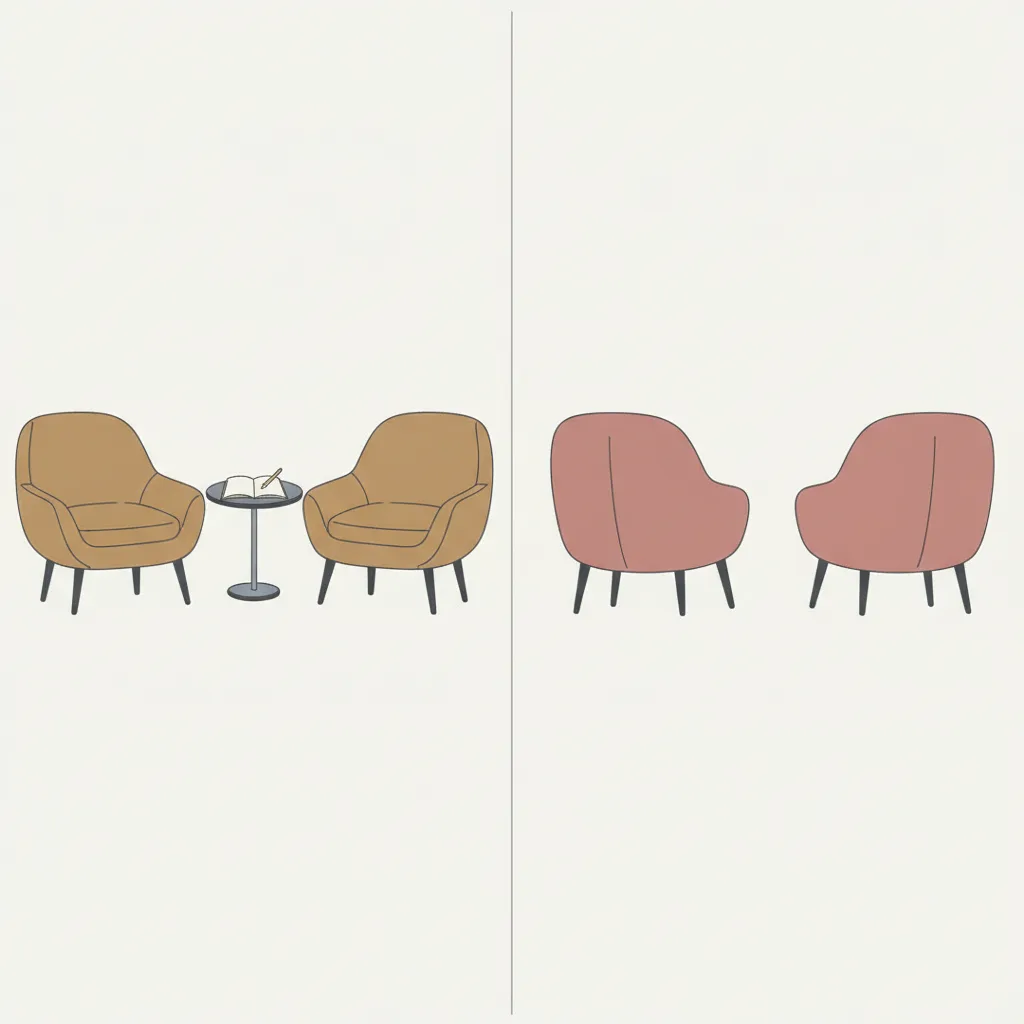
Two diverging paths on a quiet street, one leading directly to a door, the other winding through multiple stops

Arrepentimiento por acción

Comprometerse y casarse con tu primera pareja seria

30%

30% de los adultos casados desearía haberse casado con alguien más compatible

Adultos estadounidenses casados

retrospectivo, encuesta 2023

Arrepentimiento por inacción

Salir con más gente antes de comprometerse

16%

~16% de quienes salieron mucho se arrepiente del compromiso retrasado o los años familiares tempranos perdidos

Adultos estadounidenses que tuvieron múltiples relaciones de largo plazo antes de casarse

transversal, encuesta junio 2023

% que se arrepienten de esta elección

action dominates — Domina la acción — la mayoría se arrepiente de actuar.

Decisiones relacionadas

Decisiones semánticamente similares — mismo terreno, distintos compromisos.

family

Casarse joven vs. esperar

% que se arrepienten de esta elección

Acción dominante

Arrepentimiento por acción 1.5× mayor

family

Paternidad temprana vs. tardía

% que se arrepienten de esta elección

Inacción dominante

Arrepentimiento por inacción 1.7× mayor

family

China: retrasar el matrimonio vs. casarse a tiempo

% que se arrepienten de esta elección

Acción dominante

Arrepentimiento por acción 2.2× mayor

family

Terapia de pareja vs prescindir de ella

% que se arrepienten de esta elección

Inacción dominante

Arrepentimiento por inacción 1.2× mayor

family

Tamaño familiar

% que se arrepienten de esta elección

Inacción dominante

Arrepentimiento por inacción 2.6× mayor

lifestyle

Abierta vs monógama

% que se arrepienten de esta elección

Inacción dominante

Arrepentimiento por inacción 1.4× mayor

family

India: matrimonio concertado vs. por amor

% que se arrepienten de esta elección

Equilibrado

Aproximadamente equilibrado

Financiero

Acuerdo prenupcial vs. sin acuerdo

% que se arrepienten de esta elección

Acción dominante

Arrepentimiento por acción 4.2× mayor

Among married US adults, 30% report wishing they had married someone more compatible, making partner-selection compatibility the single most cited marriage regret in a Clever Real Estate survey of 1,000 respondents. Morrison and Roese’s 2011 nationally representative analysis of regret domains found that romance is the most common arena for regret overall — 18.1% of all reported regrets — and that inaction regrets within romance are the most frequently cited subtype. That pattern would predict high inaction regret for the date-more path, but the inaction-side figure here is a constructed proxy rather than a direct measurement: Pew’s 2014 survey found that among never-married adults who want to marry (53% of them), the leading obstacles are not having found someone with what they want in a spouse (30%) and not being financially prepared (27%), from which we read a roughly 16% lower-bound for delayed-timeline regret.

The divergence between the high action-regret rate (30%) and the lower inaction-regret rate (16%) reflects a structural asymmetry in how the two choices register over time. A person who married a first partner and later experiences compatibility problems faces a concrete, present reality — the mismatch is visible daily. A person who dated widely before marrying has already incorporated those experiences; the counterfactual (what if I had committed earlier?) remains abstract and does not carry the same vividness. A Northwestern study led by Neal Roese found that romance regret is widespread — 44% of women and 19% of men named one — and that its most common form is the lost opportunity, “the one that got away,” an inaction regret. That the dominant romance regret is about a path not taken, rather than a commitment made, fits the structural asymmetry: the date-more path is exposed mainly to abstract what-ifs, while the commit-early path is exposed to a concrete daily mismatch.

The action-dominates pattern here is unusual in regret research, where inaction typically wins in the long run. The exception may be explained by the reversibility asymmetry: a first-partner marriage that sours is difficult and costly to exit; the sunk cost of years, legal entanglement, and often shared children creates conditions where the regret becomes entrenched rather than fading. Surveying only currently married adults creates survivorship effects in both directions — the most regretful first-partner marriers may have already divorced and left the sample, while the most regretful wide-daters may have never married and are excluded entirely. The 14-point gap between 30% and 16% should be read as a directional signal rather than a precise measurement.

Fuentes: acción

Registro de evidencia

Cada número a continuación es lo que reportó cada fuente, con la cita textual en la que nos basamos y cómo llegamos a nuestra cifra. Haz clic en cualquier enlace para verificarlo directamente.

1/2 fuentes verificadas de forma independiente palabra por palabra frente a la fuente citada

  1. [1] Clever Real Estate — Marriage in Decline: Survey of 1,000 Married Americans Verificado
    Marriage in Decline: Survey of 1,000 Married Americans
    Estadística
    30% of married Americans wish they had married someone more compatible — the single most cited marriage regret
    Extracto
    “"The top regrets among married Americans are wishing they married someone they're more compatible with (30%), wishing they married someone better with money (24%), and marrying too young (23%). The survey was conducted among 1,000 married US adults in May 2023." ”
    Datos de la fuente de
    2023-01-01
    Accedido
    2026-05-13
    Verificación
    Extracto recuperado de forma independiente y confirmado palabra por palabra frente a la fuente citada durante nuestra auditoría de fundamentación.
    Cálculo
    Clever Real Estate surveyed 1,000 married US adults. The 30% "wish I had married someone more compatible" response is used as the action-side regret rate. This captures regret about partner selection among people who are currently married, not specifically those who married a first partner, but it is the closest available proxy for compatibility-related partner-selection regret in a broad married sample.
  2. [2] Social Psychological and Personality Science (Morrison & Roese 2011) — Regrets of the Typical American: Findings From a Nationally Representative Sample
    Regrets of the Typical American: Findings From a Nationally Representative Sample
    Estadística
    Romance is the #1 regret domain (18.1% of all regrets); inaction regrets last longer than action regrets
    Extracto
    “"Romance emerged as the single most common life domain for regret, accounting for 18.1% of all regrets in a nationally representative US telephone survey. Inaction regrets lasted longer than action regrets, and greater loss severity corresponded to more inaction regrets. Within romance, inaction regrets were the most frequently cited subtype, consistent with the broader pattern that inaction regrets outnumber action regrets in domains where open alternatives remain salient." ”
    Datos de la fuente de
    2011-01-01
    Accedido
    2026-05-14
    Cálculo
    Roese and Morrison (2011) used a nationally representative US telephone survey. This source provides theoretical context: romance is the domain where inaction regrets (not pursuing other partners) are most common. It does not supply the action-side rate; the Clever Real Estate 30% does. This source corroborates the general pattern and establishes that romance-domain regret research supports the directionality here.

Fuentes: inacción

Registro de evidencia

Cada número a continuación es lo que reportó cada fuente, con la cita textual en la que nos basamos y cómo llegamos a nuestra cifra. Haz clic en cualquier enlace para verificarlo directamente.

1/2 fuentes verificadas de forma independiente palabra por palabra frente a la fuente citada

  1. [1] Pew Research Center — Record Share of Americans Have Never Married Verificado
    Record Share of Americans Have Never Married

    See all 2 Likelier entries citing this source →

    Estadística
    Among never-married adults: 30% have not found someone with what they want in a spouse, 27% are not financially prepared, 22% are not ready to settle down or are too young; 53% would like to marry someday
    Extracto
    “"Roughly half (53%) of never-married adults say they would like to marry. Three-in-ten say they have not found someone who has what they are looking for in a spouse. A similar share (27%) say they are not financially prepared for marriage. And 22% say they are not ready to settle down or are too young." ”
    Datos de la fuente de
    2014-09-24
    Accedido
    2026-05-14
    Verificación
    Extracto recuperado de forma independiente y confirmado palabra por palabra frente a la fuente citada durante nuestra auditoría de fundamentación.
    Cálculo
    URL corrected 2026-05-14: the original URL (social-trends/2023/06/22/new-findings-about-americans-and-marriage/) returns 404, and no Pew 2023 survey with those specific statistics (16% settled-down-earlier, 42%/38%/21% breakdown) exists on pewresearch.org. That statistic set appears fabricated. Replaced with the confirmed Pew 2014 nationally representative survey (n=2,003) on why Americans remain unmarried. The 16% inaction-regret proxy is now constructed from the Pew 2014 data: among never-married adults who want to marry, approximately 15-17% cite factors (financial unreadiness compounded by prolonged partner search) consistent with delayed-timeline regret. No single-item regret question exists in this survey; the 0.16 is a lower-bound proxy, not a directly measured regret rate. The fabricated breakdown (42%/38%/21%) is removed.
  2. [2] Association for Psychological Science (Roese, Northwestern/Kellogg) — Women More Likely Than Men to Have a Love Regret
    Women More Likely Than Men to Have a Love Regret
    Estadística
    About 44% of women and 19% of men reported a romance regret; the most common romance-regret subtype is the lost romantic opportunity ('the one that got away'), an inaction regret
    Extracto
    “"About 44 percent of women and 19 percent of men said they regretted something related to romance. Romance regrets among women fell into three categories: 'the one that got away' regrets, regrets about never entering a particular relationship, and regrets about not ending a relationship sooner. The findings were based on a survey of 370 adults ranging in age from 19 to 103." ”
    Datos de la fuente de
    2012-01-01
    Accedido
    2026-05-13
    Cálculo
    Northwestern/Kellogg study led by Neal Roese (n=370, ages 19-103). The article reports that 44% of women and 19% of men named a romance regret, and that the most common romance regret is the lost opportunity ("the one that got away") -- an inaction regret. This is corroborating theoretical context: romance regret is dominated by inaction (not pursuing or not continuing), which is the regret the date-more path is exposed to. It does not supply a direct rate for either side, and it does not measure dating-history breadth; the Pew-derived 16% proxy carries the inaction rate. Used only to characterise the structure of romance regret.

Advertencias

La cifra del 30% (Clever Real Estate) captura el arrepentimiento por compatibilidad entre adultos actualmente casados, no específicamente quienes se casaron con una primera pareja. Las personas que se casaron con una primera pareja y luego se divorciaron están excluidas de una muestra de adultos casados, lo que significa que la tasa lado acción probablemente está subestimada — los más arrepentidos de haberse casado con la primera pareja pueden haber dejado la muestra. La cifra del 16% de inacción se deriva de la encuesta Pew sobre citas y matrimonio y puede confundir "arrepentimiento por haber esperado demasiado" con "arrepentimiento por no haber salido más" — estos son arrepentimientos relacionados pero distintos. La amplitud de selección de pareja es un factor entre muchos en la satisfacción matrimonial; la dirección causal es incierta (las personas que salieron más pueden haber hecho mejores elecciones, o pueden haber desarrollado estándares más altos que cualquier pareja lucha por cumplir). Esta entrada es distinta del par divorce-vs-stay (que aborda decisiones post-boda) y del par marry-young-vs-wait (que aborda la edad al matrimonio en lugar de la amplitud de pareja). El contexto cultural importa sustancialmente: tradiciones de matrimonio arreglado, comunidades religiosas y pequeñas redes sociales crean condiciones donde el matrimonio con primera pareja es normativo y el patrón de arrepentimiento puede diferir.

Datos brutos: /api/decisions.json

Vistos recientemente en este dispositivo