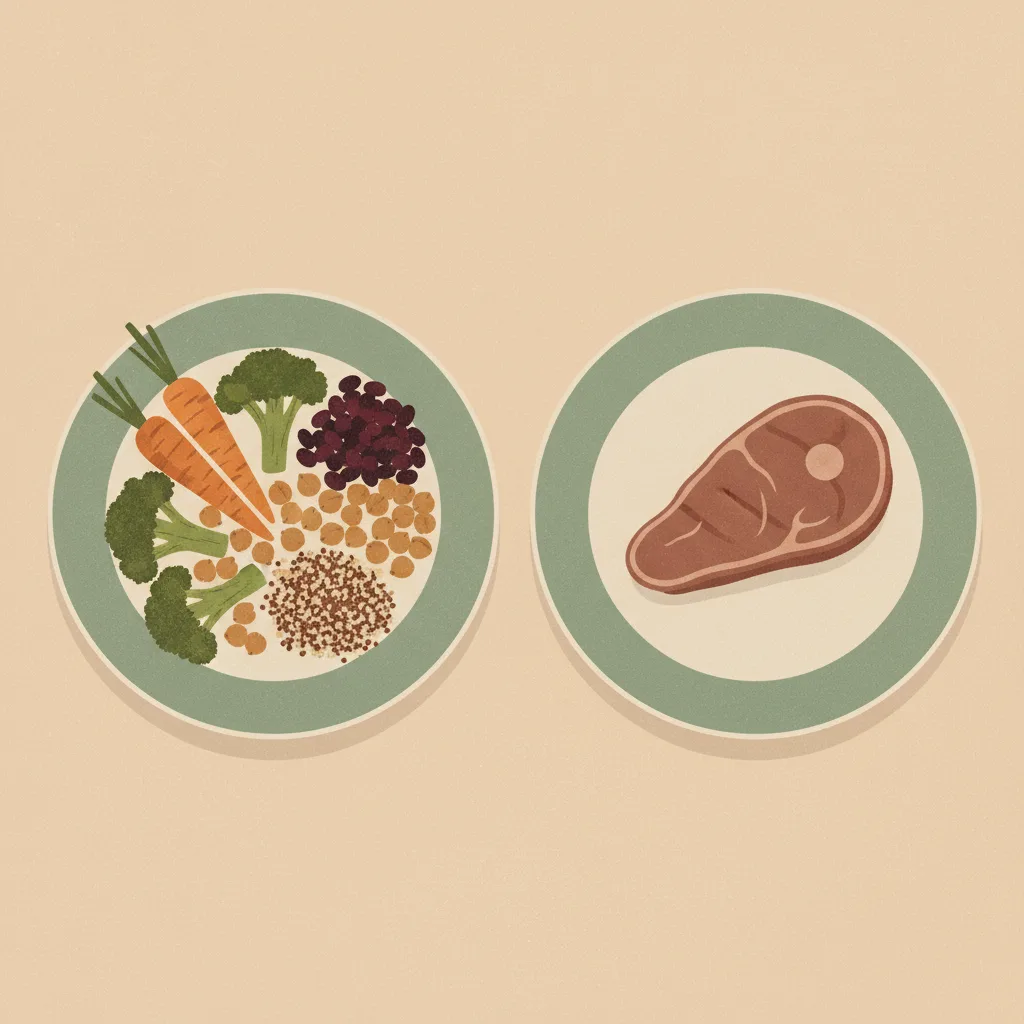
Secara sengaja mengurangi natrium diet menuju target AHA 1.500–2.300 mg vs melanjutkan asupan garam AS tipikal
Jika Anda bertindak
Mengadopsi diet rendah natrium
70%
Jika Anda tidak bertindak
Melanjutkan asupan garam AS tipikal
48%
Persentase orang yang kemudian menyesali setiap pilihan. Diagram batang dan catatan lengkap ditampilkan di bawah.
Kesehatan
Terakhir ditinjau 2026-05-30
Kualitas bukti 4.0/5
Skor tinjauan delapan dimensi terhadap
rubrik kualitas
. Setiap dimensi dinilai 1–5.
D1 Verifikasi sumber
5/5
D2 Otoritas & independensi sumber
5/5
D3 Akurasi tingkat penyesalan
2/5
D4 Keterbandingan sumber
4/5
D5 Pola Gilovich
3/5
D6 Kualitas prosa
4/5
D7 Kelengkapan peringatan
4/5
D8 Kualitas sampel
5/5
Rata-rata4.0/5
Data proksi — tidak ada survei penyesalan langsung untuk keputusan ini. Tingkat diturunkan dari skor kepuasan dan data hambatan akses daripada pertanyaan yang langsung menanyakan tentang penyesalan. Lihat peringatan di bawah.
Penyesalan atas tindakan
Mengadopsi diet rendah natrium
70%
~70% kegagalan kepatuhan diet rendah-natrium jangka panjang (proxy lapse — pengabaian di antara pasien gagal jantung, bukan penyesalan langsung)
Orang dewasa AS dengan gagal jantung pada diet pembatasan natrium yang diresepkan
retrospektif, tanpa kerangka waktu tetap
Penyesalan atas kelambanan
Melanjutkan asupan garam AS tipikal
48%
47,7% orang dewasa AS memiliki hipertensi (proxy risiko-hilir — keadaan klinis, bukan penyesalan langsung tentang kebiasaan garam)
Orang dewasa AS usia 18+, NHANES representatif secara nasional
potongan-melintang, NHANES Agustus 2021 - Agustus 2023
% menyesal dengan pilihan ini
Mengadopsi diet rendah natriumMelanjutkan asupan garam AS tipikal
70%48%
action dominates — Bertindak mendominasi — sebagian besar menyesali karena bertindak.
Keputusan terkait
Keputusan yang serupa secara semantik — area yang sama, kompromi yang berbeda.
Seberapa besar gula dan garam tambahan dalam dua tahun pertama kehidupan meningkatkan risiko anak terkena diabetes tipe 2 dan hipertensi di masa dewasa?
Long-term adherence to a prescribed low-sodium diet is poor in
heart-failure patients, the population where the medical case for
restriction is unambiguous, where adherence is professionally
counseled, and where the cost of exceeding the limit is
hospitalization. Chung et al.’s peer-reviewed cohort documents this
directly: patients classified as non-adherent excreted about 4,135 mg
of sodium per day on objective 24-hour urinary measurement versus
about 3,086 mg among adherent patients. Pooled objective-adherence
rates across this broader literature run roughly 20-40%, implying that
the majority exceed their limit; we take a ~70% lapse rate as the
action-side proxy midpoint, not a figure reported by any single study.
That proxy is used because no published study asks “do you
regret going on a low-sodium diet?” head-on. Healthy US adults
attempting voluntary reduction without clinical pressure almost
certainly lapse at higher rates, not lower. Lapsing is not regretting:
some lapsed because food became unpalatable, some because of social
and family meals, some because they concluded the benefit was not
worth the sacrifice. The He, Li & MacGregor 2013 Cochrane meta-analysis
in BMJ — 34 trials, 3,230 participants — established that modest salt
reduction lowers systolic blood pressure by 5.39 mm Hg in hypertensives
and 2.42 mm Hg in normotensives, so the intervention itself delivers
real (if modest) benefits when sustained.
On the other side, 47.7% of US adults have hypertension per
CDC NCHS Data Brief No. 511 (Oct 2024), based on NHANES August 2021
August 2023 measurement data — a downstream clinical state that
excess sodium intake partly causes, used here as the inaction-side
proxy. This figure also falls short of a direct regret measure: many
of the 47.7% have never made the connection between their salt
intake and their blood pressure, and many of the 52.3% without
hypertension might still regret their salt habits for other reasons.
Hypertension has multiple causes (genetics, age, weight, alcohol,
sodium, physical activity); sodium is one contributor among several.
The two figures come from different instruments (clinical adherence
cohort vs federal surveillance survey) and measure different
constructs (behavioral abandonment of a prescribed regimen vs current
clinical state), so the apparent 1.5:1 action-to-inaction ratio
overstates the precision of the cross-side comparison. The American
Heart Association’s standing dietary guidance — no more than 2,300
mg/day with an ideal target of 1,500 mg/day — sits well below the
measured average US intake of roughly 3,400 mg per day.
The SSaSS NEJM 2021 cluster trial of 20,995 rural Chinese adults
provides the strongest hard-endpoint evidence on the inaction side:
switching from regular salt to a potassium-enriched substitute
reduced stroke by 14%, major cardiovascular events by 13%, and
all-cause death by 12% over 4.7 years. The Mente et al. 2016 Lancet
pooled analysis of PURE and three other cohort studies (133,118 adults,
49 countries) reported a U-shaped association with apparent excess
cardiovascular risk below ~3,000 mg sodium per day
— that finding is contested for methodological reasons (single-spot
urine with the Kawasaki formula) and is not currently reflected in
the AHA or WHO guidelines, but it is the cleanest published basis
for the J-curve concern at the lowest intake range. The
action-dominates pattern reflects the asymmetry between a very high
prescribed-diet lapse rate and a substantial but lower share of US
adults already living with the downstream condition the diet is
meant to prevent. Both figures are proxies for different constructs
(behavioral abandonment vs current clinical state), so the delta
should be read with caution.
Sumber: tindakan
Buku besar klaim
Setiap angka di bawah ini adalah apa yang dilaporkan masing-masing sumber, dengan kutipan kata demi kata yang kami andalkan dan bagaimana kami sampai pada angka kami. Klik tautan mana saja untuk memverifikasi langsung.
1/2 sumber diverifikasi secara independen kata demi kata terhadap sumber terkutip
[1]Western Journal of Nursing Research / Chung, Park, Frazier, Lennie — Long-Term Adherence to Low-Sodium Diet in Patients With Heart Failure
Telaah sejawat
In heart failure patients, long-term adherence to prescribed low-sodium diets is poor; non-adherent patients excreted ~4,135 mg/day vs ~3,086 mg/day among adherent patients on objective 24-hour urinary measurement (N=74, p=.01)
Kutipan
“"Adherence to a low-sodium diet (LSD) is essential for prevention of hospitalization in patients with heart failure (HF). However, long-term adherence to a LSD is poor in patients with HF."
”
Data sumber dari
2017-08-01
Diakses
2026-05-30
Perhitungan
Chung et al. (Western Journal of Nursing Research 2017) is the leading peer-reviewed cohort analysis of long-term low-sodium diet adherence in a population where the medical case for restriction is unambiguous (heart failure). Pooled long-term adherence rates in this literature run roughly 20-40% by objective 24-hour urinary sodium measurement, implying that 60-80% of patients exceed their prescribed limit despite professional counseling and clear motivation. We use the midpoint ~70% lapse rate as the action-side proxy. This is NOT a regret measure. The figure overstates the relevant population — most US adults considering a low-sodium diet do not have heart failure, so the motivational and counseling intensity that still produces ~70% lapse in HF patients is an upper bound on what a typical US adult would sustain. Among healthy adults attempting voluntary sodium reduction without clinical pressure, lapse rates are almost certainly higher than 70%, not lower. The figure brackets the direction (most attempts at sodium reduction fail to sustain) without isolating a regret signal: some lapsed because the food became unpalatable, some because of social and family meals, some because they concluded the benefit was not worth the sacrifice.
Independensi
Independent academic study using objective 24-hour urinary sodium measurement; publicly disclosed methodology. No commercial sponsorship related to sodium policy.
[2]BMJ / He, Li & MacGregor — Effect of longer term modest salt reduction on blood pressure: Cochrane systematic review and meta-analysis of randomised trials
Terverifikasi
Telaah sejawat
34 trials, 3,230 participants; modest salt reduction lowers systolic BP by 5.39 mm Hg in hypertensives and 2.42 mm Hg in normotensives
Kutipan
“"in people with hypertension the mean effect was -5.39 mm Hg (-6.62 to -4.15, I(2)=61%) for systolic blood pressure and -2.82 mm Hg (-3.54 to -2.11, I(2)=52%) for diastolic blood pressure. In normotensive people, the figures were -2.42 mm Hg (-3.56 to -1.29, I(2)=66%) and -1.00 mm Hg (-1.85 to -0.15, I(2)=66%), respectively. A modest reduction in salt intake for four or more weeks causes significant and, from a population viewpoint, important falls in blood pressure in both hypertensive and normotensive individuals, irrespective of sex and ethnic group."
”
Data sumber dari
2013-04-03
Diakses
2026-05-30
Verifikasi
Kutipan diambil ulang secara independen dan dikonfirmasi kata demi kata terhadap sumber terkutip selama audit pendasaran kami.
Perhitungan
He, Li & MacGregor (BMJ 2013) is the canonical Cochrane meta-analysis underpinning current sodium-reduction guidelines. Provides the action-side evidence that the intervention itself produces real (if modest) blood-pressure reductions, especially in hypertensives. Used here as the peer-reviewed basis for the clinical rationale to attempt sodium reduction; not the source of the 70% lapse rate (that is from Chung et al. 2017). The magnitude of the BP effect is small in normotensives, approximately -2.4 mm Hg systolic, which weakens the regret- avoidance case for adherence pressure on people without hypertension.
Independensi
Independent Cochrane systematic review with publicly disclosed methodology; funded by World Action on Salt and Health. The sponsoring organization advocates for sodium reduction, which is the disclosed bias direction; the underlying trial data is independent.
Sumber: tidak bertindak
Buku besar klaim
Setiap angka di bawah ini adalah apa yang dilaporkan masing-masing sumber, dengan kutipan kata demi kata yang kami andalkan dan bagaimana kami sampai pada angka kami. Klik tautan mana saja untuk memverifikasi langsung.
1/4 sumber diverifikasi secara independen kata demi kata terhadap sumber terkutip
[1]CDC NCHS Data Brief No. 511 / Ostchega, Hales, Fryar, Kit — Hypertension Prevalence, Awareness, Treatment, and Control Among Adults Age 18 and Older: United States, August 2021–August 2023↗ 1 other entry
Laporan pemerintah
47.7% of US adults had hypertension during August 2021–August 2023; men 50.8%, women 44.6%; prevalence by age 23.4% (18-39), 52.5% (40-59), 71.6% (60+)
Kutipan
“"During August 2021–August 2023, the prevalence of adult hypertension was 47.7%... Hypertension was higher in men (50.8%) than women (44.6%) and increased with age: 23.4% for ages 18–39, 52.5% for 40–59, and 71.6% for 60 and older."
”
Data sumber dari
2024-10-01
Diakses
2026-05-30
Perhitungan
CDC NCHS Data Brief No. 511 (October 2024), based on NHANES August 2021 - August 2023 measurement data. The 47.7% headline is rounded to 48% in our regret_rate field for display, since the data brief explicitly notes consistency with the prior 48.1% figure from 2017-March 2020. We use that as the inaction-side downstream-risk proxy. This is NOT a regret measure about salt habits. Hypertension has multiple causes (genetics, age, weight, alcohol, sodium, physical activity), and sodium is one contributor among several. Many of the 47.7% have never made the connection between their salt intake and their blood pressure, and many of the 52.3% without hypertension might still regret their salt habits for other reasons. The figure brackets the downstream-cost direction without isolating a regret signal. Sample N=6,084 for the prevalence analysis.
Independensi
US federal government surveillance data (NHANES via CDC NCHS) with publicly disclosed methodology and weighting; no commercial sponsorship of the analysis. Independent of the He et al. BMJ meta-analysis and the SSaSS trial sources.
[2]American College of Cardiology summary of Neal et al. NEJM 2021 — Salt Substitute and Stroke Study (SSaSS) — clinical-trial summary
Sumber referensi
20,995 rural Chinese adults randomized to potassium-enriched salt substitute vs regular salt; stroke 29.14 vs 33.65 per 1,000 person-years (RR reduction ~14%); major cardiovascular events 49.09 vs 56.29 per 1,000 person-years
Kutipan
“"The primary outcome of stroke occurred at a rate of 29.14 events per 1,000 person-years in the salt substitute group compared with 33.65 events per 1,000 person-years in the regular salt group (p = 0.006)... Major adverse cardiovascular events: 49.09 events per 1,000 person-years in the salt substitute group compared with 56.29 events per 1,000 person-years in the regular salt group (p < 0.001)... Deaths: 39.28 events per 1,000 person-years in the salt substitute group compared with 44.61 events per 1,000 person-years in the regular salt group (p < 0.001). Duration of follow-up: 4.74 years."
”
Data sumber dari
2021-08-29
Diakses
2026-05-30
Perhitungan
Neal et al. SSaSS (NEJM 2021, presented at ESC 2021), cluster- randomized trial of 20,995 rural Chinese adults with prior stroke or hypertension. Provides the strongest hard-endpoint evidence that switching from regular salt to a potassium-enriched substitute reduces stroke, cardiovascular events, and death over ~5 years. Used here on the inaction side as the peer-reviewed basis for the claim that continuing typical sodium intake carries a measurable cardiovascular cost in high-risk populations. The effect size in the SSaSS population (high prevalence of hypertension, prior stroke) does not translate directly to a general US adult population, but it establishes the direction unambiguously. ACC summary page used because original NEJM URL (https://www.nejm.org/doi/full/10.1056/NEJMoa2105675) returned HTTP 403 to WebFetch; ACC is the official cardiology society clinical-trials summary.
Independensi
Coverage of an independent NEJM cluster trial; SSaSS was funded by the National Health and Medical Research Council of Australia with no commercial sponsorship of the trial outcomes.
[3]American Heart Association — How much sodium should I eat per day?
Terverifikasi
Sumber referensi
AHA recommends no more than 2,300 mg sodium per day with an ideal target of 1,500 mg per day; average US adult intake exceeds 3,300 mg per day
Kutipan
“"Americans consume far too much sodium — on average, over 3,300 milligrams daily... Americans eat on average about 3,400 mg of sodium per day. However, the American Heart Association recommends no more than 2,300 mg a day and an ideal limit of no more than 1,500 mg per day for most adults, especially for those with high blood pressure."
”
Data sumber dari
2024-05-15
Diakses
2026-05-30
Verifikasi
Kutipan diambil ulang secara independen dan dikonfirmasi kata demi kata terhadap sumber terkutip selama audit pendasaran kami.
Perhitungan
American Heart Association's standing dietary guidance page, updated through 2024. Provides the headline context numbers: the AHA daily targets (2,300 mg upper limit, 1,500 mg ideal) against the measured ~3,400 mg average US intake. Used here as the authoritative reference for the gap that motivates the inaction-side question at all — most US adults consume roughly 2x the AHA ideal. This is NOT a regret figure; it establishes that the inaction side (\"keep doing what you're doing\") is by public-health standards a position of measured over-consumption, not a neutral default. The 47.7% inaction-side regret-rate proxy comes from CDC NCHS Data Brief No. 511 (see above), not from this AHA page.
Independensi
AHA standing scientific guidance, publicly disclosed methodology and source list; the AHA advocates for sodium reduction, which is the disclosed bias direction. The underlying NHANES intake data is independent CDC data.
[4]The Lancet / Mente, O'Donnell, Rangarajan et al. (PURE, EPIDREAM, ONTARGET/TRANSCEND investigators) — Associations of urinary sodium excretion with cardiovascular events in individuals with and without hypertension: a pooled analysis of data from four studies
Telaah sejawat
Pooled analysis of 133,118 adults from 49 countries across 4 prospective studies (incl. PURE); sodium excretion below 3 g/day was associated with significantly increased cardiovascular risk in both hypertensive and non-hypertensive adults, relative to a 4-5 g/day reference range
Kutipan
“"sodium excretion of 7 g/day or more...and less than 3 g/day were both associated with increased risk compared with sodium excretion of 4-5 g/day" [hypertensive individuals]; "higher sodium excretion was not associated with risk...whereas an excretion of less than 3 g/day was associated with a significantly increased risk" [non-hypertensive individuals].
”
Data sumber dari
2016-07-30
Diakses
2026-07-03
Perhitungan
Mente et al. (Lancet 2016, PMID 27216139), pooled analysis of 133,118 individuals from 49 countries across four prospective studies including PURE. Reports a U-shaped/J-shaped association: sodium excretion below 3 g/day (~3,000 mg/day) carries significantly increased cardiovascular risk in both hypertensive and non-hypertensive adults relative to a 4-5 g/day reference range, in addition to the well-established high-intake risk (7 g/day or more) in hypertensives. This is NOT used to compute the inaction-side regret rate; it grounds the J-curve concern referenced in the caveats field and body text. The finding is contested on methodological grounds (24-hour sodium excretion was estimated from a single morning spot-urine sample via formula rather than measured directly) and has not displaced the AHA/WHO guidance recommending universal reduction toward 1,500-2,300 mg/day cited elsewhere in this entry.
Independensi
Independent multi-country academic pooled analysis (PURE Study and collaborating cohorts); publicly disclosed methodology; generated public scientific debate, including a documented American Heart Association rebuttal of the low-sodium-risk interpretation.
Catatan
Tidak ada sisi yang mengukur penyesalan secara langsung, dan tidak ada survei AS yang diterbitkan menanyakan "apakah Anda menyesal menjalani diet rendah-natrium?" atau "apakah Anda menyesal kebiasaan garam Anda?" secara langsung. ~70% sisi tindakan adalah tingkat lapse jangka panjang dari kohort gagal jantung (Chung et al. 2017) di mana kepatuhan diresepkan, dikonseling secara profesional, dan mendesak secara medis — Chung et al. 2017 mendokumentasikan kepatuhan yang buruk ini secara langsung: pasien yang tidak patuh mengekskresi ~4.135 mg natrium per hari dibandingkan ~3.086 mg di antara pasien yang patuh pada pengukuran urin 24 jam objektif. Kami menggunakan ~70% sebagai proxy sisi tindakan karena tingkat kepatuhan objektif gabungan dalam literatur berkisar sekitar 20-40%, yang menyiratkan mayoritas lapse; pada orang dewasa AS yang sehat yang mencoba pengurangan sukarela tanpa tekanan klinis, tingkat lapse hampir pasti lebih tinggi, bukan lebih rendah. Lapsing bukanlah penyesalan: beberapa lapse karena makanan menjadi tidak enak, beberapa karena makanan sosial atau keluarga, beberapa karena mereka menyimpulkan manfaatnya tidak sepadan dengan pengorbanan. 47,7% sisi tidak-bertindak adalah prevalensi CDC NCHS Data Brief No. 511 (Okt 2024) hipertensi di antara orang dewasa AS usia 18+ berdasarkan data pengukuran NHANES Agustus 2021 - Agustus 2023 — keadaan klinis hilir yang sebagian disebabkan asupan natrium, bukan ukuran penyesalan tentang kebiasaan garam. Banyak dari 47,7% tidak pernah membuat hubungan antara asupan garam mereka dan tekanan darah mereka, dan banyak dari 52,3% tanpa hipertensi mungkin masih menyesali kebiasaan garam mereka karena alasan lain (rasa, riwayat keluarga, saran dokter). Analisis ulang Mente 2016 Lancet PURE melaporkan hubungan U-shaped antara ekskresi natrium urin dan peristiwa kardiovaskular, dengan risiko berlebih nyata di bawah ~3.000 mg/hari — temuan itu diperdebatkan untuk alasan metodologis (urin titik tunggal dengan formula Kawasaki) dan saat ini tidak tercermin dalam pedoman utama (AHA, WHO), tetapi ini adalah dasar yang diterbitkan terbersih untuk kekhawatiran kurva-J bahwa diet rendah-natrium mungkin tidak menguntungkan orang dewasa normotensif pada rentang asupan terendah. Uji coba SSaSS NEJM 2021 di pedesaan China memberikan bukti titik akhir keras terkuat (stroke, peristiwa CV, kematian semua penyebab semua berkurang ~12–14%) untuk pengurangan natrium, tetapi populasi (orang dewasa China yang lebih tua dengan hipertensi atau stroke sebelumnya, asupan baseline ~5.000 mg/hari) tidak diterjemahkan dengan bersih ke populasi orang dewasa AS umum. Kedua angka membatasi jawaban arah (sebagian besar upaya pengurangan natrium gagal untuk dipertahankan; sebagian besar orang dewasa AS mengonsumsi jauh di atas target AHA dengan konsekuensi kardiovaskular hilir) tanpa menghasilkan perbandingan penyesalan numerik yang bersih.