
Lewati ke konten
Likelier

Penyesalan bertindak vs. tidak bertindak

Menyekolahkan anak di sekolah swasta vs negeri

Jika Anda bertindak

Sekolah swasta

13%

Jika Anda tidak bertindak

Sekolah negeri

41%

Persentase orang yang kemudian menyesali setiap pilihan. Diagram batang dan catatan lengkap ditampilkan di bawah.


Family

Terakhir ditinjau 2026-04-26

Kualitas bukti 4.38/5

Skor tinjauan delapan dimensi terhadap rubrik kualitas . Setiap dimensi dinilai 1–5.

D1 Verifikasi sumber
5/5
D2 Otoritas & independensi sumber
4/5
D3 Akurasi tingkat penyesalan
2/5
D4 Keterbandingan sumber
5/5
D5 Pola Gilovich
5/5
D6 Kualitas prosa
5/5
D7 Kelengkapan peringatan
5/5
D8 Kualitas sampel
4/5
Rata-rata 4.38/5
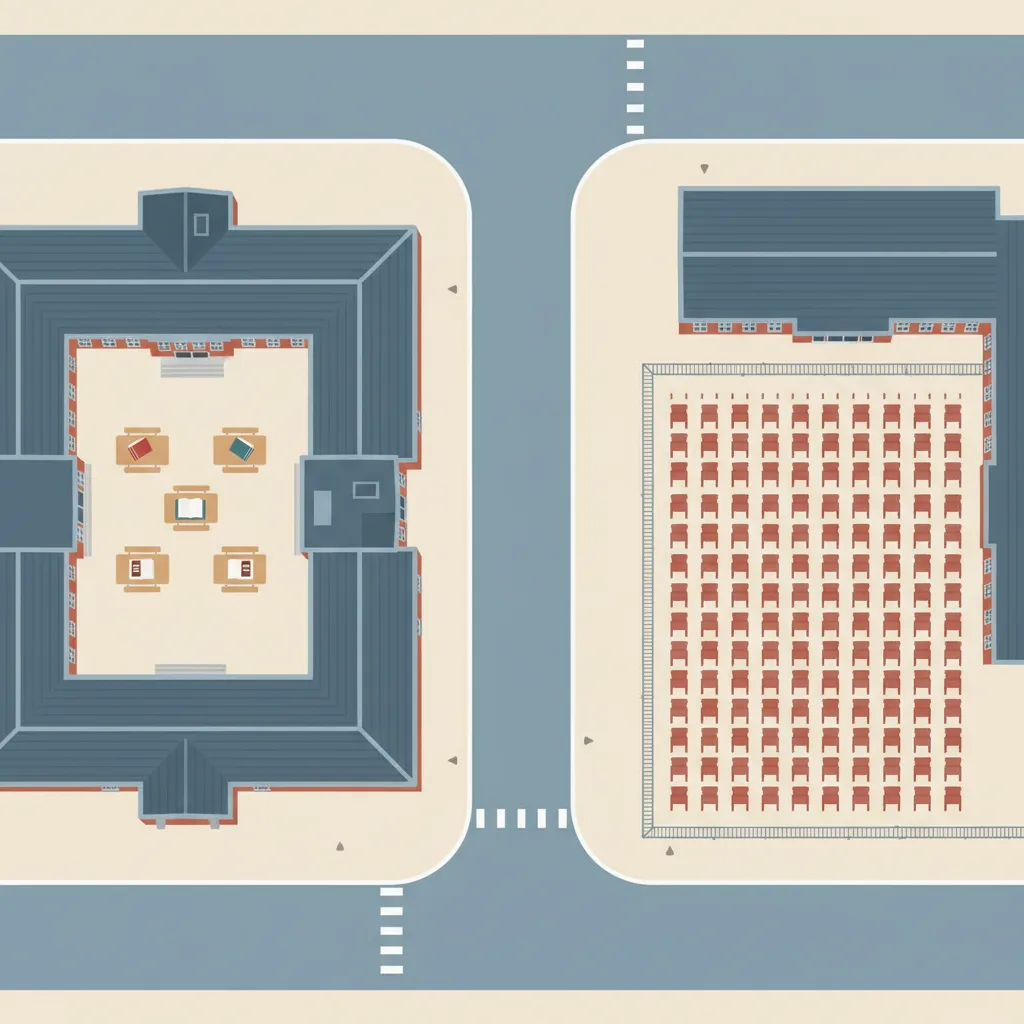
Two school buildings side by side, one with a small class and one with a large crowd, seen from above.

Penyesalan atas tindakan

Sekolah swasta

13%

13% orang tua sekolah swasta tidak akan memilih sekolah yang sama lagi (proksi)

Orang tua AS siswa K-12, representatif nasional

retrospektif, tidak ada kerangka waktu tetap

Penyesalan atas kelambanan

Sekolah negeri

41%

41% orang tua sekolah umum tidak akan memilih sekolah yang sama lagi (proksi)

Orang tua AS siswa K-12, representatif nasional

retrospektif, tidak ada kerangka waktu tetap

% menyesal dengan pilihan ini

inaction dominates — Tidak bertindak mendominasi — sebagian besar menyesali karena tidak bertindak.

Keputusan terkait

Keputusan yang serupa secara semantik — area yang sama, kompromi yang berbeda.

family

Di rumah vs bekerja

% menyesal dengan pilihan ini

Tindakan mendominasi

Penyesalan bertindak 1.3× lebih tinggi

family

Kegiatan terstruktur vs bermain bebas

% menyesal dengan pilihan ini

Tindakan mendominasi

Penyesalan bertindak 2.6× lebih tinggi

family

Ukuran keluarga

% menyesal dengan pilihan ini

Ketidakaktifan mendominasi

Penyesalan tidak bertindak 2.6× lebih tinggi

family

Menolong vs. biarkan mandiri

% menyesal dengan pilihan ini

Tindakan mendominasi

Penyesalan bertindak 1.2× lebih tinggi

family

Makan bersama keluarga

% menyesal dengan pilihan ini

Ketidakaktifan mendominasi

Penyesalan tidak bertindak 6.9× lebih tinggi

family

Biarkan berhenti vs. selesaikan

% menyesal dengan pilihan ini

Ketidakaktifan mendominasi

Penyesalan tidak bertindak 2.3× lebih tinggi

familyLangsung

Akses media sosial anak

% menyesal dengan pilihan ini

Tindakan mendominasi

Penyesalan bertindak 5.4× lebih tinggi

family

Bebas vs. pengawasan ketat

% menyesal dengan pilihan ini

Tindakan mendominasi

Penyesalan bertindak 2.3× lebih tinggi

41% of traditional public-school parents say they would not choose the same school again, according to a nationally representative 50CAN/Edge Research survey. Among private-school parents the figure is only 13% — more than three times lower. Pew Research corroborates the gap from a different angle: 79% of private-school families report high satisfaction with educational quality, compared with 55% of public-school families. Neither instrument measures regret directly, but the consistency across surveys and constructs suggests the asymmetry is real, not an artifact of question wording.

The demand-side data makes the inaction story sharper. EdChoice’s 2024 Schooling in America survey found that 36% of parents would prefer private school, yet only 9% actually enroll — a 4:1 gap driven almost entirely by tuition costs and geographic access. That gap complicates the Gilovich framing: most public-school “inaction” is involuntary, constrained by money rather than by indecision. A parent who cannot afford private school and later wishes they could have is experiencing frustrated aspiration, not the freely-chosen inaction that typically intensifies over time in the regret literature.

Selection bias is the largest confounder. Private-school families are wealthier, more likely to have two parents in the household, and more educationally engaged on every metric NCES tracks. Their higher satisfaction may reflect resources and involvement rather than anything intrinsic to private schooling. Randomized voucher studies (e.g., Milwaukee, DC Opportunity Scholarship) show modest academic gains and higher parental satisfaction, but the effect sizes are far smaller than the raw satisfaction gap implies. The directional finding — parents who chose private school regret it less — holds up; the magnitude should be read with the income gradient firmly in mind.

Sumber: tindakan

Buku besar klaim

Setiap angka di bawah ini adalah apa yang dilaporkan masing-masing sumber, dengan kutipan kata demi kata yang kami andalkan dan bagaimana kami sampai pada angka kami. Klik tautan mana saja untuk memverifikasi langsung.

2/2 sumber diverifikasi secara independen kata demi kata terhadap sumber terkutip

  1. [1] 50CAN / Edge Research — The State of Educational Opportunity in America Terverifikasi
    The State of Educational Opportunity in America
    Statistik
    87% of private-school parents would choose the same school again, vs 59% of traditional public-school parents
    Kutipan
    “"87 percent of private school parents and 82 percent of parochial/religious school parents would make the same choice, while the number drops to 59 percent for traditional public school parents." ”
    Data sumber dari
    2024-10-15
    Diakses
    2026-04-26
    Verifikasi
    Kutipan diambil ulang secara independen dan dikonfirmasi kata demi kata terhadap sumber terkutip selama audit pendasaran kami.
    Perhitungan
    50CAN / Edge Research national survey. We derive action-regret as 1 − 0.87 = 0.13 (13% would not choose the same school). This is a proxy for regret — "would not choose again" conflates dissatisfaction, changed circumstances, and active regret.
  2. [2] Pew Research Center — Parents differ sharply by party over what their K-12 children should learn in school Terverifikasi
    Parents differ sharply by party over what their K-12 children should learn in school
    Statistik
    79% of private-school parents report high satisfaction with the quality of their child's education, vs 55% of public-school parents
    Kutipan
    “"About eight-in-ten parents answering about a child in private school (79%) express high levels of satisfaction with the quality of education their child is receiving, compared with a narrower majority (55%) of those answering about a child who is in public school." ”
    Data sumber dari
    2022-10-26
    Diakses
    2026-04-26
    Verifikasi
    Kutipan diambil ulang secara independen dan dikonfirmasi kata demi kata terhadap sumber terkutip selama audit pendasaran kami.
    Perhitungan
    Pew Research Center survey of U.S. parents of K-12 children (fielded Oct 2022). The 79% vs 55% satisfaction gap corroborates the 50CAN "would choose again" differential but measures a different construct (satisfaction vs hypothetical re-choice).

Sumber: tidak bertindak

Buku besar klaim

Setiap angka di bawah ini adalah apa yang dilaporkan masing-masing sumber, dengan kutipan kata demi kata yang kami andalkan dan bagaimana kami sampai pada angka kami. Klik tautan mana saja untuk memverifikasi langsung.

1/2 sumber diverifikasi secara independen kata demi kata terhadap sumber terkutip

  1. [1] 50CAN / Edge Research — The State of Educational Opportunity in America
    The State of Educational Opportunity in America
    Statistik
    Only 59% of traditional public-school parents would choose the same school again
    Kutipan
    “"87 percent of private school parents would make the same choice, while the number drops to 59 percent for traditional public school parents." ”
    Data sumber dari
    2024-10-15
    Diakses
    2026-04-26
    Perhitungan
    Inaction-regret derived as 1 − 0.59 = 0.41. The 41% includes parents who would switch to private, charter, magnet, or homeschool — not exclusively to private school. This overstates the "wish I'd gone private" sentiment specifically.
  2. [2] EdChoice — Beyond Enrollment: What Parents Really Want from Their Children's Education Terverifikasi
    Beyond Enrollment: What Parents Really Want from Their Children's Education
    Statistik
    36% of parents would most like to enroll in private school, but only 9% actually do
    Kutipan
    “"The most popular schooling option was private schooling, with over a third of parents (36%) stating they would most like to enroll their children that way. This is four times the rate of students enrolled in private schools (9%)." ”
    Data sumber dari
    2024-08-01
    Diakses
    2026-04-26
    Verifikasi
    Kutipan diambil ulang secara independen dan dikonfirmasi kata demi kata terhadap sumber terkutip selama audit pendasaran kami.
    Perhitungan
    EdChoice 2024 Schooling in America Survey, n = 2,319 parents. The 4:1 ratio between stated preference and actual enrollment signals a large pool of constrained inaction — parents who want private school but face cost, location, or admissions barriers. This contextualizes but does not directly measure regret.

Catatan

Kedua sisi mengambil dari survei 50CAN/Edge Research yang sama, sehingga perbandingan tingkat-penyesalan secara internal konsisten, tetapi pertanyaan "akankah Anda memilih sekolah yang sama lagi" menggabungkan penyesalan dengan perubahan keadaan — orang tua yang pindah lingkungan mungkin menjawab "tidak" tanpa menyesali keputusan asli. Data kepuasan NCES (79% vs 55%) menggunakan instrumen dan tahun yang berbeda (2019 vs 2024). Bias seleksi adalah gajah: keluarga yang membayar uang sekolah swasta lebih kaya dan lebih terlibat dalam pendidikan; kepuasan mereka yang lebih tinggi dapat mencerminkan pendapatan dan keterlibatan. Kesenjangan EdChoice 36% inginkan vs 9% terdaftar menunjukkan biaya adalah hambatan utama, yang berarti non-tindakan di sini sering tidak sukarela.

Data mentah: /api/decisions.json

Baru-baru ini dilihat di perangkat ini