






Lewati ke konten
Likelier

Penyesalan bertindak vs. tidak bertindak

Kuliah di universitas swasta vs memilih universitas negeri yang setara

Jika Anda bertindak

Universitas swasta empat tahun

17%

Jika Anda tidak bertindak

Universitas negeri empat tahun

14%

Persentase orang yang kemudian menyesali setiap pilihan. Diagram batang dan catatan lengkap ditampilkan di bawah.


Career

Terakhir ditinjau 2026-05-01

Kualitas bukti 4.38/5

Skor tinjauan delapan dimensi terhadap rubrik kualitas . Setiap dimensi dinilai 1–5.

D1 Verifikasi sumber
5/5
D2 Otoritas & independensi sumber
4/5
D3 Akurasi tingkat penyesalan
2/5
D4 Keterbandingan sumber
5/5
D5 Pola Gilovich
5/5
D6 Kualitas prosa
5/5
D7 Kelengkapan peringatan
5/5
D8 Kualitas sampel
4/5
Rata-rata 4.38/5
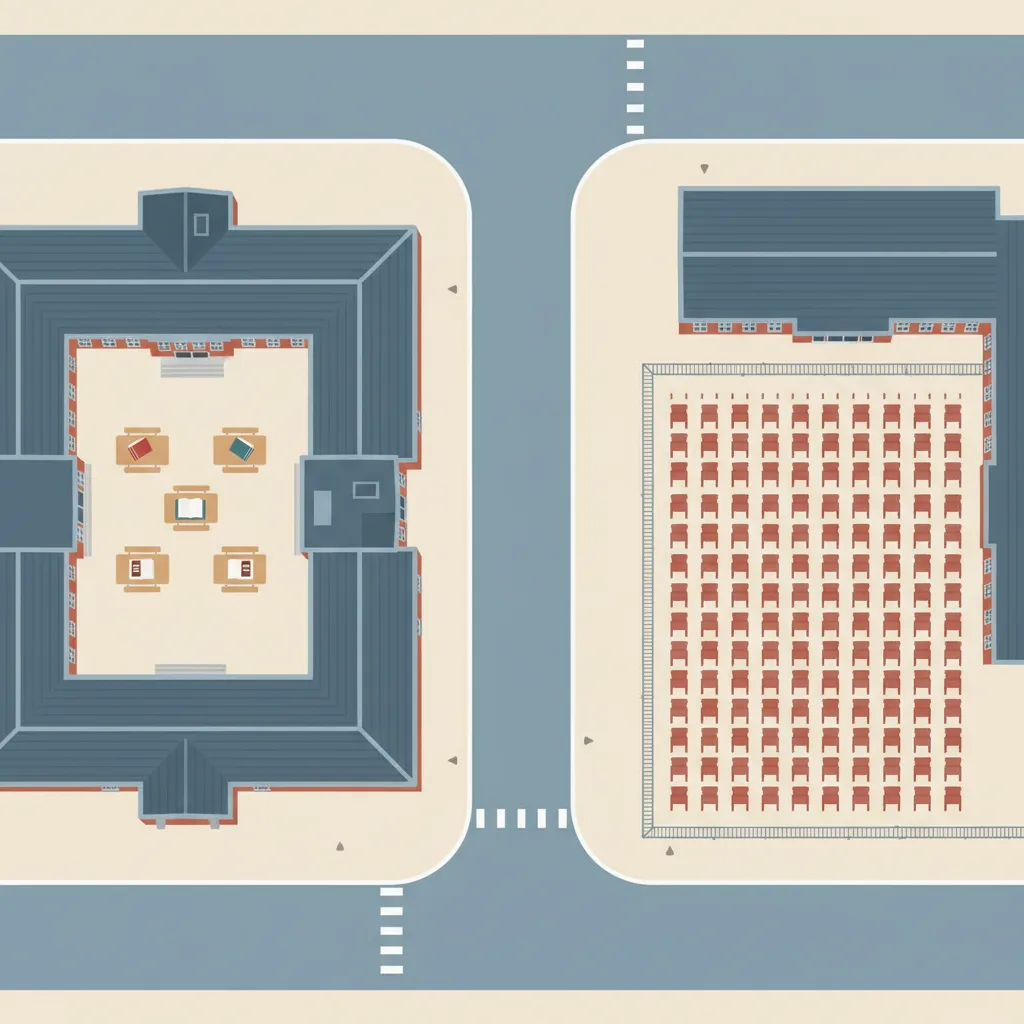
Two university campuses seen from above, one with a manicured courtyard and one with a sprawling modern campus.

Penyesalan atas tindakan

Universitas swasta empat tahun

17%

17% lulusan perguruan tinggi swasta mengatakan gelar mereka tidak sebanding dengan biaya keuangan (proksi)

Orang dewasa AS yang menghadiri perguruan tinggi nirlaba swasta empat tahun, representatif nasional

retrospektif, tidak ada kerangka waktu tetap

Penyesalan atas kelambanan

Universitas negeri empat tahun

14%

14% lulusan perguruan tinggi umum mengatakan gelar mereka tidak sebanding dengan biaya keuangan (proksi)

Orang dewasa AS yang menghadiri perguruan tinggi umum empat tahun, representatif nasional

retrospektif, tidak ada kerangka waktu tetap

% menyesal dengan pilihan ini

balanced — Cukup seimbang — kedua pilihan membawa penyesalan serupa.

Keputusan terkait

Keputusan yang serupa secara semantik — area yang sama, kompromi yang berbeda.

careerLangsung

Putus kuliah vs. selesaikan gelar

% menyesal dengan pilihan ini

Tindakan mendominasi

Penyesalan bertindak 1.1× lebih tinggi

careerLangsung

Jurusan kuliah

% menyesal dengan pilihan ini

Ketidakaktifan mendominasi

Penyesalan tidak bertindak 1.6× lebih tinggi

career

Keputusan kuliah

% menyesal dengan pilihan ini

Tindakan mendominasi

Penyesalan bertindak 1.2× lebih tinggi

Keuangan

Utang mahasiswa vs. jalur lebih murah

% menyesal dengan pilihan ini

Ketidakaktifan mendominasi

Penyesalan tidak bertindak 1.3× lebih tinggi

career

Tugas sekolah ditulis AI

% menyesal dengan pilihan ini

Seimbang

Hampir seimbang

family

Swasta vs negeri

% menyesal dengan pilihan ini

Ketidakaktifan mendominasi

Penyesalan tidak bertindak 3.2× lebih tinggi

career

Negosiasi gaji

% menyesal dengan pilihan ini

Ketidakaktifan mendominasi

Penyesalan tidak bertindak 1.2× lebih tinggi

career

Korea: layanan sipil vs. sektor swasta

% menyesal dengan pilihan ini

Tindakan mendominasi

Penyesalan bertindak 1.6× lebih tinggi

Only 17% of private-university graduates had not yet seen a financial payoff from their degree, compared with 14% of public-university graduates, according to a 2014 Pew Research Center survey of 2,002 US adults. The difference is three percentage points — within the margin of error — making this one of the clearest “balanced” findings in the regret literature. This is a payoff-to-date question, not a direct “was it worth the cost” regret item: of the 17% of private graduates without a payoff yet, a further 5% told Pew they expect their education to pay off in the future, leaving only about 12% who said it will not pay off or were unsure (about 7% for public graduates). Both groups overwhelmingly report that college paid off, and neither camp shows the sustained, growing regret that Gilovich and Medvec associate with the inaction side of most long-term dilemmas.

A useful corroborating data point comes from the Strada-Gallup Education Consumer Pulse survey of approximately 90,000 US adults: 28% of respondents said they would choose a different institution if they could decide again, compared with 36% who would choose a different field of study. The survey does not break its findings out by public-versus-private attendance, so it cannot confirm or refute an asymmetry between the two — but it does suggest that institution-choice regret is real yet secondary to field-of-study regret, which is consistent with the Pew finding that the public/private gap is small enough to sit inside the margin of error.

Three limitations shape how this entry should be read. First, the primary data are from 2013, before the steepest phase of private-tuition growth and the student-debt expansion of the late 2010s; contemporary graduates carrying larger private-school debt loads may show a larger asymmetry. Second, both figures measure satisfaction retrospectively from a population that successfully graduated; students who enrolled at private universities and did not complete their degree are absent and likely report higher regret. Third, this entry is specific to the United States, where a sharp public/private cost divide exists. In most of Europe, the financial and prestige gap between private and public higher education is structured differently, and these numbers do not transfer.

Sumber: tindakan

Buku besar klaim

Setiap angka di bawah ini adalah apa yang dilaporkan masing-masing sumber, dengan kutipan kata demi kata yang kami andalkan dan bagaimana kami sampai pada angka kami. Klik tautan mana saja untuk memverifikasi langsung.

  1. [1] Pew Research Center — Public and private college grads about equal in satisfaction with their lives
    Public and private college grads about equal in satisfaction with their lives
    Statistik
    83% of private college graduates and 86% of public college graduates said they had already seen a payoff from their education
    Kutipan
    “"Roughly equal shares of 83% among private school graduates and 86% among public school graduates said they had already seen a payoff." ”
    Data sumber dari
    2014-05-19
    Diakses
    2026-05-01
    Perhitungan
    Pew Research survey of 2,002 US adults conducted Oct 7-27, 2013. Action proxy derived as 1 - 0.83 = 0.17 (17% of private-college graduates had not yet seen a financial payoff from their education). This is a payoff-to-date perception, NOT a direct "was it worth the cost" regret measure. The 17% is not all dissatisfied: Pew reports a further 5% of private graduates "expect to see their educations pay off in the future", so the share who said it will not pay off or are unsure is the remainder, roughly 12%. Survey covered all college graduates; selection between private and public was not controlled. Subgroup sample sizes for private-college and public-college respondents within the n=2,002 survey are not separately reported; per-subgroup margin of error is wider than the approximately plus-or-minus 2.5 pp noted for the full sample.
  2. [2] Gallup / Strada Education Network — Half of U.S. Adults Would Change at Least One Education Decision
    Half of U.S. Adults Would Change at Least One Education Decision

    See all 4 Likelier entries citing this source →

    Statistik
    51% of US adults would change at least one aspect of their education experience; 28% would select a different institution
    Kutipan
    “"Fifty-one percent of U.S. adults would change at least one aspect of their education experience. Significantly fewer (28%) would select a different institution." ”
    Data sumber dari
    2017-06-01
    Diakses
    2026-05-01
    Perhitungan
    Strada-Gallup Education Consumer Pulse survey, n approximately 90,000 US adults, June 2016 through March 2017. Report does not isolate private-4yr vs public-4yr regret rates as separate figures; used here as corroboration that institution-choice regret exists but is secondary to field-of-study regret.

Sumber: tidak bertindak

Buku besar klaim

Setiap angka di bawah ini adalah apa yang dilaporkan masing-masing sumber, dengan kutipan kata demi kata yang kami andalkan dan bagaimana kami sampai pada angka kami. Klik tautan mana saja untuk memverifikasi langsung.

  1. [1] Pew Research Center — Public and private college grads about equal in satisfaction with their lives
    Public and private college grads about equal in satisfaction with their lives
    Statistik
    83% of private college graduates and 86% of public college graduates said they had already seen a payoff from their education
    Kutipan
    “"Roughly equal shares of 83% among private school graduates and 86% among public school graduates said they had already seen a payoff." ”
    Data sumber dari
    2014-05-19
    Diakses
    2026-05-01
    Perhitungan
    Same Pew 2013/2014 survey as action_side (n = 2,002). Inaction proxy derived as 1 - 0.86 = 0.14 (14% of public-college graduates had not yet seen a financial payoff from their education). This is a payoff-to-date perception, NOT a direct "was it worth the cost" regret measure. A further 7% of public graduates "expect to see their educations pay off in the future", so the share who said it will not pay off or are unsure is the remainder, roughly 7%. Subgroup sample sizes for private-college and public-college respondents within the n=2,002 survey are not separately reported; per-subgroup margin of error is wider than the approximately plus-or-minus 2.5 pp noted for the full sample.
  2. [2] Gallup / Strada Education Network — Half of U.S. Adults Would Change at Least One Education Decision
    Half of U.S. Adults Would Change at Least One Education Decision

    See all 4 Likelier entries citing this source →

    Statistik
    51% of US adults would change at least one aspect of their education experience; 36% would choose a different field of study; 28% would select a different institution
    Kutipan
    “"Fifty-one percent of U.S. adults would change at least one aspect of their education experience. Thirty-six percent of U.S. adults who pursued or completed a postsecondary degree would choose a different field of study. Significantly fewer (28%) would select a different institution." ”
    Data sumber dari
    2017-06-01
    Diakses
    2026-05-01
    Perhitungan
    The 28% who would choose a different institution includes all institution-type switches and is not specific to public-to-private transitions. Used here to establish that institution-choice regret exists but is secondary to major/field regret.

Catatan

Kedua sisi diambil dari survei Pew 2014 yang sama, membuat perbandingan secara internal konsisten, tetapi survei itu mengukur "apakah itu sebanding dengan investasi keuangan" daripada bertanya langsung tentang penyesalan. Kesenjangan 3 poin persentase berada dalam margin kesalahan survei (sekitar plus-atau-minus 2,5 pp) dan tidak boleh dibaca sebagai bukti bahwa lulusan universitas swasta lebih menyesali pilihan mereka; pembacaan jujur adalah bahwa tingkat kepuasan secara statistik tidak dapat dibedakan. Data berasal dari 2013 dan mendahului akselerasi 2015-2025 dalam biaya kuliah institusi swasta dan pertumbuhan utang siswa. Bias seleksi adalah pembauran terbesar: siswa yang menghadiri universitas swasta berbeda secara sistematis dari rekan universitas umum dalam pendapatan keluarga, persiapan akademis, dan jaringan profesional.

Data mentah: /api/decisions.json

Baru-baru ini dilihat di perangkat ini