


Lewati ke konten
Likelier

Penyesalan bertindak vs. tidak bertindak

Makan bersama keluarga vs makan terpisah terburu-buru

Jika Anda bertindak

Makan bersama keluarga secara rutin

9,0%

Jika Anda tidak bertindak

Makan terpisah/terburu-buru

62%

Persentase orang yang kemudian menyesali setiap pilihan. Diagram batang dan catatan lengkap ditampilkan di bawah.


Family

Terakhir ditinjau 2026-04-26

Kualitas bukti 4.13/5

Skor tinjauan delapan dimensi terhadap rubrik kualitas . Setiap dimensi dinilai 1–5.

D1 Verifikasi sumber
5/5
D2 Otoritas & independensi sumber
4/5
D3 Akurasi tingkat penyesalan
2/5
D4 Keterbandingan sumber
3/5
D5 Pola Gilovich
5/5
D6 Kualitas prosa
5/5
D7 Kelengkapan peringatan
5/5
D8 Kualitas sampel
4/5
Rata-rata 4.13/5
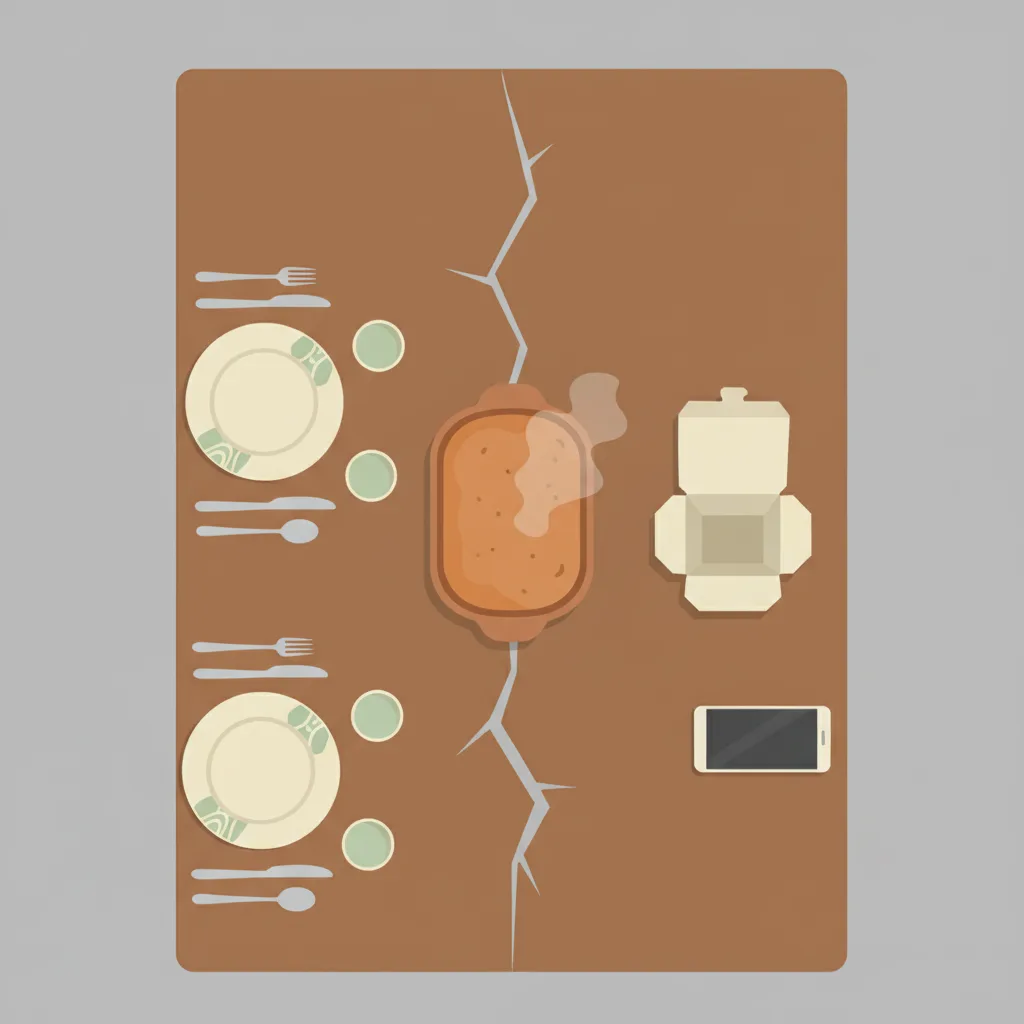
A dining table set for a family meal on one side, a counter with a lone takeout container on the other.

Penyesalan atas tindakan

Makan bersama keluarga secara rutin

9,0%

9% orang tua tidak merasa makan keluarga mengurangi stres (proksi)

Orang dewasa AS, representatif nasional

retrospektif, tidak ada kerangka waktu tetap

Penyesalan atas kelambanan

Makan terpisah/terburu-buru

62%

62% orang tua berharap mereka memiliki makan malam keluarga lebih sering (proksi kesenjangan-aspirasi)

Orang tua AS dengan anak di bawah 18

retrospektif, tidak ada kerangka waktu tetap

% menyesal dengan pilihan ini

inaction dominates — Tidak bertindak mendominasi — sebagian besar menyesali karena tidak bertindak.

Keputusan terkait

Keputusan yang serupa secara semantik — area yang sama, kompromi yang berbeda.

family

Swasta vs negeri

% menyesal dengan pilihan ini

Ketidakaktifan mendominasi

Penyesalan tidak bertindak 3.2× lebih tinggi

family

Di rumah vs bekerja

% menyesal dengan pilihan ini

Tindakan mendominasi

Penyesalan bertindak 1.3× lebih tinggi

family

Menolong vs. biarkan mandiri

% menyesal dengan pilihan ini

Tindakan mendominasi

Penyesalan bertindak 1.2× lebih tinggi

family

Disiplin vs. permisif

% menyesal dengan pilihan ini

Ketidakaktifan mendominasi

Penyesalan tidak bertindak 2.4× lebih tinggi

lifestyle

Ngemil sering

% menyesal dengan pilihan ini

Ketidakaktifan mendominasi

Penyesalan tidak bertindak 1.8× lebih tinggi

family

Kegiatan terstruktur vs bermain bebas

% menyesal dengan pilihan ini

Tindakan mendominasi

Penyesalan bertindak 2.6× lebih tinggi

family

Ukuran keluarga

% menyesal dengan pilihan ini

Ketidakaktifan mendominasi

Penyesalan tidak bertindak 2.6× lebih tinggi

family

Panti jompo vs. rawat di rumah

% menyesal dengan pilihan ini

Tindakan mendominasi

Penyesalan bertindak 2.3× lebih tinggi

A YouGov poll found that 62% of parents with children under 18 wish they had family dinners more often — the dominant inaction-side signal in this entry. On the action side, a 2022 American Heart Association survey of 1,000 US adults found that 9% of parents do not report stress reduction from regular family meals — and 84% wish they could share meals more often. The resulting 7:1 ratio between inaction-side aspiration and action-side dissatisfaction is striking but relies on asymmetric measurements — one asks about stress relief, the other about aspirational frequency — so the exact magnitude should be handled with caution.

The downstream associations of infrequent family meals are better documented than the regret itself. Harrison et al.’s systematic review of 14 studies confirmed inverse associations between family meal frequency and depression, substance use, and suicidal ideation in adolescents. These are correlational findings subject to obvious confounding — families that manage regular dinners differ socioeconomically and structurally from those that don’t — but the consistency across studies and populations makes the direction of effect reasonably secure. The aspiration gap (wanting more family meals) likely reflects both genuine awareness of these benefits and cultural messaging about what “good families” do.

The counterweight is real but poorly quantified. A 2025 BMC Public Health review argued that the “family dinner ideal” places uneven pressure on low-income, single-parent, and shift-working households, and that evidence for what specifically about the shared meal produces benefits — as opposed to the general family stability it proxies — remains thin. Quality of interaction appears to matter more than mere co-presence at a table. The aspiration gap here likely reflects genuine loss when connection opportunities are forfeited, but some of the 62% who wish for more dinners may be responding to cultural expectation rather than lived deprivation. Neither rate is a direct regret measure, and both are flagged as proxies accordingly.

Sumber: tindakan

Buku besar klaim

Setiap angka di bawah ini adalah apa yang dilaporkan masing-masing sumber, dengan kutipan kata demi kata yang kami andalkan dan bagaimana kami sampai pada angka kami. Klik tautan mana saja untuk memverifikasi langsung.

1/2 sumber diverifikasi secara independen kata demi kata terhadap sumber terkutip

  1. [1] American Heart Association / Wakefield Research — New survey: 91% of parents say their family is less stressed when they eat together
    New survey: 91% of parents say their family is less stressed when they eat together
    Statistik
    91% of parents say their family is less stressed when they regularly connect over a meal; 84% wish they could share a meal together more often
    Kutipan
    “"91 percent of parents notice their family is less stressed when they regularly connect over a meal. The survey also found that 84% of adults say they wish they could eat more meals with others." ”
    Data sumber dari
    2022-10-10
    Diakses
    2026-04-26
    Perhitungan
    Wakefield Research for AHA, 1,000 nationally representative US adults ages 18+, September 14–20 2022, online survey. MOE +/-3.1pp at 95% CI. The 9% who do not report stress reduction is the complement of the 91% headline. We use this as an upper-bound proxy for action-regret: among parents who do eat together, a small minority find no benefit. This is a satisfaction complement, not a regret measure — flagged as "(proxy)".
  2. [2] BMC Public Health — Unpacking family meals: state-of-the-art review critiquing the Western ideals, positioning and promotion of family meals Terverifikasi
    Unpacking family meals: state-of-the-art review critiquing the Western ideals, positioning and promotion of family meals
    Statistik
    Family meal promotion reinforces unrealistic expectations on resource-pressured families; evidence on what specifically helps is limited
    Kutipan
    “"Evidence surrounding what specifically about the family meal offers health benefits is limited, and family meals carry a level of moral value, evoking pressure for parents to 'achieve' a family meal ideal, unattainable for many." ”
    Data sumber dari
    2025-02-11
    Diakses
    2026-04-26
    Verifikasi
    Kutipan diambil ulang secara independen dan dikonfirmasi kata demi kata terhadap sumber terkutip selama audit pendasaran kami.
    Perhitungan
    Narrative review, not a prevalence study. Included to establish that the action side is not costless: logistical burden and social pressure are real downsides for some families. Does not supply its own regret percentage.

Sumber: tidak bertindak

Buku besar klaim

Setiap angka di bawah ini adalah apa yang dilaporkan masing-masing sumber, dengan kutipan kata demi kata yang kami andalkan dan bagaimana kami sampai pada angka kami. Klik tautan mana saja untuk memverifikasi langsung.

1/2 sumber diverifikasi secara independen kata demi kata terhadap sumber terkutip

  1. [1] YouGov — Most parents wish they were having family dinners more often
    Most parents wish they were having family dinners more often
    Statistik
    62% of parents with children under 18 wish they could have family dinners 'much more often' or 'somewhat more often'
    Kutipan
    “"Roughly six in 10 (62%) parents with children under 18 say they would like to have family dinners 'much more often' or 'somewhat more often.' Parents of children and teenagers (87%) are especially likely to say they have a family dinner with all members of their home at least once a week." ”
    Data sumber dari
    2019-10-28
    Diakses
    2026-04-26
    Perhitungan
    YouGov online survey, 1,220 US adults (938 sharing a household), October 21–22 2019, weighted to be nationally representative. The 62% is among parents with children under 18 who wish dinners happened more often. This measures aspiration gap (wanting more of something you believe is good), not classical retrospective regret. Flagged as "(aspiration-gap proxy)".
  2. [2] Canadian Family Physician (Harrison et al.) — Systematic review of the effects of family meal frequency on psychosocial outcomes in youth Terverifikasi
    Systematic review of the effects of family meal frequency on psychosocial outcomes in youth
    Statistik
    Frequent family meals are inversely associated with substance use, depression, suicidal ideation, and violent behaviour in adolescents
    Kutipan
    “"Overall, results show that frequent family meals are inversely associated with disordered eating, alcohol and substance use, violent behaviour, and feelings of depression or thoughts of suicide in adolescents, and there is a positive relationship between frequent family meals and increased self-esteem and school success." ”
    Data sumber dari
    2015-02-01
    Diakses
    2026-04-26
    Verifikasi
    Kutipan diambil ulang secara independen dan dikonfirmasi kata demi kata terhadap sumber terkutip selama audit pendasaran kami.
    Perhitungan
    Systematic review of 14 studies from MEDLINE and PsycINFO (searches 1948–2011). Not a prevalence figure; included to establish the consequence basis for why parents aspire to more family meals — the downstream associations are well documented, though correlational and subject to confounding.

Catatan

Tidak ada angka yang merupakan pengukuran penyesalan langsung — keduanya secara eksplisit ditandai sebagai proksi. 9% sisi tindakan adalah komplemen dari orang tua yang melaporkan pengurangan stres dari makan keluarga — proksi inversi-kepuasan, bukan ukuran siapa pun yang mengatakan "saya menyesali makan bersama." 62% sisi non-tindakan menangkap keinginan untuk makan malam lebih banyak (kesenjangan aspirasi), yang lebih dekat dengan ekspektasi budaya daripada penyesalan retrospektif klasik. Tidak ada survei skala besar yang secara langsung menanyakan "apakah Anda menyesali tidak makan bersama sebagai keluarga?" Survei AHA 2022 juga menemukan bahwa 84% berharap dapat berbagi makanan lebih sering. Sampel YouGov mencakup orang tua yang sudah makan bersama secara teratur tetapi menginginkan lebih banyak. Tinjauan sistematis Harrison et al. (penggunaan zat remaja) bersifat korelasional. Rasio 7:1 antara tingkat non-tindakan dan tindakan secara directional kuat.

Data mentah: /api/decisions.json

Baru-baru ini dilihat di perangkat ini