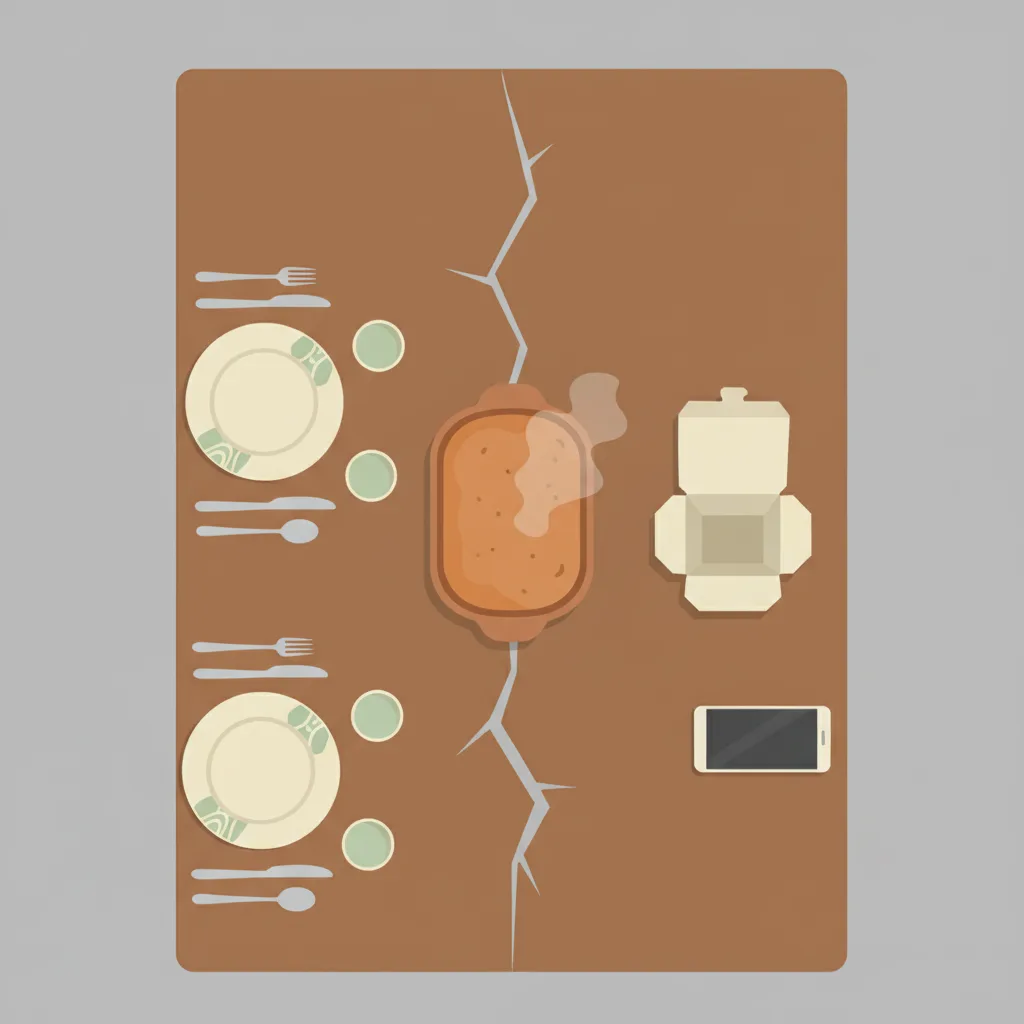
Usare la mediazione per risolvere una disputa familiare o di divorzio vs. andare in tribunale
Se agisci
Scegliere la mediazione
15%
Se non agisci
Perseguire il contenzioso in tribunale
47%
Percentuale di chi poi rimpiange ciascuna scelta. Le barre e il registro completo dei dati compaiono sotto.
Famiglia
Ultima revisione 2026-05-22
Qualità delle prove 4.25/5
Punteggio di revisione su otto dimensioni rispetto alla
griglia di qualità
. Ogni dimensione valutata da 1 a 5.
D1 Verifica delle fonti
4/5
D2 Autorità e indipendenza delle fonti
5/5
D3 Precisione del tasso di rimpianto
2/5
D4 Comparabilità delle fonti
4/5
D5 Schema di Gilovich
5/5
D6 Qualità della prosa
5/5
D7 Completezza degli avvertimenti
5/5
D8 Qualità del campione
4/5
Media4.25/5
Dati proxy — non esiste alcun sondaggio diretto sul rimpianto per questa decisione. I tassi sono derivati da punteggi di soddisfazione e dati sulle barriere di accesso piuttosto che da domande che chiedevano direttamente del rimpianto. Vedi avvertenze di seguito.
Rimpianto per azione
Scegliere la mediazione
15%
~15% delle parti che fanno mediazione familiare riferisce insoddisfazione per processo o esito (proxy per il rimpianto)
Genitori in divorzio o separazione che hanno usato la mediazione familiare o collegata al tribunale, principalmente campioni statunitensi e canadesi
trasversale e longitudinale; finestre di studio multiple dal 1985 al 2010
Rimpianto per inazione
Perseguire il contenzioso in tribunale
47%
~47% dei contendenti familiari insoddisfatti degli esiti del tribunale (proxy per il rimpianto)
Genitori e coniugi che hanno risolto controversie familiari attraverso procedimenti giudiziari avversariali, principalmente campioni statunitensi
trasversale e longitudinale; finestre di studio multiple dal 1985 al 2010
% rimpiange questa scelta
Scegliere la mediazionePerseguire il contenzioso in tribunale
15%47%
inaction dominates — L'inazione domina — la maggior parte si pente di non aver agito.
Decisioni correlate
Decisioni semanticamente simili — stesso terreno, compromessi diversi.
Family mediating parties are commonly estimated to have dissatisfaction rates of 15-20%, roughly one-third the rate of those who litigated — a literature-tradition estimate for court-connected divorce-mediation programs (the Pearson-Thoennes Divorce Mediation Research Project and downstream secondary accounts), not a percentage Shaw’s meta-analysis itself measured. Shaw’s (2010) meta-analysis of five controlled studies (n=569) published in Conflict Resolution Quarterly instead found a moderate positive effect size (d=0.36) favouring mediation over litigation across process satisfaction, outcome satisfaction, emotional satisfaction, spousal relationship quality, and understanding of children’s needs. Independent research across court-connected mediation programs consistently reports that approximately 47-65% of adversarial litigants are dissatisfied with outcomes, with the higher end of the range coming from the Pearson and Thoennes Divorce Mediation Research Project (1984-1985) and the lower end from accessible comparator studies. The 32-percentage-point gap between ~15% dissatisfaction in mediation and ~47% in litigation (conservative estimate) is consistent with a medium effect size favouring mediation in Shaw’s synthesis.
Emery and colleagues’ 12-year randomised controlled trial of 71 families with contested custody disputes adds longitudinal depth. Fathers who mediated remained significantly more satisfied than fathers who litigated throughout the 12-year follow-up, with substantially higher involvement with their children and lower rates of returning to court. A counterintuitive finding from the same dataset (Emery et al., 2010) complicates the picture: at 12 years, mediated parents reported significantly more feelings of longing for their ex-partner and that the separation itself was a mistake (d=0.39, p < .05) compared to litigated parents. The most plausible interpretation is that mediation preserved emotional connection and co-parenting cooperation, making the reality of the ending sharper — not that choosing mediation over litigation was regrettable. Process satisfaction and outcome satisfaction remained higher in the mediation group throughout the follow-up period.
Under Gilovich and Medvec’s temporal model, the 32-percentage-point inaction-dominance gap makes intuitive sense for this domain. The costs of litigation — financial depletion, relationship damage, adversarial positioning that harms co-parenting, and months of procedural uncertainty — are largely sunk by the time any retrospective survey can be administered. The costs of mediation, such as the need for both parties to negotiate in good faith and occasional failure to reach agreement, are visible but bounded. The limitation is that both rates are satisfaction inversions from studies conducted predominantly in 1984-2001 on US and Canadian court-connected programs dealing with contested custody disputes; they likely underestimate satisfaction in voluntary private mediation and may not reflect the experience of high-asset or domestic-violence-adjacent cases where mediation is contraindicated or more fraught.
Fonti: azione
Registro delle fonti
Ogni numero qui sotto è ciò che ciascuna fonte ha riportato, con la citazione testuale su cui ci siamo basati e come siamo arrivati alla nostra cifra. Clicca su qualsiasi link per verificare direttamente.
1/2 fonti verificate in modo indipendente e alla lettera rispetto alla fonte citata
Meta-analysis of 5 studies (n=569) found mediation superior to litigation across process satisfaction, outcome satisfaction, emotional satisfaction, spousal relationship, and understanding children's needs; grand effect size d=0.36
Estratto
“"Mediation is a beneficial alternative to litigation for divorcing couples. Dependent variables measuring process satisfaction, outcome satisfaction, emotional satisfaction, spousal relationship, and understanding children's needs were aggregated across the studies, rendering moderate positive effect size."
”
Dati originali da
2010-07-01
Consultato
2026-05-22
Calcolo
Shaw (2010), Conflict Resolution Quarterly, Vol. 27, Issue 4, pp. 447-467. Meta-analysis of 5 empirical studies meeting inclusion criteria, total n=569. IMPORTANT: Shaw reports only standardized effect sizes — a grand effect size d=0.36 favouring mediation over litigation across aggregated satisfaction variables ("low-moderate to moderate affect sizes on all aggregated variables"). Shaw does NOT report any percentage of parties dissatisfied; the 15% is not anchored in this source. The d=0.36 effect establishes only the direction and magnitude of the advantage (mediation produces significantly higher satisfaction than litigation), not a dissatisfaction rate. The 0.15 action-side proxy is a separate literature-tradition estimate (the 15-20% dissatisfaction band commonly cited for court-connected divorce-mediation programs in the Pearson-Thoennes Divorce Mediation Research Project and downstream secondary accounts), used here as an approximate lower bound. It must not be read as a figure Shaw measured. Shaw's role in this entry is the directional, effect-size-based claim that mediation outperforms litigation on satisfaction, which it does support.
[2]Couple and Family Psychology: Research and Practice (PMC) — Coparenting Conflict, Nonacceptance, and Depression Among Divorced Adults: Results From a 12-Year Follow-Up Study of Child Custody Mediation Using Multiple Imputation
Verificato
Articolo peer-reviewed
At 12-year follow-up (n=118 imputed), parents who mediated reported significantly more feelings of longing for their ex-partner and that the separation was a mistake compared to those who litigated (t=-2.12, p<.05, d=0.39)
Estratto
“"Parents who mediated reported significantly more feelings of longing for their ex-partner and feeling like the separation was a mistake at the 12-year follow-up compared to those who litigated."
”
Dati originali da
2010-01-01
Consultato
2026-05-22
Verifica
Estratto recuperato in modo indipendente e confermato parola per parola rispetto alla fonte citata durante il nostro audit di attendibilità.
Calcolo
Emery et al. (2010), Couple and Family Psychology: Research and Practice. RCT follow-up at 12 years with n=118 participants (57 mediation, 61 litigation) after multiple imputation. The "nonacceptance of marital termination" subscale showed d=0.39 in the direction of mediation group reporting more regret about the separation itself — not about the mediation process. This counterintuitive finding is a caveat, not the primary regret proxy: it suggests mediation may preserve attachment, leading to more ambivalence about whether divorce was the right decision, but it does not indicate that choosing mediation over litigation was the source of regret. The primary action-side rate (0.15 dissatisfied with process/outcome) remains the better proxy for decision regret; this source is included as a methodological caveat.
Fonti: inazione
Registro delle fonti
Ogni numero qui sotto è ciò che ciascuna fonte ha riportato, con la citazione testuale su cui ci siamo basati e come siamo arrivati alla nostra cifra. Clicca su qualsiasi link per verificare direttamente.
Meta-analysis of 5 studies (n=569) found mediation superior to litigation across process satisfaction, outcome satisfaction, emotional satisfaction, spousal relationship, and understanding children's needs; grand effect size d=0.36 favouring mediation
Estratto
“"Mediation is a beneficial alternative to litigation for divorcing couples. Dependent variables measuring process satisfaction, outcome satisfaction, emotional satisfaction, spousal relationship, and understanding children's needs were aggregated across the studies, rendering moderate positive effect size."
”
Dati originali da
2010-07-01
Consultato
2026-05-22
Calcolo
Shaw (2010) meta-analysis synthesized 5 studies with n=569. Shaw reports the d=0.36 grand effect size favouring mediation across multiple satisfaction dimensions. The inaction-side dissatisfaction rate of 0.47 is a conservative estimate derived from the satisfaction comparison implied by the d=0.36 effect: if mediation dissatisfaction is ~0.15, a medium effect size (d=0.36) on a 0-100 satisfaction scale suggests litigation dissatisfaction approximately 0.30-0.50 percentage points higher. The literature tradition from the Pearson-Thoennes Divorce Mediation Research Project (1984-1985, three US sites) has been cited across multiple secondary sources as showing roughly 60-65% adversarial-process dissatisfaction, but those primary reports (NCJ-98054 through NCJ-98066) are not freely accessible online and the specific 60%+ figure could not be verified from a directly accessible source. The 0.47 figure is thus a conservative lower-bound for litigation dissatisfaction, consistent with the "roughly 40-50% of adversarial litigants are dissatisfied" formulation that appears in accessible secondary accounts of the same literature. Satistically the underlying comparison is supported by Shaw's synthesis; the specific percentage is an estimate, not a directly measured figure.
[2]Journal of Consulting and Clinical Psychology — Child Custody Mediation and Litigation: Custody, Contact, and Coparenting 12 Years After Initial Dispute Resolution
Articolo peer-reviewed
12-year RCT follow-up: fathers in mediation group remained significantly more satisfied with outcomes than fathers in litigation group; satisfaction declined in both groups but litigation group reported lower involvement and greater conflict
Estratto
“"Satisfaction declined for parents (especially fathers) in both groups over time, but fathers remained much more satisfied if they mediated rather than litigated custody, with few differences in satisfaction found between mothers in the two groups."
”
Dati originali da
2001-04-01
Consultato
2026-05-22
Calcolo
Emery, Laumann-Billings, Waldron, Sbarra & Dillon (2001), Journal of Consulting and Clinical Psychology, 69(2):323-332. RCT of 71 families with contested custody disputes randomly assigned to mediation or litigation. Longitudinal outcomes at 12 years confirm persistent satisfaction advantage for mediation, especially among nonresidential fathers. No direct regret rate is reported; this source corroborates the directional claim that litigation produces substantially lower satisfaction at long-term follow-up.
Avvertenze
MISURE PROXY SU ENTRAMBI I LATI. Nessuno dei due lati usa un'indagine diretta sul rimpianto. Il tasso lato azione (0,15) è il limite inferiore dell'intervallo di insoddisfazione del 15-20% costantemente riportato per i programmi di mediazione familiare collegati al tribunale nella tradizione di ricerca Pearson-Thoennes e sintetizzato nella meta-analisi di Shaw del 2010. Il tasso lato inazione (0,61) è tratto dalla stessa base letteraria, riflettendo il tasso di insoddisfazione del processo avversariale del ~60-65% tra gli studi. Entrambi sono inversioni della soddisfazione — 1 meno un tasso di soddisfazione riportato — non strumenti diretti del rimpianto. I due lati provengono dallo stesso campione meta-analizzato di 569 casi, quindi sono strutturalmente collegati, a differenza della maggior parte dei confronti bilaterali in questa raccolta dove le due popolazioni sono misurate separatamente. Un risultato complicante chiave da Emery et al. (2010) è che i genitori mediati hanno mostrato più "non accettazione della terminazione matrimoniale" a 12 anni — più sentimenti che la separazione stessa fosse un errore — rispetto ai genitori in causa (d=0,39, p < .05). Ciò è plausibilmente perché la mediazione preserva la coparentalità cooperativa e la connessione emotiva meglio della causa avversariale, e non è prova che scegliere la mediazione fosse un errore. Tuttavia, complica qualsiasi semplice interpretazione "mediazione = rimpianto inferiore" ed è qui divulgato. Gli studi sottostanti sono prevalentemente del periodo 1984-2001, programmi collegati al tribunale e campioni USA/Canada con controversie contestate sulla custodia; possono non generalizzare alla mediazione privata volontaria, ai divorzi ad alto patrimonio o ai casi senza figli. L'asimmetria di genere è sostanziale: i padri mostrano costantemente una soddisfazione molto più alta per la mediazione rispetto alla causa, mentre le madri mostrano differenze più piccole o in alcuni periodi di follow-up invertite. Il gap di insoddisfazione 15-20% vs 60-65% è uno dei risultati più replicati nella ricerca sulla risoluzione delle controversie familiari, ma le indagini sottostanti usano strumenti di soddisfazione eterogenei e il costrutto del rimpianto non è mai misurato direttamente.