



Vai al contenuto
Likelier

Rimpianto per l’azione vs. l’inazione

Mangiare insieme in famiglia vs mangiare di fretta separatamente

Se agisci

Pasti regolari in famiglia

9,0%

Se non agisci

Mangiare separatamente o di corsa

62%

Percentuale di chi poi rimpiange ciascuna scelta. Le barre e il registro completo dei dati compaiono sotto.


Famiglia

Ultima revisione 2026-04-26

Qualità delle prove 4.13/5

Punteggio di revisione su otto dimensioni rispetto alla griglia di qualità . Ogni dimensione valutata da 1 a 5.

D1 Verifica delle fonti
5/5
D2 Autorità e indipendenza delle fonti
4/5
D3 Precisione del tasso di rimpianto
2/5
D4 Comparabilità delle fonti
3/5
D5 Schema di Gilovich
5/5
D6 Qualità della prosa
5/5
D7 Completezza degli avvertimenti
5/5
D8 Qualità del campione
4/5
Media 4.13/5
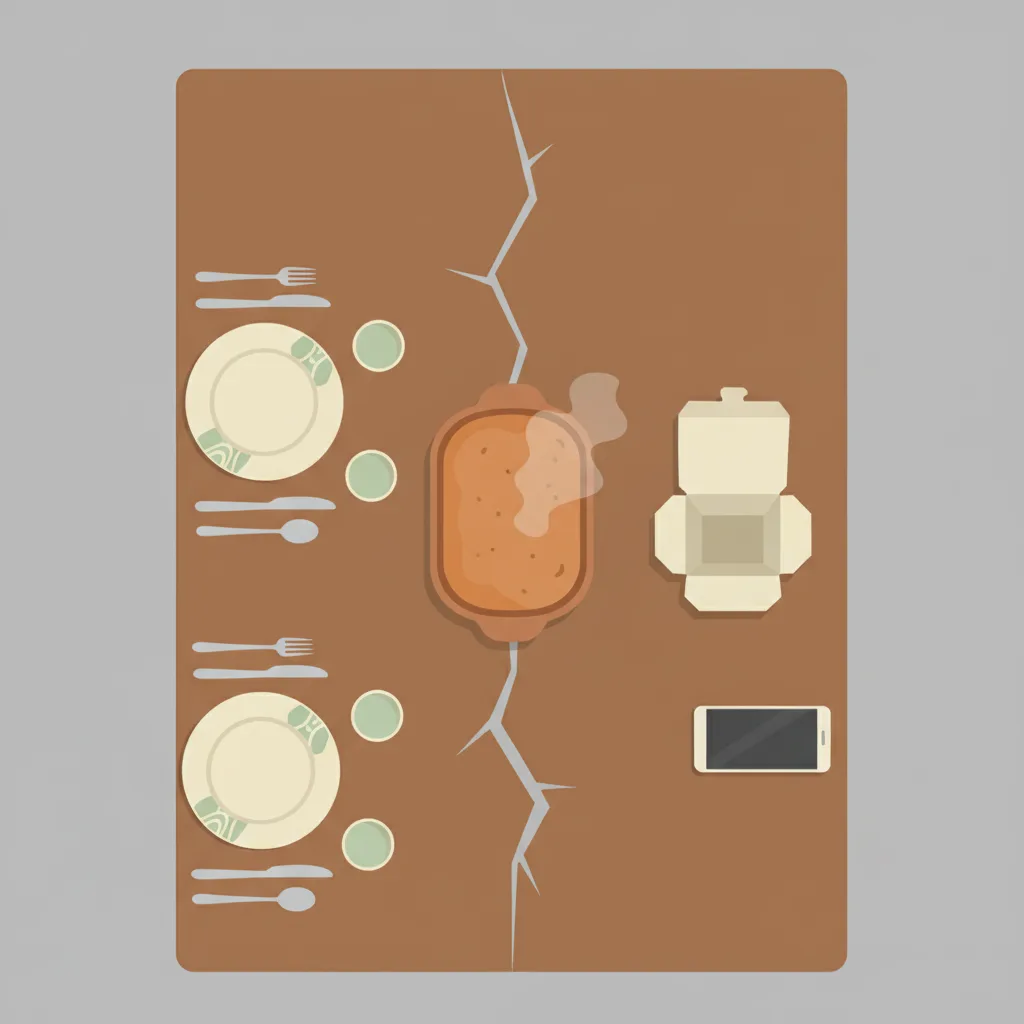
A dining table set for a family meal on one side, a counter with a lone takeout container on the other.

Rimpianto per azione

Pasti regolari in famiglia

9,0%

Il 9% dei genitori non trova i pasti familiari riducenti lo stress (proxy)

Adulti statunitensi, rappresentativo a livello nazionale

retrospettivo, nessun arco temporale fisso

Rimpianto per inazione

Mangiare separatamente o di corsa

62%

Il 62% dei genitori vorrebbe avere cene familiari più spesso (proxy di gap di aspirazione)

Genitori statunitensi con figli sotto i 18 anni

retrospettivo, nessun arco temporale fisso

% rimpiange questa scelta

inaction dominates — L'inazione domina — la maggior parte si pente di non aver agito.

Decisioni correlate

Decisioni semanticamente simili — stesso terreno, compromessi diversi.

family

Privata vs pubblica

% rimpiange questa scelta

L'inazione prevale

Rimpianto per l'inazione 3.2× maggiore

family

Genitore a casa vs lavoratore

% rimpiange questa scelta

L'azione prevale

Rimpianto per l'azione 1.3× maggiore

family

Soccorrere vs. lasciar fare

% rimpiange questa scelta

L'azione prevale

Rimpianto per l'azione 1.2× maggiore

family

Disciplina vs. permissività

% rimpiange questa scelta

L'inazione prevale

Rimpianto per l'inazione 2.4× maggiore

lifestyle

Spuntini frequenti

% rimpiange questa scelta

L'inazione prevale

Rimpianto per l'inazione 1.8× maggiore

family

Attività vs gioco libero

% rimpiange questa scelta

L'azione prevale

Rimpianto per l'azione 2.6× maggiore

family

Dimensione della famiglia

% rimpiange questa scelta

L'inazione prevale

Rimpianto per l'inazione 2.6× maggiore

family

Casa di cura vs. assistenza domiciliare

% rimpiange questa scelta

L'azione prevale

Rimpianto per l'azione 2.3× maggiore

A YouGov poll found that 62% of parents with children under 18 wish they had family dinners more often — the dominant inaction-side signal in this entry. On the action side, a 2022 American Heart Association survey of 1,000 US adults found that 9% of parents do not report stress reduction from regular family meals — and 84% wish they could share meals more often. The resulting 7:1 ratio between inaction-side aspiration and action-side dissatisfaction is striking but relies on asymmetric measurements — one asks about stress relief, the other about aspirational frequency — so the exact magnitude should be handled with caution.

The downstream associations of infrequent family meals are better documented than the regret itself. Harrison et al.’s systematic review of 14 studies confirmed inverse associations between family meal frequency and depression, substance use, and suicidal ideation in adolescents. These are correlational findings subject to obvious confounding — families that manage regular dinners differ socioeconomically and structurally from those that don’t — but the consistency across studies and populations makes the direction of effect reasonably secure. The aspiration gap (wanting more family meals) likely reflects both genuine awareness of these benefits and cultural messaging about what “good families” do.

The counterweight is real but poorly quantified. A 2025 BMC Public Health review argued that the “family dinner ideal” places uneven pressure on low-income, single-parent, and shift-working households, and that evidence for what specifically about the shared meal produces benefits — as opposed to the general family stability it proxies — remains thin. Quality of interaction appears to matter more than mere co-presence at a table. The aspiration gap here likely reflects genuine loss when connection opportunities are forfeited, but some of the 62% who wish for more dinners may be responding to cultural expectation rather than lived deprivation. Neither rate is a direct regret measure, and both are flagged as proxies accordingly.

Fonti: azione

Registro delle fonti

Ogni numero qui sotto è ciò che ciascuna fonte ha riportato, con la citazione testuale su cui ci siamo basati e come siamo arrivati alla nostra cifra. Clicca su qualsiasi link per verificare direttamente.

1/2 fonti verificate in modo indipendente e alla lettera rispetto alla fonte citata

  1. [1] American Heart Association / Wakefield Research — New survey: 91% of parents say their family is less stressed when they eat together
    New survey: 91% of parents say their family is less stressed when they eat together
    Statistica
    91% of parents say their family is less stressed when they regularly connect over a meal; 84% wish they could share a meal together more often
    Estratto
    “"91 percent of parents notice their family is less stressed when they regularly connect over a meal. The survey also found that 84% of adults say they wish they could eat more meals with others." ”
    Dati originali da
    2022-10-10
    Consultato
    2026-04-26
    Calcolo
    Wakefield Research for AHA, 1,000 nationally representative US adults ages 18+, September 14–20 2022, online survey. MOE +/-3.1pp at 95% CI. The 9% who do not report stress reduction is the complement of the 91% headline. We use this as an upper-bound proxy for action-regret: among parents who do eat together, a small minority find no benefit. This is a satisfaction complement, not a regret measure — flagged as "(proxy)".
  2. [2] BMC Public Health — Unpacking family meals: state-of-the-art review critiquing the Western ideals, positioning and promotion of family meals Verificato
    Unpacking family meals: state-of-the-art review critiquing the Western ideals, positioning and promotion of family meals
    Statistica
    Family meal promotion reinforces unrealistic expectations on resource-pressured families; evidence on what specifically helps is limited
    Estratto
    “"Evidence surrounding what specifically about the family meal offers health benefits is limited, and family meals carry a level of moral value, evoking pressure for parents to 'achieve' a family meal ideal, unattainable for many." ”
    Dati originali da
    2025-02-11
    Consultato
    2026-04-26
    Verifica
    Estratto recuperato in modo indipendente e confermato parola per parola rispetto alla fonte citata durante il nostro audit di attendibilità.
    Calcolo
    Narrative review, not a prevalence study. Included to establish that the action side is not costless: logistical burden and social pressure are real downsides for some families. Does not supply its own regret percentage.

Fonti: inazione

Registro delle fonti

Ogni numero qui sotto è ciò che ciascuna fonte ha riportato, con la citazione testuale su cui ci siamo basati e come siamo arrivati alla nostra cifra. Clicca su qualsiasi link per verificare direttamente.

1/2 fonti verificate in modo indipendente e alla lettera rispetto alla fonte citata

  1. [1] YouGov — Most parents wish they were having family dinners more often
    Most parents wish they were having family dinners more often
    Statistica
    62% of parents with children under 18 wish they could have family dinners 'much more often' or 'somewhat more often'
    Estratto
    “"Roughly six in 10 (62%) parents with children under 18 say they would like to have family dinners 'much more often' or 'somewhat more often.' Parents of children and teenagers (87%) are especially likely to say they have a family dinner with all members of their home at least once a week." ”
    Dati originali da
    2019-10-28
    Consultato
    2026-04-26
    Calcolo
    YouGov online survey, 1,220 US adults (938 sharing a household), October 21–22 2019, weighted to be nationally representative. The 62% is among parents with children under 18 who wish dinners happened more often. This measures aspiration gap (wanting more of something you believe is good), not classical retrospective regret. Flagged as "(aspiration-gap proxy)".
  2. [2] Canadian Family Physician (Harrison et al.) — Systematic review of the effects of family meal frequency on psychosocial outcomes in youth Verificato
    Systematic review of the effects of family meal frequency on psychosocial outcomes in youth
    Statistica
    Frequent family meals are inversely associated with substance use, depression, suicidal ideation, and violent behaviour in adolescents
    Estratto
    “"Overall, results show that frequent family meals are inversely associated with disordered eating, alcohol and substance use, violent behaviour, and feelings of depression or thoughts of suicide in adolescents, and there is a positive relationship between frequent family meals and increased self-esteem and school success." ”
    Dati originali da
    2015-02-01
    Consultato
    2026-04-26
    Verifica
    Estratto recuperato in modo indipendente e confermato parola per parola rispetto alla fonte citata durante il nostro audit di attendibilità.
    Calcolo
    Systematic review of 14 studies from MEDLINE and PsycINFO (searches 1948–2011). Not a prevalence figure; included to establish the consequence basis for why parents aspire to more family meals — the downstream associations are well documented, though correlational and subject to confounding.

Avvertenze

Nessuna delle due cifre è una misura diretta del rimpianto — entrambe sono esplicitamente contrassegnate come proxy in regret_display. La cifra del 9% lato azione è il complemento dei genitori che riportano riduzione dello stress dai pasti familiari — un proxy di inversione della soddisfazione, non una misura di chiunque dica "mi pento di mangiare insieme". La cifra del 62% lato inazione cattura il desiderio di più cene (gap di aspirazione), che è più vicino all'aspettativa culturale che al rimpianto retrospettivo classico. Nessuna indagine su larga scala chiede direttamente "si pente di non mangiare insieme come famiglia?" L'indagine AHA 2022 ha anche rilevato che l'84% vorrebbe poter condividere i pasti più spesso, corroborando la direzione YouGov. Il campione YouGov include genitori che già mangiano insieme regolarmente ma vogliono di più, gonfiando il tasso di inazione rispetto al vero rimpianto di non averlo mai fatto. La revisione sistematica Harrison et al. sull'uso di sostanze negli adolescenti (i cenanti infrequenti hanno maggiori probabilità di usare tabacco) è correlazionale e soggetta a confondimento: le famiglie che mangiano insieme differiscono da quelle che non lo fanno in modi oltre il pasto stesso. La revisione BMC Public Health nota che l'"ideale della cena familiare" pone pressione sproporzionata sulle famiglie a basso reddito e monoparentali, quindi il gap di aspirazione può riflettere in parte la normazione culturale piuttosto che l'evidenza di danno netto da pasti persi. Il rapporto 7:1 tra tassi di inazione e azione è direzionalmente robusto ma sovrastima la vera asimmetria del rimpianto data la debole proxy lato azione.

Dati grezzi: /api/decisions.json

Visti di recente su questo dispositivo