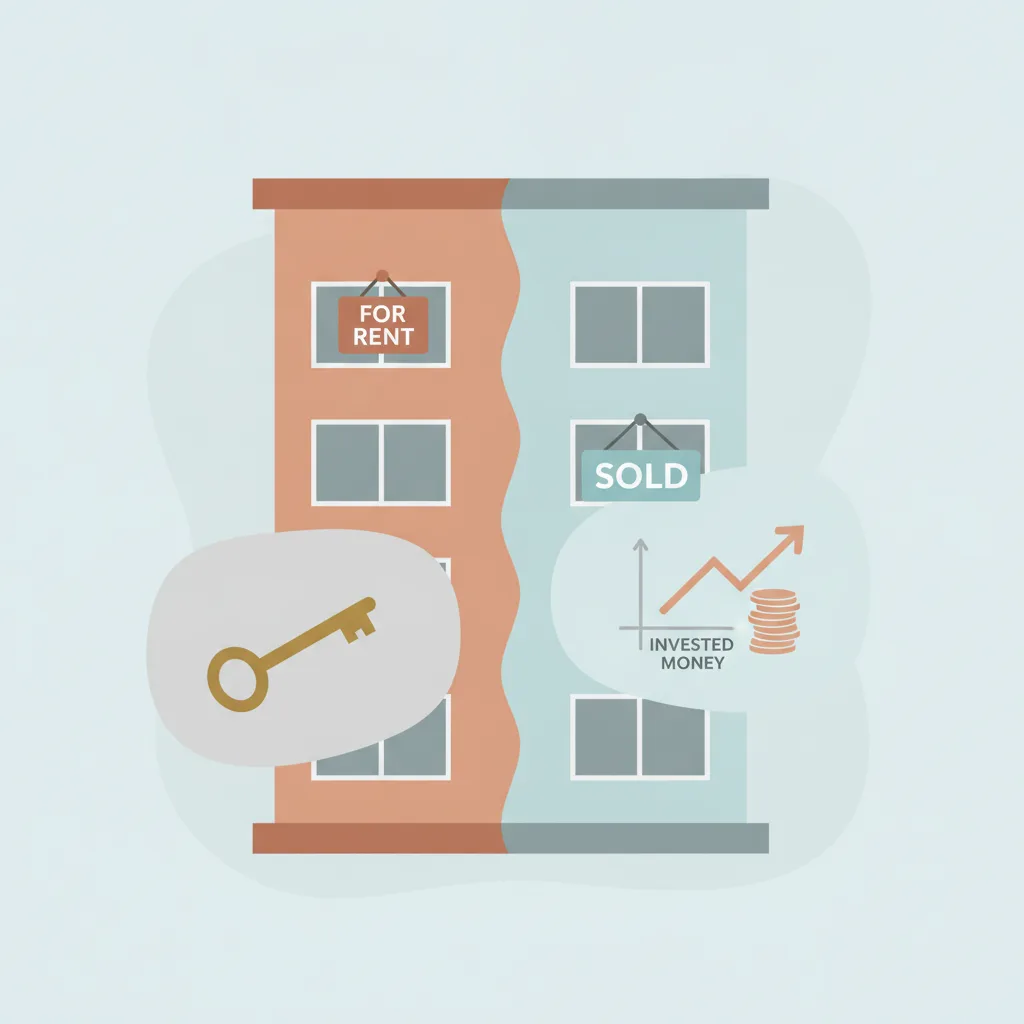
Affittare un immobile di proprietà contro venderlo e investire il denaro
Se agisci
Vendere e investire
25%
Se non agisci
Tenere e affittare
40%
Percentuale di chi poi rimpiange ciascuna scelta. Le barre e il registro completo dei dati compaiono sotto.
Finanza
Ultima revisione 2026-07-09
Qualità delle prove 4.13/5
Punteggio di revisione su otto dimensioni rispetto alla
griglia di qualità
. Ogni dimensione valutata da 1 a 5.
D1 Verifica delle fonti
4/5
D2 Autorità e indipendenza delle fonti
4/5
D3 Precisione del tasso di rimpianto
3/5
D4 Comparabilità delle fonti
4/5
D5 Schema di Gilovich
4/5
D6 Qualità della prosa
5/5
D7 Completezza degli avvertimenti
4/5
D8 Qualità del campione
5/5
Media4.13/5
Dati proxy — non esiste alcun sondaggio diretto sul rimpianto per questa decisione. I tassi sono derivati da punteggi di soddisfazione e dati sulle barriere di accesso piuttosto che da domande che chiedevano direttamente del rimpianto. Vedi avvertenze di seguito.
Rimpianto per azione
Vendere e investire
25%
Il 25% di chi vende si pente della vendita — rimpiange la casa a cui ha rinunciato
Adulti statunitensi che hanno venduto una casa nel 2021–2022 (sondaggio Clever Real Estate 2022)
retrospettivo, entro ~1–2 anni dalla vendita
Rimpianto per inazione
Tenere e affittare
40%
Il 40% dei proprietari di immobili in affitto vorrebbe non aver mai iniziato
No survey pits “rent it out” directly against “sell it and invest the money,” so this pairs the two closest measured regrets. About 40% of residential rental owners wish they’d never started investing in real estate (Clever Real Estate’s 2024 survey of 764 investors), against about 25% of recent sellers who regret selling because they miss the home they gave up (Clever’s 2022 survey of 1,000 sellers). On those proxies, keeping-and-renting is the more-regretted path — the opposite of the intuition that selling is the move you might kick yourself for later.
The reason keep-and-rent regret runs high is that landlording is not the passive income it is sold as. In the same 2024 survey, 56% of owners had already had to evict a tenant, 61% were still chasing missed rent every month, and 87% reported some regret about their investment decisions. The NBER study of landlords’ own lease ledgers puts a price on the hassle: filing a single eviction costs the equivalent of two to three months’ rent, and nonpayment is common enough that many landlords tolerate months of it before acting. Against that, the seller’s regret is quieter and more emotional — missing a home — rather than a recurring operational drain.
Read the gap cautiously. This is a proxy pairing, flagged as such: the two numbers come from different people surveyed in different years, the seller figure includes forced moves that mix circumstance with choice, and the investor sample leans toward heavily-invested owners who may regret more than a one-flat landlord would. It also says nothing about the money — whether renting out or selling-and-investing wins financially depends on rental yield, local price growth, and what the sale proceeds earn elsewhere, none of which a regret rate measures. The Gilovich pattern (holding-and-managing regret accumulates while the sold home fades into a wistful memory) fits the direction here, but the evidence is indicative, not a head-to-head test.
Fonti: azione
Registro delle fonti
Ogni numero qui sotto è ciò che ciascuna fonte ha riportato, con la citazione testuale su cui ci siamo basati e come siamo arrivati alla nostra cifra. Clicca su qualsiasi link per verificare direttamente.
[1]Clever Real Estate — American Home Seller Report: 2022 Edition
Fonte di riferimento
One-fourth of home sellers (25%) regretted selling because they miss their old home
Estratto
“"One-fourth of respondents (25%) regretted selling because they miss their old home" — from a survey of 1,000 people who sold a home in 2021 or 2022 (fielded Sept. 29 – Oct. 2, 2022).
”
Dati originali da
2022-10-12
Consultato
2026-07-09
Calcolo
Used as a proxy for regret about the decision to sell itself. The 25% "miss their old home" figure is the cleanest available decision-construct regret for sellers — distinct from the much larger "process" regret numbers (priced too low, sold too fast, commission too high) that other seller surveys report, which measure regret about how the sale went, not regret about having sold. Because it is a proxy (not a head-to-head "sell vs rent-out" survey), this entry is flagged proxy_only.
Fonti: inazione
Registro delle fonti
Ogni numero qui sotto è ciò che ciascuna fonte ha riportato, con la citazione testuale su cui ci siamo basati e come siamo arrivati alla nostra cifra. Clicca su qualsiasi link per verificare direttamente.
[1]Clever Real Estate — Residential Real Estate Investing in 2024: More Rent Money, More Rental Problems↗ 1 other entry
Fonte di riferimento
40% of residential real estate investors wish they'd never started investing in real estate; 87% have regrets about their investment decisions; 56% have had to evict a tenant
Estratto
“"40% say they wish they'd never started investing in real estate [...] 87% [...] have regrets about their investment decisions [...] More than half of respondents (56%) have had to evict a tenant at some point." — survey of 764 US residential real estate investors, fielded May 18–June 9, 2024.
”
Dati originali da
2024-07-01
Consultato
2026-07-09
Calcolo
The 40% "wish they'd never started" figure is used as the regret proxy for the keep-and-rent side. The broader 87% "have regrets" figure is not used as the headline because it spans market and financial regrets, not the decision to become a landlord specifically. Sample skews toward active, heavily-invested owners (90% had lost money on an investment).
[2]National Bureau of Economic Research (NBER Working Paper 33155) — Nonpayment and Eviction in the Rental Housing Market↗ 1 other entry
Studio primario
Filing an eviction costs landlords the equivalent of 2–3 months of rent; nonpayment is common and frequently tolerated before eviction
Estratto
“"Filing an eviction costs landlords the equivalent of 2-3 months of rent [...] Nonpayment is common, is frequently tolerated by landlords, and is often followed by recovery."
”
Dati originali da
2024-11-01
Consultato
2026-07-09
Calcolo
Cited to explain why keep-and-rent regret runs high: landlording carries real, recurring costs (an eviction alone runs 2–3 months' rent), which the "passive income" framing understates. Corroboration for the regret driver, not a regret rate itself.
Avvertenze
Questo è un abbinamento basato solo su indicatori sostitutivi: nessun sondaggio chiede alle stesse persone se si pentono di aver scelto di affittare un immobile invece di venderlo e investire il denaro, quindi ogni lato usa il costrutto più vicino disponibile. Il lato della vendita è approssimato dal 25% di chi ha venduto di recente e «rimpiange la vecchia casa» (Clever 2022); il lato del tenere e affittare, dal 40% dei proprietari che «vorrebbero non aver mai iniziato a investire in immobili» (Clever 2024). Le due cifre provengono da campioni diversi (venditori vs. investitori) in anni diversi (2022 vs. 2024), quindi il confronto è indicativo, non controllato. La cifra «rimpiango la mia casa» include persone costrette a trasferirsi da un cambio di lavoro o dalle finanze, mescolando le circostanze con la scelta; il campione degli investitori è sbilanciato verso proprietari attivi e fortemente investiti (il 90% ha perso denaro su un investimento), sovrastimando probabilmente il rammarico di chi affitta un singolo appartamento ereditato o lasciato libero. Fondamentale: i tassi di rammarico non dicono nulla sul denaro: se produca un risultato finanziario migliore affittare oppure vendere e investire dipende dal rendimento locativo, dalla crescita locale dei prezzi e dai rendimenti di mercato sui proventi della vendita — tutti fattori dipendenti dal percorso e dal momento, e qui non considerati. L'inquadramento è statunitense; le leggi a tutela degli inquilini e i costi di transazione differiscono nettamente da paese a paese.