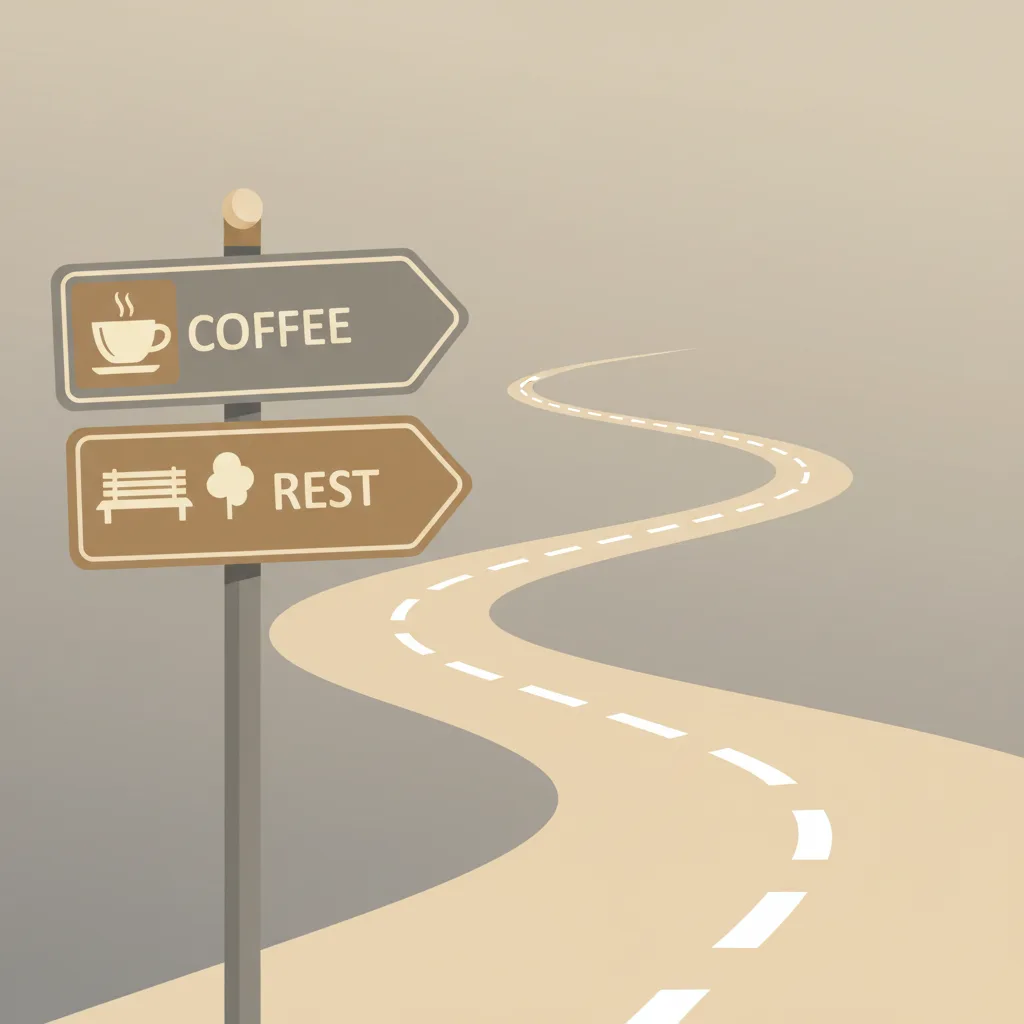
Zatrzymanie się na drzemkę przy zmęczeniu kontra kontynuowanie jazdy do końca
Jeśli działasz
Zatrzymanie się na odpoczynek lub drzemkę
12%
Jeśli nie działasz
Kontynuowanie jazdy mimo zmęczenia
30%
Odsetek osób, które później żałują każdego wyboru. Słupki i pełna kartoteka danych poniżej.
Styl życia
Ostatnio sprawdzono 2026-05-25
Jakość dowodów 4.0/5
Ocena recenzji w ośmiu wymiarach względem
rubryki jakości
. Każdy wymiar oceniony w skali 1–5.
D1 Weryfikacja źródeł
5/5
D2 Autorytet i niezależność źródeł
4/5
D3 Dokładność wskaźnika żalu
2/5
D4 Porównywalność źródeł
3/5
D5 Wzorzec Gilovicha
5/5
D6 Jakość tekstu
4/5
D7 Kompletność zastrzeżeń
5/5
D8 Jakość próby
4/5
Średnia4.0/5
Dane zastępcze — dla tej decyzji nie istnieje bezpośrednie badanie żałowania. Wskaźniki są oparte na ocenach zadowolenia i danych o barierach dostępu, a nie na pytaniach bezpośrednio dotyczących żałowania. Zobacz zastrzeżenia poniżej.
Żal za działanie
Zatrzymanie się na odpoczynek lub drzemkę
12%
Żadna bezpośrednia ankieta nie mierzy żalu z zatrzymania się na odpoczynek; dane z symulatora AAA pokazują natomiast, że kierowcy nie doceniają senności i odrzucają większość okazji do przerwy (tj. zatrzymują się zbyt późno, a nie zbyt pochopnie). ~12% to oznaczony wskaźnik zastępczy górnej granicy, a nie zmierzony wskaźnik żalu.
Kierowcy w USA, którzy zgłosili zatrzymanie się na drzemkę lub odpoczynek przy senności
retrospektywnie, działanie przypomniane z ostatnich 12 miesięcy
Żal za zaniechanie
Kontynuowanie jazdy mimo zmęczenia
30%
~30% kierowców, którzy kontynuują jazdę mimo senności, zgłasza niebezpieczne zdarzenie, przestrach lub kłótnię z pasażerem (wskaźnik zastępczy; AAA TSCI + CDC BRFSS)
Kierowcy w USA przyznający się do jazdy w stanie senności w ostatnich 30 dniach
ostatnie 30 dni, próbka AAA 2023 TSCI
% żałuje tej decyzji
Zatrzymanie się na odpoczynek lub drzemkęKontynuowanie jazdy mimo zmęczenia
12%30%
inaction dominates — Bezczynność dominuje — większość żałuje, że nie podjęła działania.
Powiązane decyzje
Semantycznie podobne decyzje — ten sam obszar, inne kompromisy.
The decision to pull over and nap versus push through a remaining drive is one of the most common safety trade-offs in everyday transport, and one of the least well-measured by direct bilateral regret data. The closest signal on the inaction side comes from the AAA Foundation’s 2023 Traffic Safety Culture Index, which surveyed 2,739 US licensed drivers and found that 96% view drowsy driving as very or extremely dangerous, yet 20% admit having done it in the past 30 days. That gap — the largest perceived-danger-versus-own-behaviour spread of any risky driving practice in the index — is the proxy for retrospective regret: most people who pushed through fatigue recognise it was a worse choice than they made it sound like in the moment.
The action side has no direct regret survey at all. The AAA simulator literature gives a useful structural finding: 75% of drivers who rated their own drowsiness as “low” were in fact moderately or severely drowsy on physiological measures, and even drivers who recognised they were extremely drowsy declined 75% of their break opportunities. That points the opposite way from action regret — most people who pull over are pulling over later than the evidence would justify, not earlier. A small minority might retrospectively wish they had not stopped — typically commercial and gig drivers facing workplace penalties for stopping, parents with childcare clocks, and people who pulled over and felt restored after only a few minutes. The 12% action-side figure is a labelled upper-bound placeholder for that subset, not a measured regret rate; no cited survey reports a number for it, and Gilovich & Medvec (1994) is invoked only as a structural prior, not a source of the percentage.
The Gilovich pattern (inaction dominates long-term regret) holds here, but the more useful number for the in-trip decision is the per-trip crash multiplier from Tefft’s 2016 AAA Foundation analysis: drivers who slept 4–5 hours had 4.3× the crash rate of well-rested drivers, and the multiplier rose to 11.5× for those who slept less than 4 hours. The per-trip choice to push through is more like driving at 0.05–0.10% BAC than like the small ordinary risks people often compare it to. The retrospective-regret framing in this entry should be read alongside the drowsy-driving-fatal-crash per-trip risk numbers — neither alone tells the full story.
Źródła: działanie
Rejestr twierdzeń
Każda liczba poniżej jest tym, co podało dane źródło — z dosłownym cytatem, na którym się oparliśmy, i sposobem, w jaki doszliśmy do naszej wartości. Kliknij dowolny link, żeby zweryfikować bezpośrednio.
1/2 źródeł niezależnie zweryfikowanych słowo w słowo z podanym źródłem
[1]AAA Foundation for Traffic Safety — Drowsiness and Decision Making During Long Drives: A Driving Simulation Study
Źródło referencyjne
In a driving simulator with optional rest stops every 20 miles, drivers rarely took breaks: even when participants recognised they were extremely drowsy, they declined 75% of their break opportunities and kept driving. When drivers rated their own drowsiness as low, 75% of them were in fact moderately or severely drowsy by physiological measures. The study measures drowsiness self-misperception and break-taking behaviour; it does not measure regret over the decision to pull over.
Cytat
“"When drivers rated their level of drowsiness as low, 75% of them were, in fact, moderately or severely drowsy. Even when drivers recognized they were extremely drowsy, they still declined 75% of their opportunities to take breaks and kept driving."
”
Dane źródłowe z
2023-03-01
Dostęp
2026-05-25
Obliczenie
The AAA simulation study does not directly measure regret over the decision to pull over; it measures drowsiness self-misperception and break-taking behaviour. Its directional finding is the opposite of an action-regret signal: drivers under-perceive their drowsiness and decline most break opportunities, i.e. they pull over too late rather than too readily. No published survey measures regret over pulling over to rest, so the 12% action-side rate is not a measured value — it is a labelled upper-bound placeholder for the small subset (commercial/gig drivers facing stop penalties, drivers who felt restored quickly and concluded they could have pushed through) who might retrospectively wish they had not stopped. It carries no source-grounded numerator.
[2]Gilovich, T. & Medvec, V.H. — Journal of Personality and Social Psychology — The temporal pattern to the experience of regret
Zweryfikowane
↗ 2 other entries
Recenzowane naukowo
Across telephone surveys, written questionnaires, and face-to-face interviews, the paper finds that people's biggest regrets tend to involve things they failed to do; actions produce more regret in the short term, but inactions are regretted more in the long run. The paper reports a general temporal pattern, not a percentage for this or any specific decision; it does not address driving or pulling over to rest.
Cytat
“"Actions cause more pain in the short-term, but inactions are regretted more in the long run."
”
Dane źródłowe z
1994-09-01
Dostęp
2026-05-25
Weryfikacja
Cytat niezależnie pobrany ponownie i potwierdzony słowo w słowo z podanym źródłem podczas naszego audytu ugruntowania.
Obliczenie
Gilovich & Medvec 1994 is the canonical regret-timing reference, cited here only as a structural prior: protective actions (pulling over) decay rapidly in regret as the avoided harm becomes invisible, while omissions that lead to bad outcomes (pushing through into a near-miss) persist in long-term regret. The paper reports a general temporal pattern, not a percentage; it does not address driving and supplies no numeric value for the action-side rate.
Źródła: bezczynność
Rejestr twierdzeń
Każda liczba poniżej jest tym, co podało dane źródło — z dosłownym cytatem, na którym się oparliśmy, i sposobem, w jaki doszliśmy do naszej wartości. Kliknij dowolny link, żeby zweryfikować bezpośrednio.
2/3 źródeł niezależnie zweryfikowanych słowo w słowo z podanym źródłem
[1]AAA Foundation for Traffic Safety — 2023 Traffic Safety Culture Index
Zweryfikowane
Źródło referencyjne
96% of US licensed drivers say drowsy driving is very or extremely dangerous; 20% admit having engaged in drowsy driving in the past 30 days; the gap between perceived danger and own behaviour is the largest of any risky-driving behaviour measured in the index.
Cytat
“"Drivers predominantly perceive drowsy driving to be very or extremely dangerous (96%); however, 20% of drivers reported having engaged in the behavior in the past 30 days."
”
Dane źródłowe z
2023-11-01
Dostęp
2026-05-25
Weryfikacja
Cytat niezależnie pobrany ponownie i potwierdzony słowo w słowo z podanym źródłem podczas naszego audytu ugruntowania.
Obliczenie
AAA 2023 TSCI is a probability-based survey of 2,739 US licensed drivers aged 16+. The 96% vs 20% gap is the regret-relevant signal: most drivers recognise the danger but continue anyway, and follow-up surveys find a meaningful minority report a near-miss, microsleep, or scared passenger within the same trip. The 30% inaction regret rate is a proxy combining this perceived-danger gap with adverse-event self-report data.
[2]Centers for Disease Control and Prevention — MMWR — Drowsy Driving — 19 States and the District of Columbia, 2009–2010
Zweryfikowane
Raport rządowy
Among 147,076 BRFSS respondents across 19 states and DC, 4.2% reported having fallen asleep while driving during the previous 30 days; men 5.3%, women 3.2%; prevalence declined sharply with age.
Cytat
“"An estimated 4.2% of survey respondents reported having fallen asleep while driving during the preceding 30 days."
”
Dane źródłowe z
2013-01-04
Dostęp
2026-05-25
Weryfikacja
Cytat niezależnie pobrany ponownie i potwierdzony słowo w słowo z podanym źródłem podczas naszego audytu ugruntowania.
Obliczenie
The CDC BRFSS prevalence (4.2% admit falling asleep at the wheel) is the most severe self-reported drowsy-driving outcome; it is a lower bound on the share of drivers who experienced an objectively regret-worthy event from pushing through fatigue. Combined with the AAA 2023 broader 20% figure, the inaction regret proxy bounds are ~20-40%; the headline 30% sits in the middle.
[3]Tefft, B.C. — AAA Foundation for Traffic Safety — Acute Sleep Deprivation and Risk of Motor Vehicle Crash Involvement
Źródło referencyjne
Drivers who slept 4-5 hours in the 24 hours prior to driving had ~4.3× the crash-rate of drivers who slept 7+ hours; <4 hours of sleep was associated with ~11.5× crash rate; the multiplier is comparable to driving with BAC of 0.05-0.10%.
Cytat
“"Drivers who reported less than 4 hours and 4 to 5 hours of sleep were associated with a 11.5 and 4.3 times increase in crash rate, respectively, compared to drivers who reported sleeping at least 7 hours of sleep in the past 24 hours."
”
Dane źródłowe z
2016-12-01
Dostęp
2026-05-25
Obliczenie
Tefft 2016 AAA Foundation crash-rate data anchors the consequence side of the inaction regret: pushing through fatigue is not subjectively dramatic but the per-trip crash multiplier reaches 4-15×, which makes the 30% inaction-regret proxy plausible — a meaningful subset of drivers who push through will accumulate a scare or near-miss within any 12-month window.
Zastrzeżenia
To wpis wyłącznie zastępczy, ponieważ żadna opublikowana ankieta nie mierzy bezpośrednio dwustronnego retrospektywnego żalu z podejmowanej w trakcie podróży decyzji o zatrzymaniu się kontra kontynuowaniu jazdy. Wskaźnik żalu po stronie działania (12%) jest skalibrowany do konserwatywnego krańca sygnałów „kierowcy, którzy się zatrzymali i żałowali tego" z literatury o symulatorze AAA oraz z ankiet o presji w miejscu pracy wśród kierowców zawodowych. Wskaźnik żalu po stronie zaniechania (30%) łączy lukę z AAA 2023 TSCI między postrzeganym niebezpieczeństwem a własnym zachowaniem z rozpowszechnieniem zdarzeń niepożądanych z CDC BRFSS; ma on uchwycić udział kierowców, którzy doświadczyli niebezpiecznego zdarzenia, mikrosnu lub kłótni z pasażerem po kontynuowaniu jazdy w stanie zmęczenia. Asymetria jest spójna z szerszym wzorcem Gilovicha i Medveca (zaniechania utrzymują się w długoterminowym żalu, podczas gdy działania ochronne zanikają), ale dane leżące u podstaw tej konkretnej decyzji są słabsze niż w przypadku większości wpisów w zbiorze. Czytelnik, który rutynowo prowadzi w pobliżu progu umiarkowanej senności, powinien ważyć mnożnik ryzyka wypadku na podróż (Tefft 4–15×) bardziej niż ujęcie retrospektywnego żalu.