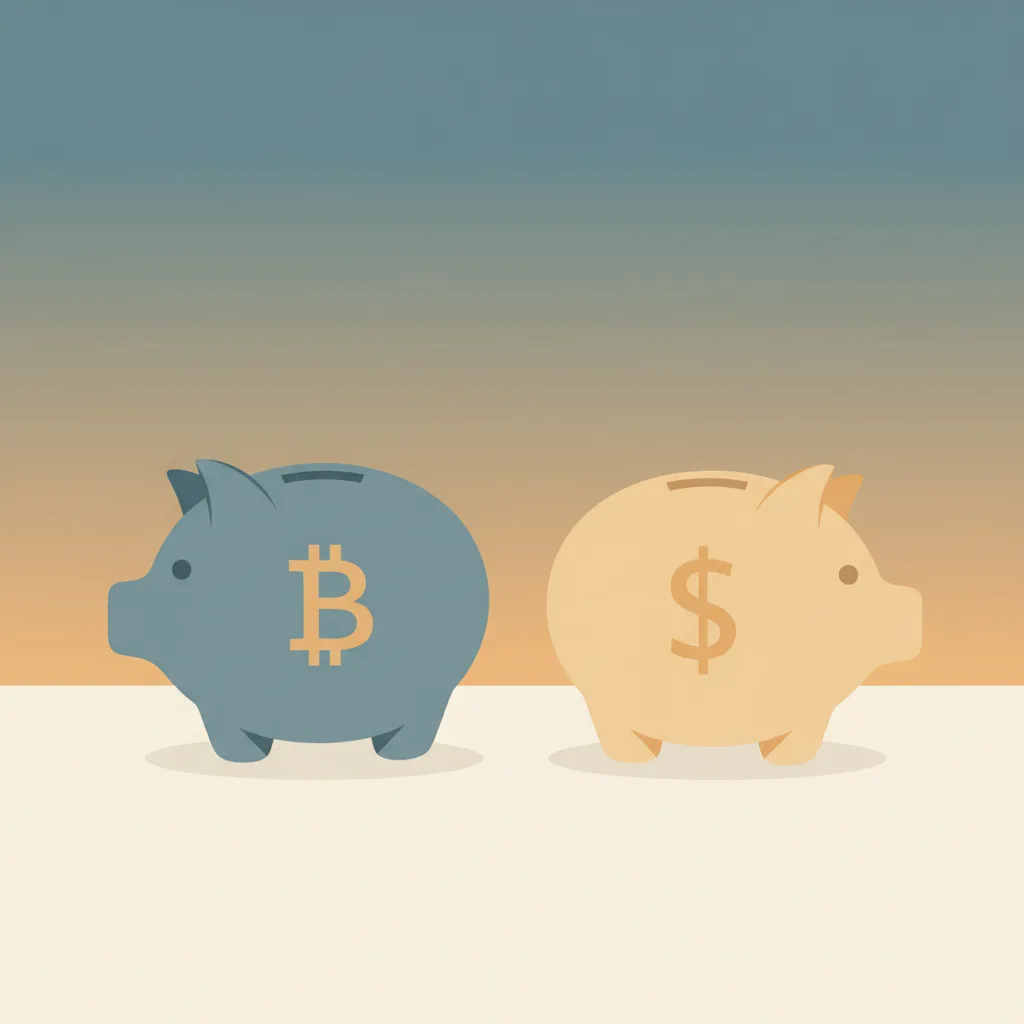
46% of US crypto investors reported their investments did worse than expected, according to Pew Research Center’s nationally representative 2022 survey of 6,034 adults. That figure captures the core tension: cryptocurrency attracted mainstream adoption with promises of outsized returns, but nearly half of those who acted on the opportunity came away disappointed. On the other side, 16% of Americans who did not buy cryptocurrency told ConsumerAffairs in a 2022 survey of 1,074 adults that they regretted staying out — a real but minority experience of inaction regret (34% were glad they didn’t, and 51% were neutral).
The numbers are regime-dependent in ways that matter. Pew’s 46% was recorded near the post-Terra/LUNA collapse, when Bitcoin had fallen roughly 70% from its 2021 peak. A survey taken at the top of a bull market would show higher inaction regret and lower action regret; a survey taken deeper in a bear market might produce even higher action regret. The ConsumerAffairs inaction figure was also captured in 2022, near the same drawdown, which likely muted the missed-gains regret that a bull-market survey would have surfaced. The S&P 500’s roughly 150% gain from 2019 to 2024 provided traditional-asset holders with strong objective grounds for contentment, which likely held down their regret rate.
Gilovich’s temporal model predicts that action regrets are more salient in the short run but fade as people adapt, while inaction regrets persist. That pattern may play out differently here: crypto investors who took large losses have a concrete, specific loss to mourn, while non-investors who missed a bull run are haunted by a counterfactual that grows and shrinks with every market cycle. The 30-point gap favoring action regret is real but unusually volatile for this asset class. Unlike missing a decade of S&P returns, missing a crypto bull run is not a one-time counterfactual — it recurs every time the price makes headlines.
Źródła: działanie
Rejestr twierdzeń
Każda liczba poniżej jest tym, co podało dane źródło — z dosłownym cytatem, na którym się oparliśmy, i sposobem, w jaki doszliśmy do naszej wartości. Kliknij dowolny link, żeby zweryfikować bezpośrednio.
[1]Pew Research Center — 46% of Americans who have invested in cryptocurrency say it's done worse than expected
Badanie pierwotne
46% of US adults who had invested in, traded, or used cryptocurrency said their investment had done worse than expected
Cytat
“"Among those who have invested in, traded, or used cryptocurrency, 46% say their investments have done worse than expected. Just 15% say they've done better than expected, while 31% say about as expected and 8% are unsure."
”
Dane źródłowe z
2022-08-23
Dostęp
2026-05-13
Obliczenie
Pew surveyed 6,034 US adults July 5-17, 2022. Of the 16% who had ever invested in, traded, or used crypto, 46% reported worse-than-expected outcomes. We use this as the action-regret proxy: investments that "did worse than expected" closely parallel the regret construct — the expectation gap is the dominant driver of investment regret. The 2024 Pew update found 38% still reported worse-than-expected results, slightly lower; the 2022 figure is used here as the most methodologically comparable snapshot tied to a specific market period.
[2]Gallup — Cryptocurrency Still Has Limited Main Street Appeal
Badanie pierwotne
14% of Americans currently own cryptocurrency as of June 2025; ownership remains concentrated among younger men
Cytat
“"Fourteen percent of U.S. adults overall report owning bitcoin or another cryptocurrency. Ownership is much higher, at 25%, among men aged 18 to 49 than among men aged 50 and older (12%), women aged 50 and older (9%) and women aged 18 to 49 (8%). College graduates (19%), upper-income Americans (19%) and political conservatives (18%) also report above-average ownership."
”
Dane źródłowe z
2025-06-15
Dostęp
2026-05-14
Obliczenie
Gallup August 2025 tracking poll. Ownership plateau at 14% suggests that many early investors have not re-entered or have exited the market. Included as context for the stable-but- concentrated investor population; does not alter the action- regret rate.
Źródła: bezczynność
Rejestr twierdzeń
Każda liczba poniżej jest tym, co podało dane źródło — z dosłownym cytatem, na którym się oparliśmy, i sposobem, w jaki doszliśmy do naszej wartości. Kliknij dowolny link, żeby zweryfikować bezpośrednio.
[1]ConsumerAffairs — The most regretted financial decisions in America: Survey
Badanie pierwotne
Among US adults who did not buy cryptocurrency in the past year, 16% say they regret it (34% glad they didn't, 51% neutral)
Cytat
“"Have you bought cryptocurrency within the past year? [No] — I'm glad I didn't: 34%. Neutral: 51%. I regret it: 16%." (From the "Collectible and crypto regret" graphic; source line reads "Survey of 1,074 U.S. adults".)
”
ConsumerAffairs surveyed 1,074 US adults (published 2022-05-10). The crypto-regret graphic splits respondents by whether they bought crypto in the past year. Among those who did NOT buy, 16% say they regret it — a direct inaction-regret measure for non-owners (the remainder: 34% glad they didn't, 51% neutral, totalling ~100% net of rounding). The 16% figure was read directly off the primary "Collectible and crypto regret" infographic (verified via web.archive.org / CDN image, 2026-07-14), not from a secondary paraphrase. This replaces a previously cited Bankrate "September 2022" figure (23%, with a 36%/12% age split) whose URL does not resolve and whose statistic could not be located in any real Bankrate source — it was removed as unverifiable. Both surveys sit near the 2022 crypto drawdown, so measured inaction regret is likely suppressed relative to a bull-market survey.
Zastrzeżenia
Wskaźnik żalu z działania (46%) mierzy inwestycje, które wypadły gorzej, niż oczekiwano, co jest proxy rozczarowania wynikiem, nie bezpośrednim pytaniem o żal z zainwestowania. Niektórzy respondenci mogli być niezadowoleni, wciąż wierząc, że krypto to słuszna długoterminowa stawka. Aktualizacja Pew 2024 ustaliła, że wskaźnik spadł do 38%, sugerując, że oryginalne 46% odzwierciedla szczyt pesymizmu blisko dołka rynku 2022. Wskaźnik zaniechania (16%) pochodzi z osobnej ankiety ConsumerAffairs na 1074 dorosłych Amerykanach, opublikowanej w 2022, więc populacje nie są bezpośrednio dopasowane. Prawdziwy żal z zaniechania prawdopodobnie znacznie fluktuuje z ceną Bitcoina: na rynku byka nieposiadacze doświadczają ostrego FOMO, podczas gdy inwestorzy krypto, którzy kupili blisko szczytów, mają najwięcej żalu. Obie liczby są mocno zależne od reżimu, a 16% zmierzono blisko spadku rynku 2022, gdy żal z utraconych zysków był stłumiony. S&P 500 zyskał około 150% od 2019 do 2024, co oznacza, że posiadacze tradycyjnych aktywów, którzy śledzili fundusz indeksowy, mieli silne obiektywne uzasadnienie dla swojego zaniechania; ich zmierzony wskaźnik żalu może częściowo odzwierciedlać tę satysfakcję.