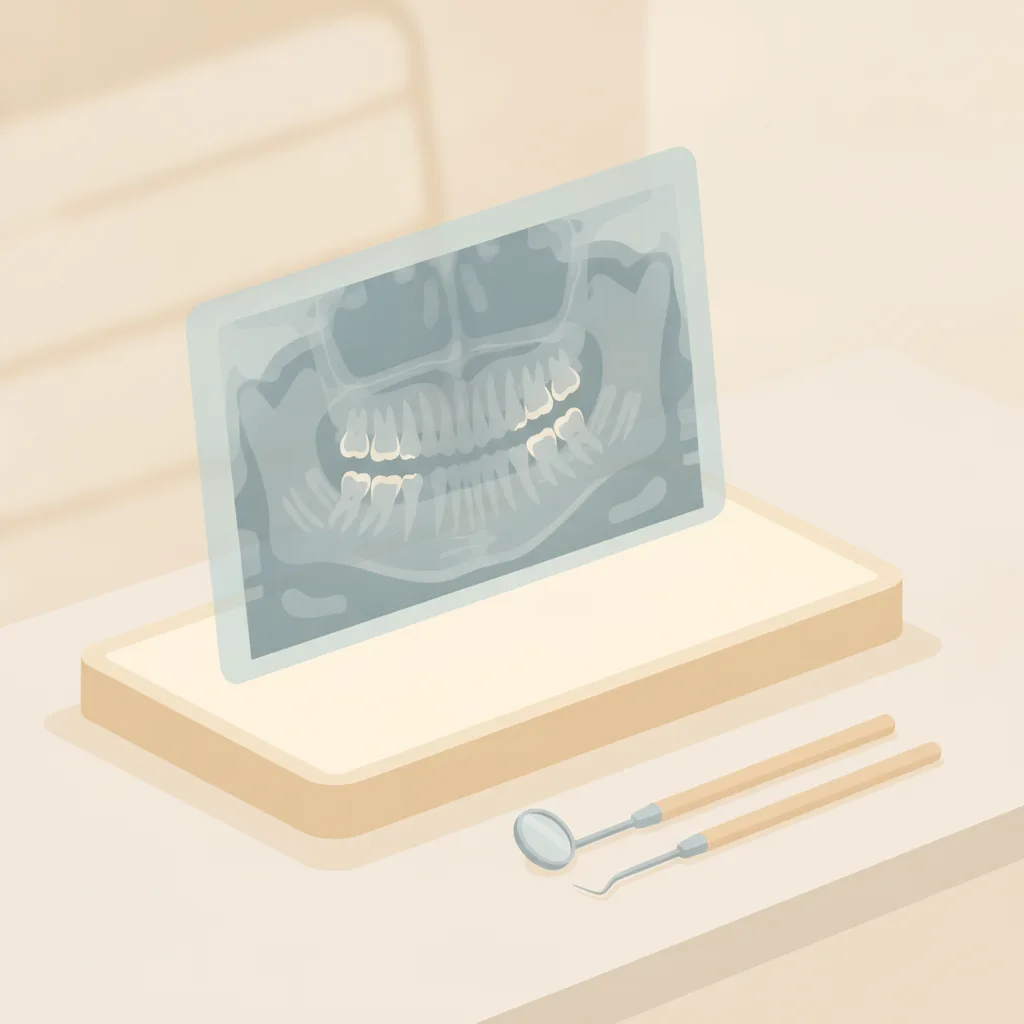
Zachowanie bezobjawowych zębów mądrości i obserwacja
64%
Odsetek osób, które później żałują każdego wyboru. Słupki i pełna kartoteka danych poniżej.
Zdrowie
Ostatnio sprawdzono 2026-07-14
Jakość dowodów 4.25/5
Ocena recenzji w ośmiu wymiarach względem
rubryki jakości
. Każdy wymiar oceniony w skali 1–5.
D1 Weryfikacja źródeł
5/5
D2 Autorytet i niezależność źródeł
4/5
D3 Dokładność wskaźnika żalu
3/5
D4 Porównywalność źródeł
5/5
D5 Wzorzec Gilovicha
5/5
D6 Jakość tekstu
4/5
D7 Kompletność zastrzeżeń
4/5
D8 Jakość próby
4/5
Średnia4.25/5
Dane zastępcze — dla tej decyzji nie istnieje bezpośrednie badanie żałowania. Wskaźniki są oparte na ocenach zadowolenia i danych o barierach dostępu, a nie na pytaniach bezpośrednio dotyczących żałowania. Zobacz zastrzeżenia poniżej.
~36% profilaktycznie usuniętych zębów mądrości nie wymagałoby usunięcia w ciągu 18 lat — operacja (z ~4% odsetkiem powikłań) wykonana na zębie, który pozostał bezproblemowy (wskaźnik zastępczy niepotrzebnej operacji)
Zachowanie bezobjawowych zębów mądrości i obserwacja
64%
~64% zachowanych bezobjawowych zębów mądrości i tak zostaje usuniętych w ciągu 18 lat — obserwacja zwykle odracza operację, zamiast jej uniknąć (wskaźnik zastępczy odroczonej ekstrakcji)
Młodzi dorośli zachowujący bezobjawowe trzecie trzonowce; wartość oparta na zbiorczym, skumulowanym wyniku siedmiu badań z przeglądu Bouloux 2015 (każde badanie ≥50 osób), a nie na pojedynczej kohorcie
skumulowanie po 18 latach obserwacji
% żałuje tej decyzji
Profilaktyczne usunięcie bezobjawowych zębów mądrościZachowanie bezobjawowych zębów mądrości i obserwacja
36%64%
inaction dominates — Bezczynność dominuje — większość żałuje, że nie podjęła działania.
Powiązane decyzje
Semantycznie podobne decyzje — ten sam obszar, inne kompromisy.
Keeping asymptomatic wisdom teeth and watching is the choice that most often fails to close the matter: across seven longitudinal studies, about 64% of retained symptom-free third molars are extracted within 18 years, at a steady rate of roughly 3% per year (Bouloux et al., 2015). A same-era 18-year cohort found 73% of the teeth that were unerupted at baseline came out before follow-up ended (Ventä et al., 2004), though that study’s follow-up window overlaps the period Bouloux pooled, so the two are better read as consistent than as independent. The reasons are ordinary: caries, gum disease, later inflammation, and part of that 64% is care that was simply timed to need rather than regretted. The practical upshot is that watching usually defers the operation rather than avoiding it, and the extraction then falls later in life rather than in early adulthood.
Removing the tooth up front does not escape regret either; it relocates it. Because prophylactic removal is itself an extraction, its regret falls on the mirror-image group: the roughly 36% of removed teeth that would have stayed trouble-free over the same 18 years, operated on for nothing. Every one of those extractions carries about a 4.2% chance of a complication, overwhelmingly dry socket, with infection and jaw-joint symptoms far behind (Chen et al., 2021). The Cochrane review found only two studies and 493 people bearing on whether disease-free impacted wisdom teeth should come out at all, and rated the evidence very low certainty (Ghaeminia et al., 2020). NICE went further in 2000, concluding that prophylactic removal of pathology-free impacted third molars should be discontinued in the NHS — a position US practice frequently sets aside.
The two figures are close on purpose, because the decision is close. Both come from the same fact: about two-thirds of these teeth eventually need removal and about a third do not. Watch, and you carry a 64% chance of the surgery you were trying to avoid; remove, and you carry a 36% chance the surgery was needless. Severity runs opposite to frequency — the deferred operation is common but often appropriate, while the unnecessary one is rarer but incurred up front against a benefit the evidence cannot show. What survives the symmetry is a modest lean, consistent with Gilovich and Medvec’s temporal asymmetry: over a long horizon, more people end up back in the chair than are spared it. Whether that reads as regret or as a reasonable bet that mostly postponed a minor operation is the judgement the evidence declines to settle.
Źródła: działanie
Rejestr twierdzeń
Każda liczba poniżej jest tym, co podało dane źródło — z dosłownym cytatem, na którym się oparliśmy, i sposobem, w jaki doszliśmy do naszej wartości. Kliknij dowolny link, żeby zweryfikować bezpośrednio.
[1]Journal of Oral and Maxillofacial Surgery (Bouloux et al. 2015) — What is the risk of future extraction of asymptomatic third molars? A systematic review
Recenzowane naukowo
Seven longitudinal studies, follow-up 1 to 18 years: cumulative extraction incidence rose from 5% at 1 year to 64% at 18 years — leaving ~36% of retained asymptomatic third molars still not extracted at 18 years
Cytat
“"The mean incidence rate for M3 extraction of previously asymptomatic M3s was 3.0% annually (range 1 to 9%). The cumulative incidence rate for M3 removal ranged from 5% at 1 year to 64% at 18 years. ... The cumulative risk of M3 extraction for young adults with asymptomatic M3s is sufficiently high to warrant its consideration when reviewing the risks and benefits of M3 retention as a management strategy."
”
Dane źródłowe z
2015-05-01
Dostęp
2026-07-14
Obliczenie
The action-side proxy is the mirror image of the inaction figure. If 64% of retained asymptomatic third molars are extracted by 18 years, then roughly 36% are not — those teeth would have stayed trouble-free over that horizon, so removing them prophylactically was, in hindsight, an operation for nothing. We anchor the action proxy at 0.36, the complement of Bouloux's 64% cumulative extraction rate. This is an "unnecessary-surgery" proxy, not a regret survey, and 0.36 is an upper bound: over a full lifetime the never-needed fraction shrinks, because some of that 36% would eventually have required extraction after 18 years. Using the same dataset for both sides keeps the two proxies on one axis.
[2]National Institute for Health and Care Excellence (NICE), UK — Guidance on the extraction of wisdom teeth (Technology appraisal guidance TA1)
Raport rządowy
National guidance: the practice of prophylactic removal of pathology-free impacted third molars should be discontinued in the NHS; surgery limited to teeth with evidence of pathology
Cytat
“"The practice of prophylactic removal of pathology-free impacted third molars should be discontinued in the NHS. ... Surgical removal of impacted third molars should be limited to patients with evidence of pathology. ... A first episode of pericoronitis, unless particularly severe, should not be considered an indication for surgery."
”
Dane źródłowe z
2000-03-27
Dostęp
2026-07-14
Obliczenie
The policy basis for treating prophylactic removal as regret-prone. A national appraisal body concluded that routinely removing symptom-free impacted third molars should stop, because the benefit is unproven while every extraction carries surgical risk. US practice frequently diverges, which is why this decision is genuinely contested. Establishes the frame; not a rate.
[3]PLOS ONE (Chen, Chi & Lee 2021) — Revisit incidence of complications after impacted mandibular third molar extraction: A nationwide population-based cohort study↗ 1 other entry
Recenzowane naukowo
“"The overall cumulative complication rate for iLM3 extraction was 4.2%. ... The incidence of DS was the highest (3.66%) ... the incidence of SSI was very low (0.17%) ... about 4 out of 1000 patients had temporomandibular joint symptoms and sought treatment (0.41%)."
”
Dane źródłowe z
2021-02-22
Dostęp
2026-07-14
Obliczenie
Quantifies what an unnecessary extraction costs. Every prophylactic removal — including the ~36% that were never needed — runs about a 4.2% chance of a complication, dry socket being the commonest and generally self-limiting. Permanent nerve injury is rarer, a few per thousand. Note the population: this cohort is all impacted lower-molar extractions, mixed symptomatic and asymptomatic, not solely prophylactic cases, so the 4.2% is a general operative-risk figure, not a rate specific to the unnecessary subset. Supplies the severity of the action harm, not its frequency.
[4]Cochrane Database of Systematic Reviews (Ghaeminia et al. 2020, CD003879) — Surgical removal versus retention for the management of asymptomatic disease-free impacted wisdom teeth
Recenzowane naukowo
Two included studies (one RCT with 77 adolescent participants analysed; one prospective cohort of 416 healthy males aged 24–84): only low- to very-low-certainty evidence; insufficient to determine whether asymptomatic disease-free impacted wisdom teeth should be removed or retained
Cytat
“"This review update includes the same two studies that were identified in our previous version of the review ... We found only low- to very-low-certainty evidence of the effects of removal compared with retention ... Insufficient evidence is available to determine whether asymptomatic disease-free impacted wisdom teeth should be removed or retained."
”
Dane źródłowe z
2020-05-04
Dostęp
2026-07-14
Obliczenie
The evidentiary weight behind the action-side regret framing. The benefit a prophylactic extraction is meant to buy — preventing future disease — cannot be demonstrated: the whole randomised-plus-cohort evidence base is two studies and 493 participants, rated low to very low certainty. This is why removing a symptom-free tooth is treated as regret-prone rather than clearly protective. Establishes the strength of the evidence, not a rate.
Źródła: bezczynność
Rejestr twierdzeń
Każda liczba poniżej jest tym, co podało dane źródło — z dosłownym cytatem, na którym się oparliśmy, i sposobem, w jaki doszliśmy do naszej wartości. Kliknij dowolny link, żeby zweryfikować bezpośrednio.
[1]Journal of Oral and Maxillofacial Surgery (Bouloux et al. 2015) — What is the risk of future extraction of asymptomatic third molars? A systematic review
Recenzowane naukowo
Seven longitudinal studies, follow-up 1 to 18 years: mean extraction incidence 3.0% per year (range 1–9%); cumulative extraction incidence rose from 5% at 1 year to 64% at 18 years
Cytat
“"The mean incidence rate for M3 extraction of previously asymptomatic M3s was 3.0% annually (range 1 to 9%). The cumulative incidence rate for M3 removal ranged from 5% at 1 year to 64% at 18 years. ... The cumulative risk of M3 extraction for young adults with asymptomatic M3s is sufficiently high to warrant its consideration when reviewing the risks and benefits of M3 retention as a management strategy."
”
Dane źródłowe z
2015-05-01
Dostęp
2026-07-14
Obliczenie
The inaction-side proxy. Retained asymptomatic third molars are extracted at about 3% per year, so the cumulative share removed climbs to 64% by 18 years. We anchor the inaction proxy at 0.64, taken directly from this figure. The regret construct: watching does not usually spare the surgery, it defers it, and the extraction then happens later in life. (Conventional oral-surgery teaching holds that later extraction in an older patient is harder, though Chen 2021 — cited below — found no age association with complications in its own cohort, so we do not lean on that claim.) This is a "needed extraction anyway" rate, not a survey asking whether people regret having waited, and part of that 64% is appropriately-timed care rather than a mistake.
[2]Journal of Oral and Maxillofacial Surgery (Ventä, Ylipaavalniemi & Turtola 2004) — Clinical outcome of third molars in adults followed during 18 years
Recenzowane naukowo
118 subjects followed from mean age 20 to 39: 73% of initially unerupted third molars and 64% of initially partially erupted third molars were removed during the 18-year follow-up (maxilla and mandible combined)
Cytat
“"Most of the initially unerupted third molars were removed during the follow-up period (73%, maxilla and mandible together). ... More than half of the initially partially erupted third molars were removed during the follow-up period (64%, maxilla and mandible together)."
”
Dane źródłowe z
2004-02-01
Dostęp
2026-07-14
Obliczenie
A same-order-of-magnitude 18-year cohort: 118 adults tracked from a mean age of 20 to 39, most third molars unerupted at baseline ending up removed (roughly two-thirds to three-quarters over ~18 years). Treat this as consistency, not clean independent replication: Bouloux 2015 is a systematic review whose only 18-year datapoint plausibly draws on this same cohort, so we cannot confirm this is a wholly separate measurement of the 64%. Small sample; supports the direction of the inaction proxy, not an independent rate.
Zastrzeżenia
Obie liczby są wskaźnikami zastępczymi wyprowadzonymi z tego samego faktu — że mniej więcej 64% zachowanych bezobjawowych trzecich trzonowców zostaje usuniętych w ciągu 18 lat (Bouloux 2015; zgodnie z kohortą Ventä 2004, której 18-letnie okno może pokrywać się z badaniami zbiorczo analizowanymi przez Bouloux) — leżą więc na jednej osi, ale żadna nie pochodzi z badania żalu. 64% po stronie zaniechania to odsetek "operacja i tak okazała się potrzebna"; 36% po stronie działania to jego dopełnienie — udział profilaktycznie usuniętych zębów, które w tym samym horyzoncie pozostałyby spokojne, czyli operacja wykonana na darmo. Porównanie jest celowo bliskie, bo wybór jest bliski: profilaktyczne usunięcie samo w sobie oznacza 100% ekstrakcji, więc obserwacja nigdy nie wypada gorzej na osi "uniknąć operacji" — daje ~36% szans na to, że operacja nigdy nie będzie potrzebna, i ~64% szans na operację, która i tak by nastąpiła, tylko później. Dlatego delta jest umiarkowana, a nie jednostronna, i żadna strona nie wygrywa wyraźnie. Ciężkość biegnie odwrotnie do częstości: szkoda działania ponoszona jest z góry, na młodszej i łatwiejszej operacyjnie jamie ustnej, w zamian za korzyść, której przegląd Cochrane (Ghaeminia 2020 — tylko 493 uczestników w dwóch badaniach, bardzo niska pewność) nie potrafi wykazać; szkoda zaniechania jest częstsza, ale często stanowi jedynie odroczenie, a część tych 64% to opieka udzielona we właściwym czasie, gdy ząb rzeczywiście zachorował, a nie żałowany błąd. Wartość 36% po stronie działania jest górną granicą z dwóch powodów. Po pierwsze, w skali życia więcej zachowanych zębów ostatecznie wymaga usunięcia, co zmniejsza udział nigdy-niepotrzebnych. Po drugie, zapożycza ona wskaźnik z kohorty zachowującej zęby, a zęby faktycznie kwalifikowane do profilaktycznego usunięcia nie są losową próbą — klinicyści usuwają raczej anatomię wyższego ryzyka (głębokie zatrzymanie, ustawienie mezjalno-kątowe, ścisły kontakt z drugim trzonowcem), która częściej sprawia później kłopoty. Udział nigdy-niepotrzebnych wśród zębów rzeczywiście usuwanych jest więc prawdopodobnie niższy niż 36%, a to obciążenie selekcją do leczenia działa na niekorzyść strony działania. Wskaźnik powikłań 4,2% z badania Chen dotyczy wszystkich ekstrakcji zatrzymanych dolnych trzonowców, objawowych i bezobjawowych łącznie, a nie wyłącznie przypadków profilaktycznych. To decyzja rzeczywiście sporna — NICE uznał w 2000 roku, że profilaktyczne usuwanie wolnych od patologii zatrzymanych trzecich trzonowców powinno zostać w NHS zaniechane, podczas gdy praktyka amerykańska często je usuwa. Populacje są tajwańskie, fińskie i zbiorczo-międzynarodowe, a nie amerykańskie. Kierunek przewagi zaniechania jest zgodny z ramami asymetrii czasowej Gilovicha i Medveca, ale tutaj jest wąski i zależy od tego, jak zważyć częste odroczenie wobec rzadszej, poniesionej z góry niepotrzebnej operacji.