






Ir para o conteúdo
Likelier

Arrependimento de agir vs. não agir

Adotar uma dieta vegetariana ou vegana vs continuar a comer carne

Se você agir

Adotar dieta vegetariana/vegana

84%

Se você não agir

Continuar comendo carne

22%

Porcentagem de quem mais tarde se arrepende de cada escolha. As barras e o registro completo aparecem abaixo.


Estilo de vida

Última revisão 2026-04-26

Qualidade das evidências 4.0/5

Pontuação de revisão em oito dimensões segundo a grelha de qualidade . Cada dimensão pontuada de 1 a 5.

D1 Verificação das fontes
5/5
D2 Autoridade e independência das fontes
4/5
D3 Precisão da taxa de arrependimento
2/5
D4 Comparabilidade das fontes
3/5
D5 Padrão de Gilovich
3/5
D6 Qualidade da prosa
5/5
D7 Completude das ressalvas
5/5
D8 Qualidade da amostra
5/5
Média 4.0/5
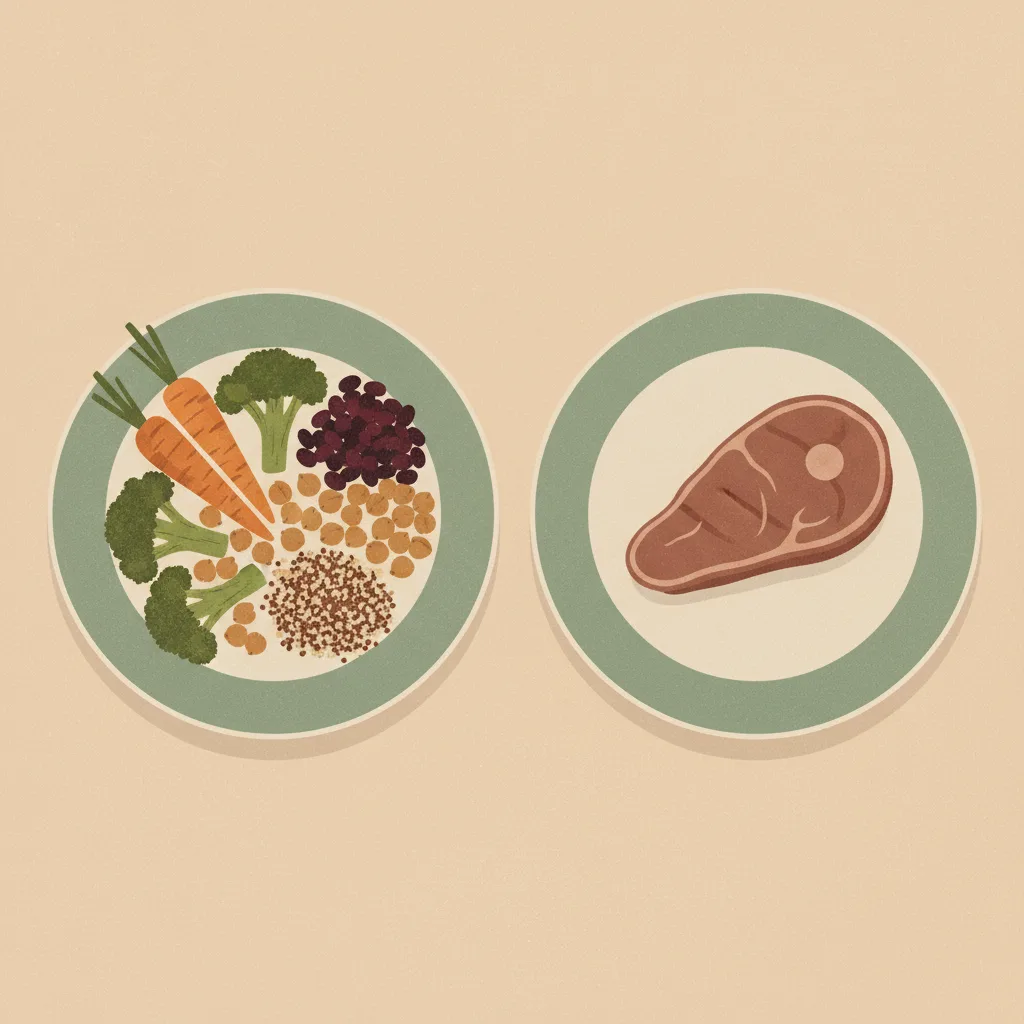
Two plates side by side, one with vegetables and legumes, the other with a cut of meat, both slightly faded.

Arrependimento por ação

Adotar dieta vegetariana/vegana

84%

84% abandonaram o vegetarianismo (proxy de desistência — taxa de abandono, não arrependimento direto)

Adultos nos EUA que tentaram vegetarianismo ou veganismo

retrospectivo, sem prazo fixo

Arrependimento por omissão

Continuar comendo carne

22%

22% sentem culpa por comer carne o tempo todo (proxy de culpa — não arrependimento direto)

Adultos não-veganos no Reino Unido, nacionalmente representativo

retrospectivo, sem prazo fixo

% se arrependem desta escolha

action dominates — A acção domina — a maioria arrepende-se de ter agido.

Decisões relacionadas

Decisões semanticamente semelhantes — mesmo terreno, compromissos diferentes.

lifestyle

Ficar ou recolocar o animal

% se arrependem desta escolha

A inação predomina

Arrependimento de inação 5.7× maior

lifestyle

Tatuagem

% se arrependem desta escolha

A ação predomina

Arrependimento de ação 1.6× maior

Saúde

Parar de fumar

% se arrependem desta escolha

A inação predomina

Arrependimento de inação 90.0× maior

lifestyle

Jejum intermitente

% se arrependem desta escolha

A ação predomina

Arrependimento de ação 2.9× maior

lifestyle

Elétrico vs gasolina

% se arrependem desta escolha

A ação predomina

Arrependimento de ação 2.9× maior

Saúde

Piercing corporal

% se arrependem desta escolha

A ação predomina

Arrependimento de ação 4.0× maior

lifestyle

Deixar a religião

% se arrependem desta escolha

A inação predomina

Arrependimento de inação 2.9× maior

Saúde

Buscar longevidade vs aceitar envelhecimento

% se arrependem desta escolha

A inação predomina

Arrependimento de inação 1.5× maior

The largest study of vegetarian and vegan retention — Faunalytics’ 2014 survey of 11,399 US adults via Harris Interactive — found that 84% of people who adopted a vegetarian or vegan diet eventually returned to eating meat. That number is the action-side proxy shown above, used directly rather than the previously constructed composite. But lapse rate is not regret rate. Crucially, 37% of the lapsed expressed interest in re-adopting, meaning they do not regret the diet itself — they regret stopping it, or faced barriers they could not overcome. A Faunalytics obstacle analysis found that social isolation (84% were not part of any veg community), food access, and meal prep difficulty — not principled rejection of the diet — drove most lapses.

On the other side, a 2022 Vegan Society survey of 2,000 non-vegan UK adults found that 22% report feeling guilty about eating meat all of the time — a persistent-guilt figure we use as the inaction proxy rather than the combined 71% who report guilt “some” or “all” of the time. Persistent guilt maps more closely to a regret-adjacent construct than intermittent discomfort. Cognitive dissonance research (Bastian et al., 2012) shows that meat-related guilt is often resolved through justification strategies — “the guilt persists but produces no corresponding desire to act.” The Vegan Society, as the commissioning body, has an advocacy interest in high guilt numbers.

What the data establishes is that dietary identity is unstable: most people who try vegetarianism quit (though many want to try again), and roughly one in five meat eaters carries persistent guilt about it. The action-dominates pattern reflects an asymmetry between a very high lapse rate and a modest persistent-guilt rate, but readers should note that lapsing conflates genuine dissatisfaction with situational barriers. Both figures are proxies for different constructs (behavioral abandonment vs affective discomfort), so the large delta should be read with caution.

Fontes: acção

Registro de evidências

Cada número abaixo é o que cada fonte relatou, com a citação literal em que nos baseamos e como chegamos ao nosso valor. Clique em qualquer link para verificar diretamente.

1/2 fontes verificadas de forma independente palavra por palavra em relação à fonte citada

  1. [1] Faunalytics / Harris Interactive — A Summary of Faunalytics' Study of Current and Former Vegetarians and Vegans Verificado
    A Summary of Faunalytics' Study of Current and Former Vegetarians and Vegans
    Estatística
    84% of people who have adopted a vegetarian or vegan diet subsequently abandon it; 53% lasted less than one year; 37% of the lapsed are interested in re-adopting
    Trecho
    “"84% of vegetarians/vegans abandon their diet. About a third (34%) of lapsed vegetarians/vegans maintained the diet for three months or less, and slightly more than half (53%) adhered to the diet for less than one year. The only motivation cited by a majority (58%) of former vegetarians/vegans was health." ”
    Dados da fonte de
    2014-12-02
    Acessado
    2026-04-26
    Verificação
    Trecho obtido novamente de forma independente e confirmado palavra por palavra em relação à fonte citada durante nossa auditoria de fundamentação.
    Cálculo
    Faunalytics commissioned Harris Interactive to survey 11,399 US adults aged 17+. Of those who had ever identified as vegetarian/vegan, 84% had reverted to eating meat. We use the 84% lapse rate directly as the action-side proxy. This is NOT a regret measure — it counts anyone who tried vegetarianism even briefly as a "former vegetarian." Crucially, 37% of lapsed expressed interest in re-adopting, meaning many lapsed for situational reasons (social isolation, food access) rather than because they regret the decision in principle.
  2. [2] Faunalytics — Bringing Back Former Vegans And Vegetarians: An Obstacle Analysis
    Bringing Back Former Vegans And Vegetarians: An Obstacle Analysis
    Estatística
    Food dissatisfaction is the most common struggle; accessibility and meal preparation time are the primary must-haves for re-adoption
    Trecho
    “"Dissatisfaction with veg*n food is the most common struggle, with nearly half of lapsed veg*ns experiencing cravings, boredom with their veg*n diet, feeling hungry on the diet, and other issues related to food dissatisfaction." ”
    Dados da fonte de
    2019-10-01
    Acessado
    2026-04-26
    Cálculo
    Faunalytics obstacle analysis of former veg*ns. Confirms that many lapsed for practical/situational reasons (access, time, social isolation) rather than regretting the decision in principle. 84% of former veg*ns were not part of any vegetarian community, and 63% disliked sticking out from the crowd.

Fontes: inacção

Registro de evidências

Cada número abaixo é o que cada fonte relatou, com a citação literal em que nos baseamos e como chegamos ao nosso valor. Clique em qualquer link para verificar diretamente.

  1. [1] The Vegan Society / Attest — Younger people feel more guilty about eating meat than older people, Vegan Society research finds
    Younger people feel more guilty about eating meat than older people, Vegan Society research finds
    Estatística
    22% of non-vegan UK adults feel guilty about eating meat all of the time; an additional 49% feel guilty some of the time
    Trecho
    “"49 per cent of respondents felt guilty about eating meat 'some' of the time, while a further 22 per cent felt guilty 'all' of the time. Even amongst those not limiting their consumption of meat and animal products at all, 45 per cent said they felt guilty about it 'some' or 'all' of the time." ”
    Dados da fonte de
    2022-11-01
    Acessado
    2026-04-26
    Cálculo
    Vegan Society commissioned Attest to survey 2,000 non-vegan UK adults (working age, nationally representative for age, gender, and region) in October 2022. We use the 22% "guilty all the time" figure rather than the combined 71% (some + all), because persistent guilt is a closer proxy for regret-adjacent affect than intermittent guilt. The Vegan Society as commissioning body has an advocacy interest in high guilt numbers. Guilt about eating meat is NOT the same as regret about not going vegetarian — cognitive dissonance research shows meat-guilt is often resolved through justification strategies.
  2. [2] Faunalytics / Harris Interactive — A Summary of Faunalytics' Study of Current and Former Vegetarians and Vegans
    A Summary of Faunalytics' Study of Current and Former Vegetarians and Vegans
    Estatística
    88% of US adults have never tried vegetarianism or veganism; 10% are former veg*ns; 2% are current veg*ns
    Trecho
    “"About 88 percent of the U.S. population had never attempted a vegetarian or vegan diet, yet among the 12 percent who tried, only 2 percent had stuck with it." ”
    Dados da fonte de
    2014-12-02
    Acessado
    2026-04-26
    Cálculo
    Faunalytics population data. 88% of US adults have never tried vegetarianism, providing context: the vast majority of meat eaters have not even considered the alternative seriously, making "regret about not going vegetarian" a narrow phenomenon even if guilt about meat is widespread.

Ressalvas

Neither side measures regret directly. The action-side 84% is a lapse rate — it counts anyone who tried vegetarianism and reverted, including sub-3-month experiments. Lapsing is not regretting: 37% of the lapsed expressed interest in re-adopting, and the Faunalytics obstacle analysis found that practical barriers (social isolation, food access, meal prep difficulty) drove most lapses rather than principled rejection. The raw 84% should be read as "the diet failed to stick" rather than "they regret trying." The inaction-side 22% is persistent guilt ("all the time") about eating meat, not regret about failing to go vegetarian. Cognitive dissonance research (Bastian et al., 2012) shows that meat-related guilt is often resolved through justification strategies without behavior change. The two samples are from different countries (US vs UK) and different decades (2014 vs 2022). The action-dominates pattern reflects the asymmetry between a high lapse rate and a modest persistent-guilt rate, but both are proxies for different constructs (behavioral abandonment vs affective discomfort). The large delta (0.62) overstates the difference in actual regret because lapsing conflates regret with situational barriers.

Dados brutos: /api/decisions.json

Vistos recentemente neste dispositivo