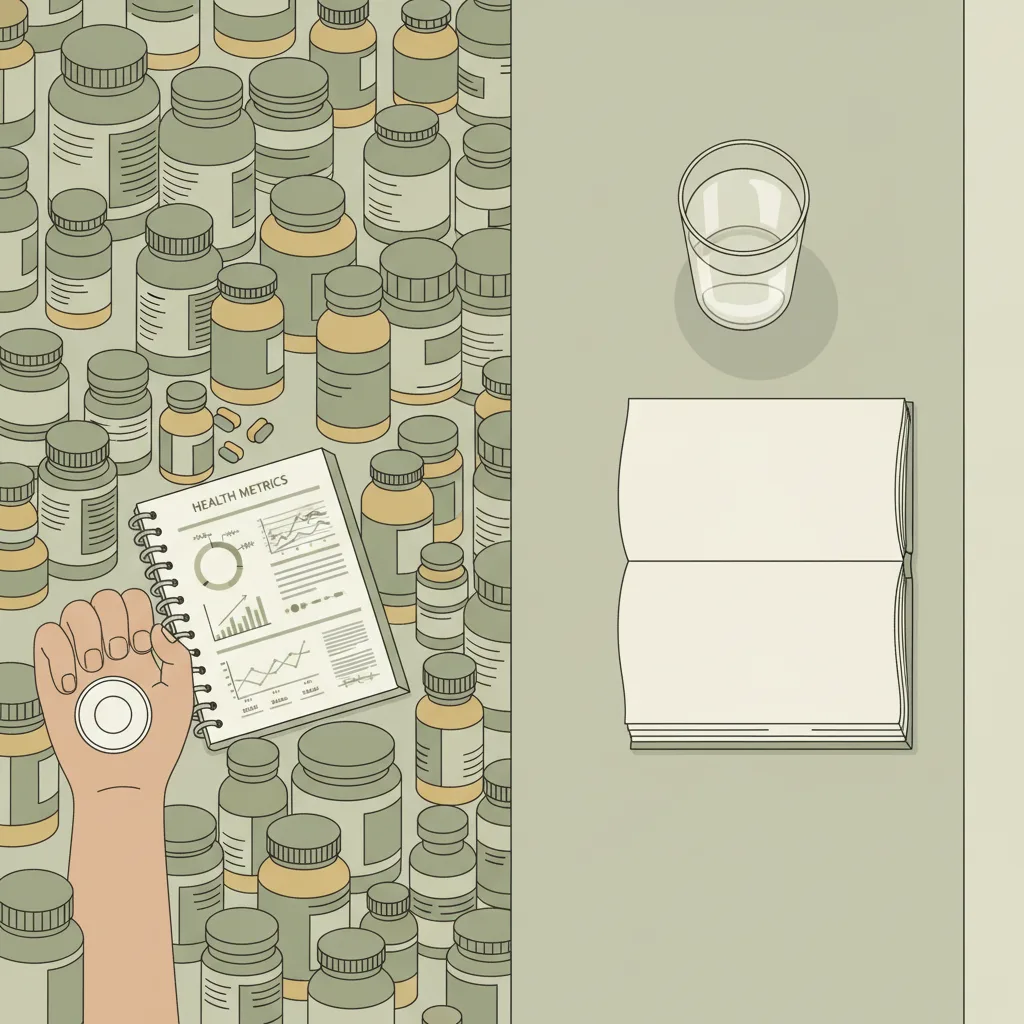
Morte assistida médica vs. cuidados paliativos para doença terminal
Se você agir
Assistência médica para morrer (MAID)
5,0%
Se você não agir
Cuidados de conforto / paliativos (morte natural)
25%
Porcentagem de quem mais tarde se arrepende de cada escolha. As barras e o registro completo aparecem abaixo.
Saúde
Última revisão 2026-05-04
Qualidade das evidências 4.0/5
Pontuação de revisão em oito dimensões segundo a
grelha de qualidade
. Cada dimensão pontuada de 1 a 5.
D1 Verificação das fontes
4/5
D2 Autoridade e independência das fontes
4/5
D3 Precisão da taxa de arrependimento
2/5
D4 Comparabilidade das fontes
3/5
D5 Padrão de Gilovich
5/5
D6 Qualidade da prosa
5/5
D7 Completude das ressalvas
5/5
D8 Qualidade da amostra
4/5
Média4.0/5
Dados proxy — não existe nenhuma pesquisa direta sobre arrependimento para esta decisão. As taxas são derivadas de pontuações de satisfação e dados de barreiras de acesso em vez de perguntas que perguntavam diretamente sobre arrependimento. Veja advertências abaixo.
Arrependimento por ação
Assistência médica para morrer (MAID)
5,0%
~5% dos familiares enlutados apresentam luto complicado após uma morte assistida (e um luto menos traumático do que após uma morte natural)
Famílias enlutadas de pacientes MAID na Bélgica, Países Baixos, Canadá e Oregon (dados multijurisdicionais)
retrospectivo, 1–12 meses pós-morte
Arrependimento por omissão
Cuidados de conforto / paliativos (morte natural)
25%
~25% das famílias enlutadas relatam necessidades não atendidas ou arrependimento quanto à qualidade dos cuidados de fim de vida
Famílias enlutadas de pacientes terminais que morreram sem MAID em ambientes de hospício/hospital nos EUA e Europa
retrospectivo, dentro de 6–12 meses pós-morte
% se arrependem desta escolha
Assistência médica para morrer (MAID)Cuidados de conforto / paliativos (morte natural)
5,0%25%
inaction dominates — A inacção domina — a maioria arrepende-se de não ter agido.
Decisões relacionadas
Decisões semanticamente semelhantes — mesmo terreno, compromissos diferentes.
Recusar o tratamento oncológico convencional; recorrer apenas à medicina alternativa (sem cirurgia, quimioterapia, radioterapia ou hormonoterapia)Aceitar o tratamento oncológico convencional (cirurgia, quimioterapia, radioterapia, hormonoterapia conforme o estágio)
In the jurisdictions where it is legal, medical aid in dying is chosen by a small but growing minority of terminally ill patients — 5.4% of deaths in the Netherlands in 2023, 4.1% in Canada in 2022, and a small fraction of a percent of all deaths in Oregon (38.6 per 10,000 total deaths over the law’s first 18 years), though cancer patients make up the large majority of Oregon’s MAID users — 77% of the 991 patients who used the Death With Dignity Act between 1998 and 2015. These provision counts come from government monitoring reports, which do not survey bereaved families. The family-distress evidence comes instead from bereavement studies: Swarte and colleagues’ BMJ 2003 cross-sectional comparison (189 relatives bereaved by euthanasia vs 316 by natural death of gynaecological-cancer patients) found less traumatic grief and fewer post-traumatic stress reactions in the euthanasia group, and a Swiss study of relatives who witnessed assisted suicide found roughly 5% met criteria for complicated grief (and 13% for full PTSD). One figure stands out from the Oregon Death With Dignity Act data: roughly 30–40% of patients who receive the legally required prescription for lethal medication never use it. For many, simply having the option is sufficient.
The comparison group — families of patients who died without MAID, in hospice or hospital settings — shows substantial unmet need. Teno and colleagues’ landmark 2004 JAMA survey of bereaved families of decedents (n=1,578) found that about a quarter said the patient did not get adequate help with pain (24.2%) and a similar share had concerns with physician communication (23.9%), while half reported insufficient emotional support (50.2%); nursing-home patients were least likely to be “always” treated with respect (68.2%, versus 96.2% in home hospice). The Detering 2010 BMJ RCT found that among families of patients who died, control-group relatives (no advance care planning) had clinically significant depression in 30% of cases, anxiety in 19%, and high PTSD risk in 15% — whereas the advance-care-planning group registered none of these. These figures reflect real, fixable gaps in comfort care rather than a universal defect of natural dying; well-resourced hospice deaths scored far better than institutional ones.
The methodological problem that makes this entry uniquely uncertain is the impossibility of asking MAID patients whether they regret the decision. All regret measurement is family-proxied, and all cross-group comparison conflates eligibility, access, and choice. MAID patients are a selected group: motivated enough to navigate legal and clinical requirements, often dying of cancer with predictable trajectories, and in jurisdictions with functioning access infrastructure. MAID remains illegal in the great majority of the world’s roughly 195 countries; those populations have no choice, and their inclusion would likely shift every figure. What the available data supports most clearly is this: in jurisdictions where both paths are genuinely available and supported, the major asymmetry is not in the dying itself but in the quality of the dying — and unmet needs in natural-death settings remain common enough to constitute a public health gap, not a rare failure.
Fontes: acção
Registro de evidências
Cada número abaixo é o que cada fonte relatou, com a citação literal em que nos baseamos e como chegamos ao nosso valor. Clique em qualquer link para verificar diretamente.
2/4 fontes verificadas de forma independente palavra por palavra em relação à fonte citada
[1]Health Canada — Fourth Annual Report on Medical Assistance in Dying in Canada 2022
Relatório governamental
13,241 MAID provisions in Canada in 2022, representing 4.1% of all deaths in Canada
Trecho
“"In 2022, there were 13,241 MAID provisions in Canada, accounting for 4.1% of all deaths in Canada. Since the introduction of federal MAID legislation in 2016, the number of reported MAID deaths has increased steadily each year."
”
Dados da fonte de
2023-10-24
Acessado
2026-05-04
Cálculo
Health Canada Fourth Annual Report on MAID 2022 establishes only the provision count and its share of all deaths (13,241 = 4.1%; corroborated by Statistics Canada, The Daily 2023-11-29). This federal monitoring report does NOT survey bereaved families and contains no family-satisfaction or family-regret figure — it is cited here for the denominator (how common MAID is), not for the action-side regret rate. The regret rate is grounded in the Swarte (BMJ 2003) and Wagner (2012) bereavement studies below.
9,068 euthanasia/assisted-suicide notifications in the Netherlands in 2023 (5.4% of all deaths); 5 cases found not to meet the due care criteria (>99.9% compliant)
Trecho
“"In 2023 the RTEs received 9,068 notifications of euthanasia. These 9,068 deaths represent 5.4% of the total number of deaths in the Netherlands. In five of the notified cases the committees found that the physician had not acted in accordance with all of the due care criteria."
”
Dados da fonte de
2024-04-04
Acessado
2026-05-04
Cálculo
Dutch RTE Annual Report 2023 (direct PDF: euthanasiecommissie.nl/.../jaarverslag-2023/ Annual+report+2023.pdf; figures corroborated by FSSPX News 2024). 9,068 notifications = 5.4% of all Dutch deaths; only 5 of 9,068 cases (0.06%) were judged non-compliant, i.e. >99.9% met every due care criterion. This report counts and reviews notifications; it does NOT contain a bereaved-family satisfaction or regret survey, so it is cited for the provision count and compliance rate only — not for the action-side regret figure.
[3]Ontario HIV Treatment Network (rapid response) citing Swarte et al. BMJ 2003 and Wagner et al. 2012 — Effects of euthanasia on the bereaved family and friends (Swarte et al., BMJ 2003) and Death by request in Switzerland (Wagner et al., 2012), as summarised in the OHTN rapid response on the impact of MAID on family and friends
Verificado
Revisado por pares
Family/friends bereaved by euthanasia had less traumatic grief and fewer post-traumatic stress reactions than those bereaved by natural death (Swarte, n=189 vs 316); among relatives who witnessed assisted suicide, 5% met criteria for complicated grief and 13% for full PTSD (Wagner)
Trecho
“"[On Swarte et al. 2003, Netherlands] family and friends of patients who requested medical assistance in dying had less traumatic grief symptoms, fewer current feelings of grief, and fewer post-traumatic stress symptoms compared to the family and friends of women who died naturally. [On Wagner et al. 2012, Switzerland] 13% met the criteria for full PTSD, 7% met the criteria for subthreshold PTSD, and 5% met the criteria for complicated grief. The prevalence of depression was 16% and the prevalence of anxiety was 6%."
”
Dados da fonte de
2003-07-26
Acessado
2026-06-30
Verificação
Trecho obtido novamente de forma independente e confirmado palavra por palavra em relação à fonte citada durante nossa auditoria de fundamentação.
Cálculo
The ~5% action-side figure is grounded here, not in the provision-counting government reports above. The direct comparison study (Swarte, BMJ 2003; n=189 euthanasia vs n=316 natural death of gynaecological-cancer patients) found LESS traumatic grief and fewer PTSD reactions among the euthanasia-bereaved — i.e. family distress after MAID is at or below the natural-death baseline. The Swiss witness study (Wagner 2012) gives a concrete absolute: ~5% complicated grief among relatives who were present at an assisted death. This is a family-distress proxy, not a direct "do you regret the decision?" survey — see proxy_only and caveats. 0.05 is used as a conservative distress/complicated-grief rate consistent with both studies.
[4]Drug and Alcohol Dependence / peer-reviewed characterization of Oregon Health Authority DWDA data, 1998-2015 — Characterizing 18 Years of the Death With Dignity Act in Oregon
Verificado
Revisado por pares
Of 991 Oregon patients who used the Death With Dignity Act 1998-2015, 762 (77.1%) had cancer as the underlying terminal illness; DWDA deaths represent 38.6 per 10,000 total Oregon deaths over the period
Trecho
“"Cancer was the most common underlying terminal illness, with 762 (77.1%) patients." "DWDA deaths make up only a small fraction of overall Oregon resident mortality, with a rate of 38.6 per 10,000 total deaths."
”
Dados da fonte de
2018-01-01
Acessado
2026-07-03
Verificação
Trecho obtido novamente de forma independente e confirmado palavra por palavra em relação à fonte citada durante nossa auditoria de fundamentação.
Cálculo
Used to correct and ground the Oregon reference in the body text (originally an unsourced "3-4% of cancer deaths" claim that does not match any published Oregon Health Authority or peer-reviewed figure; Oregon Health Authority annual reports and this characterization paper report DWDA usage as a rate per 10,000 deaths, not a percentage of cancer deaths specifically, and the overall DWDA share of Oregon deaths is well under 1%). Replaced with the two verified figures: cancer as underlying illness in 77.1% of DWDA patients, and DWDA deaths at 38.6 per 10,000 of all Oregon deaths, 1998-2015. Not used to compute the action-side regret rate — provided for provision-count context only, same role as the Health Canada and Dutch RTE sources above.
Independência
Peer-reviewed academic characterization of Oregon Health Authority's own published DWDA surveillance data; independent of the Swarte and Wagner bereavement studies used for the regret rate.
Fontes: inacção
Registro de evidências
Cada número abaixo é o que cada fonte relatou, com a citação literal em que nos baseamos e como chegamos ao nosso valor. Clique em qualquer link para verificar diretamente.
1/2 fontes verificadas de forma independente palavra por palavra em relação à fonte citada
[1]JAMA (Teno et al., 2004; PMID 14709580) — Family Perspectives on End-of-Life Care at the Last Place of Care
Verificado
↗ 1 other entry
Revisado por pares
Bereaved families of 1,578 decedents: ~25% said pain was not adequately treated and ~24% had concerns with physician communication; 50.2% said the patient did not get enough emotional support; nursing-home patients least likely to be 'always' treated with respect (68.2% vs 96.2% home hospice)
Trecho
“"Nearly one fourth of all respondents reported that the patient did not receive any or enough help with pain (24.2%) or dyspnea (22.4%). About 1 in 4 families reported concerns with physician communication regarding medical decision making (23.9%). Half of family members reported that the patient did not receive enough emotional support (50.2%). Nursing home residents were less likely than those cared for in a hospital or by home hospice services to always have been treated with respect at the end of life (68.2% vs 79.6% and 96.2%, respectively)."
”
Dados da fonte de
2004-01-07
Acessado
2026-06-30
Verificação
Trecho obtido novamente de forma independente e confirmado palavra por palavra em relação à fonte citada durante nossa auditoria de fundamentação.
Cálculo
Teno et al. 2004 JAMA — mortality follow-back survey of bereaved families of decedents (n=1,578; PMID 14709580). Correct article is fullarticle/197944 (the previously cited fullarticle/198197 was an unrelated software review). The inaction-side ~25% proxy is the rate of clearly unmet end-of-life needs — ~24% inadequate pain treatment and ~24% physician-communication concerns; family rating of "always treated with respect" was as low as 68.2% in nursing homes (i.e. ~32% short of always). This is used as an unmet-needs / dissatisfaction proxy because no survey asks natural-death families "do you wish MAID had been chosen." Hospice deaths scored far better (96.2% respect), which is why the proxy is a cross-setting figure, not a universal property of natural dying.
[2]BMJ — The impact of advance care planning on end of life care in elderly patients: randomised controlled trial↗ 1 other entry
Revisado por pares
Among families of patients who died (29 intervention vs 27 control), control-group relatives had clinically significant depression 30% (8/27), anxiety 19% (5/27) and high PTSD risk 15% (4/27); the advance-care-planning group was 0% on all three
Trecho
“[Paraphrase from Table 3 — BMJ full text paywalled; figures verified via PMC2844949] Among family members of the patients who died, in the control group (no advance care planning) clinically significant depression occurred in 30% (8/27), anxiety in 19% (5/27), and post-traumatic stress in 15% (4/27); in the intervention (advance care planning) group the corresponding rate was 0% on each measure ("scores of this level occurred only in the family members of control group patients who had died"). Family members of intervention patients were more satisfied with the quality of dying.
”
Dados da fonte de
2010-03-23
Acessado
2026-06-30
Cálculo
Detering et al. BMJ 2010 RCT of 309 elderly inpatients (PMID 20332506; family-outcome subgroup: 56 deceased, 29 intervention / 27 control). Verbatim from Table 3: control-group bereaved relatives showed depression 30% (8/27), anxiety 19% (5/27), high PTSD risk 15% (4/27); the ACP group was 0% on all three. (The earlier excerpt's "15% in the ACP group" was wrong — 15% is the control-group PTSD figure; the ACP group was 0%.) These are family distress measures, not MAID-specific regret; cited as a corroborating signal that ~1 in 4–1 in 3 bereaved relatives suffer significant distress when end-of-life care/planning is not optimised, consistent with the inaction-side ~25% unmet-needs proxy.
Ressalvas
This entry is among the most methodologically constrained in the project. The core challenge is asymmetric measurement: MAID patients are dead and cannot report their own regret; their family proxy is the best available signal. Natural-death patients and families likewise face no clean counterfactual ("would you have chosen MAID if it had been available and acceptable?"). The regret rates used here are family-reported distress measures, not direct decision-regret surveys, and should be understood as proxies. MAID is legal in approximately 30 jurisdictions worldwide (including Canada, Netherlands, Belgium, Australia, and several US states); eligibility criteria vary substantially from terminal-illness-only (Oregon) to broader non-terminal suffering (Netherlands, Belgium, Canada Track 2). The 30–40% of MAID prescription-holders who receive the prescription but never ingest it — Oregon data across 1997–2023 — suggests that access itself reduces distress regardless of use. The reverse-causation concern is real: MAID patients may select into the process partly because their deaths were already going well; hospice patients dying with unmet needs were not MAID-eligible or did not choose it for other reasons.