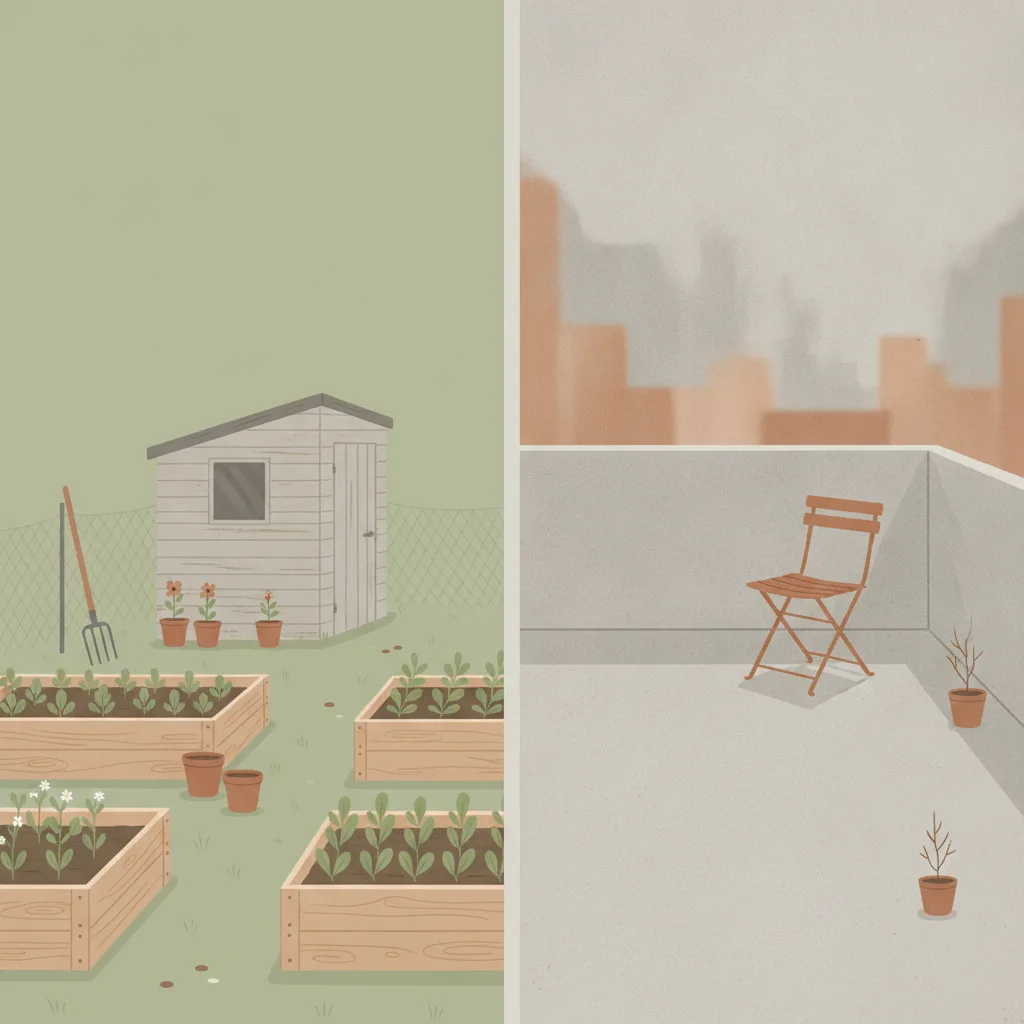
Arranjar uma horta comunitária ou talhão de horta urbana vs. ficar sem
Se você agir
Ter uma horta comunitária ou lote de cultivo
8,0%
Se você não agir
Continuar sem horta ou lote de cultivo
38%
Pelo menos um número é uma estimativa indireta, não uma taxa de arrependimento medida. Abaixo explicamos como cada número foi obtido.
Estilo de vida
Última revisão 2026-05-04
Qualidade das evidências 4.13/5
Pontuação de revisão em oito dimensões segundo a
grelha de qualidade
. Cada dimensão pontuada de 1 a 5.
D1 Verificação das fontes
5/5
D2 Autoridade e independência das fontes
4/5
D3 Precisão da taxa de arrependimento
2/5
D4 Comparabilidade das fontes
3/5
D5 Padrão de Gilovich
5/5
D6 Qualidade da prosa
5/5
D7 Completude das ressalvas
5/5
D8 Qualidade da amostra
4/5
Média4.13/5
Dados indiretos: para esta decisão, pelo menos um número vem de uma medida indireta, como desfechos, satisfação ou intenção, ou de uma estimativa editorial, e não de uma pesquisa direta sobre arrependimento. As notas de cada lado, abaixo, explicam como cada número foi obtido.
Se você agir
Ter uma horta comunitária ou lote de cultivo
8,0%
91,9% dos titulares de hortas comunitárias avaliam o benefício de saúde mental de sua parcela como 8/10 ou mais (proxy de satisfação — não existe pesquisa direta de arrependimento ou de abandono de parcela; os ~8% mostrados são a parcela que não deu a nota máxima, NÃO uma taxa de arrependimento medida)
Titulares de horta comunitária no Reino Unido
pesquisa retrospectiva, 2025
Se você não agir
Continuar sem horta ou lote de cultivo
38%
~38% dos não jardineiros citam a falta de acesso como o motivo pelo qual não cultivam uma horta
Adultos britânicos que não jardinaram nos últimos 12 meses
pesquisa transversal, 2025
Número de cada escolha (a medida está indicada na página)
Ter uma horta comunitária ou lote de cultivoContinuar sem horta ou lote de cultivo
8,0%38%
Decisões relacionadas
Decisões semanticamente semelhantes — mesmo terreno, compromissos diferentes.
Approximately 91.9% of UK allotment plot holders rate the mental health benefit
of their plot at 8 or higher out of 10, with 63% giving a perfect 10, according to
the National Allotment Society’s 2025 survey of approximately 2,000 holders. A 2010
peer-reviewed study in Environmental Health (van den Berg et al.) reached the same
figure independently: 91% of Dutch allotment gardeners reported increased happiness
after visiting their plot, and their life satisfaction scores were significantly
higher than those of matched non-gardening neighbors drawn from the same residential
areas (2.26 vs 2.12, p<0.05). Neither survey asked holders whether they regret
their plot; both measured benefit ratings, and in both the residual 8–9% is simply
the share who did not give the top positive response rather than a count of people
who wished they had not taken a plot. No published study reports a direct allotment
regret or relinquishment-due-to-regret rate, so the figure shown here is a
satisfaction-tail proxy, not a measured regret rate. The pattern
holds across age groups but is sharpest in older adults: among those over 62, the
Dutch gardeners scored 0.32 on a composite wellbeing index versus −0.26 for same-age
neighbors, and loneliness scores diverged by a factor of nearly three.
The inaction side is structured by access rather than preference. The RHS State of
Gardening 2025 found that 38% of UK adults who had not gardened in the past year
cited lack of access to growing space as the reason — the largest single barrier,
and one that implies desire without opportunity rather than chosen non-participation.
In the same RHS survey, 14.7 million adults said they would be interested in
volunteering for organised community gardening sessions, while 2.5 million had
taken part in community gardening initiatives over the past three years. Over
174,000 people are on UK waiting lists for allotment plots at any given time, with
average waits of four years nationally and up to twelve years in some London boroughs.
This is unusual among decisions studied here: the inaction group is partly
involuntary, shaped by land supply and local authority policy rather than freely
chosen preference. Whether one frames that constraint as regret or frustration, it
is directionally the same: a large population wants the outcome and does not have it.
The Gilovich inaction-dominance pattern is among the more robust in this dataset for
this topic, though both sides rest on proxies rather than direct regret questions.
The roughly 30-percentage-point gap between the action-side satisfaction-tail proxy
(~8% non-top rating) and the inaction-side access-barrier proxy (~38% cite lack of
access) is consistent across UK survey data and the Dutch controlled study, and
it is consistent with findings in adjacent decisions like gym membership and therapy
— categories where the barrier to starting tends to feel large and the regret after
starting tends to be low. The specific mechanism is well-documented: allotment
holders visit regularly (unlike vacation cabin owners), the costs are low relative to
perceived benefit, and the social dimension of a shared site appears to add value
that solo garden ownership does not. For those fortunate enough to reach the front
of a waiting list, the decision to take the plot is almost universally reported as
the right one.
Fontes: acção
Registro de evidências
Cada número abaixo é o que cada fonte relatou, com a citação literal em que nos baseamos e como chegamos ao nosso valor. Clique em qualquer link para verificar diretamente.
2/2 fontes verificadas de forma independente palavra por palavra em relação à fonte citada
[1]National Allotment Society (via Pressat press office) — Growing the Evidence: Survey Shows the Power of Allotments
Verificado
Fonte de referência
91.9% of UK allotment holders rate mental health benefits at 8/10 or higher; 63% give a perfect 10/10
Trecho
“"Nearly 63% of respondents rated the impact of their allotment on mental wellbeing a perfect 10, with 91.9% scoring it 8 or higher. Physical health benefits were similarly high, with 88.1% rating them 8 or above. 89.2% increased their fresh produce intake after getting a plot. 80.3% credited their plot with forming new social relationships."
”
Dados da fonte de
2025-08-11
Acessado
2026-05-04
Verificação
Trecho obtido novamente de forma independente e confirmado palavra por palavra em relação à fonte citada durante nossa auditoria de fundamentação.
Cálculo
NAS 2025 survey of approximately 2,000 UK allotment plot holders. The survey measured benefit ratings, not regret: 91.9% rated the plot's mental-health benefit 8/10 or higher. The 8% stored as regret_rate is the arithmetic complement of that 91.9% (those who did NOT give a top-band rating), i.e. the satisfaction-score tail — NOT a dissatisfaction or regret rate. No question asked "do you regret getting an allotment", and no published survey measures allotment regret or relinquishment-due-to-regret (the 2024 Birmingham study of 876 tenants, Bloomfield, reports tenure — 9% held a plot <1 year, 36% 1–5 years — but no regret/quit rate; the 2025 APSE Local Authority State of the Market survey reports waiting-list demand, not plot abandonment). The non-top rating share is used only as the closest available proxy, with that limitation stated explicitly in the display and caveats. It is in the same range as the Netherlands peer-reviewed study (van den Berg et al. 2010), where 91% of allotment gardeners reported increased happiness after plot visits — again a positive-rating figure, not a measure of regret. The residual 8–9% in both samples is the share who did not give the top positive response, not a count of people who wished they had not taken a plot.
Independência
NAS is an independent UK charity that represents allotment holders. This survey is independent of the RHS, van den Berg academic study, and any commercial or government source.
[2]Environmental Health (BioMed Central / Springer) — Allotment gardening and health: a comparative survey among allotment gardeners and their neighbors without an allotment
Verificado
Revisado por pares
91% of allotment gardeners reported increased happiness after plot visits; life satisfaction 2.26 vs 2.12 for non-gardening neighbors (p<0.05)
Trecho
“"Eighty-four percent reported feeling healthier after a visit to the allotment garden. [...] 91 percent reported feeling happier and 86 percent reported feeling less stressed."
”
Dados da fonte de
2010-10-27
Acessado
2026-05-04
Verificação
Trecho obtido novamente de forma independente e confirmado palavra por palavra em relação à fonte citada durante nossa auditoria de fundamentação.
Cálculo
van den Berg et al. (2010) surveyed 121 allotment gardeners and 63 matched non-allotment neighbors recruited from the same residential areas near 12 allotment sites in 8 Dutch cities (July–September sampling). Both groups completed the same wellbeing questionnaire, providing a genuine comparison of people who garden vs. comparable people who do not. The 91% happiness increase rate among gardeners implies approximately 9% who did not report this outcome — consistent with the NAS 2025 UK figure. Used here as the independent peer-reviewed anchor corroborating the NAS satisfaction finding.
Independência
Independent of all other sources: peer-reviewed academic study published in a Springer/BioMed Central journal, conducted by Dutch university researchers (Wageningen UR), using a controlled matched-sample design rather than a self-selected holder survey. Different country (Netherlands), different year (2010), different methodology.
Fontes: inacção
Registro de evidências
Cada número abaixo é o que cada fonte relatou, com a citação literal em que nos baseamos e como chegamos ao nosso valor. Clique em qualquer link para verificar diretamente.
1/2 fontes verificadas de forma independente palavra por palavra em relação à fonte citada
[1]Royal Horticultural Society — RHS State of Gardening Report 2025
Fonte de referência
38% of non-gardeners cite lack of access to indoor or outdoor growing space as the reason they do not garden; 8.5 million people have never gardened, many of whom lack access to suitable space
Trecho
“"Notably, 38% of non-gardeners had no space in which to garden. [...] 2.5m people took part in community gardening initiatives over the past three years [...] yet 8.5 million people have never gardened [...] 14.7 million adults said they would be interested in volunteering for organised community gardening sessions."
”
Dados da fonte de
2025-01-01
Acessado
2026-05-04
Cálculo
RHS State of Gardening is the annual national survey of UK gardening participation and barriers. The 38% access-barrier figure measures the share of recent non-gardeners who attribute their non-participation to lacking space rather than lacking interest — i.e., they want to garden but cannot. This is a proxy for inaction regret: access-deprived non-gardeners represent a population that wants the outcome (a plot) but does not have it. The 14.7 million figure counts adults interested in volunteering for organised community gardening sessions; it measures interest in volunteering, not a wish for a plot, and is only a rough population-level scale check. METHODOLOGICAL CAVEAT: "cites access as the barrier" is not the same as "regrets not having a plot" — the 38% is the best available proxy, not a direct regret measurement. The waiting list data (174,000+ on UK allotment lists, average wait 4 years) corroborates the scale of unmet demand.
Independência
The RHS is the UK's leading horticultural charity, independent of the NAS and of the van den Berg academic research. The RHS State of Gardening surveys general UK adults, not specifically allotment holders, making it methodologically complementary to the NAS holder-only survey.
[2]Environmental Health (BioMed Central / Springer) — Allotment gardening and health: a comparative survey among allotment gardeners and their neighbors without an allotment
Verificado
Revisado por pares
Non-allotment neighbors scored significantly lower on life satisfaction (2.12 vs 2.26, p<0.05) and loneliness (aged 62+: 0.80 vs 0.28) compared to allotment gardeners in the same residential areas
Trecho
“"84 percent of the allotment gardeners met the Dutch guideline [...] this norm was met by only 62 percent of the respondents in the control group."
”
Dados da fonte de
2010-10-27
Acessado
2026-05-04
Verificação
Trecho obtido novamente de forma independente e confirmado palavra por palavra em relação à fonte citada durante nossa auditoria de fundamentação.
Cálculo
The non-gardening neighbor group in van den Berg et al. (2010) represents the inaction side: people living near allotments who do not garden. Their measurably lower life satisfaction (p<0.05) and higher loneliness scores provide peer-reviewed evidence that the non-gardening state is associated with worse wellbeing outcomes than the gardening state. This is a wellbeing gap, not a direct regret measurement, but it is the strongest controlled evidence available for the cost of the inaction choice. Used here as the independent corroborating anchor for the RHS access-barrier finding.
Independência
Same study as cited on the action side; used here as the inaction-side comparison group. The neighbor group (n=63) and gardener group (n=121) were both recruited from the same residential areas, providing the closest available controlled comparison.
Ressalvas
MEDIÇÕES POR PROXY — NENHUM DOS LADOS USA UMA PERGUNTA DIRETA DE ARREPENDIMENTO. Nenhuma pesquisa ou estudo publicado na literatura sobre hortas comunitárias pergunta diretamente aos titulares se se arrependem de terem obtido uma parcela, ou aos não titulares se se arrependem de não terem uma. A taxa de ação de 8% é o complemento da pontuação de satisfação de 91,9% (NAS 2025) — uma inversão de satisfação, não uma medida de arrependimento. A taxa de inação de 38% é a parcela de barreira de acesso do lado direito — "cita o acesso como o motivo pelo qual não cultivo" ≠ "arrepende-se de não ter uma parcela". Ambos são os proxies mais próximos disponíveis; não existem dados melhores na literatura publicada. VIÉS DE SOBREVIVÊNCIA / ATRITO: A pesquisa NAS 2025 cobre apenas os titulares atuais de parcelas. Pessoas que adquiriram uma parcela, a acharam insatisfatória ou exigente demais e a abandonaram não estão representadas — sua exclusão significa que a verdadeira fração de ex-titulares que não repetiriam a escolha é quase certamente maior do que o resíduo de 8% que não deu a nota máxima aqui apresentado, que é um proxy da cauda de satisfação e não uma taxa de arrependimento medida. INFLAÇÃO POR DESEJABILIDADE SOCIAL: A jardinagem em hortas comunitárias carrega um forte enquadramento cultural positivo no Reino Unido (saúde, comunidade, sustentabilidade). As pontuações de satisfação autorrelatadas provavelmente são infladas por efeitos de desejabilidade social; os titulares podem subdeclarar a insatisfação mesmo em uma pesquisa anônima. GRUPO DE COMPARAÇÃO PEQUENO: A comparação bilateral revisada por pares de van den Berg (2010) — a evidência controlada mais forte desta entrada — usa apenas n=63 vizinhos não jardineiros ao lado de n=121 jardineiros de horta comunitária. Com esse tamanho de amostra, a diferença de satisfação com a vida (2,26 vs 2,12, p<0,05) é estatisticamente significativa, mas o intervalo de confiança é amplo; o tamanho do efeito deve ser tratado como direcional, e não preciso. ESCOPO POPULACIONAL: Todas as cifras são do Reino Unido/Europa; a cultura de hortas comunitárias nos EUA é menos enraizada, as listas de espera são mais curtas e as normas de posse de parcelas diferem — a transposição direta das taxas não é apropriada. RESTRIÇÕES DE ACESSO SOBRE A INAÇÃO: Ao contrário da maioria das decisões neste conjunto de dados, a escolha pela inação é frequentemente involuntária — mais de 174.000 pessoas estão em listas de espera no Reino Unido, com esperas médias de 4 anos e de até 12 anos em alguns bairros de Londres. Uma parte do grupo de "inação" agiria se a oferta permitisse, o que complica o enquadramento de Gilovich, que pressupõe que a inação foi escolhida livremente.