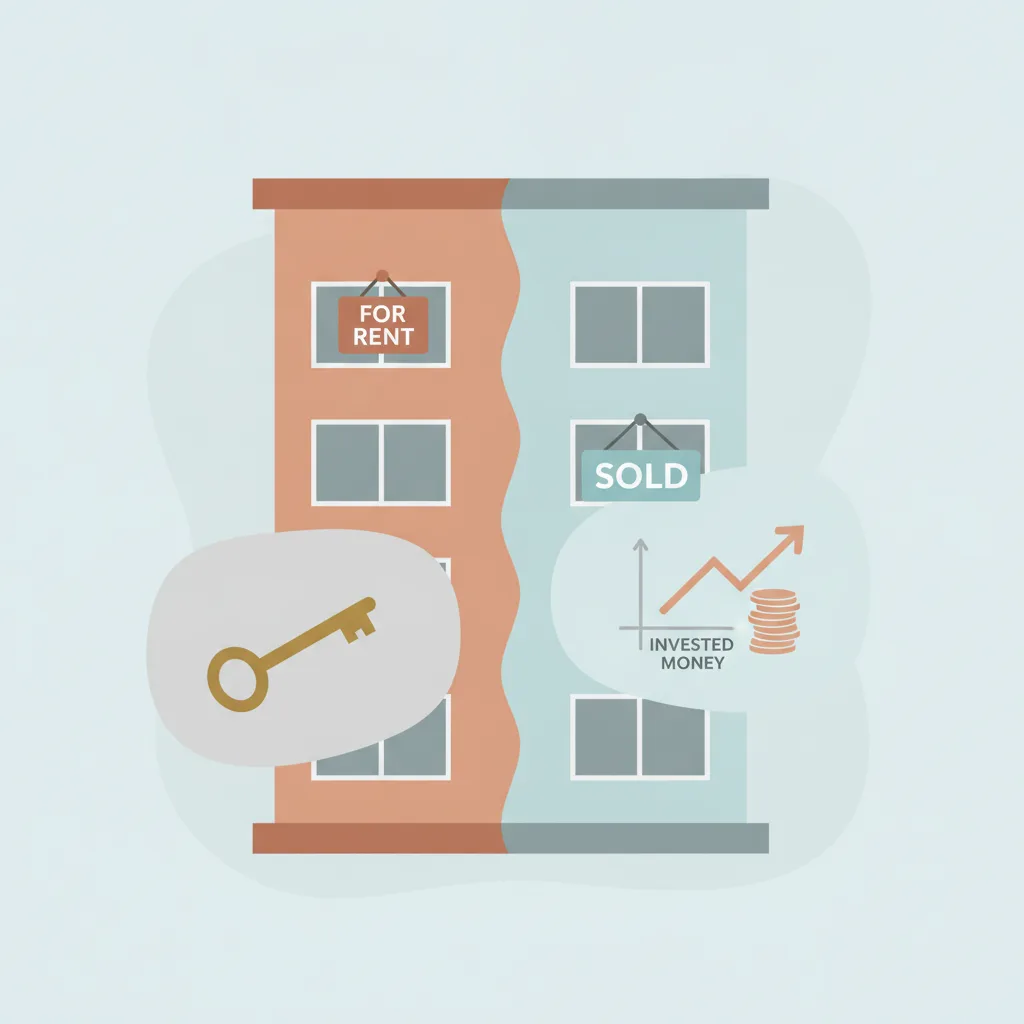
Arrendar um imóvel que se possui contra vendê-lo e investir o dinheiro
Se você agir
Vender e investir
25%
Se você não agir
Manter e arrendar
40%
Porcentagem de quem mais tarde se arrepende de cada escolha. As barras e o registro completo aparecem abaixo.
Financeiro
Última revisão 2026-07-09
Qualidade das evidências 4.13/5
Pontuação de revisão em oito dimensões segundo a
grelha de qualidade
. Cada dimensão pontuada de 1 a 5.
D1 Verificação das fontes
4/5
D2 Autoridade e independência das fontes
4/5
D3 Precisão da taxa de arrependimento
3/5
D4 Comparabilidade das fontes
4/5
D5 Padrão de Gilovich
4/5
D6 Qualidade da prosa
5/5
D7 Completude das ressalvas
4/5
D8 Qualidade da amostra
5/5
Média4.13/5
Dados proxy — não existe nenhuma pesquisa direta sobre arrependimento para esta decisão. As taxas são derivadas de pontuações de satisfação e dados de barreiras de acesso em vez de perguntas que perguntavam diretamente sobre arrependimento. Veja advertências abaixo.
Arrependimento por ação
Vender e investir
25%
25% de quem vende arrepende-se da venda — sente falta da casa de que abdicou
Adultos dos EUA que venderam uma casa em 2021–2022 (inquérito Clever Real Estate 2022)
retrospetivo, no prazo de ~1–2 anos após a venda
Arrependimento por omissão
Manter e arrendar
40%
40% dos proprietários de imóveis para arrendamento gostariam de nunca ter começado
Investidores imobiliários residenciais / senhorios dos EUA (inquérito Clever Real Estate 2024)
retrospetivo, proprietários atuais
% se arrependem desta escolha
Vender e investirManter e arrendar
25%40%
inaction dominates — A inacção domina — a maioria arrepende-se de não ter agido.
Decisões relacionadas
Decisões semanticamente semelhantes — mesmo terreno, compromissos diferentes.
No survey pits “rent it out” directly against “sell it and invest the money,” so this pairs the two closest measured regrets. About 40% of residential rental owners wish they’d never started investing in real estate (Clever Real Estate’s 2024 survey of 764 investors), against about 25% of recent sellers who regret selling because they miss the home they gave up (Clever’s 2022 survey of 1,000 sellers). On those proxies, keeping-and-renting is the more-regretted path — the opposite of the intuition that selling is the move you might kick yourself for later.
The reason keep-and-rent regret runs high is that landlording is not the passive income it is sold as. In the same 2024 survey, 56% of owners had already had to evict a tenant, 61% were still chasing missed rent every month, and 87% reported some regret about their investment decisions. The NBER study of landlords’ own lease ledgers puts a price on the hassle: filing a single eviction costs the equivalent of two to three months’ rent, and nonpayment is common enough that many landlords tolerate months of it before acting. Against that, the seller’s regret is quieter and more emotional — missing a home — rather than a recurring operational drain.
Read the gap cautiously. This is a proxy pairing, flagged as such: the two numbers come from different people surveyed in different years, the seller figure includes forced moves that mix circumstance with choice, and the investor sample leans toward heavily-invested owners who may regret more than a one-flat landlord would. It also says nothing about the money — whether renting out or selling-and-investing wins financially depends on rental yield, local price growth, and what the sale proceeds earn elsewhere, none of which a regret rate measures. The Gilovich pattern (holding-and-managing regret accumulates while the sold home fades into a wistful memory) fits the direction here, but the evidence is indicative, not a head-to-head test.
Fontes: acção
Registro de evidências
Cada número abaixo é o que cada fonte relatou, com a citação literal em que nos baseamos e como chegamos ao nosso valor. Clique em qualquer link para verificar diretamente.
[1]Clever Real Estate — American Home Seller Report: 2022 Edition
Fonte de referência
One-fourth of home sellers (25%) regretted selling because they miss their old home
Trecho
“"One-fourth of respondents (25%) regretted selling because they miss their old home" — from a survey of 1,000 people who sold a home in 2021 or 2022 (fielded Sept. 29 – Oct. 2, 2022).
”
Dados da fonte de
2022-10-12
Acessado
2026-07-09
Cálculo
Used as a proxy for regret about the decision to sell itself. The 25% "miss their old home" figure is the cleanest available decision-construct regret for sellers — distinct from the much larger "process" regret numbers (priced too low, sold too fast, commission too high) that other seller surveys report, which measure regret about how the sale went, not regret about having sold. Because it is a proxy (not a head-to-head "sell vs rent-out" survey), this entry is flagged proxy_only.
Fontes: inacção
Registro de evidências
Cada número abaixo é o que cada fonte relatou, com a citação literal em que nos baseamos e como chegamos ao nosso valor. Clique em qualquer link para verificar diretamente.
[1]Clever Real Estate — Residential Real Estate Investing in 2024: More Rent Money, More Rental Problems↗ 1 other entry
Fonte de referência
40% of residential real estate investors wish they'd never started investing in real estate; 87% have regrets about their investment decisions; 56% have had to evict a tenant
Trecho
“"40% say they wish they'd never started investing in real estate [...] 87% [...] have regrets about their investment decisions [...] More than half of respondents (56%) have had to evict a tenant at some point." — survey of 764 US residential real estate investors, fielded May 18–June 9, 2024.
”
Dados da fonte de
2024-07-01
Acessado
2026-07-09
Cálculo
The 40% "wish they'd never started" figure is used as the regret proxy for the keep-and-rent side. The broader 87% "have regrets" figure is not used as the headline because it spans market and financial regrets, not the decision to become a landlord specifically. Sample skews toward active, heavily-invested owners (90% had lost money on an investment).
[2]National Bureau of Economic Research (NBER Working Paper 33155) — Nonpayment and Eviction in the Rental Housing Market↗ 1 other entry
Estudo primário
Filing an eviction costs landlords the equivalent of 2–3 months of rent; nonpayment is common and frequently tolerated before eviction
Trecho
“"Filing an eviction costs landlords the equivalent of 2-3 months of rent [...] Nonpayment is common, is frequently tolerated by landlords, and is often followed by recovery."
”
Dados da fonte de
2024-11-01
Acessado
2026-07-09
Cálculo
Cited to explain why keep-and-rent regret runs high: landlording carries real, recurring costs (an eviction alone runs 2–3 months' rent), which the "passive income" framing understates. Corroboration for the regret driver, not a regret rate itself.
Ressalvas
Este é um emparelhamento baseado apenas em indicadores substitutos: nenhum inquérito pergunta às mesmas pessoas se se arrependem de ter escolhido arrendar um imóvel em vez de o vender e investir o dinheiro, pelo que cada lado usa o constructo mais próximo disponível. O lado da venda é aproximado pelos 25% de quem vendeu recentemente e «sente falta da antiga casa» (Clever 2022); o lado do manter e arrendar, pelos 40% dos proprietários que «gostariam de nunca ter começado a investir em imóveis» (Clever 2024). Os dois valores provêm de amostras diferentes (vendedores vs. investidores) em anos diferentes (2022 vs. 2024), pelo que a comparação é indicativa, não controlada. O valor «tenho saudades da minha casa» inclui pessoas obrigadas a mudar-se por uma mudança de emprego ou por finanças, misturando circunstância com escolha; a amostra de investidores está enviesada para proprietários ativos e fortemente investidos (90% perderam dinheiro num investimento), sobrestimando provavelmente o arrependimento de quem arrenda um único apartamento herdado ou deixado vago. Fundamental: as taxas de arrependimento nada dizem sobre o dinheiro: se produz um melhor resultado financeiro arrendar ou vender e investir depende do rendimento do arrendamento, da valorização local dos preços e dos retornos de mercado sobre o produto da venda — tudo dependente do percurso e do momento, e aqui não considerado. O enquadramento é dos EUA; a lei de proteção do inquilino e os custos de transação diferem acentuadamente de país para país.