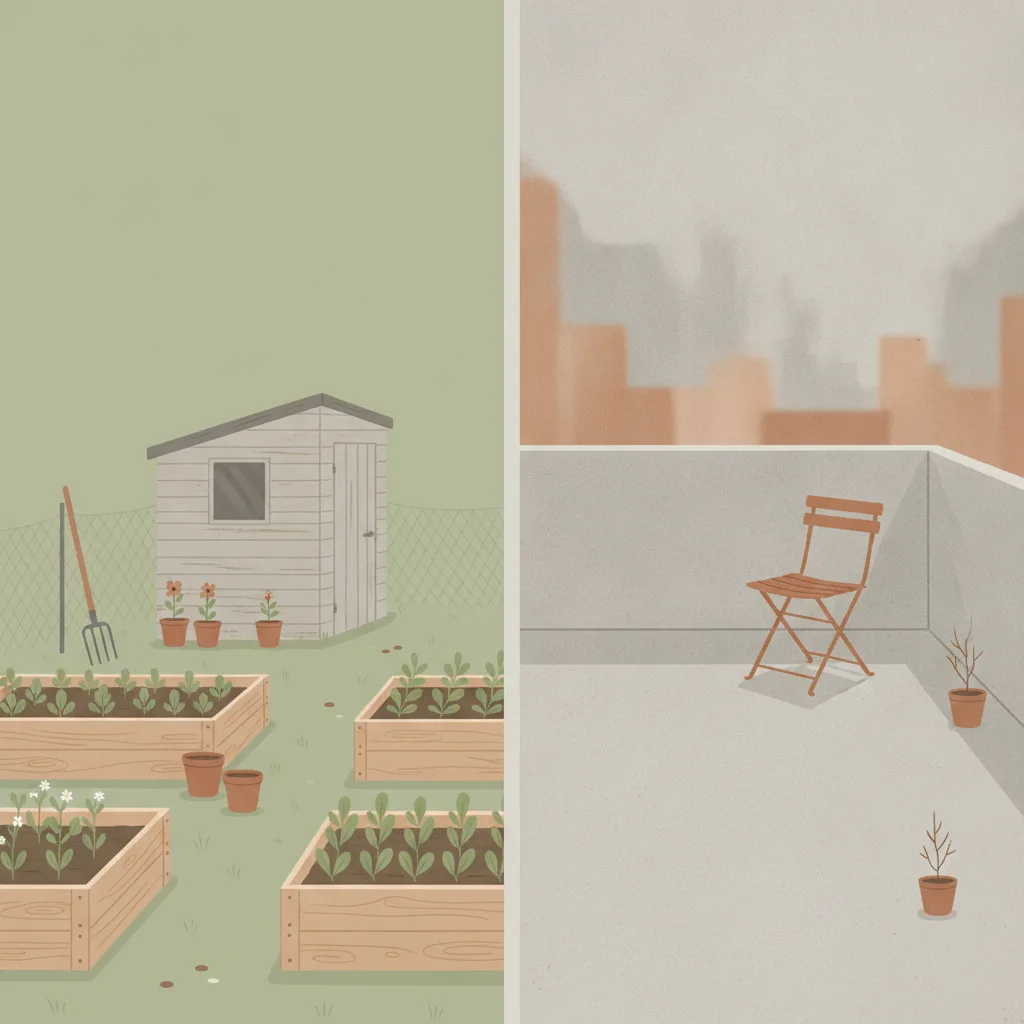
Получить участок на огороде или в общественном саду vs. остаться без него
Если вы действуете
Завести садовый или общественный участок
8,0%
Если вы бездействуете
Остаться без садового участка
38%
Хотя бы одно число является косвенной оценкой, а не измеренной долей сожалеющих. Как получено каждое число, описано ниже.
Образ жизни
Последнее обновление 2026-05-04
Качество доказательств 4.13/5
Оценка по восьми измерениям согласно
рубрике качества
. Каждое измерение оценивается от 1 до 5.
D1 Проверка источников
5/5
D2 Авторитетность и независимость источника
4/5
D3 Точность уровня сожаления
2/5
D4 Сопоставимость источников
3/5
D5 Шаблон Гиловича
5/5
D6 Качество текста
5/5
D7 Полнота оговорок
5/5
D8 Качество выборки
4/5
Среднее4.13/5
Косвенные данные: по этому решению хотя бы один показатель получен из косвенной меры, такой как последствия, удовлетворённость или намерение, либо из редакционной оценки, а не из прямого опроса о сожалении. В примечаниях к каждой стороне ниже описано, как получен показатель.
Если вы действуете
Завести садовый или общественный участок
8,0%
91,9% владельцев садовых участков оценивают пользу своего участка для психического здоровья на 8/10 или выше (прокси удовлетворённости — прямого опроса о сожалении или об отказе от участка не существует; показанные ~8% — это доля тех, кто НЕ поставил высшую оценку, а НЕ измеренная доля сожалений)
Британские арендаторы садовых участков
ретроспективный опрос, 2025
Если вы бездействуете
Остаться без садового участка
38%
~38% несадоводов называют отсутствие доступа причиной, по которой они не занимаются садоводством
Британские взрослые, не садоводствовавшие в последние 12 месяцев
поперечный опрос, 2025
Число для каждого выбора (что именно измерено, указано на странице)
Завести садовый или общественный участокОстаться без садового участка
8,0%38%
Похожие решения
Семантически близкие решения — та же область, другие компромиссы.
Approximately 91.9% of UK allotment plot holders rate the mental health benefit
of their plot at 8 or higher out of 10, with 63% giving a perfect 10, according to
the National Allotment Society’s 2025 survey of approximately 2,000 holders. A 2010
peer-reviewed study in Environmental Health (van den Berg et al.) reached the same
figure independently: 91% of Dutch allotment gardeners reported increased happiness
after visiting their plot, and their life satisfaction scores were significantly
higher than those of matched non-gardening neighbors drawn from the same residential
areas (2.26 vs 2.12, p<0.05). Neither survey asked holders whether they regret
their plot; both measured benefit ratings, and in both the residual 8–9% is simply
the share who did not give the top positive response rather than a count of people
who wished they had not taken a plot. No published study reports a direct allotment
regret or relinquishment-due-to-regret rate, so the figure shown here is a
satisfaction-tail proxy, not a measured regret rate. The pattern
holds across age groups but is sharpest in older adults: among those over 62, the
Dutch gardeners scored 0.32 on a composite wellbeing index versus −0.26 for same-age
neighbors, and loneliness scores diverged by a factor of nearly three.
The inaction side is structured by access rather than preference. The RHS State of
Gardening 2025 found that 38% of UK adults who had not gardened in the past year
cited lack of access to growing space as the reason — the largest single barrier,
and one that implies desire without opportunity rather than chosen non-participation.
In the same RHS survey, 14.7 million adults said they would be interested in
volunteering for organised community gardening sessions, while 2.5 million had
taken part in community gardening initiatives over the past three years. Over
174,000 people are on UK waiting lists for allotment plots at any given time, with
average waits of four years nationally and up to twelve years in some London boroughs.
This is unusual among decisions studied here: the inaction group is partly
involuntary, shaped by land supply and local authority policy rather than freely
chosen preference. Whether one frames that constraint as regret or frustration, it
is directionally the same: a large population wants the outcome and does not have it.
The Gilovich inaction-dominance pattern is among the more robust in this dataset for
this topic, though both sides rest on proxies rather than direct regret questions.
The roughly 30-percentage-point gap between the action-side satisfaction-tail proxy
(~8% non-top rating) and the inaction-side access-barrier proxy (~38% cite lack of
access) is consistent across UK survey data and the Dutch controlled study, and
it is consistent with findings in adjacent decisions like gym membership and therapy
— categories where the barrier to starting tends to feel large and the regret after
starting tends to be low. The specific mechanism is well-documented: allotment
holders visit regularly (unlike vacation cabin owners), the costs are low relative to
perceived benefit, and the social dimension of a shared site appears to add value
that solo garden ownership does not. For those fortunate enough to reach the front
of a waiting list, the decision to take the plot is almost universally reported as
the right one.
Источники: действие
Реестр утверждений
Каждое число ниже — это то, что сообщил источник, с дословной цитатой, на которую мы опирались, и тем, как мы пришли к нашей цифре. Нажмите на ссылку, чтобы проверить самостоятельно.
2/2 источников независимо дословно сверены с указанным источником
[1]National Allotment Society (via Pressat press office) — Growing the Evidence: Survey Shows the Power of Allotments
Проверено
Авторитетный справочник
91.9% of UK allotment holders rate mental health benefits at 8/10 or higher; 63% give a perfect 10/10
Выдержка
“"Nearly 63% of respondents rated the impact of their allotment on mental wellbeing a perfect 10, with 91.9% scoring it 8 or higher. Physical health benefits were similarly high, with 88.1% rating them 8 or above. 89.2% increased their fresh produce intake after getting a plot. 80.3% credited their plot with forming new social relationships."
”
Данные источника:
2025-08-11
Дата обращения
2026-05-04
Проверка
Выдержка независимо повторно загружена и подтверждена слово в слово по указанному источнику в ходе нашей проверки достоверности.
Расчёт
NAS 2025 survey of approximately 2,000 UK allotment plot holders. The survey measured benefit ratings, not regret: 91.9% rated the plot's mental-health benefit 8/10 or higher. The 8% stored as regret_rate is the arithmetic complement of that 91.9% (those who did NOT give a top-band rating), i.e. the satisfaction-score tail — NOT a dissatisfaction or regret rate. No question asked "do you regret getting an allotment", and no published survey measures allotment regret or relinquishment-due-to-regret (the 2024 Birmingham study of 876 tenants, Bloomfield, reports tenure — 9% held a plot <1 year, 36% 1–5 years — but no regret/quit rate; the 2025 APSE Local Authority State of the Market survey reports waiting-list demand, not plot abandonment). The non-top rating share is used only as the closest available proxy, with that limitation stated explicitly in the display and caveats. It is in the same range as the Netherlands peer-reviewed study (van den Berg et al. 2010), where 91% of allotment gardeners reported increased happiness after plot visits — again a positive-rating figure, not a measure of regret. The residual 8–9% in both samples is the share who did not give the top positive response, not a count of people who wished they had not taken a plot.
Независимость
NAS is an independent UK charity that represents allotment holders. This survey is independent of the RHS, van den Berg academic study, and any commercial or government source.
[2]Environmental Health (BioMed Central / Springer) — Allotment gardening and health: a comparative survey among allotment gardeners and their neighbors without an allotment
Проверено
Рецензируемая публикация
91% of allotment gardeners reported increased happiness after plot visits; life satisfaction 2.26 vs 2.12 for non-gardening neighbors (p<0.05)
Выдержка
“"Eighty-four percent reported feeling healthier after a visit to the allotment garden. [...] 91 percent reported feeling happier and 86 percent reported feeling less stressed."
”
Данные источника:
2010-10-27
Дата обращения
2026-05-04
Проверка
Выдержка независимо повторно загружена и подтверждена слово в слово по указанному источнику в ходе нашей проверки достоверности.
Расчёт
van den Berg et al. (2010) surveyed 121 allotment gardeners and 63 matched non-allotment neighbors recruited from the same residential areas near 12 allotment sites in 8 Dutch cities (July–September sampling). Both groups completed the same wellbeing questionnaire, providing a genuine comparison of people who garden vs. comparable people who do not. The 91% happiness increase rate among gardeners implies approximately 9% who did not report this outcome — consistent with the NAS 2025 UK figure. Used here as the independent peer-reviewed anchor corroborating the NAS satisfaction finding.
Независимость
Independent of all other sources: peer-reviewed academic study published in a Springer/BioMed Central journal, conducted by Dutch university researchers (Wageningen UR), using a controlled matched-sample design rather than a self-selected holder survey. Different country (Netherlands), different year (2010), different methodology.
Источники: бездействие
Реестр утверждений
Каждое число ниже — это то, что сообщил источник, с дословной цитатой, на которую мы опирались, и тем, как мы пришли к нашей цифре. Нажмите на ссылку, чтобы проверить самостоятельно.
1/2 источников независимо дословно сверены с указанным источником
[1]Royal Horticultural Society — RHS State of Gardening Report 2025
Авторитетный справочник
38% of non-gardeners cite lack of access to indoor or outdoor growing space as the reason they do not garden; 8.5 million people have never gardened, many of whom lack access to suitable space
Выдержка
“"Notably, 38% of non-gardeners had no space in which to garden. [...] 2.5m people took part in community gardening initiatives over the past three years [...] yet 8.5 million people have never gardened [...] 14.7 million adults said they would be interested in volunteering for organised community gardening sessions."
”
Данные источника:
2025-01-01
Дата обращения
2026-05-04
Расчёт
RHS State of Gardening is the annual national survey of UK gardening participation and barriers. The 38% access-barrier figure measures the share of recent non-gardeners who attribute their non-participation to lacking space rather than lacking interest — i.e., they want to garden but cannot. This is a proxy for inaction regret: access-deprived non-gardeners represent a population that wants the outcome (a plot) but does not have it. The 14.7 million figure counts adults interested in volunteering for organised community gardening sessions; it measures interest in volunteering, not a wish for a plot, and is only a rough population-level scale check. METHODOLOGICAL CAVEAT: "cites access as the barrier" is not the same as "regrets not having a plot" — the 38% is the best available proxy, not a direct regret measurement. The waiting list data (174,000+ on UK allotment lists, average wait 4 years) corroborates the scale of unmet demand.
Независимость
The RHS is the UK's leading horticultural charity, independent of the NAS and of the van den Berg academic research. The RHS State of Gardening surveys general UK adults, not specifically allotment holders, making it methodologically complementary to the NAS holder-only survey.
[2]Environmental Health (BioMed Central / Springer) — Allotment gardening and health: a comparative survey among allotment gardeners and their neighbors without an allotment
Проверено
Рецензируемая публикация
Non-allotment neighbors scored significantly lower on life satisfaction (2.12 vs 2.26, p<0.05) and loneliness (aged 62+: 0.80 vs 0.28) compared to allotment gardeners in the same residential areas
Выдержка
“"84 percent of the allotment gardeners met the Dutch guideline [...] this norm was met by only 62 percent of the respondents in the control group."
”
Данные источника:
2010-10-27
Дата обращения
2026-05-04
Проверка
Выдержка независимо повторно загружена и подтверждена слово в слово по указанному источнику в ходе нашей проверки достоверности.
Расчёт
The non-gardening neighbor group in van den Berg et al. (2010) represents the inaction side: people living near allotments who do not garden. Their measurably lower life satisfaction (p<0.05) and higher loneliness scores provide peer-reviewed evidence that the non-gardening state is associated with worse wellbeing outcomes than the gardening state. This is a wellbeing gap, not a direct regret measurement, but it is the strongest controlled evidence available for the cost of the inaction choice. Used here as the independent corroborating anchor for the RHS access-barrier finding.
Независимость
Same study as cited on the action side; used here as the inaction-side comparison group. The neighbor group (n=63) and gardener group (n=121) were both recruited from the same residential areas, providing the closest available controlled comparison.
Оговорки
Proxy measurements: neither side uses a direct regret question. No published survey or study in the allotment literature directly asks holders whether they regret getting a plot, or non-holders whether they regret not having one. The 8% action rate is the complement of the 91.9% satisfaction score (NAS 2025) — a satisfaction inversion, not a regret measure. The 38% inaction rate is the RHS access-barrier share — "cites access as the reason I don't garden" ≠ "regrets not having a plot." Both are the closest available proxies; no better data exists in the published literature. SURVIVORSHIP / ATTRITION BIAS: The NAS 2025 survey covers current plot holders only. People who acquired a plot, found it unsatisfying or too demanding, and relinquished it are not represented — their exclusion means the true share of ever-holders who would not repeat the choice is almost certainly higher than the 8% non-top-rating residual shown here, which is a satisfaction-tail proxy and not a measured regret rate. SOCIAL DESIRABILITY INFLATION: Allotment gardening carries strong positive cultural framing in the UK (health, community, sustainability). Self-reported satisfaction scores are likely inflated by social desirability effects; holders may understate dissatisfaction even on an anonymous survey. SMALL COMPARISON GROUP: The van den Berg (2010) peer-reviewed bilateral comparison — the strongest controlled evidence in this entry — uses only n=63 non-gardening neighbors alongside n=121 allotment gardeners. At this sample size the life satisfaction gap (2.26 vs 2.12, p<0.05) is statistically significant but the confidence interval is wide; the effect size should be treated as directional rather than precise. POPULATION SCOPE: All figures are UK/European; US community garden culture is less embedded, waiting lists shorter, and plot tenure norms differ — direct transposition of rates is not appropriate. ACCESS CONSTRAINTS ON INACTION: Unlike most decisions in this dataset, the inaction choice is frequently involuntary — 174,000+ people are on UK waiting lists with average waits of 4 years and up to 12 years in some London boroughs. Some portion of the "inaction" group would act if supply allowed, which complicates the Gilovich framing that assumes inaction was freely chosen.