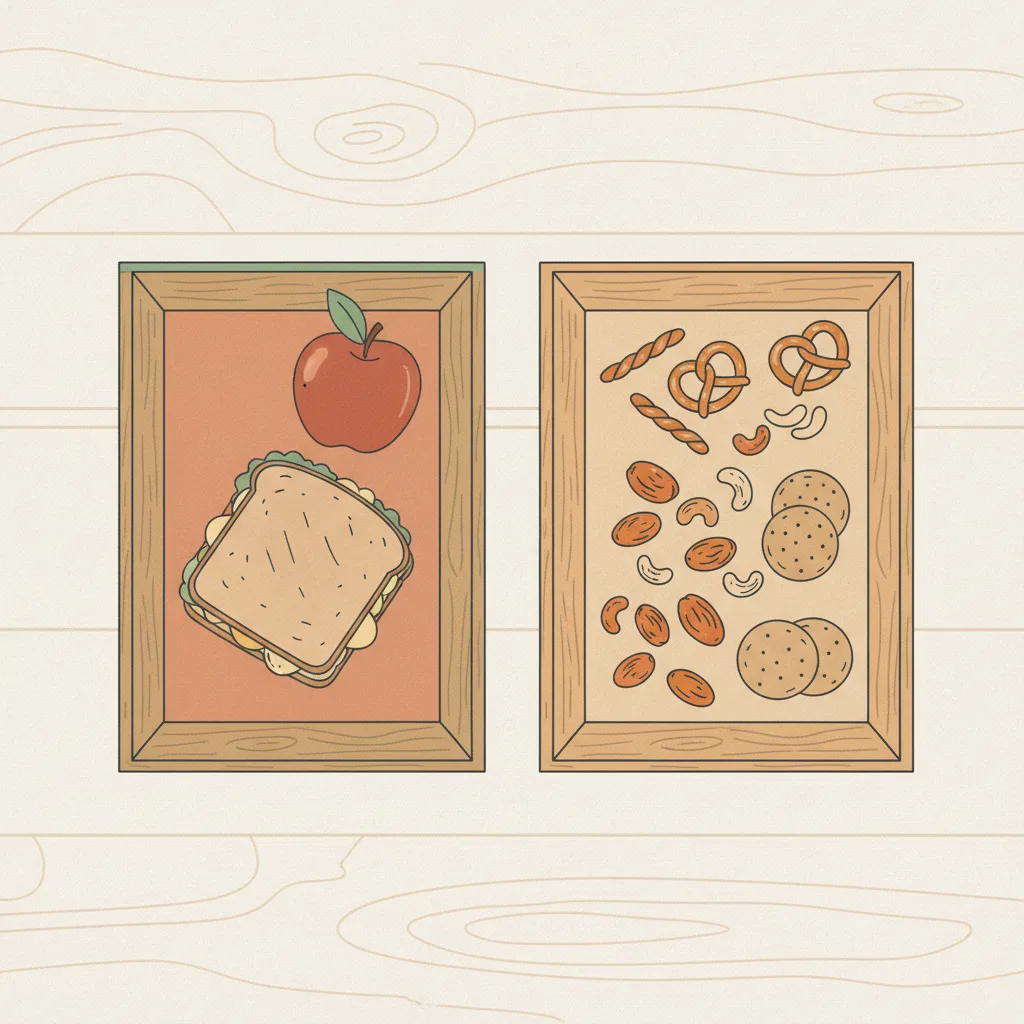
Snacken zwischen den Mahlzeiten (modernes Grasing-Muster) vs nur 2-3 feste Mahlzeiten ohne Snacks
Wenn du handelst
Snacken zwischen den Mahlzeiten
15%
Wenn du nicht handelst
Nur 2-3 feste Mahlzeiten (keine Snacks)
27%
Anteil derer, die jede Entscheidung später bereuen. Balken und vollständige Datengrundlage erscheinen unten.
Lebensstil
Zuletzt überprüft 2026-05-30
Evidenzqualität 3.75/5
Bewertungsergebnis nach acht Dimensionen gemäß der
Qualitätsrubrik
. Jede Dimension wird mit 1–5 bewertet.
D1 Quellenüberprüfung
4/5
D2 Quellenautorität & Unabhängigkeit
5/5
D3 Genauigkeit der Bedauernsrate
2/5
D4 Vergleichbarkeit der Quellen
4/5
D5 Gilovich-Muster
3/5
D6 Prosaqualität
4/5
D7 Vollständigkeit der Einschränkungen
3/5
D8 Stichprobenqualität
5/5
Durchschnitt3.75/5
Stellvertretende Daten — für diese Entscheidung gibt es keine direkte Bedauernsstudie. Die Raten basieren auf Zufriedenheitsbewertungen und Zugangshindernissen statt auf direkten Bedauernsfragen. Siehe Vorbehalte unten.
Reue fürs Handeln
Snacken zwischen den Mahlzeiten
15%
~15% der US-Erwachsenen fassen einen Neujahrsvorsatz, der auf die Reduzierung von Snacks/zuckerhaltigen Lebensmitteln abzielt (der snackspezifische Anteil an Purdues Zahl von 25% für jegliche Lebensmittelvorsätze — prospektiv geäußerte Absicht, kein retrospektives Bereuen)
US-Erwachsene, landesweit repräsentativ
Querschnitt, erhoben im Januar 2024
Reue fürs Unterlassen
Nur 2-3 feste Mahlzeiten (keine Snacks)
27%
27% der US-Erwachsenen bemühen sich aktiv, Gewicht zu verlieren (Proxy für Gewichtsmanagement-Absicht — kein direktes Bereuen des Muster nur mit Mahlzeiten)
US-Erwachsene, landesweit repräsentativ
Querschnitt, erhoben 6.–20. November 2024
% bereuen diese Entscheidung
Snacken zwischen den MahlzeitenNur 2-3 feste Mahlzeiten (keine Snacks)
15%27%
inaction dominates — Nichthandeln dominiert — die meisten bereuen, nicht gehandelt zu haben.
Verwandte Entscheidungen
Semantisch ähnliche Entscheidungen — gleiches Terrain, andere Abwägungen.
Twenty-seven percent of US adults are actively working to lose
weight, per Gallup’s November 2024 national poll of 1,001 adults
— the closest available proxy for dissatisfaction with eating patterns
that might motivate adopting a meals-only structure. That figure is
the inaction-side proxy shown above. It falls short of a direct regret
measure: the meals-only pattern is the minority position in the US,
so the question “do you regret not snacking?” is structurally rare,
and most adults who restrict to defined meals do so deliberately as
a weight-management or blood-sugar strategy rather than as a
regret-driven reversal of a prior snacking habit.
On the other side, 25% of US consumers set a food or nutrition-
related New Year’s resolution in 2024, per Purdue’s Consumer Food
Insights survey of 1,200 US adults — up six percentage points from
2023, with “the majority” planning to limit salty snacks, sugary
foods, regular soft drinks and alcohol. That 25% spans many dietary
goals, not snacking, so the action-side proxy is the snacking-specific
slice: roughly 13-18% of all US adults if “the majority” means about
half to two-thirds of those with resolutions, which we set at ~15%.
Even that ~15% is prospective intent to cut snacks, not retrospective
regret about a snacking habit. The structural
backdrop: USDA NHANES 2017-March 2020 data show 95% of US adults
snack on a given day, 78% snack multiple times, and among consumers
snacks contribute 24% of daily energy and 43% of added sugars. The
two figures come from different instruments (Purdue resolution
intent vs Gallup active weight-management) and measure different
constructs (prospective resolution vs current effort), so any
cross-side comparison is approximate.
The meal-frequency question is genuinely contested in the nutrition
literature. Bellisle’s 2014 Physiology & Behavior review concludes
that snacking neither clearly causes obesity nor clearly prevents
it, that eating frequency does not independently predict body weight
when total energy intake is controlled, and that the same eating
pattern can have different effects depending on food quality and
context. That weakens the case for either side carrying strong
regret: most US adults snack, most US adults who snack are not
measurably worse off for it when energy intake is matched, and the
few who reverse to a meals-only pattern do not have unambiguous
evidence that their previous behavior caused them measurable harm.
The ~12-point gap between the ~15% snacking-resolution share and the
27% active weight-management share is a difference between two weak,
non-comparable proxy instruments, not a measured difference in
regret. Readers should treat both figures as proxies for different
constructs and not read the delta as a precise regret comparison.
Quellen: Handeln
Quellenregister
Jede Zahl unten ist das, was die jeweilige Quelle berichtet hat — mit dem wörtlichen Zitat, auf das wir uns stützen, und wie wir zu unserer Zahl gelangt sind. Klicke auf einen Link, um direkt zu prüfen.
1/3 Quellen unabhängig wortwörtlich mit der zitierten Quelle abgeglichen
[1]News-Medical / coverage of Purdue Consumer Food Insights Jan 2024 — Increasing New Year's resolutions for healthier eating, Purdue report finds
Referenzquelle
25% of US consumers had a food/nutrition-related New Year's resolution in 2024 (up 6 pp from 2023); the majority plan to increase fruits, vegetables and water while limiting salty snacks, sugary foods, regular soft drinks and alcohol; 46% anticipate cravings as an obstacle
Auszug
“"25% of consumers responded 'yes' when asked if they had any food or nutrition-related New Year's resolutions, up 6 percentage points from the response to the same question last year... the survey-based report out of Purdue University's Center for Food Demand Analysis and Sustainability...included 1,200 consumers across the U.S."
”
Quelldaten von
2024-02-15
Abgerufen
2026-05-30
Berechnung
Purdue Center for Food Demand Analysis and Sustainability, Consumer Food Insights, Volume 3 Issue 1, January 2024, N=1,200 US consumers. The 25% headline is the share of US consumers with ANY food/nutrition-related New Year's resolution, covering many dietary goals (more fruit/veg/water, less salty snacks, sugary foods, soft drinks, alcohol) — it is NOT a snacking-specific figure and NOT a regret measure. Because the report says \"the majority\" of those resolutions target the salty-snacks/sugary-foods/soft-drinks/alcohol basket (not snacking alone), the snacking-targeted share is roughly 0.25 x ~50-70% = 13-18% of all US adults. We therefore set the action-side proxy to the midpoint, ~15% (regret_rate 0.15), and label it explicitly as prospective resolution intent to cut snacks/sugary foods, not retrospective regret about snacking. The earlier 25% figure fused the all-resolutions headline with a snacking claim and overstated the snacking-targeted signal; this has been corrected.
Unabhängigkeit
Independent academic survey from Purdue's Center for Food Demand Analysis and Sustainability with publicly disclosed methodology; no commercial sponsorship of the consumer insights series.
[2]USDA Agricultural Research Service / Sebastian, Hoy, Goldman, Moshfegh — Snack Consumption by U.S. Adults: What We Eat in America, NHANES 2017 - March 2020
Regierungsbericht
95% of US adults aged 20+ consume one or more foods or beverages as a snack on the intake day; 78% consume two or more snacks; snacks provide on average 24% of daily energy and 43% of added sugars among consumers
Auszug
“"Among adults aged 20 years and older, 95% consume one or more foods and/or beverages at a snack on the intake day... Currently, consuming multiple snacks is the norm, with 78% consuming two or more on any given day. Among consumers, snacks provide on average 24% of daily intake of energy and 43% of added sugars."
”
Quelldaten von
2024-04-01
Abgerufen
2026-05-30
Berechnung
USDA Dietary Data Brief No. 53, based on NHANES 2017-March 2020 nationally representative dietary recall data. Establishes the prevalence baseline: 95% of US adults snack at least once on a given day; 78% snack multiple times; snacks contribute 24% of daily energy and 43% of added sugars on average. Used here on the action side as the govt_report context: snacking is the normal modern US eating pattern, not a deviation. This is NOT the regret-rate figure; that is from Purdue Jan 2024 (see above). The NHANES data establishes that the question \"do you regret snacking?\" applies to nearly all US adults if at all, and that the dietary stakes (43% of added sugars from snacks among consumers) are concrete.
Unabhängigkeit
US federal government data (NHANES via USDA ARS) with publicly disclosed methodology; no commercial sponsorship of the survey or analysis. Independent of the Purdue insights series.
[3]Journal of Nutrition / Piernas & Popkin — Snacking Increased among U.S. Adults between 1977 and 2006
Verifiziert
Peer-Review
US adult snacking prevalence increased from 71% to 97% between 1977-78 and 2003-06; contribution of snacks to total energy intake increased from 18% to 24%
Auszug
“"snacking prevalence increased significantly from 71 to 97% in 2003-2006... the percentage of snacking on both d 1 and d 2 increased from 42 to 78%... the contribution of snacks to total energy intake increased from 18 to 24%."
”
Quelldaten von
2010-02-01
Abgerufen
2026-05-30
Verifizierung
Der Auszug wurde bei unserer Grounding-Prüfung unabhängig erneut abgerufen und Wort für Wort mit der zitierten Quelle abgeglichen.
Berechnung
Piernas & Popkin (J Nutr 2010) established the long-run shift: US adult snacking went from a minority behavior (71% on any given day in 1977-78) to near-universal (97% by 2003-06), with the share of daily energy from snacks rising from 18% to 24%. Used on the action side as the peer-reviewed historical baseline for the prevalence claim above. This is NOT the action-side regret-rate figure; that is the snacking-specific share (~15%) derived from Purdue's January 2024 resolution survey (see above). Snacking-related regret has not been directly surveyed in the US, so the action side relies on a prospective resolution-intent proxy, not a retrospective regret measure.
Unabhängigkeit
Independent academic analysis of CDC NHANES data; methodology publicly disclosed. No commercial sponsorship of the analysis.
Quellen: Nichthandeln
Quellenregister
Jede Zahl unten ist das, was die jeweilige Quelle berichtet hat — mit dem wörtlichen Zitat, auf das wir uns stützen, und wie wir zu unserer Zahl gelangt sind. Klicke auf einen Link, um direkt zu prüfen.
2/2 Quellen unabhängig wortwörtlich mit der zitierten Quelle abgeglichen
[1]Gallup News — 43% of Americans Say They Are Overweight; 55% Want to Slim Down
Verifiziert
↗ 1 other entry
Referenzquelle
27% of US adults are actively working to lose weight; 55% want to lose weight; 43% view themselves as overweight
Auszug
“"43%, view themselves as overweight... 55%, say they want to lose weight... only 27% report they are actively working toward that goal."
”
Quelldaten von
2024-12-10
Abgerufen
2026-05-30
Verifizierung
Der Auszug wurde bei unserer Grounding-Prüfung unabhängig erneut abgerufen und Wort für Wort mit der zitierten Quelle abgeglichen.
Berechnung
Gallup national poll, N=1,001 US adults, fielded November 6-20, 2024, margin of error ±4 percentage points. Used here as the inaction-side proxy: 27% of US adults are actively pursuing weight management, a state that implies current dissatisfaction with some aspect of current eating behavior including the absence of structural snacking discipline. This is NOT a direct regret measure about the meals-only pattern; in fact, the meals-only pattern is the minority position (95% of US adults snack daily per NHANES), so the question \"do you regret not snacking?\" is structurally rare. The 27% captures the directional signal: a substantial minority of US adults are actively dissatisfied enough with their current diet to do something about it, and \"cut the snacks\" is one of the most common dietary-change targets in popular guidance.
Unabhängigkeit
Independent Gallup national poll using random-digit-dial methodology; no shared sample with USDA NHANES or Piernas & Popkin. Different methodology and different construct.
[2]Physiology & Behavior / France Bellisle — Meals and snacking, diet quality and energy balance
Verifiziert
Peer-Review
Snacking may contribute to excess energy intake and weight gain via context, frequency and food quality; in some reports snacking facilitates energy-intake adjustment to needs, in others (especially obese populations) it contributes energy but little nutrition
Auszug
“"Snacking may contribute to excess energy intake and weight gain through different ways, for example: context/environment of eating, frequency of consumption and quality of food choices. In many reports, snacking appears to facilitate the adjustment of energy intake to needs, and to contribute carbohydrates, rather than fats, to the diet. By contrast, snacking often appears to contribute much energy but little nutrition in the diet of other consumers, particularly obese children and adults."
”
Quelldaten von
2014-07-01
Abgerufen
2026-05-30
Verifizierung
Der Auszug wurde bei unserer Grounding-Prüfung unabhängig erneut abgerufen und Wort für Wort mit der zitierten Quelle abgeglichen.
Berechnung
Bellisle (Physiology & Behavior 2014) is the canonical peer- reviewed review framing the meal-frequency literature. The critical finding: eating frequency does not independently predict body weight when total energy intake is controlled. Used here on the inaction side as the literature basis for the observation that the case for a meals-only pattern is genuinely contested — snacking neither clearly causes obesity nor clearly prevents it, and the same eating pattern can have different effects depending on food quality and context. This is NOT the regret rate; that is from Gallup 2024. Bellisle's review provides the scientific context that weakens the case for the inaction side carrying strong regret: most US adults snack, most US adults who snack are not measurably worse off for it when energy intake is matched, and the few who reverse to a meals-only pattern do not have unambiguous evidence that their previous behavior was harmful.
Unabhängigkeit
Independent peer-reviewed academic review with publicly disclosed methodology; Bellisle has published widely on eating frequency, including some industry-funded studies on snacking listed in her overall body of work but the 2014 P&B review is not directly industry-sponsored.
Einschränkungen
Keine der beiden Seiten misst Bereuen direkt, und keine veröffentlichte US-Befragung fragt geradeheraus „Bereuen Sie das Snacken zwischen den Mahlzeiten?" oder „Bereuen Sie es, nicht zu snacken?" Die Frage der Mahlzeitenhäufigkeit ist in der Ernährungsliteratur tatsächlich umstritten (Bellisle 2014, Physiol Behav): Die Esshäufigkeit sagt das Körpergewicht nicht unabhängig voraus, wenn die Gesamtenergiezufuhr kontrolliert wird. Die Purdue-Befragung Consumer Food Insights vom Januar 2024 ergab, dass 25% der US-Verbraucher IRGENDEINEN Lebensmittel-/Ernährungs-Neujahrsvorsatz haben; diese 25% umfassen viele Ernährungsziele, nicht das Snacken. Da „die Mehrheit" dieser Vorsätze auf den Korb salziger Snacks/zuckerhaltiger Lebensmittel/Erfrischungsgetränke/Alkohol abzielt, beträgt der snackspezifische Anteil grob 13–18% aller US-Erwachsenen, sodass wir den Proxy auf der Handlungsseite auf den Mittelwert von ~15% setzen. (Eine frühere Version verwendete die vollen 25%, was den Aufhänger aller Vorsätze mit einer Snacking-Aussage verschmolz und das Handlungssignal überzeichnete.) Selbst bei 15% ist dies eine prospektive Vorsatzabsicht, kein retrospektives Bereuen des Snackens. Die 27% auf der Unterlassungsseite sind der Gallup-Anteil vom November 2024 an US-Erwachsenen, die sich aktiv bemühen, Gewicht zu verlieren — ein verwandtes, aber indirektes Signal, und das Muster nur mit Mahlzeiten ist in den USA selbst die Minderheitsposition (95% der US-Erwachsenen snacken täglich laut USDA NHANES 2017–März 2020), sodass die Frage „Bereuen Sie es, nicht zu snacken?" strukturell selten ist. Wir verwenden die 27%-Zahl aktiver Gewichtsbemühungen als den nächstliegenden verfügbaren reue-nahen Proxy. Die beiden Zahlen stammen aus verschiedenen Instrumenten und Populationen (Purdue-Vorsatzabsichts-Befragung vs. Gallup-Umfrage zu aktivem Gewichtsmanagement) und messen verschiedene Konstrukte (prospektiver Vorsatz vs. aktuelle Bemühung), sodass jeder seitenübergreifende Vergleich näherungsweise ist und nicht als präzise Reue-Lücke gelesen werden sollte. Das ~12-Punkte-regret_delta spiegelt zwei nicht vergleichbare Proxy-Instrumente wider, keinen gemessenen Unterschied im Bereuen. Der Reue-Frage liegt die umstrittene Kausalität zugrunde: NHANES-Daten zeigen, dass Snacks 24% der täglichen Energie und 43% des zugesetzten Zuckers unter Verbrauchern beitragen, was das Snacking-Muster als wesentlichen Beitragsfaktor für eine nährstoffarme Kalorienzufuhr etabliert, doch Bellisles Überblick argumentiert, dass die Dimension der Mahlzeitenhäufigkeit der Gesamtenergiezufuhr und der Lebensmittelqualität weitgehend untergeordnet ist.