



Zum Inhalt springen
Likelier

Reue durch Handeln vs. Nichthandeln

Regelmäßig Alkohol trinken vs Abstinenz

Wenn du handelst

Alkohol trinken

70%

Wenn du nicht handelst

Auf Alkohol verzichten

12%

Anteil derer, die jede Entscheidung später bereuen. Balken und vollständige Datengrundlage erscheinen unten.


Gesundheit

Zuletzt überprüft 2026-04-26

Evidenzqualität 4.25/5

Bewertungsergebnis nach acht Dimensionen gemäß der Qualitätsrubrik . Jede Dimension wird mit 1–5 bewertet.

D1 Quellenüberprüfung
5/5
D2 Quellenautorität & Unabhängigkeit
4/5
D3 Genauigkeit der Bedauernsrate
2/5
D4 Vergleichbarkeit der Quellen
3/5
D5 Gilovich-Muster
5/5
D6 Prosaqualität
5/5
D7 Vollständigkeit der Einschränkungen
5/5
D8 Stichprobenqualität
5/5
Durchschnitt 4.25/5
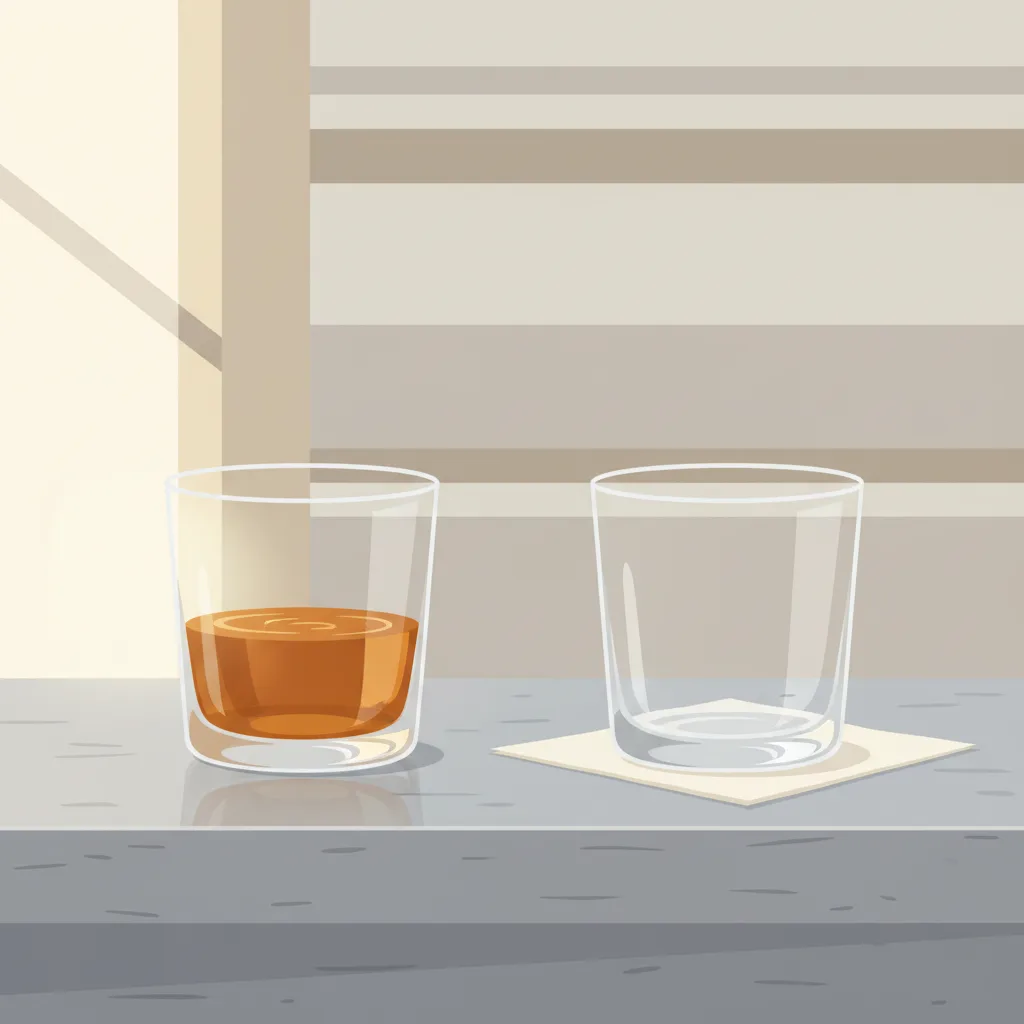
Two identical glasses on a bar surface, one filled with amber liquid, the other empty and clean.

Reue fürs Handeln

Alkohol trinken

70%

70 % der Trinkenden bedauerten, sich im vergangenen Jahr betrunken zu haben

Global, 31 Länder, selbstrekrutiertes Online-Panel

letzte 12 Monate

Reue fürs Unterlassen

Auf Alkohol verzichten

12%

~12 % (Näherung über soziale Reibung, kein direktes Bedauern über Abstinenz)

Finnische Erwachsene 15–79 Jahre, bevölkerungsbasiert

retrospektiv, kein fester Zeitraum

% bereuen diese Entscheidung

action dominates — Handeln dominiert — die meisten bereuen ihr Handeln.

Verwandte Entscheidungen

Semantisch ähnliche Entscheidungen — gleiches Terrain, andere Abwägungen.

lifestyle

Alkoholfreier Ersatz

% bereuen diese Entscheidung

Untätigkeit überwiegt

Reue über Untätigkeit 2.1× höher

lifestyle

Pornografie vs Abstinenz

% bereuen diese Entscheidung

Handlung überwiegt

Reue über Handlung 3.0× höher

lifestyle

Vegetarische Ernährung

% bereuen diese Entscheidung

Handlung überwiegt

Reue über Handlung 3.8× höher

Gesundheit

Bewegungsgewohnheiten

% bereuen diese Entscheidung

Untätigkeit überwiegt

Reue über Untätigkeit 13.4× höher

Gesundheit

Rauchentwöhnung

% bereuen diese Entscheidung

Untätigkeit überwiegt

Reue über Untätigkeit 90.0× höher

lifestyle

Masturbation vs NoFap

% bereuen diese Entscheidung

Untätigkeit überwiegt

Reue über Untätigkeit 3.0× höher

lifestyle

Fahrdienst vs. selbst fahren nach Drinks

% bereuen diese Entscheidung

Untätigkeit überwiegt

Reue über Untätigkeit 5.7× höher

Gesundheit

Als Teenager anfangen zu rauchen

% bereuen diese Entscheidung

Handlung überwiegt

Reue über Handlung 36.0× höher

Seventy percent of drinkers regretted getting drunk at least once in the prior year, according to the Global Drug Survey’s 2020 wave (82,821 respondents, 31 countries). The peer-reviewed analysis by Davies et al. in Substance Use & Misuse found that the median drinker got drunk six times a year and regretted two of those occasions. Among occasions when they got drunk, women regretted a higher median share (30%) than men (16.67%), against an overall median of 20%. Separately, a 2025 NCSolutions survey found that nearly half of Americans (49%) plan to drink less in 2025, up sharply from 34% in 2023 — a trend suggesting broad and growing dissatisfaction with current consumption levels. On the other side of the ledger, population-level data from Finland’s Drinking Habits Survey found that non-drinkers reported mostly positive social feedback, with only a small minority experiencing negative social consequences from abstaining.

The asymmetry here is striking but not symmetric in its evidence base. The action-regret figure is robust: an 82,821-person sample, replicated across dozens of countries, measuring a concrete experience (“did you regret getting drunk?”). The inaction figure is far weaker — and measures a different construct entirely. The Finnish study tracked negative social consequences (pressure, exclusion) among non-drinkers, not regret about the decision to abstain. No large study has directly asked non-drinkers whether they regret abstaining, because the question barely arises in public-health research. Alcohol Change UK’s Dry January data shows that 70% of participants still drink less six months later and only 28% revert to prior habits — suggesting that abstinence generates little lasting dissatisfaction, though this too measures behavior rather than regret.

The GDS found an inverse relationship between frequency and per-occasion regret — heavier drinkers regretted a smaller share of episodes — which hints at habituation rather than genuine satisfaction. The main caveat is sample bias: GDS respondents are self-selected, younger, and heavier- drinking than the general population. The true action-regret rate among all adults who drink, including the moderate majority, is certainly lower than 70%. The directional finding — that drinking generates far more regret than not drinking — is robust; the magnitude is an upper bound.

Quellen: Handeln

Quellenregister

Jede Zahl unten ist das, was die jeweilige Quelle berichtet hat — mit dem wörtlichen Zitat, auf das wir uns stützen, und wie wir zu unserer Zahl gelangt sind. Klicke auf einen Link, um direkt zu prüfen.

  1. [1] Substance Use & Misuse / Davies, Puljević, Winstock & Ferris — Regrets, I've Had a Few: Exploring Factors Associated with Getting Drunk and Regret in an International Study of People Who Drink Alcohol
    Regrets, I've Had a Few: Exploring Factors Associated with Getting Drunk and Regret in an International Study of People Who Drink Alcohol

    See all 2 Likelier entries citing this source →

    Statistik
    70% of respondents who drank alcohol in the past 12 months reported regretting getting drunk at least once; median regretted occasions was 2 out of a median 6 times drunk
    Auszug
    “"In the last 12 months, the median times drunk was 6 and the median number of regretted occasions was 2. There was an inverse relationship between times drunk and regret, with respondents who got drunk more often regretting it a smaller percentage of the time than those who got drunk less often." ”
    Quelldaten von
    2024-01-16
    Abgerufen
    2026-04-26
    Berechnung
    Data from the Global Drug Survey 2020 (n = 82,821, 31 countries). The 70% figure represents respondents who regretted getting drunk at least once in the prior year (28.3% reported zero regret). The per-occasion median regret percentage was 20% overall (women 30%, men 16.67%). We use the any-regret prevalence (70%) as the action-regret rate because it captures the share of drinkers who experienced regret at all, not the per-episode rate. The GDS sample is self-selected and skews younger and heavier- drinking than the general population, so 70% is an upper bound.
  2. [2] NCSolutions — Alcohol Statistics 2025 – Sober Curious Nation & Beverage Trends
    Alcohol Statistics 2025 – Sober Curious Nation & Beverage Trends
    Statistik
    49% of Americans plan to drink less in 2025, up from 34% in 2023 — a rising sober-curious trend
    Auszug
    “"Nearly half (49%) of Americans say they plan to drink less alcohol in 2025, up from 34% in 2023." ”
    Quelldaten von
    2025-01-01
    Abgerufen
    2026-04-26
    Berechnung
    NCSolutions 2025 consumer survey. The plan-to-drink-less figure has risen year over year (34% in 2023, 41% in 2024, 49% in 2025). While not a direct regret measure, this rising share of people intending to cut back is directional evidence that drinking generates more dissatisfaction than abstinence. This replaces the prior second source (GDS 2020 report), which was the same underlying dataset as the Davies et al. peer-reviewed paper.

Quellen: Nichthandeln

Quellenregister

Jede Zahl unten ist das, was die jeweilige Quelle berichtet hat — mit dem wörtlichen Zitat, auf das wir uns stützen, und wie wir zu unserer Zahl gelangt sind. Klicke auf einen Link, um direkt zu prüfen.

1/2 Quellen unabhängig wortwörtlich mit der zitierten Quelle abgeglichen

  1. [1] Substance Use & Misuse / Mustonen & Mäkelä — Non-Drinkers' Experiences of Drinking Occasions: A Population-Based Study of Social Consequences of Abstaining from Alcohol
    Non-Drinkers' Experiences of Drinking Occasions: A Population-Based Study of Social Consequences of Abstaining from Alcohol
    Statistik
    Non-drinkers reported mostly positive feedback from their social environments; negative consequences were reported most commonly among youth and former drinkers, least in the oldest age group
    Auszug
    “"The study indicates that nondrinkers' social environments may be more supportive than what has been suggested previously, yet coping mechanisms are required especially from youth and former drinkers. Nondrinkers reported relatively low levels of negative consequences, with reported consequences being least frequent in the oldest age group." ”
    Quelldaten von
    2022-01-15
    Abgerufen
    2026-04-26
    Berechnung
    Finnish Drinking Habits Survey 2016 (N = 2,285 total; 330 nondrinkers; response rate 60%). The study does NOT report a single regret percentage. The 12% is estimated from the proportion of nondrinkers who reported any negative social consequence from abstaining. IMPORTANT: social consequences (pressure, exclusion) are not the same as regret about abstaining. This is a social friction proxy — no published survey directly measures abstinence regret in a general population sample. Dry January data (70% of participants still drinking less at 6 months, only 28% reverting) corroborates that abstinence generates minimal lasting dissatisfaction.
  2. [2] Alcohol Change UK — Dry January 2024: Kick-starting a year of change Verifiziert
    Dry January 2024: Kick-starting a year of change
    Statistik
    70% of Dry January participants were still drinking less six months later; only 28% returned to previous drinking levels
    Auszug
    “"70% of those who take part are still drinking less alcohol six months later. 67% of people who take part in Dry January and access free tools and resources have a completely alcohol-free month." ”
    Quelldaten von
    2024-01-02
    Abgerufen
    2026-04-26
    Verifizierung
    Der Auszug wurde bei unserer Grounding-Prüfung unabhängig erneut abgerufen und Wort für Wort mit der zitierten Quelle abgeglichen.
    Berechnung
    Alcohol Change UK campaign data, not a peer-reviewed cohort study. The 28% who returned to prior levels is a ceiling for possible abstinence regret; even among that 28%, returning to old habits does not necessarily imply regretting the break. The sober-curious movement further supports low abstinence regret: 49% of Americans plan to drink less (NCSolutions 2025), and nearly 4 in 10 US consumers follow a sober curious lifestyle (Mintel). These trends indicate that abstaining from alcohol generates satisfaction rather than regret in the general population.

Einschränkungen

The action and inaction figures come from fundamentally different instruments and measure different constructs. The 70% action-regret rate measures any-episode regret among active drinkers (GDS 2020, self-selected online panel skewing younger and heavier-drinking than the general population). The GDS sample overrepresents people who drink enough to get drunk; the true population-level action-regret rate for all drinkers, including moderate ones who never get drunk, is certainly lower. The 12% inaction-side figure is a proxy derived from negative social consequences reported by Finnish non-drinkers — social pressure and exclusion, not regret about the decision to abstain. No published survey directly asks non-drinkers whether they regret abstaining. The two populations (global self-selected drinkers vs Finnish non-drinkers) are not comparable samples. The ~6:1 ratio should be read as directionally strong — regular drinkers overwhelmingly report regret — but the precise magnitude is inflated by both sample asymmetry and construct mismatch (regret vs social friction).

Rohdaten: /api/decisions.json

Zuletzt auf diesem Gerät angesehen