





Saltar al contenido
Likelier

Arrepentimiento por actuar o por no actuar

Divorciarse vs. quedarse en un matrimonio infeliz

Si actúas

Divorciarse

30%

Si no actúas

Permanecer en un matrimonio infeliz

32%

Porcentaje de quienes luego se arrepienten de cada elección. Las barras y el registro completo aparecen abajo.


Familia

Última revisión 2026-04-25

Calidad de la evidencia 3.63/5

Puntuación de revisión en ocho dimensiones según la rúbrica de calidad . Cada dimensión puntuada de 1 a 5.

D1 Verificación de fuentes
4/5
D2 Autoridad e independencia de las fuentes
3/5
D3 Precisión de la tasa de arrepentimiento
3/5
D4 Comparabilidad de las fuentes
2/5
D5 Patrón de Gilovich
5/5
D6 Calidad de la prosa
4/5
D7 Completitud de las advertencias
4/5
D8 Calidad de la muestra
4/5
Media 3.63/5
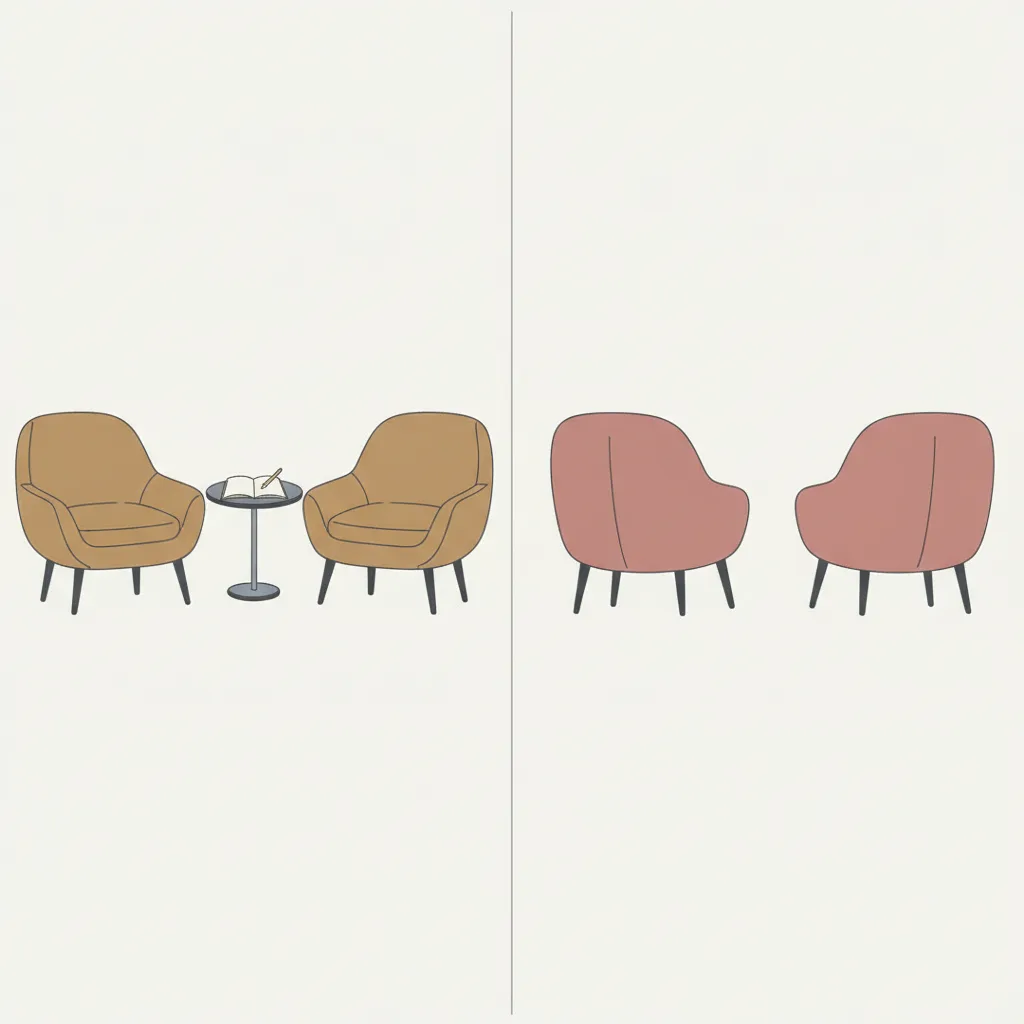
Two diverging hallways in a quiet house, one leading to an open door with light, the other to a closed door.

Arrepentimiento por acción

Divorciarse

30%

El 27-39% de los divorciados se arrepienten de haberse divorciado (27% mujeres, 39% hombres)

Adultos estadounidenses que se divorciaron, panel en línea

retrospectiva, sin marco temporal fijo

Arrepentimiento por inacción

Permanecer en un matrimonio infeliz

32%

~1/3 siguen infelices 5 años después (proxy de resultado, no una encuesta de arrepentimiento)

Adultos estadounidenses en matrimonios infelices, panel NSFH representativo a nivel nacional

seguimiento longitudinal de 5 años

% que se arrepienten de esta elección

balanced — Equilibrio aproximado — ambas opciones conllevan un arrepentimiento similar.

Decisiones relacionadas

Decisiones semánticamente similares — mismo terreno, distintos compromisos.

family

Arrepentimiento por infidelidad

% que se arrepienten de esta elección

Acción dominante

Arrepentimiento por acción 3.7× mayor

family

Mediación familiar vs litigio

% que se arrepienten de esta elección

Inacción dominante

Arrepentimiento por inacción 3.1× mayor

family

Casarse joven vs. esperar

% que se arrepienten de esta elección

Acción dominante

Arrepentimiento por acción 1.5× mayor

family

Tener hijos

% que se arrepienten de esta elección

Equilibrado

Aproximadamente equilibrado

family

Distanciamiento familiar

% que se arrepienten de esta elección

Inacción dominante

Arrepentimiento por inacción 3.4× mayor

family

Quedarse en casa vs trabajar

% que se arrepienten de esta elección

Acción dominante

Arrepentimiento por acción 1.3× mayor

family

Terapia de pareja vs prescindir de ella

% que se arrepienten de esta elección

Inacción dominante

Arrepentimiento por inacción 1.2× mayor

family

Tamaño familiar

% que se arrepienten de esta elección

Inacción dominante

Arrepentimiento por inacción 2.6× mayor

Riesgos detrás de esta decisión

Las probabilidades que sustentan esta elección.

About one-third of unhappily married adults who stayed married were still unhappy five years later (an outcome, not a regret survey), according to Waite et al.’s 2002 NSFH study — a rate nearly identical to the 30% of divorced adults who report regretting their divorce, anchored by Avvo’s 2016 panel survey (27% women, 39% men) and corroborated by broader estimates reaching at least one-third. The gender gap in divorce regret is consistent: men regret divorce more often than women, likely because women initiate roughly two-thirds of divorces and have therefore had more time to process the decision before it becomes final.

The cultural framing heavily favors action: divorce is positioned as liberation, staying as settling. The data complicates this. Waite’s finding that most unhappy marriages self-correct within five years is one of the more robust results in this literature, based on a nationally representative panel (NSFH) that tracked the same unhappily married respondents from a baseline rating to a five-year follow-up. It does not mean staying is always better — the study excluded abusive marriages, and “happy” was measured by a single survey item. But it does mean the widespread assumption that unhappiness in marriage is permanent is empirically wrong for the majority.

The near-parity between divorce-regret and staying-and-staying-unhappy rates (roughly 30% vs one-third) makes this one of the most balanced entries in the dataset — bearing in mind the inaction figure is an outcome, not a self-reported regret. The delta is within the margin of error for both surveys. The practical implication is that neither path reliably avoids regret — which is itself a useful calibration against the certainty that either side’s advocates tend to project.

Fuentes: acción

Registro de evidencia

Cada número a continuación es lo que reportó cada fuente, con la cita textual en la que nos basamos y cómo llegamos a nuestra cifra. Haz clic en cualquier enlace para verificarlo directamente.

3/3 fuentes verificadas de forma independiente palabra por palabra frente a la fuente citada

  1. [1] Avvo (original press release) — Avvo study: Men regret divorce more often than women Verificado
    Avvo study: Men regret divorce more often than women
    Estadística
    27% of women and 39% of men regret their divorce (73% of women and 61% of men report no regret)
    Extracto
    “"73% of women report having no regret over being divorced while 61% of men say the same." ”
    Datos de la fuente de
    2016-03-15
    Accedido
    2026-06-30
    Verificación
    Extracto recuperado de forma independiente y confirmado palabra por palabra frente a la fuente citada durante nuestra auditoría de fundamentación.
    Cálculo
    Avvo 2016 survey via Research Now panel, 2,000 US adults age 18+, credibility interval ±2.5 pp. The press release frames it as no-regret: 73% of women and 61% of men report no regret, i.e. 27% of women and 39% of men regret divorcing. Gender-weighted midpoint ~33%, rounded to 0.30.
  2. [2] Psychology Today — 7 Reasons People Regret Divorce Verificado
    7 Reasons People Regret Divorce
    Estadística
    At least one-third of people regret their marriage dissolution; up to 80% among those who divorced for the wrong reasons
    Extracto
    “"Statistical data suggests that at least one-third of people regret their marriage dissolution. That number can rise to 80 percent for ex-spouses who chose the wrong reasons to get divorced and feel that it could have been prevented if both parties had put forth more effort." ”
    Datos de la fuente de
    2023-06-12
    Accedido
    2026-06-30
    Verificación
    Extracto recuperado de forma independiente y confirmado palabra por palabra frente a la fuente citada durante nuestra auditoría de fundamentación.
    Cálculo
    Psychology Today narrative review corroborates the one-third floor (rising to 80% for subsets who divorced for the wrong reasons). We use the one-third floor as triangulation for the 0.30 rate.
  3. [3] ScienceDaily, reporting Rosenfeld (Stanford), American Sociological Association 2015 Annual Meeting — Women More Likely Than Men to Initiate Divorces, But Not Non-Marital Breakups Verificado
    Women More Likely Than Men to Initiate Divorces, But Not Non-Marital Breakups
    Estadística
    Women initiated 69% of divorces versus 31% for men, based on the 2009-2015 waves of the nationally representative 'How Couples Meet and Stay Together' survey (2,262 adults age 19-94, 371 of whom had broken up or divorced by 2015)
    Extracto
    “"Women initiated 69 percent of all divorces, compared to 31 percent for men." ”
    Datos de la fuente de
    2015-08-22
    Accedido
    2026-07-03
    Verificación
    Extracto recuperado de forma independiente y confirmado palabra por palabra frente a la fuente citada durante nuestra auditoría de fundamentación.
    Cálculo
    Rosenfeld (Stanford sociology), presented at the 2015 American Sociological Association Annual Meeting, analyzing the "How Couples Meet and Stay Together" panel (2009-2015 waves, N=2,262 adults aged 19-94; 371 breakups/divorces by 2015). Added to ground the body's explanatory claim that women initiate roughly two-thirds of divorces -- a contextual figure explaining the gender gap in divorce regret, not a regret-rate input; does not change the action_side regret_rate (0.30).

Fuentes: inacción

Registro de evidencia

Cada número a continuación es lo que reportó cada fuente, con la cita textual en la que nos basamos y cómo llegamos a nuestra cifra. Haz clic en cualquier enlace para verificarlo directamente.

  1. [1] Institute for American Values / Waite, Browning et al. — Does Divorce Make People Happy? Findings from a Study of Unhappy Marriages
    Does Divorce Make People Happy? Findings from a Study of Unhappy Marriages
    Estadística
    Two-thirds of unhappily married adults who stayed married reported being happy five years later; approximately one-third remained unhappy
    Extracto
    “"Two out of three unhappily married adults who avoided divorce or separation ended up happily married five years later. Just one out of three unhappy marriages ended in divorce or separation; among those who stayed, two-thirds reported being 'happily married' five years later." ”
    Datos de la fuente de
    2002-07-11
    Accedido
    2026-04-25
    Cálculo
    Waite et al. tracked NSFH respondents who rated their marriages unhappy in wave 1. Of those who stayed, two-thirds reported being "happily married" at wave 2 (5 years later); the remaining ~one-third were still unhappy. This is an OUTCOME proxy — the study measured marital-happiness status, never asked a regret question — so the 0.32 rate stands in for "stayed and remained unhappy," not self-reported regret of the decision to stay.

Advertencias

El estudio de Waite define "infeliz" mediante la autodeclaración en un único ítem y contabiliza como éxito a cualquiera que más tarde declare estar "feliz", ignorando la infelicidad intermedia. También excluye los matrimonios con violencia doméstica, donde permanecer conlleva riesgo físico. Las cifras de arrepentimiento por divorcio proceden del panel en línea de Avvo 2016 (n = 2.000, ±2,5 pp) — una muestra no probabilística, no revisada por pares. El comunicado de prensa original de Avvo informa de que el 73% de las mujeres y el 61% de los hombres no se arrepienten, es decir, el 27% de las mujeres y el 39% de los hombres que se arrepienten de haberse divorciado; algunos blogs secundarios reformulan además la cifra masculina como 32%, algo que la fuente primaria no respalda. Fundamentalmente, el "32%" de la inacción es una medida de RESULTADO (siguen infelices cinco años después), no una encuesta de arrepentimiento — el estudio NSFH nunca preguntó si quienes se quedaron se arrepentían de haberse quedado. Las dos poblaciones (todos los divorciados frente a quienes permanecen en matrimonios infelices) no son directamente comparables — los efectos de selección dominan. La casi paridad en las tasas es el hallazgo; el delta preciso es ruido.

Datos brutos: /api/decisions.json

Vistos recientemente en este dispositivo