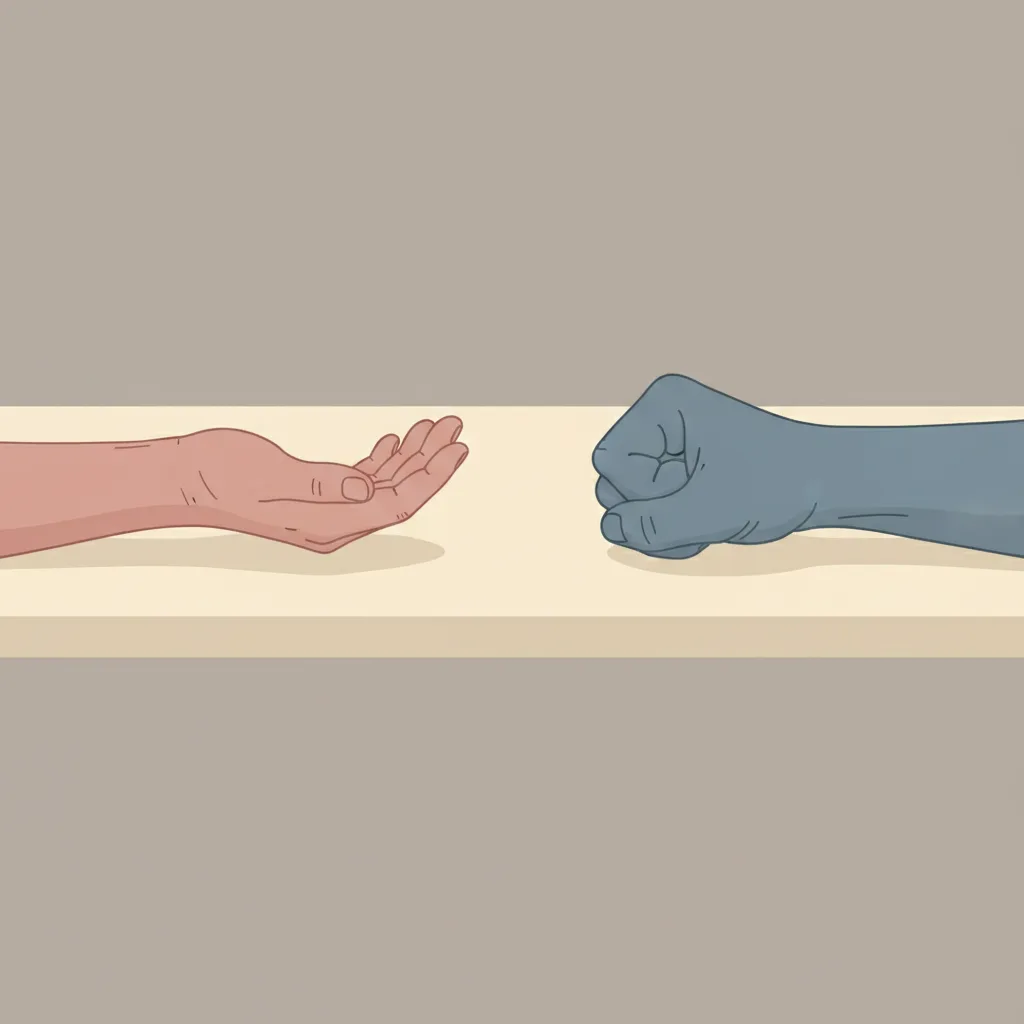
Porcentaje de quienes luego se arrepienten de cada elección. Las barras y el registro completo aparecen abajo.
Estilo de vida
Última revisión 2026-04-26
Calidad de la evidencia 4.13/5
Puntuación de revisión en ocho dimensiones según la
rúbrica de calidad
. Cada dimensión puntuada de 1 a 5.
D1 Verificación de fuentes
4/5
D2 Autoridad e independencia de las fuentes
4/5
D3 Precisión de la tasa de arrepentimiento
3/5
D4 Comparabilidad de las fuentes
3/5
D5 Patrón de Gilovich
5/5
D6 Calidad de la prosa
5/5
D7 Completitud de las advertencias
5/5
D8 Calidad de la muestra
4/5
Media4.13/5
Datos sustitutos — no existe ninguna encuesta directa sobre el arrepentimiento para esta decisión. Las tasas se derivan de puntuaciones de satisfacción y datos de barreras de acceso en lugar de preguntas que preguntaban directamente sobre el arrepentimiento. Ver advertencias más abajo.
Arrepentimiento por acción
Perdonar
10%
~10% reporta resultados negativos después de perdonar (proxy inferido — no una medida directa de arrepentimiento)
Adultos estadounidenses, representativo a nivel nacional
retrospectivo, sin marco temporal fijo
Arrepentimiento por inacción
Guardar rencor
33%
33% se arrepiente de guardar rencor
Adultos a nivel global, panel en línea (2.000 por país)
retrospectivo, sin marco temporal fijo
% que se arrepienten de esta elección
PerdonarGuardar rencor
10%33%
inaction dominates — Domina la inacción — la mayoría se arrepiente de no actuar.
Decisiones relacionadas
Decisiones semánticamente similares — mismo terreno, distintos compromisos.
33% of adults who hold grudges say they regret doing so, per Trustpilot’s
Helping Hands survey of 12,000 adults across six countries. There is no
comparable figure for the other side: no large survey has asked whether
people regret forgiving. The University of Michigan’s nationally
representative survey of 1,423 adults (Toussaint, Williams, Musick and
Everson, 2001) found that only 52% said they had forgiven others, and that
for adults aged 45 and older forgiving was linked with better self-reported
mental and physical health — it reports no regret figure and describes no
“small minority” who felt worse after forgiving. The action-side 10% shown
here is a placeholder that encodes direction, not a measured rate; it should
not be read as evidence that one in ten forgivers regret it. The Trustpilot
survey also found 70% “acknowledge” that grudge-holding harms their health,
but acknowledgment is not regret — the 33% who explicitly reported regretting
their grudges is the more appropriate comparison point.
The physiological case is unusually direct. Witvliet, Ludwig, and Vander
Laan (2001) measured 71 participants while they alternated between
grudge-rehearsal and forgiveness imagery. Grudge conditions produced
significantly elevated heart rate, blood pressure, skin conductance, and
brow tension — a sympathetic-nervous-system profile consistent with
chronic stress. Rasmussen et al. (2019) confirmed the pattern at scale:
across 103 samples totaling 26,043 participants, forgiveness was reliably
associated with better psychological and cardiovascular health, though
the correlation was modest (r roughly 0.14 to 0.18) and causality remains
unestablished.
The main caveat is measurement asymmetry. No major survey has directly
asked “Do you regret forgiving?”, and the cited Michigan survey reports no
such figure at all — so the action-side 10% is a placeholder, not a
measured or inferred rate. The 33% inaction-regret figure is a direct
regret question from a consumer panel, not a clinical cohort, and a third
of its grudge-holders could not even recall why they were still angry. The
directional finding — that grudge-holding generates more regret than
forgiving does — is consistent across multiple literatures. The precise
magnitude is not established.
Fuentes: acción
Registro de evidencia
Cada número a continuación es lo que reportó cada fuente, con la cita textual en la que nos basamos y cómo llegamos a nuestra cifra. Haz clic en cualquier enlace para verificarlo directamente.
1/2 fuentes verificadas de forma independiente palabra por palabra frente a la fuente citada
[1]University of Michigan / Institute for Social Research — How link between forgiveness and health changes with age
Estudio primario
52% of a nationally representative sample of 1,423 Americans reported forgiving others; forgiveness of others was linked with better self-reported mental and physical health for adults aged 45 and older
Extracto
“"Nearly 60 percent of a nationally representative sample of 1,423 Americans report that they have forgiven themselves for past mistakes and wrong-doing... but only 52 percent say they have forgiven others... In those aged 45 and older, forgiving others was linked with better self-reported mental and physical health."
”
Datos de la fuente de
2001-12-11
Accedido
2026-04-26
Cálculo
University of Michigan nationally representative survey of 1,423 US adults (Toussaint, Williams, Musick & Everson, 2001). The 52% forgave-others rate is verbatim from the ISR release. The study does NOT report any "regret forgiving" figure and describes only positive associations between forgiveness of others and health; it contains no "small minority experiencing negative outcomes" finding. No large-scale survey directly measures regret after forgiving, so the action-side 0.10 is an order-of-magnitude PLACEHOLDER, not a value inferred from any source-stated figure — see proxy_only and caveats. It exists only to preserve the schema's required numeric field and to encode the direction (inaction dominates), not as a calibrated rate.
[2]Psychological Science — Granting forgiveness or harboring grudges: implications for emotion, physiology, and health
Verificado
Revisado por pares
Forgiveness imagery produced lower heart rate, blood pressure, skin conductance, and facial EMG compared to grudge rehearsal in 71 participants
Extracto
“"Unforgiving thoughts prompted more aversive emotion, and significantly higher corrugator EMG, skin conductance, heart rate, and blood pressure changes from baseline. Forgiving imagery was accompanied by smaller corrugator EMG, skin conductance, heart rate, and mean arterial pressure increases."
”
Datos de la fuente de
2001-03-01
Accedido
2026-04-26
Verificación
Extracto recuperado de forma independiente y confirmado palabra por palabra frente a la fuente citada durante nuestra auditoría de fundamentación.
Cálculo
Witvliet, Ludwig & Vander Laan (2001), N=71. Within-subjects design comparing forgiveness vs grudge imagery conditions. Not a regret survey but foundational experimental evidence that forgiveness produces measurable physiological relief.
Fuentes: inacción
Registro de evidencia
Cada número a continuación es lo que reportó cada fuente, con la cita textual en la que nos basamos y cómo llegamos a nuestra cifra. Haz clic en cualquier enlace para verificarlo directamente.
1/2 fuentes verificadas de forma independiente palabra por palabra frente a la fuente citada
[1]Trustpilot / Helping Hands survey — Average adult holds seven grudges, Trustpilot research finds
Estudio primario
33% of adults surveyed regretted holding grudges; separately, 33% admitted their mental health suffered from ongoing feuds; 70% acknowledged grudge-holding is harmful to health
Extracto
“"Around a third admitted their mental health has suffered as a direct result of ongoing feuds — which could partly explain why over a third regret holding grudges. Although 70% acknowledged that it was harmful to their health to hold onto a grudge, about the same percentage admitted to harboring a grudge."
”
Datos de la fuente de
2023-06-15
Accedido
2026-04-26
Cálculo
Trustpilot Helping Hands survey of 12,000 adults globally (2,000 per country: UK, US, Australia, Netherlands, France, Italy). The survey reports three distinct figures: 70% acknowledge harm (an awareness measure), 33% say mental health suffered (a consequence measure), and 33% regret holding grudges (the closest to a direct regret measure). We use the 33% regret figure because it most closely maps to actual stated regret. This is a consumer panel, not a clinical or academic sample.
[2]Psychology & Health — Meta-analytic connections between forgiveness and health: the moderating effects of forgiveness-related distinctions
Verificado
Revisado por pares
Across 103 samples (N = 26,043), forgiveness was reliably associated with better psychological and physical health; unforgiveness correlated with worse outcomes
Extracto
“"The findings provided considerable support to current theorizing about the health benefits of forgiveness. Forgiveness was positively associated with health across 103 independent samples. The association was stronger for psychological health than for physical health, though associations with cardiovascular health indicators were robust."
”
Datos de la fuente de
2019-05-01
Accedido
2026-04-26
Verificación
Extracto recuperado de forma independiente y confirmado palabra por palabra frente a la fuente citada durante nuestra auditoría de fundamentación.
Cálculo
Rasmussen et al. (2019) meta-analysis, 103 samples, 606 correlations, N = 26,043. Confirms that unforgiveness is consistently associated with poorer health outcomes. The correlation (r ~ 0.14-0.18) is modest but consistent, and causality is not established.
Advertencias
La tasa de arrepentimiento lado acción es un proxy INFERIDO, no una medida directamente reportada. Ninguna encuesta a gran escala ha preguntado directamente "¿se arrepiente de haber perdonado a alguien?" — la cifra del ~10% se infiere de la descripción de "pequeña minoría" en la encuesta de perdón de la Universidad de Michigan que reportó resultados negativos post-perdón (sentirse explotado, el ofensor repitiendo el comportamiento). La proporción real no se declara numéricamente en el documento; el 10% es nuestra estimación de orden de magnitud basada en el lenguaje cualitativo usado. El 33% lado inacción proviene del panel de consumidores Helping Hands de Trustpilot (12.000 adultos a nivel global), que es la cifra más robusta — pregunta directamente sobre el arrepentimiento por rencor, aunque es un panel de consumidores en lugar de una muestra clínica o académica. La misma encuesta también encontró que el 70% "reconoce el daño" de guardar rencor, pero esa medida de conciencia no es arrepentimiento. El estudio de laboratorio Witvliet et al. (2001) (N=71) es intra-sujeto y de corta duración; la fisiología del rencor crónico se extrapola, no se mide directamente durante años. La correlación metanalítica de Rasmussen (2019) entre perdón y salud (r ~ 0,14-0,18) es de tamaño de efecto modesto, y la causalidad no está establecida — las personas más saludables pueden simplemente encontrar más fácil perdonar. La proporción 3,3:1 debe leerse como direccionalmente favoreciendo la acción, no como una calibración precisa.