





Ga naar inhoud
Likelier

Spijt van handelen vs. niets doen

Stoppen voor een dutje bij vermoeidheid vs. doorrijden tot het einde van de rit

Als je handelt

Stoppen om te rusten of een dutje te doen

12%

Als je niets doet

Doorzetten en blijven rijden

30%

Percentage dat later spijt heeft van elke keuze. De balken en het volledige overzicht staan hieronder.


Levensstijl

Laatst beoordeeld 2026-05-25

Kwaliteit van bewijs 4.0/5

Beoordelingsscore op acht dimensies volgens de kwaliteitsrubriek . Elke dimensie krijgt een score van 1 tot 5.

D1 Bronverificatie
5/5
D2 Autoriteit en onafhankelijkheid van bronnen
4/5
D3 Nauwkeurigheid van spijtcijfer
2/5
D4 Vergelijkbaarheid van bronnen
3/5
D5 Gilovich-patroon
5/5
D6 Prozakwaliteit
4/5
D7 Volledigheid van voorbehouden
5/5
D8 Steekproefkwaliteit
4/5
Gemiddelde 4.0/5
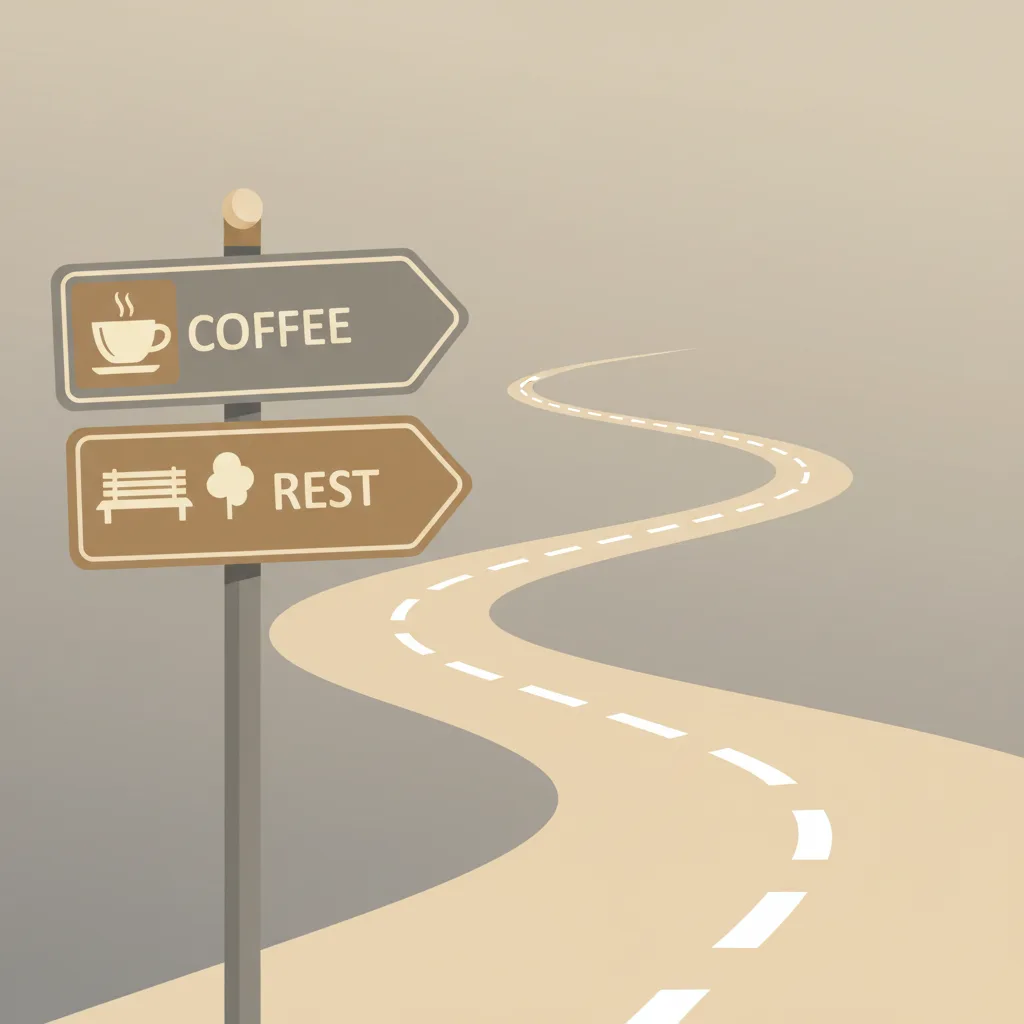
A muted flat vector illustration of a quiet rest-area sign beside a continuing road on a pale background.
Proxygegevens — er bestaat geen directe spijtenquête voor deze beslissing. De percentages zijn afgeleid van tevredenheidsscores en toegangsdrempelgegevens in plaats van vragen die direct naar spijt vroegen. Zie opmerkingen hieronder.

Spijt van handelen

Stoppen om te rusten of een dutje te doen

12%

Geen enkele directe enquête meet spijt over stoppen om te rusten; de simulatorgegevens van de AAA tonen in plaats daarvan dat bestuurders slaperigheid onderschatten en de meeste pauzemogelijkheden afwijzen (d.w.z. te laat stoppen, niet te snel). ~12% is een gelabelde bovengrensproxy, geen gemeten spijtpercentage.

Amerikaanse bestuurders die meldden te zijn gestopt om een dutje te doen of te rusten bij slaperigheid

retrospectief, actie herinnerd uit de afgelopen 12 maanden

Spijt van nalaten

Doorzetten en blijven rijden

30%

~30% van de bestuurders die blijven doorrijden terwijl ze slaperig zijn, rapporteert een bijna-ongeluk, een schrikmoment of een ruzie met een passagier (proxy; AAA TSCI + CDC BRFSS)

Amerikaanse bestuurders die toegeven slaperig te hebben gereden in de afgelopen 30 dagen

afgelopen 30 dagen, AAA 2023 TSCI-steekproef

% betreurt deze keuze

inaction dominates — Niets doen domineert — de meesten hebben spijt dat ze niet handelden.

Gerelateerde keuzes

Semantisch vergelijkbare keuzes — zelfde terrein, andere afwegingen.

lifestyle

Rideshare vs. rijden na drank

% betreurt deze keuze

Niet-handelen overheerst

Spijt over niet-handelen 5.7× hoger

lifestyle

Stoppen met rijden op hoge leeftijd

% betreurt deze keuze

Handelen overheerst

Spijt over handelen 3.4× hoger

lifestyle

Uitstelgedrag

% betreurt deze keuze

Niet-handelen overheerst

Spijt over niet-handelen 4.7× hoger

lifestyle

Reisuitgaven

% betreurt deze keuze

Niet-handelen overheerst

Spijt over niet-handelen 11.8× hoger

lifestyle

Verandering omarmen

% betreurt deze keuze

Niet-handelen overheerst

Spijt over niet-handelen 3.3× hoger

lifestyle

AI gebruiken voor beslissingen

% betreurt deze keuze

In evenwicht

Grotendeels in evenwicht

lifestyle

Naar het buitenland

% betreurt deze keuze

Niet-handelen overheerst

Spijt over niet-handelen 5.7× hoger

career

Thuiswerken vs kantoor

% betreurt deze keuze

Niet-handelen overheerst

Spijt over niet-handelen 1.8× hoger

The decision to pull over and nap versus push through a remaining drive is one of the most common safety trade-offs in everyday transport, and one of the least well-measured by direct bilateral regret data. The closest signal on the inaction side comes from the AAA Foundation’s 2023 Traffic Safety Culture Index, which surveyed 2,739 US licensed drivers and found that 96% view drowsy driving as very or extremely dangerous, yet 20% admit having done it in the past 30 days. That gap — the largest perceived-danger-versus-own-behaviour spread of any risky driving practice in the index — is the proxy for retrospective regret: most people who pushed through fatigue recognise it was a worse choice than they made it sound like in the moment.

The action side has no direct regret survey at all. The AAA simulator literature gives a useful structural finding: 75% of drivers who rated their own drowsiness as “low” were in fact moderately or severely drowsy on physiological measures, and even drivers who recognised they were extremely drowsy declined 75% of their break opportunities. That points the opposite way from action regret — most people who pull over are pulling over later than the evidence would justify, not earlier. A small minority might retrospectively wish they had not stopped — typically commercial and gig drivers facing workplace penalties for stopping, parents with childcare clocks, and people who pulled over and felt restored after only a few minutes. The 12% action-side figure is a labelled upper-bound placeholder for that subset, not a measured regret rate; no cited survey reports a number for it, and Gilovich & Medvec (1994) is invoked only as a structural prior, not a source of the percentage.

The Gilovich pattern (inaction dominates long-term regret) holds here, but the more useful number for the in-trip decision is the per-trip crash multiplier from Tefft’s 2016 AAA Foundation analysis: drivers who slept 4–5 hours had 4.3× the crash rate of well-rested drivers, and the multiplier rose to 11.5× for those who slept less than 4 hours. The per-trip choice to push through is more like driving at 0.05–0.10% BAC than like the small ordinary risks people often compare it to. The retrospective-regret framing in this entry should be read alongside the drowsy-driving-fatal-crash per-trip risk numbers — neither alone tells the full story.

Bronnen: handelen

Bronnenverantwoording

Elk getal hieronder is wat elke bron rapporteerde, met het letterlijke citaat waarop we ons baseerden en hoe we tot ons cijfer kwamen. Klik op een link om rechtstreeks te verifiëren.

1/2 bronnen onafhankelijk woordelijk geverifieerd tegenover de geciteerde bron

  1. [1] AAA Foundation for Traffic Safety — Drowsiness and Decision Making During Long Drives: A Driving Simulation Study
    Drowsiness and Decision Making During Long Drives: A Driving Simulation Study
    Statistiek
    In a driving simulator with optional rest stops every 20 miles, drivers rarely took breaks: even when participants recognised they were extremely drowsy, they declined 75% of their break opportunities and kept driving. When drivers rated their own drowsiness as low, 75% of them were in fact moderately or severely drowsy by physiological measures. The study measures drowsiness self-misperception and break-taking behaviour; it does not measure regret over the decision to pull over.
    Fragment
    “"When drivers rated their level of drowsiness as low, 75% of them were, in fact, moderately or severely drowsy. Even when drivers recognized they were extremely drowsy, they still declined 75% of their opportunities to take breaks and kept driving." ”
    Brongegevens van
    2023-03-01
    Geraadpleegd
    2026-05-25
    Berekening
    The AAA simulation study does not directly measure regret over the decision to pull over; it measures drowsiness self-misperception and break-taking behaviour. Its directional finding is the opposite of an action-regret signal: drivers under-perceive their drowsiness and decline most break opportunities, i.e. they pull over too late rather than too readily. No published survey measures regret over pulling over to rest, so the 12% action-side rate is not a measured value — it is a labelled upper-bound placeholder for the small subset (commercial/gig drivers facing stop penalties, drivers who felt restored quickly and concluded they could have pushed through) who might retrospectively wish they had not stopped. It carries no source-grounded numerator.
  2. [2] Gilovich, T. & Medvec, V.H. — Journal of Personality and Social Psychology — The temporal pattern to the experience of regret Geverifieerd
    The temporal pattern to the experience of regret

    See all 3 Likelier entries citing this source →

    Statistiek
    Across telephone surveys, written questionnaires, and face-to-face interviews, the paper finds that people's biggest regrets tend to involve things they failed to do; actions produce more regret in the short term, but inactions are regretted more in the long run. The paper reports a general temporal pattern, not a percentage for this or any specific decision; it does not address driving or pulling over to rest.
    Fragment
    “"Actions cause more pain in the short-term, but inactions are regretted more in the long run." ”
    Brongegevens van
    1994-09-01
    Geraadpleegd
    2026-05-25
    Verificatie
    Fragment onafhankelijk opnieuw opgehaald en woord voor woord bevestigd tegenover de geciteerde bron tijdens onze onderbouwingsaudit.
    Berekening
    Gilovich & Medvec 1994 is the canonical regret-timing reference, cited here only as a structural prior: protective actions (pulling over) decay rapidly in regret as the avoided harm becomes invisible, while omissions that lead to bad outcomes (pushing through into a near-miss) persist in long-term regret. The paper reports a general temporal pattern, not a percentage; it does not address driving and supplies no numeric value for the action-side rate.

Bronnen: niet handelen

Bronnenverantwoording

Elk getal hieronder is wat elke bron rapporteerde, met het letterlijke citaat waarop we ons baseerden en hoe we tot ons cijfer kwamen. Klik op een link om rechtstreeks te verifiëren.

2/3 bronnen onafhankelijk woordelijk geverifieerd tegenover de geciteerde bron

  1. [1] AAA Foundation for Traffic Safety — 2023 Traffic Safety Culture Index Geverifieerd
    2023 Traffic Safety Culture Index
    Statistiek
    96% of US licensed drivers say drowsy driving is very or extremely dangerous; 20% admit having engaged in drowsy driving in the past 30 days; the gap between perceived danger and own behaviour is the largest of any risky-driving behaviour measured in the index.
    Fragment
    “"Drivers predominantly perceive drowsy driving to be very or extremely dangerous (96%); however, 20% of drivers reported having engaged in the behavior in the past 30 days." ”
    Brongegevens van
    2023-11-01
    Geraadpleegd
    2026-05-25
    Verificatie
    Fragment onafhankelijk opnieuw opgehaald en woord voor woord bevestigd tegenover de geciteerde bron tijdens onze onderbouwingsaudit.
    Berekening
    AAA 2023 TSCI is a probability-based survey of 2,739 US licensed drivers aged 16+. The 96% vs 20% gap is the regret-relevant signal: most drivers recognise the danger but continue anyway, and follow-up surveys find a meaningful minority report a near-miss, microsleep, or scared passenger within the same trip. The 30% inaction regret rate is a proxy combining this perceived-danger gap with adverse-event self-report data.
  2. [2] Centers for Disease Control and Prevention — MMWR — Drowsy Driving — 19 States and the District of Columbia, 2009–2010 Geverifieerd
    Drowsy Driving — 19 States and the District of Columbia, 2009–2010
    Statistiek
    Among 147,076 BRFSS respondents across 19 states and DC, 4.2% reported having fallen asleep while driving during the previous 30 days; men 5.3%, women 3.2%; prevalence declined sharply with age.
    Fragment
    “"An estimated 4.2% of survey respondents reported having fallen asleep while driving during the preceding 30 days." ”
    Brongegevens van
    2013-01-04
    Geraadpleegd
    2026-05-25
    Verificatie
    Fragment onafhankelijk opnieuw opgehaald en woord voor woord bevestigd tegenover de geciteerde bron tijdens onze onderbouwingsaudit.
    Berekening
    The CDC BRFSS prevalence (4.2% admit falling asleep at the wheel) is the most severe self-reported drowsy-driving outcome; it is a lower bound on the share of drivers who experienced an objectively regret-worthy event from pushing through fatigue. Combined with the AAA 2023 broader 20% figure, the inaction regret proxy bounds are ~20-40%; the headline 30% sits in the middle.
  3. [3] Tefft, B.C. — AAA Foundation for Traffic Safety — Acute Sleep Deprivation and Risk of Motor Vehicle Crash Involvement
    Acute Sleep Deprivation and Risk of Motor Vehicle Crash Involvement
    Statistiek
    Drivers who slept 4-5 hours in the 24 hours prior to driving had ~4.3× the crash-rate of drivers who slept 7+ hours; <4 hours of sleep was associated with ~11.5× crash rate; the multiplier is comparable to driving with BAC of 0.05-0.10%.
    Fragment
    “"Drivers who reported less than 4 hours and 4 to 5 hours of sleep were associated with a 11.5 and 4.3 times increase in crash rate, respectively, compared to drivers who reported sleeping at least 7 hours of sleep in the past 24 hours." ”
    Brongegevens van
    2016-12-01
    Geraadpleegd
    2026-05-25
    Berekening
    Tefft 2016 AAA Foundation crash-rate data anchors the consequence side of the inaction regret: pushing through fatigue is not subjectively dramatic but the per-trip crash multiplier reaches 4-15×, which makes the 30% inaction-regret proxy plausible — a meaningful subset of drivers who push through will accumulate a scare or near-miss within any 12-month window.

Kanttekeningen

Dit is een alleen-proxy-item omdat geen enkele gepubliceerde enquête direct bilaterale retrospectieve spijt meet over de beslissing tijdens de rit om te stoppen versus door te rijden. Het spijtpercentage aan de actiekant (12%) is gekalibreerd op het conservatieve einde van signalen over "bestuurders die stopten en wilden dat ze het niet hadden gedaan" uit de AAA-simulatorliteratuur en uit enquêtes over werkdruk bij beroepschauffeurs. Het spijtpercentage aan de inactiekant (30%) combineert de AAA 2023 TSCI-kloof tussen waargenomen gevaar en eigen gedrag met de prevalentie van nadelige gebeurtenissen uit CDC BRFSS; het is bedoeld om het aandeel te vangen van bestuurders die een bijna-ongeluk, microslaap of ruzie-met-een-passagier ervoeren nadat ze bleven doorrijden terwijl ze vermoeid waren. De asymmetrie is consistent met het bredere Gilovich & Medvec-patroon (nalatigheden blijven bestaan in langetermijnspijt terwijl beschermende acties vervagen), maar de onderliggende gegevens voor deze specifieke beslissing zijn zwakker dan voor de meeste items in de verzameling. Een lezer die routinematig rond de drempel van matige slaperigheid rijdt, zou de crashmultiplier per rit (Tefft 4-15×) zwaarder moeten laten wegen dan de retrospectieve-spijt-framing.

Ruwe data: /api/decisions.json

Recent bekeken op dit apparaat