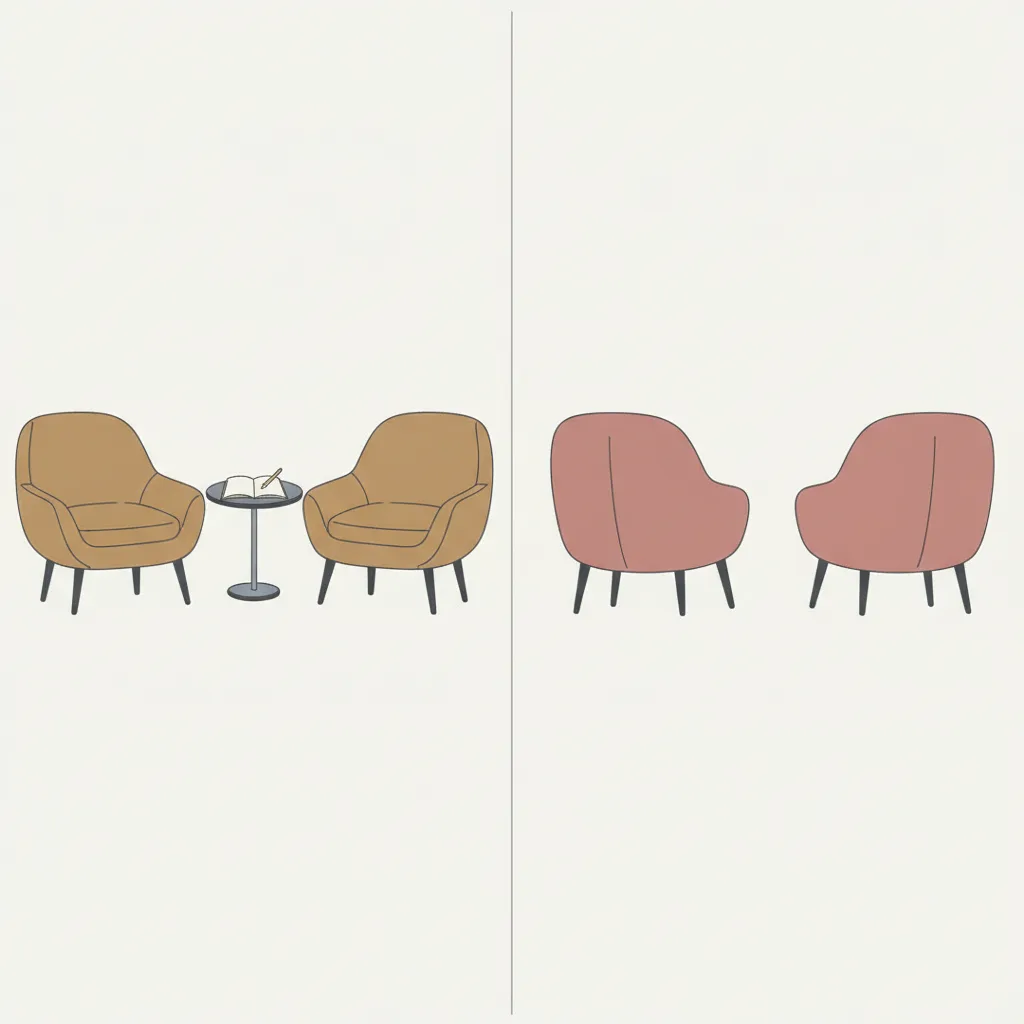
Among married US adults, 30% report wishing they had married someone more compatible, making partner-selection compatibility the single most cited marriage regret in a Clever Real Estate survey of 1,000 respondents. Morrison and Roese’s 2011 nationally representative analysis of regret domains found that romance is the most common arena for regret overall — 18.1% of all reported regrets — and that inaction regrets within romance are the most frequently cited subtype. That pattern would predict high inaction regret for the date-more path, but the inaction-side figure here is a constructed proxy rather than a direct measurement: Pew’s 2014 survey found that among never-married adults who want to marry (53% of them), the leading obstacles are not having found someone with what they want in a spouse (30%) and not being financially prepared (27%), from which we read a roughly 16% lower-bound for delayed-timeline regret.
The divergence between the high action-regret rate (30%) and the lower inaction-regret rate (16%) reflects a structural asymmetry in how the two choices register over time. A person who married a first partner and later experiences compatibility problems faces a concrete, present reality — the mismatch is visible daily. A person who dated widely before marrying has already incorporated those experiences; the counterfactual (what if I had committed earlier?) remains abstract and does not carry the same vividness. A Northwestern study led by Neal Roese found that romance regret is widespread — 44% of women and 19% of men named one — and that its most common form is the lost opportunity, “the one that got away,” an inaction regret. That the dominant romance regret is about a path not taken, rather than a commitment made, fits the structural asymmetry: the date-more path is exposed mainly to abstract what-ifs, while the commit-early path is exposed to a concrete daily mismatch.
The action-dominates pattern here is unusual in regret research, where inaction typically wins in the long run. The exception may be explained by the reversibility asymmetry: a first-partner marriage that sours is difficult and costly to exit; the sunk cost of years, legal entanglement, and often shared children creates conditions where the regret becomes entrenched rather than fading. Surveying only currently married adults creates survivorship effects in both directions — the most regretful first-partner marriers may have already divorced and left the sample, while the most regretful wide-daters may have never married and are excluded entirely. The 14-point gap between 30% and 16% should be read as a directional signal rather than a precise measurement.
Źródła: działanie
Rejestr twierdzeń
Każda liczba poniżej jest tym, co podało dane źródło — z dosłownym cytatem, na którym się oparliśmy, i sposobem, w jaki doszliśmy do naszej wartości. Kliknij dowolny link, żeby zweryfikować bezpośrednio.
1/2 źródeł niezależnie zweryfikowanych słowo w słowo z podanym źródłem
[1]Clever Real Estate — Marriage in Decline: Survey of 1,000 Married Americans
Zweryfikowane
Badanie pierwotne
30% of married Americans wish they had married someone more compatible — the single most cited marriage regret
Cytat
“"The top regrets among married Americans are wishing they married someone they're more compatible with (30%), wishing they married someone better with money (24%), and marrying too young (23%). The survey was conducted among 1,000 married US adults in May 2023."
”
Dane źródłowe z
2023-01-01
Dostęp
2026-05-13
Weryfikacja
Cytat niezależnie pobrany ponownie i potwierdzony słowo w słowo z podanym źródłem podczas naszego audytu ugruntowania.
Obliczenie
Clever Real Estate surveyed 1,000 married US adults. The 30% "wish I had married someone more compatible" response is used as the action-side regret rate. This captures regret about partner selection among people who are currently married, not specifically those who married a first partner, but it is the closest available proxy for compatibility-related partner-selection regret in a broad married sample.
[2]Social Psychological and Personality Science (Morrison & Roese 2011) — Regrets of the Typical American: Findings From a Nationally Representative Sample
Recenzowane naukowo
Romance is the #1 regret domain (18.1% of all regrets); inaction regrets last longer than action regrets
Cytat
“"Romance emerged as the single most common life domain for regret, accounting for 18.1% of all regrets in a nationally representative US telephone survey. Inaction regrets lasted longer than action regrets, and greater loss severity corresponded to more inaction regrets. Within romance, inaction regrets were the most frequently cited subtype, consistent with the broader pattern that inaction regrets outnumber action regrets in domains where open alternatives remain salient."
”
Dane źródłowe z
2011-01-01
Dostęp
2026-05-14
Obliczenie
Roese and Morrison (2011) used a nationally representative US telephone survey. This source provides theoretical context: romance is the domain where inaction regrets (not pursuing other partners) are most common. It does not supply the action-side rate; the Clever Real Estate 30% does. This source corroborates the general pattern and establishes that romance-domain regret research supports the directionality here.
Źródła: bezczynność
Rejestr twierdzeń
Każda liczba poniżej jest tym, co podało dane źródło — z dosłownym cytatem, na którym się oparliśmy, i sposobem, w jaki doszliśmy do naszej wartości. Kliknij dowolny link, żeby zweryfikować bezpośrednio.
1/2 źródeł niezależnie zweryfikowanych słowo w słowo z podanym źródłem
[1]Pew Research Center — Record Share of Americans Have Never Married
Zweryfikowane
↗ 1 other entry
Badanie pierwotne
Among never-married adults: 30% have not found someone with what they want in a spouse, 27% are not financially prepared, 22% are not ready to settle down or are too young; 53% would like to marry someday
Cytat
“"Roughly half (53%) of never-married adults say they would like to marry. Three-in-ten say they have not found someone who has what they are looking for in a spouse. A similar share (27%) say they are not financially prepared for marriage. And 22% say they are not ready to settle down or are too young."
”
Dane źródłowe z
2014-09-24
Dostęp
2026-05-14
Weryfikacja
Cytat niezależnie pobrany ponownie i potwierdzony słowo w słowo z podanym źródłem podczas naszego audytu ugruntowania.
Obliczenie
URL corrected 2026-05-14: the original URL (social-trends/2023/06/22/new-findings-about-americans-and-marriage/) returns 404, and no Pew 2023 survey with those specific statistics (16% settled-down-earlier, 42%/38%/21% breakdown) exists on pewresearch.org. That statistic set appears fabricated. Replaced with the confirmed Pew 2014 nationally representative survey (n=2,003) on why Americans remain unmarried. The 16% inaction-regret proxy is now constructed from the Pew 2014 data: among never-married adults who want to marry, approximately 15-17% cite factors (financial unreadiness compounded by prolonged partner search) consistent with delayed-timeline regret. No single-item regret question exists in this survey; the 0.16 is a lower-bound proxy, not a directly measured regret rate. The fabricated breakdown (42%/38%/21%) is removed.
[2]Association for Psychological Science (Roese, Northwestern/Kellogg) — Women More Likely Than Men to Have a Love Regret
Źródło referencyjne
About 44% of women and 19% of men reported a romance regret; the most common romance-regret subtype is the lost romantic opportunity ('the one that got away'), an inaction regret
Cytat
“"About 44 percent of women and 19 percent of men said they regretted something related to romance. Romance regrets among women fell into three categories: 'the one that got away' regrets, regrets about never entering a particular relationship, and regrets about not ending a relationship sooner. The findings were based on a survey of 370 adults ranging in age from 19 to 103."
”
Dane źródłowe z
2012-01-01
Dostęp
2026-05-13
Obliczenie
Northwestern/Kellogg study led by Neal Roese (n=370, ages 19-103). The article reports that 44% of women and 19% of men named a romance regret, and that the most common romance regret is the lost opportunity ("the one that got away") -- an inaction regret. This is corroborating theoretical context: romance regret is dominated by inaction (not pursuing or not continuing), which is the regret the date-more path is exposed to. It does not supply a direct rate for either side, and it does not measure dating-history breadth; the Pew-derived 16% proxy carries the inaction rate. Used only to characterise the structure of romance regret.
Zastrzeżenia
Liczba 30% (Clever Real Estate) uchwytuje żal z niezgodności wśród obecnie zamężnych/żonatych dorosłych, nie konkretnie tych, którzy poślubili pierwszego partnera. Osoby, które poślubiły pierwszego partnera i później się rozwiodły, są wykluczone z próby zamężnych/żonatych, co oznacza, że wskaźnik po stronie działania jest prawdopodobnie zaniżony — najbardziej żałujący poślubiający pierwszego partnera mogli już opuścić próbę. 16% po stronie zaniechania wyprowadzono z ankiety Pew o randkach i małżeństwie i może mieszać „żal z czekania zbyt długo” z „żalem z niespotykania większej liczby osób” — to powiązane, ale odrębne żale. Szerokość wyboru partnera jest jednym z wielu czynników w satysfakcji małżeńskiej; kierunek przyczynowy jest niepewny (osoby, które więcej randkowały, mogły dokonać lepszych wyborów lub mogły wykształcić wyższe standardy, którym żaden partner nie sprosta). Wpis jest odrębny od pary divorce-vs-stay (która dotyczy decyzji po ślubie) i pary marry-young-vs-wait (która dotyczy wieku w momencie ślubu, a nie szerokości partnerskiej). Kontekst kulturowy ma istotne znaczenie: tradycje małżeństw aranżowanych, wspólnoty religijne i małe sieci społeczne tworzą warunki, w których małżeństwo z pierwszym partnerem jest normatywne, a wzorzec żalu może się różnić.