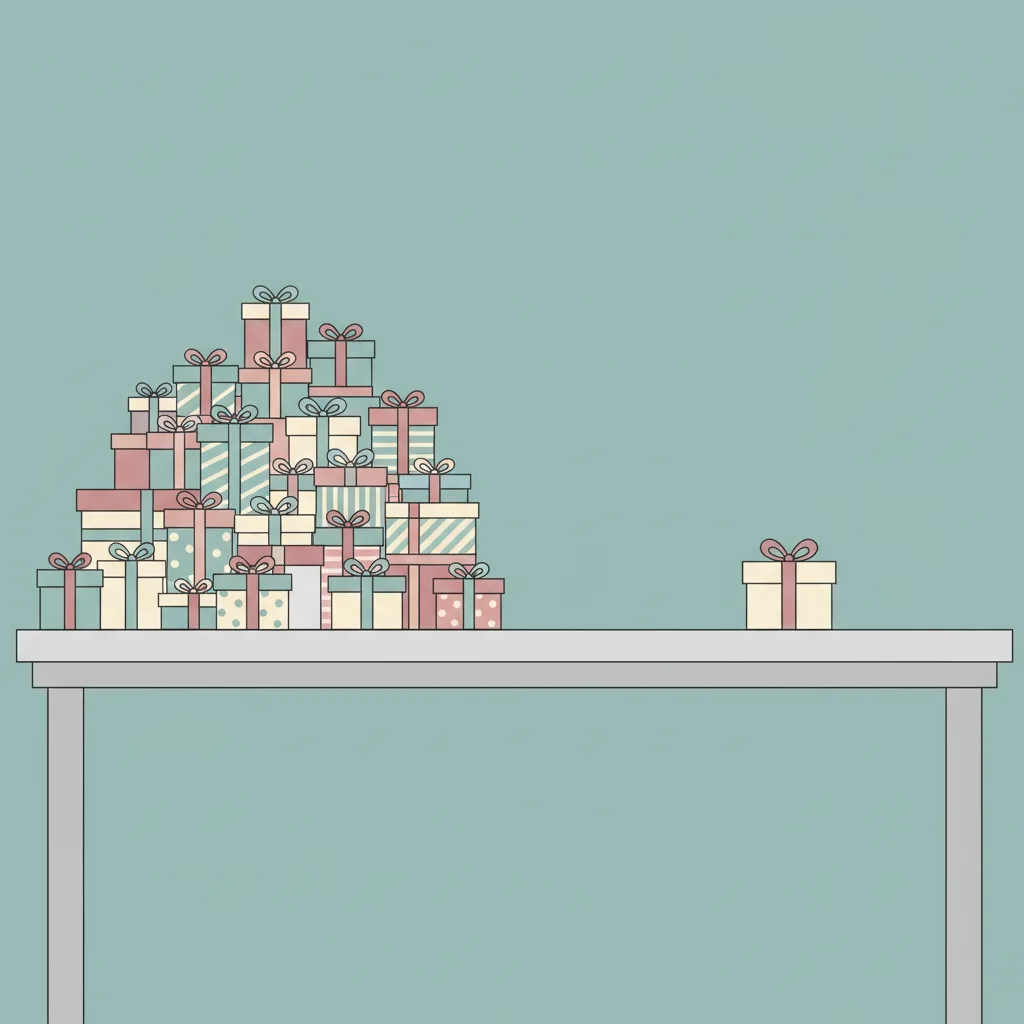
Kupowanie wnukowi (lub dziecku) każdej zabawki i prezentu, o które prosi, kontra powstrzymywanie się od dawania prezentów i mówienie nie
Jeśli działasz
Dawanie wszystkiego
40%
Jeśli nie działasz
Powściągliwość w prezentach
14%
Odsetek osób, które później żałują każdego wyboru. Słupki i pełna kartoteka danych poniżej.
Rodzina
Ostatnio sprawdzono 2026-05-05
Jakość dowodów 3.88/5
Ocena recenzji w ośmiu wymiarach względem
rubryki jakości
. Każdy wymiar oceniony w skali 1–5.
D1 Weryfikacja źródeł
4/5
D2 Autorytet i niezależność źródeł
4/5
D3 Dokładność wskaźnika żalu
3/5
D4 Porównywalność źródeł
4/5
D5 Wzorzec Gilovicha
5/5
D6 Jakość tekstu
4/5
D7 Kompletność zastrzeżeń
4/5
D8 Jakość próby
3/5
Średnia3.88/5
Dane zastępcze — dla tej decyzji nie istnieje bezpośrednie badanie żałowania. Wskaźniki są oparte na ocenach zadowolenia i danych o barierach dostępu, a nie na pytaniach bezpośrednio dotyczących żałowania. Zobacz zastrzeżenia poniżej.
Żal za działanie
Dawanie wszystkiego
40%
40% rodziców mówi, że dziadkowie są zbyt miękcy lub pobłażliwi (proxy)
Amerykańscy rodzice dzieci w wieku 0–18 lat, którzy zgłosili nieporozumienia z dziadkiem (podgrupa ogólnokrajowej reprezentatywnej próby n=2016)
przekrojowo, badane styczeń–luty 2020
Żal za zaniechanie
Powściągliwość w prezentach
14%
14% rodziców mówi, że dziadkowie są zbyt surowi lub twardzi (proxy)
Amerykańscy rodzice dzieci w wieku 0–18 lat, którzy zgłosili nieporozumienia z dziadkiem (podgrupa ogólnokrajowej reprezentatywnej próby n=2016)
przekrojowo, badane styczeń–luty 2020
% żałuje tej decyzji
Dawanie wszystkiegoPowściągliwość w prezentach
40%14%
action dominates — Działanie dominuje — większość żałuje, że podjęła działanie.
Powiązane decyzje
Semantycznie podobne decyzje — ten sam obszar, inne kompromisy.
Among US parents who report disagreements with a grandparent about child-rearing, 40% attribute those disagreements to grandparents being too soft or lenient, compared with only 14% who say grandparents are too tough, a nearly 3:1 ratio within the same response scale from a C.S. Mott Children’s Hospital National Poll of 2,016 nationally representative US parents fielded in January–February 2020. The asymmetry holds even though the dominant cultural script around grandparenting celebrates indulgence: “spoiling” is often described as a grandparent’s right, yet parents experiencing it in practice flag the leniency direction at three times the rate of the restraint direction. Both rates come from the same survey and the same subset of disagreement-reporting parents, making the cross-group comparison the most direct parallel evidence available on this bilateral question. Neither figure measures grandparent self-regret about their choices; both reflect parental observation of the downstream costs, and are flagged throughout as proxy estimates.
The child-development literature independently supports the direction of this asymmetry. Bredehoft, Mennicke, Potter, and Clarke (1998), writing in the Journal of Family and Consumer Sciences Education, surveyed 730 adults and found that the 124 who self-identified as adult children of overindulgence reported, as a great majority (71%), lasting difficulty as adults knowing what is enough or what is normal, a consequence that persisted long after the material gifts were forgotten. On the developmental side, Dauch, Imwalle, Ocasio, and Metz (2018) published an experiment in Infant Behavior and Development showing that toddlers given access to four toys rather than sixteen played for longer durations and in markedly more sophisticated ways, suggesting that abundance itself displaces the focused engagement that promotes cognitive and attentional development. The restraint literature does not argue that gift refusal has no costs; a grandparent who is consistently tight or withholding creates a different friction, but the outcome evidence clusters more heavily against excess than against moderation.
The Gilovich framework predicts that action regrets (having been too generous, having never said no) are salient and interpersonally costly in the present (parents notice and object), while inaction regrets (having been too restrained) tend to crystallize later and more privately, if at all. The 2.9:1 ratio in parental conflict reports is consistent with this temporal asymmetry. The primary caveat is that the Mott data captures a relational friction between generations, not a direct self-regret measurement by the gift-giving party; grandparents themselves may weight the same behavior differently. Research identifying relational and structural overindulgence as more harmful than pure material excess also suggests the action-side risk may be somewhat overstated when isolated to toy and gift quantity specifically.
Źródła: działanie
Rejestr twierdzeń
Każda liczba poniżej jest tym, co podało dane źródło — z dosłownym cytatem, na którym się oparliśmy, i sposobem, w jaki doszliśmy do naszej wartości. Kliknij dowolny link, żeby zweryfikować bezpośrednio.
3/3 źródeł niezależnie zweryfikowanych słowo w słowo z podanym źródłem
[1]C.S. Mott Children's Hospital National Poll on Children's Health, University of Michigan — When parents and grandparents disagree
Zweryfikowane
Źródło referencyjne
40% of parents say disagreements with grandparents occur because grandparents are too soft on the child; 14% say grandparents are too tough; 6% report major disagreements and 37% minor disagreements
Cytat
“"Among parents who say they have had disagreements with a grandparent about how the grandparent cares for their child, 40% say the disagreements occur because grandparents are too soft on the child, while 14% say grandparents are too tough."
”
Dane źródłowe z
2020-08-17
Dostęp
2026-05-04
Weryfikacja
Cytat niezależnie pobrany ponownie i potwierdzony słowo w słowo z podanym źródłem podczas naszego audytu ugruntowania.
Obliczenie
C.S. Mott Children's Hospital National Poll on Children's Health (Vol. 36, Issue 5, August 2020). Survey of 2,016 US parents of children ages 0–18, randomly selected and stratified. Among parents who reported disagreements with a grandparent, 40% attributed those disagreements to grandparents being too lenient or soft. This is used as the action-side proxy for regret: parents registering that uninhibited gift-giving and leniency is a problem conflicting with their child-rearing choices. The 40% is not a direct self-report of grandparent regret — it is parental observation of the costs of overindulgence — flagged as "(proxy)".
[2]Journal of Family and Consumer Sciences Education (Bredehoft, Mennicke, Potter & Clarke) — Perceptions attributed by adults to parental overindulgence during childhood
Zweryfikowane
Recenzowane naukowo
71% of adult children of overindulgence (ACOs; n=124 self-identified from 730 surveyed) reported difficulty as adults knowing what is enough or what is normal; ACOs simultaneously felt loved, confused, guilty, bad and sad about the overindulgence
Cytat
“"The great majority (71%) of the overindulged subjects reported having difficulty knowing what is enough, or what is normal as adults. ACOs simultaneously felt both positively and negatively about the overindulgence, that is, they felt loved, confused, guilty, bad and sad."
”
Dane źródłowe z
1998-10-01
Dostęp
2026-05-04
Weryfikacja
Cytat niezależnie pobrany ponownie i potwierdzony słowo w słowo z podanym źródłem podczas naszego audytu ugruntowania.
Obliczenie
Bredehoft, Mennicke, Potter & Clarke (1998), Journal of Family and Consumer Sciences Education, 16(2), 3–17. Survey of 730 subjects; 124 self-identified as adult children of overindulgence (ACO). The 71% figure applies to the ACO subsample (n=124), not to the full 730. This source does not supply the 40% action-rate; it corroborates the direction of harm from overindulgent material gifting by showing that adults retrospectively raised that way report lasting difficulty calibrating sufficiency. The population is different (adult self-report on childhood, not current parental observation), but the convergence supports the action-side framing.
[3]C.S. Mott Children's Hospital National Poll on Children's Health, University of Michigan — Parent efforts to teach children about gratitude
Zweryfikowane
Źródło referencyjne
58% of US parents of children ages 4–10 worry that they are giving their children too much
Cytat
“"Over half of parents (58%) worry that they are giving their children too much, while 42% say they sometimes are embarrassed by how selfish their child acts."
”
Dane źródłowe z
2021-10-01
Dostęp
2026-05-05
Weryfikacja
Cytat niezależnie pobrany ponownie i potwierdzony słowo w słowo z podanym źródłem podczas naszego audytu ugruntowania.
Obliczenie
C.S. Mott Children's Hospital National Poll on Children's Health, University of Michigan. N=1,125 parents with at least one child age 4–10, fielded June 2021. The 58% worry-about-over-giving rate documents that concern about material excess is widespread among the parenting generation — even before grandparent gift-giving is layered on top. This source measures worry (a prospective concern), not retrospective regret, and covers parent-to-child giving rather than grandparent-to-grandchild giving. It does not supply the action-side 40% proxy rate; that comes from Mott 2020. It corroborates the cultural prevalence of over-giving concern and provides independent evidence that parents themselves recognise an excess problem in their households, which is relevant context for the grandparent layer of the same dynamic.
Niezależność
Independent from Mott 2020 (different survey wave, Vol. 39 Issue 5 vs Vol. 36 Issue 5, different sample frame: parents of children 4–10 vs parents of children 0–18, different topic focus: gratitude vs grandparent disagreements).
Źródła: bezczynność
Rejestr twierdzeń
Każda liczba poniżej jest tym, co podało dane źródło — z dosłownym cytatem, na którym się oparliśmy, i sposobem, w jaki doszliśmy do naszej wartości. Kliknij dowolny link, żeby zweryfikować bezpośrednio.
1/2 źródeł niezależnie zweryfikowanych słowo w słowo z podanym źródłem
[1]C.S. Mott Children's Hospital National Poll on Children's Health, University of Michigan — When parents and grandparents disagree
Zweryfikowane
Źródło referencyjne
14% of parents say disagreements with grandparents occur because grandparents are too tough on the child, vs 40% who say grandparents are too soft
Cytat
“"Among parents who say they have had disagreements with a grandparent about how the grandparent cares for their child, 40% say the disagreements occur because grandparents are too soft on the child, while 14% say grandparents are too tough."
”
Dane źródłowe z
2020-08-17
Dostęp
2026-05-04
Weryfikacja
Cytat niezależnie pobrany ponownie i potwierdzony słowo w słowo z podanym źródłem podczas naszego audytu ugruntowania.
Obliczenie
Same Mott 2020 survey (n=2,016). The 14% who say grandparents are too tough is used as the inaction-side proxy for regret: the share of cases where restraint and limit-setting is itself the source of conflict and parental concern. This is not grandparent self-regret about being too strict; it is parents flagging that restraint has gone too far. Flagged as "(proxy)". The 40%:14% ratio (2.9:1) from the same survey and same response scale makes the comparison directly valid across sides.
[2]Infant Behavior and Development (Dauch, Imwalle, Ocasio & Metz) — The influence of the number of toys in the environment on toddlers' play
Recenzowane naukowo
Toddlers with access to 4 toys (vs 16) showed longer duration of toy play and played in more sophisticated ways; fewer toys led to higher-quality, more sustained engagement
Cytat
“"With fewer toys, participants had fewer incidences of toy play, longer durations of toy play, and played with toys in a greater variety of ways. The findings suggest that an environment with fewer toys may better support toddlers' play."
”
Dane źródłowe z
2018-02-01
Dostęp
2026-05-04
Obliczenie
Dauch, Imwalle, Ocasio & Metz (2018), Infant Behavior and Development, 50, 78–87. Experimental study with n=36 toddlers ages 18–30 months; each child played under two conditions (4 toys and 16 toys). This source does not supply the 14% inaction rate; it corroborates the developmental case for restraint in gifting by showing that fewer toys produce demonstrably richer play. The finding supports why restrained gift-giving is not costless but is substantially less problematic than excess — the inaction-dominates concern is not supported by child development data.
Zastrzeżenia
Oba wskaźniki pochodzą z tego samego sondażu Mott 2020 (n=2016) i mierzą rodzicielską obserwację zachowania dziadków, a nie samożal dziadków co do ich własnych wyborów dotyczących prezentów. 40% i 14% wyciągnięto z podgrupy rodziców, którzy zgłosili nieporozumienia z dziadkiem — nie z pełnej próby — co oznacza, że mianownik jest mniejszy, a porównanie odzwierciedla kierunek konfliktu, a nie nieuwarunkowany wskaźnik częstości. Żadna z liczb nie jest bezpośrednim pomiarem żalu; obie są oznaczone jako „(proxy)”. Ustalenie Bredehoft i in. (1998), że 71% dorosłych nadmiernie pobłażanych zgłasza trwałe trudności z kalibracją wystarczalności, pochodzi z znacznie mniejszej podpróby (n=124 samoidentyfikujących się ACO z 730 ankietowanych), używa retrospektywnego samoraportu i obejmuje wszystkie formy nadmiernego pobłażania — nie tylko prezenty materialne. Badania konsekwentnie identyfikują nadmierne pobłażanie relacyjne i strukturalne jako bardziej szkodliwe niż samo materialne — więc ryzyko po stronie działania może być nieco przeszacowane, jeśli wpis czyta się jako odnoszący się tylko do ilości zabawek i prezentów. Eksperyment Dauch i in. (2018) ogranicza się do maluchów w laboratoryjnej sali zabaw; uogólnienie na akumulację prezentów w realnym świecie przez miesiące i lata jest wiarygodne, ale niezbadane bezpośrednio. Żadna szeroka ankieta nie pyta dziadków wprost „czy żałujesz, że kupowałeś za dużo?” lub „czy żałujesz, że byłeś zbyt powściągliwy w prezentach?” — takie dane nie wydają się istnieć w opublikowanej literaturze.