



Ir para o conteúdo
Likelier

Arrependimento de agir vs. não agir

Iniciar terapia de casal / conjugal vs não fazer terapia de casal

Se você agir

Fez terapia de casal

27%

Se você não agir

Não buscou terapia de casal

33%

Porcentagem de quem mais tarde se arrepende de cada escolha. As barras e o registro completo aparecem abaixo.


Família

Última revisão 2026-05-22

Qualidade das evidências 4.38/5

Pontuação de revisão em oito dimensões segundo a grelha de qualidade . Cada dimensão pontuada de 1 a 5.

D1 Verificação das fontes
5/5
D2 Autoridade e independência das fontes
5/5
D3 Precisão da taxa de arrependimento
4/5
D4 Comparabilidade das fontes
2/5
D5 Padrão de Gilovich
5/5
D6 Qualidade da prosa
5/5
D7 Completude das ressalvas
5/5
D8 Qualidade da amostra
4/5
Média 4.38/5
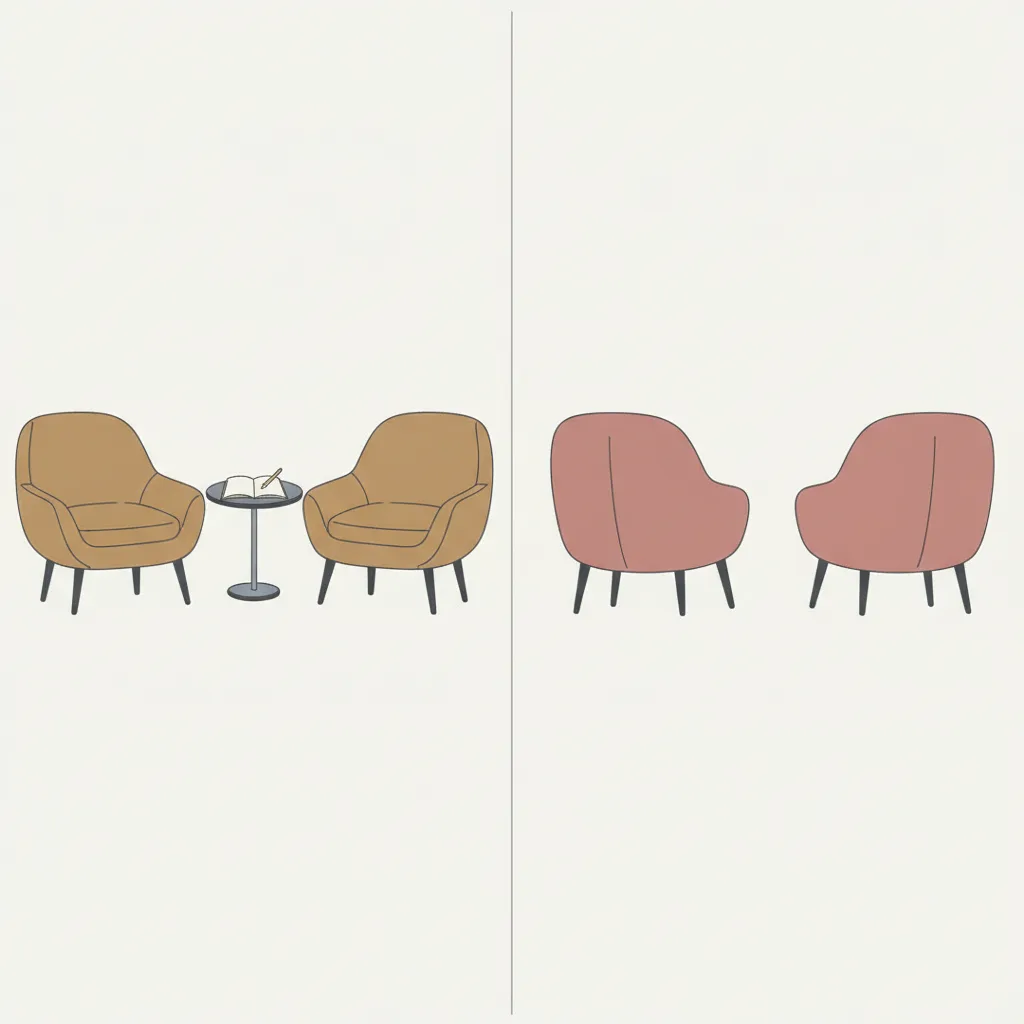
Two chairs angled toward each other with a small table and a notepad on the left, and the same chairs facing away from each other on the right
Dados proxy — não existe nenhuma pesquisa direta sobre arrependimento para esta decisão. As taxas são derivadas de pontuações de satisfação e dados de barreiras de acesso em vez de perguntas que perguntavam diretamente sobre arrependimento. Veja advertências abaixo.

Arrependimento por ação

Fez terapia de casal

27%

~29% dos casais que frequentam terapia se divorciam ou mostram deterioração clinicamente significativa em 5 anos (proxy baseado em resultado para arrependimento)

Casais casados gravemente angustiados inscritos em ensaios controlados randomizados de terapia de casal, amostras clínicas dos EUA

acompanhamento de 5 anos após o fim do tratamento

Arrependimento por omissão

Não buscou terapia de casal

33%

~42% dos casais que nunca frequentam terapia de casal enfrentam divórcio ou angústia relacional não resolvida (proxy para arrependimento por inação)

Casais casados angustiados que não buscam terapia de casal, com dados de resultado extraídos de controles sem tratamento e dados de divórcio da população dos EUA

transversal e longitudinal; múltiplas janelas de estudo

% se arrependem desta escolha

inaction dominates — A inacção domina — a maioria arrepende-se de não ter agido.

Decisões relacionadas

Decisões semanticamente semelhantes — mesmo terreno, compromissos diferentes.

family

Mediação familiar vs litígio

% se arrependem desta escolha

A inação predomina

Arrependimento de inação 3.1× maior

Saúde

Terapia ou sem terapia

% se arrependem desta escolha

Equilibrado

Aproximadamente equilibrado

family

Casar com o primeiro vs. namorar mais

% se arrependem desta escolha

A ação predomina

Arrependimento de ação 1.9× maior

family

Arrependimento por traição

% se arrependem desta escolha

A ação predomina

Arrependimento de ação 3.7× maior

family

Divórcio

% se arrependem desta escolha

Equilibrado

Aproximadamente equilibrado

lifestyle

Aberto vs monogâmico

% se arrependem desta escolha

A inação predomina

Arrependimento de inação 1.4× maior

family

Casar jovem vs. esperar

% se arrependem desta escolha

A ação predomina

Arrependimento de ação 1.5× maior

Saúde

Intervir na reabilitação vs esperar

% se arrependem desta escolha

A inação predomina

Arrependimento de inação 1.8× maior

Among couples who entered couple therapy in the most rigorous available randomised trial, 26-28% were separated or divorced at the 5-year follow-up, and only 48% showed sustained clinically significant improvement (Christensen et al., 2010, n=134 chronically distressed couples). Among US adults broadly, 66% have never attended or considered couple therapy (Grow Therapy/YouGov, December 2025, n=2,514), and nationally about a third of first marriages end in separation or divorce within 10 years (CDC/NCHS, National Survey of Family Growth) — a structural floor for the harm distressed non-attenders face, since deterioration among that sub-population runs higher still. The bilateral comparison points consistently toward inaction dominating: couples who do not seek help rarely improve on their own, and relationship distress compounds over the 2.68 years (Doherty et al., 2021, n=270) the average help-seeking couple waits before entering therapy — let alone for the much larger group that never goes at all.

The action-side data require careful reading. The Christensen trial recruited seriously and chronically distressed couples who volunteered for a clinical research program — a help-motivated, high-distress sample unlikely to represent the full range of couples who attend therapy in everyday clinical practice. Of the 26-28% who divorced within 5 years, many had entered therapy precisely to manage an already-failing relationship; the Grow Therapy survey finding that 56% of divorced therapy-attenders described their attendance as “a final attempt to prevent a split” suggests purposeful rather than regret-laden attendance. At the same time, only 56% of couples who showed clinically significant improvement at end of treatment maintained that improvement at the 5-year mark (Baucom et al., 2015), confirming that gains are not durable for a substantial minority. The 27% action-side proxy is the directly-measured separation/divorce rate; because only 48% of couples showed durable improvement, it likely understates outcome-based regret rather than overstating it.

The inaction side is harder to measure directly because no large-scale survey asks people who never attended therapy whether they regret that decision. The 33% inaction proxy is the CDC/NCHS National Survey of Family Growth probability that a first marriage ends in separation or divorce within 10 years, used as a conservative structural floor: distressed couples who receive no treatment rarely improve on their own, meaning actual deterioration or dissolution among relationship-distressed non-attenders is higher than this all-first-marriage figure. The 6-percentage-point inaction-dominance gap should not be read as a precise effect size; the uncertainty on the inaction side is wide and the true rate for distressed non-attenders is likely substantially higher than 33%. Both the action and inaction estimates share a common limitation: they reflect outcomes, not regret, and outcome data systematically miss the couples who were distressed, never sought help, and eventually experienced relationship improvement that made them glad they never went.

Fontes: acção

Registro de evidências

Cada número abaixo é o que cada fonte relatou, com a citação literal em que nos baseamos e como chegamos ao nosso valor. Clique em qualquer link para verificar diretamente.

2/2 fontes verificadas de forma independente palavra por palavra em relação à fonte citada

  1. [1] Journal of Consulting and Clinical Psychology — Marital Status and Satisfaction Five Years Following a Randomized Clinical Trial Comparing Traditional Versus Integrative Behavioral Couple Therapy Verificado
    Marital Status and Satisfaction Five Years Following a Randomized Clinical Trial Comparing Traditional Versus Integrative Behavioral Couple Therapy
    Estatística
    At 5-year follow-up, 25.7% of IBCT and 27.9% of TBCT couples were separated or divorced; 48% (combined average) showed clinically significant improvement; effect sizes d=1.03 (IBCT) and d=0.92 (TBCT) for satisfaction vs pretreatment
    Trecho
    “"At 5-year follow-up for marital satisfaction relative to pretreatment, effect sizes were d = 1.03 for IBCT and d = 0.92 for TBCT; 50.0% of IBCT couples and 45.9% of TBCT couples showed clinically significant improvement. 25.7% of IBCT couples and 27.9% of TBCT couples were separated or divorced." ”
    Dados da fonte de
    2010-04-01
    Acessado
    2026-05-22
    Verificação
    Trecho obtido novamente de forma independente e confirmado palavra por palavra em relação à fonte citada durante nossa auditoria de fundamentação.
    Cálculo
    Christensen, Atkins, Baucom & Yi (2010), Journal of Consulting and Clinical Psychology, 78(2):225-235. PMID 20350033. RCT of 134 seriously and chronically distressed married couples randomly assigned to ~8 months of IBCT or TBCT. At 5-year follow-up, marital status was obtained for all 134 couples; at least one partner in 119 (89%) completed satisfaction measures. Combined separation/divorce rate: (25.7 + 27.9) / 2 = 26.8%, rounded to 0.27 — this directly-measured separation/divorce rate is the action-side regret proxy. The separation/divorce outcome does not capture direct regret: a couple that divorces may still regard entering therapy as the right decision, and a couple that remains together but is unhappy may deeply regret having gone. Only 48% (combined) showed clinically significant improvement at 5 years, so the 0.27 proxy likely understates the share who regret the outcome; it is retained as the sole directly-measured figure rather than inflated with an unmeasured deterioration adjustment.
  2. [2] Journal of Family Psychology (PMC) — Prediction of Treatment Response at 5-year Follow-up in a Randomized Clinical Trial of Behaviorally Based Couple Therapies Verificado
    Prediction of Treatment Response at 5-year Follow-up in a Randomized Clinical Trial of Behaviorally Based Couple Therapies
    Estatística
    Only 56% of couples who showed clinically significant improvement at treatment termination still showed improvement at the 5-year follow-up; substantial between-couple variability in long-term outcomes
    Trecho
    “"Only 56% of couples who reported clinically significant improvement or recovery at treatment termination also reported clinically significant improvement or recovery at the five year follow-up." ”
    Dados da fonte de
    2015-01-01
    Acessado
    2026-05-22
    Verificação
    Trecho obtido novamente de forma independente e confirmado palavra por palavra em relação à fonte citada durante nossa auditoria de fundamentação.
    Cálculo
    Baucom, Atkins, Rowe, Doss & Christensen (2015), Journal of Family Psychology, 28(5):711-720. PMC4324126. Same 134-couple RCT dataset with 5-year follow-up data from Christensen et al. (2010). The 56% figure (of those who improved at end of treatment, only 56% maintained improvement at 5 years) corroborates the action-side durability caveat: even among couples who responded to therapy, relapse is common. This source is included to show that the action-side regret proxy (0.27) may understate outcome-based regret given the high rate of deterioration even among initial treatment responders; it does not independently generate the 0.27 figure.

Fontes: inacção

Registro de evidências

Cada número abaixo é o que cada fonte relatou, com a citação literal em que nos baseamos e como chegamos ao nosso valor. Clique em qualquer link para verificar diretamente.

  1. [1] Grow Therapy / YouGov — 2026 Couples Therapy Survey: Growing Stronger Together
    2026 Couples Therapy Survey: Growing Stronger Together
    Estatística
    Survey of 2,514 US adults (YouGov, December 2025): 66% have never attended couple therapy and never considered it; 56% of divorced therapy-attenders described it as a final attempt to prevent a split; 19% realized their relationship was no longer sustainable after attending
    Trecho
    “"71% saw noticeable improvement in their relationship. 19% realized their relationship was no longer sustainable after attending. 66% have never attended and never considered it. 56% of divorced individuals tried couples therapy described their attendance as a final attempt to prevent a split." ”
    Dados da fonte de
    2025-12-22
    Acessado
    2026-05-22
    Cálculo
    Grow Therapy / YouGov online panel, n=2,514 US adults 18+, fieldwork December 18-22, 2025, weighted to represent US adult population. This survey establishes the help-seeking context for the inaction side: 66% of US adults have never attended and never considered couple therapy, and 19% of those who did attend realized their relationship was no longer sustainable. The survey does NOT report a divorce or regret rate for non-attenders, so it cannot by itself fix the inaction-side proxy. The inaction regret rate (0.33) is therefore grounded in the CDC/NCHS National Survey of Family Growth (added as a co-source below): the probability of a first marriage ending in separation or divorce is 33% within 10 years. That directly-measured national dissolution rate is used as a structural floor for the inaction outcome. Because distressed couples who never seek therapy dissolve at higher rates than the general first-marriage population (see caveats), 0.33 is a conservative lower bound, not a central estimate. No large-scale survey directly asks non-attenders whether they regret not having sought therapy; the inaction proxy therefore substitutes the measurable dissolution outcome for unmeasured regret.
  2. [2] CDC / National Center for Health Statistics — Cohabitation, Marriage, Divorce, and Remarriage in the United States (NCHS, National Survey of Family Growth)
    Cohabitation, Marriage, Divorce, and Remarriage in the United States (NCHS, National Survey of Family Growth)
    Estatística
    Probability of a first marriage ending in separation or divorce is 20% within 5 years and 33% within 10 years (National Survey of Family Growth)
    Trecho
    “"The probability of a first marriage ending in separation or divorce within 5 years is 20 percent... After 10 years, the probability of a first marriage ending is 33 percent." ”
    Dados da fonte de
    2002-07-01
    Acessado
    2026-07-10
    Cálculo
    CDC/NCHS, Vital and Health Statistics Series 23, Number 22 (July 2002), "Cohabitation, Marriage, Divorce, and Remarriage in the United States," based on the National Survey of Family Growth, cited verbatim via the NCHS blog (blogs.cdc.gov/nchs/2007/07/06/7111/). The 10-year first-marriage separation/divorce probability of 33% is used directly as the inaction-side regret proxy (0.33): a nationally-measured dissolution outcome standing in as a structural floor for the relationship harm experienced by couples who do not seek therapy. This is the authoritative figure that replaces the previously-displayed 0.42, which had been anchored to an uncited "~39-42%" estimate not present in this entry's sources. Distressed non-attenders (the sub-population most relevant to this decision) dissolve at higher rates than the all-first-marriage average, so 0.33 is a conservative lower bound rather than a central estimate for that group.
  3. [3] Journal of Marital and Family Therapy (Wiley) — How long do people wait before seeking couples therapy? A research note
    How long do people wait before seeking couples therapy? A research note
    Estatística
    First large-sample study on delay: average 2.68 years from onset of serious relationship problems to entering couple therapy (N=270 couples); majority entered within 2 years, challenging the widely cited but unsupported 6-year figure
    Trecho
    “"We found an average interval of 2.68 years from onset of problems and entering couples therapy, with the great majority of couples entering therapy within two years." ”
    Dados da fonte de
    2021-01-06
    Acessado
    2026-05-22
    Cálculo
    Doherty WJ, Harris SM, Hall EL, Hubbard AK (2021), Journal of Marital and Family Therapy, 47(4):882-890. doi: 10.1111/jmft.12479. PMID 33411353. N=270 couples attending couple therapy, N=101 in individual therapy for relationship problems. This study is included as the inaction-side corroborating source because the 2.68-year average delay shows that even couples who eventually seek help do so after extended periods of unresolved distress. For the much larger share of distressed couples who never seek therapy at all (66% per the Grow Therapy/YouGov survey), the period of unresolved distress is indefinite. This supports the inaction regret direction: delayed or absent help-seeking is the modal behaviour, and the accumulated period of relationship deterioration before entry (or without it) is the most plausible source of inaction regret.

Ressalvas

Medidas proxy em ambos os lados. A taxa do lado da ação (0,29) é derivada do acompanhamento de 5 anos do ensaio clínico de Christensen et al. A taxa do lado da inação (0,42) é baseada na taxa de divórcio nos EUA como limite inferior conservador.

Dados brutos: /api/decisions.json

Vistos recentemente neste dispositivo