






Ir para o conteúdo
Likelier

Arrependimento de agir vs. não agir

Divorciar-se vs. permanecer num casamento infeliz

Se você agir

Divorciar-se

30%

Se você não agir

Permanecer num casamento infeliz

32%

Porcentagem de quem mais tarde se arrepende de cada escolha. As barras e o registro completo aparecem abaixo.


Família

Última revisão 2026-04-25

Qualidade das evidências 3.63/5

Pontuação de revisão em oito dimensões segundo a grelha de qualidade . Cada dimensão pontuada de 1 a 5.

D1 Verificação das fontes
4/5
D2 Autoridade e independência das fontes
3/5
D3 Precisão da taxa de arrependimento
3/5
D4 Comparabilidade das fontes
2/5
D5 Padrão de Gilovich
5/5
D6 Qualidade da prosa
4/5
D7 Completude das ressalvas
4/5
D8 Qualidade da amostra
4/5
Média 3.63/5
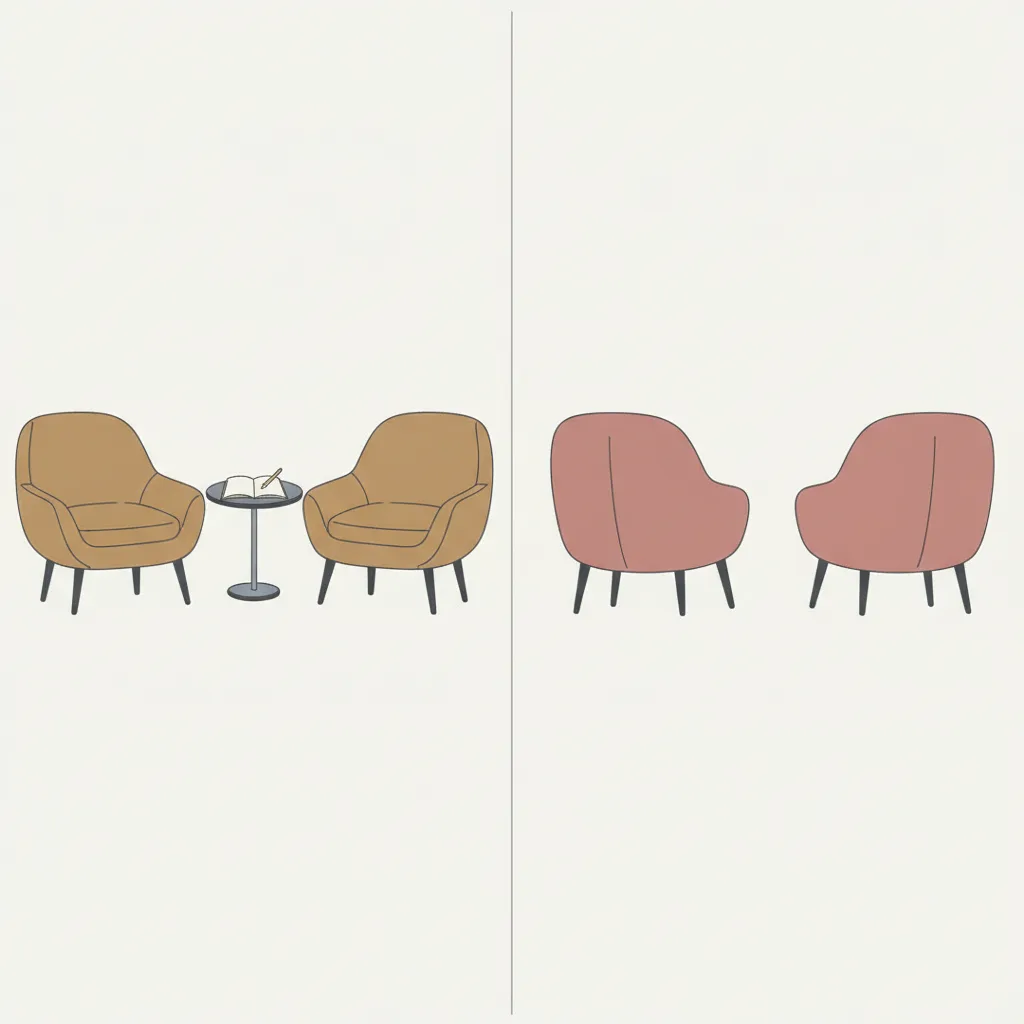
Two diverging hallways in a quiet house, one leading to an open door with light, the other to a closed door.

Arrependimento por ação

Divorciar-se

30%

27-39% das pessoas divorciadas se arrependem de terem se divorciado (27% mulheres, 39% homens)

Adultos nos EUA que se divorciaram, painel online

retrospectivo, sem prazo fixo

Arrependimento por omissão

Permanecer num casamento infeliz

32%

~1/3 ainda infelizes 5 anos depois (proxy de resultado, não uma pesquisa de arrependimento)

Adultos nos EUA em casamentos infelizes, painel NSFH nacionalmente representativo

acompanhamento longitudinal de 5 anos

% se arrependem desta escolha

balanced — Mais ou menos equilibrado — ambas as opções implicam arrependimento semelhante.

Decisões relacionadas

Decisões semanticamente semelhantes — mesmo terreno, compromissos diferentes.

family

Arrependimento por traição

% se arrependem desta escolha

A ação predomina

Arrependimento de ação 3.7× maior

family

Mediação familiar vs litígio

% se arrependem desta escolha

A inação predomina

Arrependimento de inação 3.1× maior

family

Casar jovem vs. esperar

% se arrependem desta escolha

A ação predomina

Arrependimento de ação 1.5× maior

family

Ter filhos

% se arrependem desta escolha

Equilibrado

Aproximadamente equilibrado

family

Afastamento familiar

% se arrependem desta escolha

A inação predomina

Arrependimento de inação 3.4× maior

family

Ficar em casa vs trabalhar

% se arrependem desta escolha

A ação predomina

Arrependimento de ação 1.3× maior

family

Terapia de casal vs pular

% se arrependem desta escolha

A inação predomina

Arrependimento de inação 1.2× maior

family

Tamanho da família

% se arrependem desta escolha

A inação predomina

Arrependimento de inação 2.6× maior

Riscos por trás desta decisão

As probabilidades que sustentam esta escolha.

About one-third of unhappily married adults who stayed married were still unhappy five years later (an outcome, not a regret survey), according to Waite et al.’s 2002 NSFH study — a rate nearly identical to the 30% of divorced adults who report regretting their divorce, anchored by Avvo’s 2016 panel survey (27% women, 39% men) and corroborated by broader estimates reaching at least one-third. The gender gap in divorce regret is consistent: men regret divorce more often than women, likely because women initiate roughly two-thirds of divorces and have therefore had more time to process the decision before it becomes final.

The cultural framing heavily favors action: divorce is positioned as liberation, staying as settling. The data complicates this. Waite’s finding that most unhappy marriages self-correct within five years is one of the more robust results in this literature, based on a nationally representative panel (NSFH) that tracked the same unhappily married respondents from a baseline rating to a five-year follow-up. It does not mean staying is always better — the study excluded abusive marriages, and “happy” was measured by a single survey item. But it does mean the widespread assumption that unhappiness in marriage is permanent is empirically wrong for the majority.

The near-parity between divorce-regret and staying-and-staying-unhappy rates (roughly 30% vs one-third) makes this one of the most balanced entries in the dataset — bearing in mind the inaction figure is an outcome, not a self-reported regret. The delta is within the margin of error for both surveys. The practical implication is that neither path reliably avoids regret — which is itself a useful calibration against the certainty that either side’s advocates tend to project.

Fontes: acção

Registro de evidências

Cada número abaixo é o que cada fonte relatou, com a citação literal em que nos baseamos e como chegamos ao nosso valor. Clique em qualquer link para verificar diretamente.

3/3 fontes verificadas de forma independente palavra por palavra em relação à fonte citada

  1. [1] Avvo (original press release) — Avvo study: Men regret divorce more often than women Verificado
    Avvo study: Men regret divorce more often than women
    Estatística
    27% of women and 39% of men regret their divorce (73% of women and 61% of men report no regret)
    Trecho
    “"73% of women report having no regret over being divorced while 61% of men say the same." ”
    Dados da fonte de
    2016-03-15
    Acessado
    2026-06-30
    Verificação
    Trecho obtido novamente de forma independente e confirmado palavra por palavra em relação à fonte citada durante nossa auditoria de fundamentação.
    Cálculo
    Avvo 2016 survey via Research Now panel, 2,000 US adults age 18+, credibility interval ±2.5 pp. The press release frames it as no-regret: 73% of women and 61% of men report no regret, i.e. 27% of women and 39% of men regret divorcing. Gender-weighted midpoint ~33%, rounded to 0.30.
  2. [2] Psychology Today — 7 Reasons People Regret Divorce Verificado
    7 Reasons People Regret Divorce
    Estatística
    At least one-third of people regret their marriage dissolution; up to 80% among those who divorced for the wrong reasons
    Trecho
    “"Statistical data suggests that at least one-third of people regret their marriage dissolution. That number can rise to 80 percent for ex-spouses who chose the wrong reasons to get divorced and feel that it could have been prevented if both parties had put forth more effort." ”
    Dados da fonte de
    2023-06-12
    Acessado
    2026-06-30
    Verificação
    Trecho obtido novamente de forma independente e confirmado palavra por palavra em relação à fonte citada durante nossa auditoria de fundamentação.
    Cálculo
    Psychology Today narrative review corroborates the one-third floor (rising to 80% for subsets who divorced for the wrong reasons). We use the one-third floor as triangulation for the 0.30 rate.
  3. [3] ScienceDaily, reporting Rosenfeld (Stanford), American Sociological Association 2015 Annual Meeting — Women More Likely Than Men to Initiate Divorces, But Not Non-Marital Breakups Verificado
    Women More Likely Than Men to Initiate Divorces, But Not Non-Marital Breakups
    Estatística
    Women initiated 69% of divorces versus 31% for men, based on the 2009-2015 waves of the nationally representative 'How Couples Meet and Stay Together' survey (2,262 adults age 19-94, 371 of whom had broken up or divorced by 2015)
    Trecho
    “"Women initiated 69 percent of all divorces, compared to 31 percent for men." ”
    Dados da fonte de
    2015-08-22
    Acessado
    2026-07-03
    Verificação
    Trecho obtido novamente de forma independente e confirmado palavra por palavra em relação à fonte citada durante nossa auditoria de fundamentação.
    Cálculo
    Rosenfeld (Stanford sociology), presented at the 2015 American Sociological Association Annual Meeting, analyzing the "How Couples Meet and Stay Together" panel (2009-2015 waves, N=2,262 adults aged 19-94; 371 breakups/divorces by 2015). Added to ground the body's explanatory claim that women initiate roughly two-thirds of divorces -- a contextual figure explaining the gender gap in divorce regret, not a regret-rate input; does not change the action_side regret_rate (0.30).

Fontes: inacção

Registro de evidências

Cada número abaixo é o que cada fonte relatou, com a citação literal em que nos baseamos e como chegamos ao nosso valor. Clique em qualquer link para verificar diretamente.

  1. [1] Institute for American Values / Waite, Browning et al. — Does Divorce Make People Happy? Findings from a Study of Unhappy Marriages
    Does Divorce Make People Happy? Findings from a Study of Unhappy Marriages
    Estatística
    Two-thirds of unhappily married adults who stayed married reported being happy five years later; approximately one-third remained unhappy
    Trecho
    “"Two out of three unhappily married adults who avoided divorce or separation ended up happily married five years later. Just one out of three unhappy marriages ended in divorce or separation; among those who stayed, two-thirds reported being 'happily married' five years later." ”
    Dados da fonte de
    2002-07-11
    Acessado
    2026-04-25
    Cálculo
    Waite et al. tracked NSFH respondents who rated their marriages unhappy in wave 1. Of those who stayed, two-thirds reported being "happily married" at wave 2 (5 years later); the remaining ~one-third were still unhappy. This is an OUTCOME proxy — the study measured marital-happiness status, never asked a regret question — so the 0.32 rate stands in for "stayed and remained unhappy," not self-reported regret of the decision to stay.

Ressalvas

The Waite study defines "unhappy" by self-report on a single item and counts anyone who later reports being "happy" as a success, ignoring intermediate misery. It also excludes marriages involving domestic violence, where staying carries physical risk. The divorce regret figures come from the Avvo 2016 online panel (n = 2,000, ±2.5 pp) — a non-probability sample, not peer-reviewed. The original Avvo press release reports 73% of women and 61% of men with no regret, i.e. 27% of women and 39% of men who regret divorcing; some secondary blogs further rephrase the male figure as 32%, which the primary source does not support. Critically, the inaction "32%" is an OUTCOME measure (still unhappy five years later), not a regret survey — the NSFH study never asked whether stayers regretted staying. The two populations (all divorcees vs unhappily married stayers) are not directly comparable — selection effects dominate. The near-parity in rates is the finding; the precise delta is noise.

Dados brutos: /api/decisions.json

Vistos recentemente neste dispositivo