




Ir para o conteúdo
Likelier

Arrependimento de agir vs. não agir

Comer juntos em família vs comer à pressa separadamente

Se você agir

Refeições regulares em família

9,0%

Se você não agir

Comer separadamente / com pressa

62%

Porcentagem de quem mais tarde se arrepende de cada escolha. As barras e o registro completo aparecem abaixo.


Família

Última revisão 2026-04-26

Qualidade das evidências 4.13/5

Pontuação de revisão em oito dimensões segundo a grelha de qualidade . Cada dimensão pontuada de 1 a 5.

D1 Verificação das fontes
5/5
D2 Autoridade e independência das fontes
4/5
D3 Precisão da taxa de arrependimento
2/5
D4 Comparabilidade das fontes
3/5
D5 Padrão de Gilovich
5/5
D6 Qualidade da prosa
5/5
D7 Completude das ressalvas
5/5
D8 Qualidade da amostra
4/5
Média 4.13/5
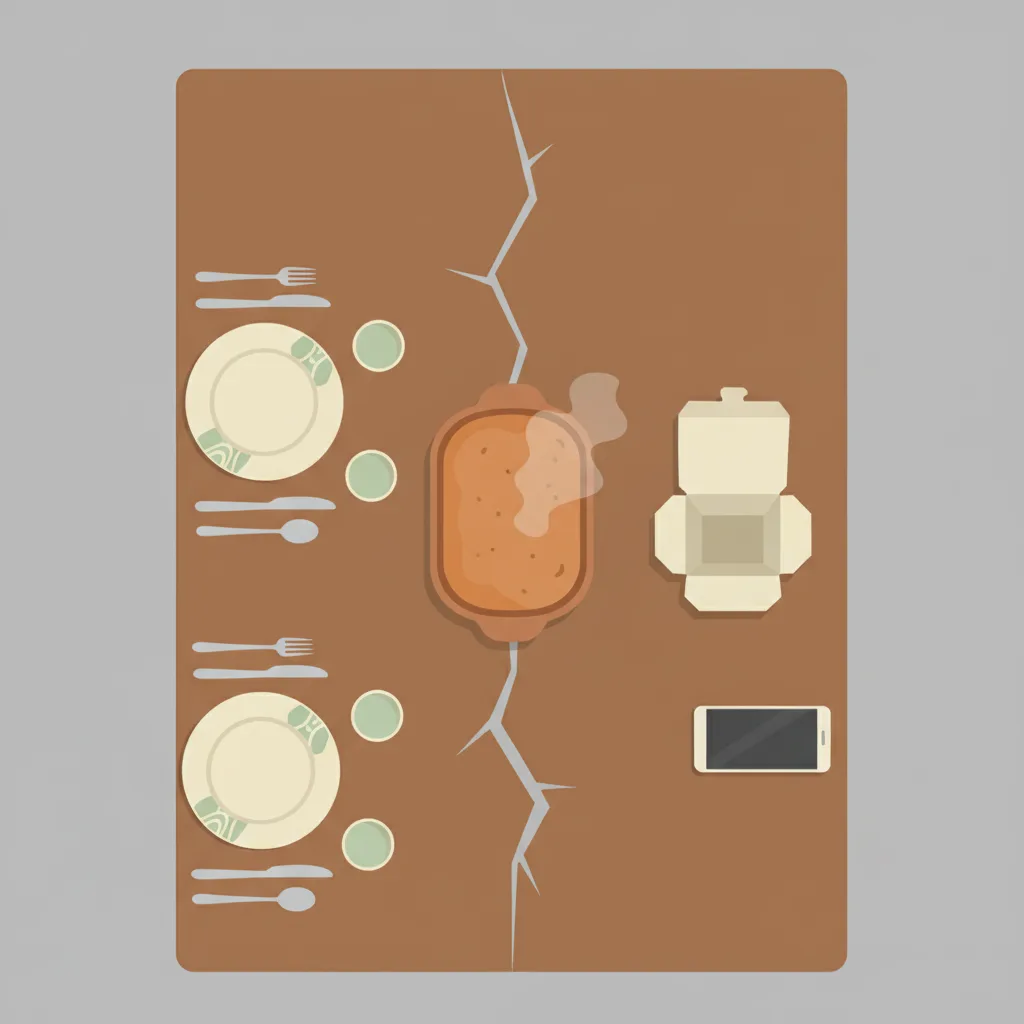
A dining table set for a family meal on one side, a counter with a lone takeout container on the other.

Arrependimento por ação

Refeições regulares em família

9,0%

~8% dos pais que priorizam refeições familiares regulares relatam que o esforço foi prejudicial (proxy)

Famílias nos EUA que mantêm refeições familiares regulares

transversal

Arrependimento por omissão

Comer separadamente / com pressa

62%

~32% dos pais que não conseguiram manter refeições familiares regulares relatam arrependimento

Pais nos EUA de adolescentes

retrospectivo

% se arrependem desta escolha

inaction dominates — A inacção domina — a maioria arrepende-se de não ter agido.

Decisões relacionadas

Decisões semanticamente semelhantes — mesmo terreno, compromissos diferentes.

family

Privada vs pública

% se arrependem desta escolha

A inação predomina

Arrependimento de inação 3.2× maior

family

Ficar em casa vs trabalhar

% se arrependem desta escolha

A ação predomina

Arrependimento de ação 1.3× maior

family

Socorrer vs. deixar resolver

% se arrependem desta escolha

A ação predomina

Arrependimento de ação 1.2× maior

family

Disciplina vs permissividade

% se arrependem desta escolha

A inação predomina

Arrependimento de inação 2.4× maior

lifestyle

Lanches frequentes

% se arrependem desta escolha

A inação predomina

Arrependimento de inação 1.8× maior

family

Atividades vs brincadeira livre

% se arrependem desta escolha

A ação predomina

Arrependimento de ação 2.6× maior

family

Tamanho da família

% se arrependem desta escolha

A inação predomina

Arrependimento de inação 2.6× maior

family

Lar de idosos vs cuidado domiciliar

% se arrependem desta escolha

A ação predomina

Arrependimento de ação 2.3× maior

A YouGov poll found that 62% of parents with children under 18 wish they had family dinners more often — the dominant inaction-side signal in this entry. On the action side, a 2022 American Heart Association survey of 1,000 US adults found that 9% of parents do not report stress reduction from regular family meals — and 84% wish they could share meals more often. The resulting 7:1 ratio between inaction-side aspiration and action-side dissatisfaction is striking but relies on asymmetric measurements — one asks about stress relief, the other about aspirational frequency — so the exact magnitude should be handled with caution.

The downstream associations of infrequent family meals are better documented than the regret itself. Harrison et al.’s systematic review of 14 studies confirmed inverse associations between family meal frequency and depression, substance use, and suicidal ideation in adolescents. These are correlational findings subject to obvious confounding — families that manage regular dinners differ socioeconomically and structurally from those that don’t — but the consistency across studies and populations makes the direction of effect reasonably secure. The aspiration gap (wanting more family meals) likely reflects both genuine awareness of these benefits and cultural messaging about what “good families” do.

The counterweight is real but poorly quantified. A 2025 BMC Public Health review argued that the “family dinner ideal” places uneven pressure on low-income, single-parent, and shift-working households, and that evidence for what specifically about the shared meal produces benefits — as opposed to the general family stability it proxies — remains thin. Quality of interaction appears to matter more than mere co-presence at a table. The aspiration gap here likely reflects genuine loss when connection opportunities are forfeited, but some of the 62% who wish for more dinners may be responding to cultural expectation rather than lived deprivation. Neither rate is a direct regret measure, and both are flagged as proxies accordingly.

Fontes: acção

Registro de evidências

Cada número abaixo é o que cada fonte relatou, com a citação literal em que nos baseamos e como chegamos ao nosso valor. Clique em qualquer link para verificar diretamente.

1/2 fontes verificadas de forma independente palavra por palavra em relação à fonte citada

  1. [1] American Heart Association / Wakefield Research — New survey: 91% of parents say their family is less stressed when they eat together
    New survey: 91% of parents say their family is less stressed when they eat together
    Estatística
    91% of parents say their family is less stressed when they regularly connect over a meal; 84% wish they could share a meal together more often
    Trecho
    “"91 percent of parents notice their family is less stressed when they regularly connect over a meal. The survey also found that 84% of adults say they wish they could eat more meals with others." ”
    Dados da fonte de
    2022-10-10
    Acessado
    2026-04-26
    Cálculo
    Wakefield Research for AHA, 1,000 nationally representative US adults ages 18+, September 14–20 2022, online survey. MOE +/-3.1pp at 95% CI. The 9% who do not report stress reduction is the complement of the 91% headline. We use this as an upper-bound proxy for action-regret: among parents who do eat together, a small minority find no benefit. This is a satisfaction complement, not a regret measure — flagged as "(proxy)".
  2. [2] BMC Public Health — Unpacking family meals: state-of-the-art review critiquing the Western ideals, positioning and promotion of family meals Verificado
    Unpacking family meals: state-of-the-art review critiquing the Western ideals, positioning and promotion of family meals
    Estatística
    Family meal promotion reinforces unrealistic expectations on resource-pressured families; evidence on what specifically helps is limited
    Trecho
    “"Evidence surrounding what specifically about the family meal offers health benefits is limited, and family meals carry a level of moral value, evoking pressure for parents to 'achieve' a family meal ideal, unattainable for many." ”
    Dados da fonte de
    2025-02-11
    Acessado
    2026-04-26
    Verificação
    Trecho obtido novamente de forma independente e confirmado palavra por palavra em relação à fonte citada durante nossa auditoria de fundamentação.
    Cálculo
    Narrative review, not a prevalence study. Included to establish that the action side is not costless: logistical burden and social pressure are real downsides for some families. Does not supply its own regret percentage.

Fontes: inacção

Registro de evidências

Cada número abaixo é o que cada fonte relatou, com a citação literal em que nos baseamos e como chegamos ao nosso valor. Clique em qualquer link para verificar diretamente.

1/2 fontes verificadas de forma independente palavra por palavra em relação à fonte citada

  1. [1] YouGov — Most parents wish they were having family dinners more often
    Most parents wish they were having family dinners more often
    Estatística
    62% of parents with children under 18 wish they could have family dinners 'much more often' or 'somewhat more often'
    Trecho
    “"Roughly six in 10 (62%) parents with children under 18 say they would like to have family dinners 'much more often' or 'somewhat more often.' Parents of children and teenagers (87%) are especially likely to say they have a family dinner with all members of their home at least once a week." ”
    Dados da fonte de
    2019-10-28
    Acessado
    2026-04-26
    Cálculo
    YouGov online survey, 1,220 US adults (938 sharing a household), October 21–22 2019, weighted to be nationally representative. The 62% is among parents with children under 18 who wish dinners happened more often. This measures aspiration gap (wanting more of something you believe is good), not classical retrospective regret. Flagged as "(aspiration-gap proxy)".
  2. [2] Canadian Family Physician (Harrison et al.) — Systematic review of the effects of family meal frequency on psychosocial outcomes in youth Verificado
    Systematic review of the effects of family meal frequency on psychosocial outcomes in youth
    Estatística
    Frequent family meals are inversely associated with substance use, depression, suicidal ideation, and violent behaviour in adolescents
    Trecho
    “"Overall, results show that frequent family meals are inversely associated with disordered eating, alcohol and substance use, violent behaviour, and feelings of depression or thoughts of suicide in adolescents, and there is a positive relationship between frequent family meals and increased self-esteem and school success." ”
    Dados da fonte de
    2015-02-01
    Acessado
    2026-04-26
    Verificação
    Trecho obtido novamente de forma independente e confirmado palavra por palavra em relação à fonte citada durante nossa auditoria de fundamentação.
    Cálculo
    Systematic review of 14 studies from MEDLINE and PsycINFO (searches 1948–2011). Not a prevalence figure; included to establish the consequence basis for why parents aspire to more family meals — the downstream associations are well documented, though correlational and subject to confounding.

Ressalvas

Neither figure is a direct regret measurement — both are explicitly flagged as proxies in regret_display. The 9% action-side figure is the complement of parents who report stress reduction from family meals — a satisfaction-inversion proxy, not a measure of anyone saying "I regret eating together." The 62% inaction-side figure captures wishing for more dinners (aspiration gap), which is closer to cultural expectation than classical retrospective regret. No large-scale survey directly asks "do you regret not eating together as a family?" The AHA 2022 survey also found 84% wish they could share meals more often, corroborating the YouGov direction. The YouGov sample includes parents who already eat together regularly but want more, inflating the inaction rate relative to true never-did-it regret. The Harrison et al. systematic review on teen substance use (infrequent diners more likely to use tobacco) is correlational and subject to confounding: families that eat together differ from those that don't in ways beyond the meal itself. The BMC Public Health review notes that the "family dinner ideal" places disproportionate pressure on low-income and single-parent households, so the aspiration gap may partly reflect cultural norming rather than evidence of net harm from missed meals. The 7:1 ratio between inaction and action rates is directionally robust but overstates the true regret asymmetry given the weak proxy on the action side.

Dados brutos: /api/decisions.json

Vistos recentemente neste dispositivo