
Ir para o conteúdo
Likelier

Arrependimento de agir vs. não agir

Colocar os filhos numa escola privada vs pública

Se você agir

Escola particular

13%

Se você não agir

Escola pública

41%

Porcentagem de quem mais tarde se arrepende de cada escolha. As barras e o registro completo aparecem abaixo.


Família

Última revisão 2026-04-26

Qualidade das evidências 4.38/5

Pontuação de revisão em oito dimensões segundo a grelha de qualidade . Cada dimensão pontuada de 1 a 5.

D1 Verificação das fontes
5/5
D2 Autoridade e independência das fontes
4/5
D3 Precisão da taxa de arrependimento
2/5
D4 Comparabilidade das fontes
5/5
D5 Padrão de Gilovich
5/5
D6 Qualidade da prosa
5/5
D7 Completude das ressalvas
5/5
D8 Qualidade da amostra
4/5
Média 4.38/5
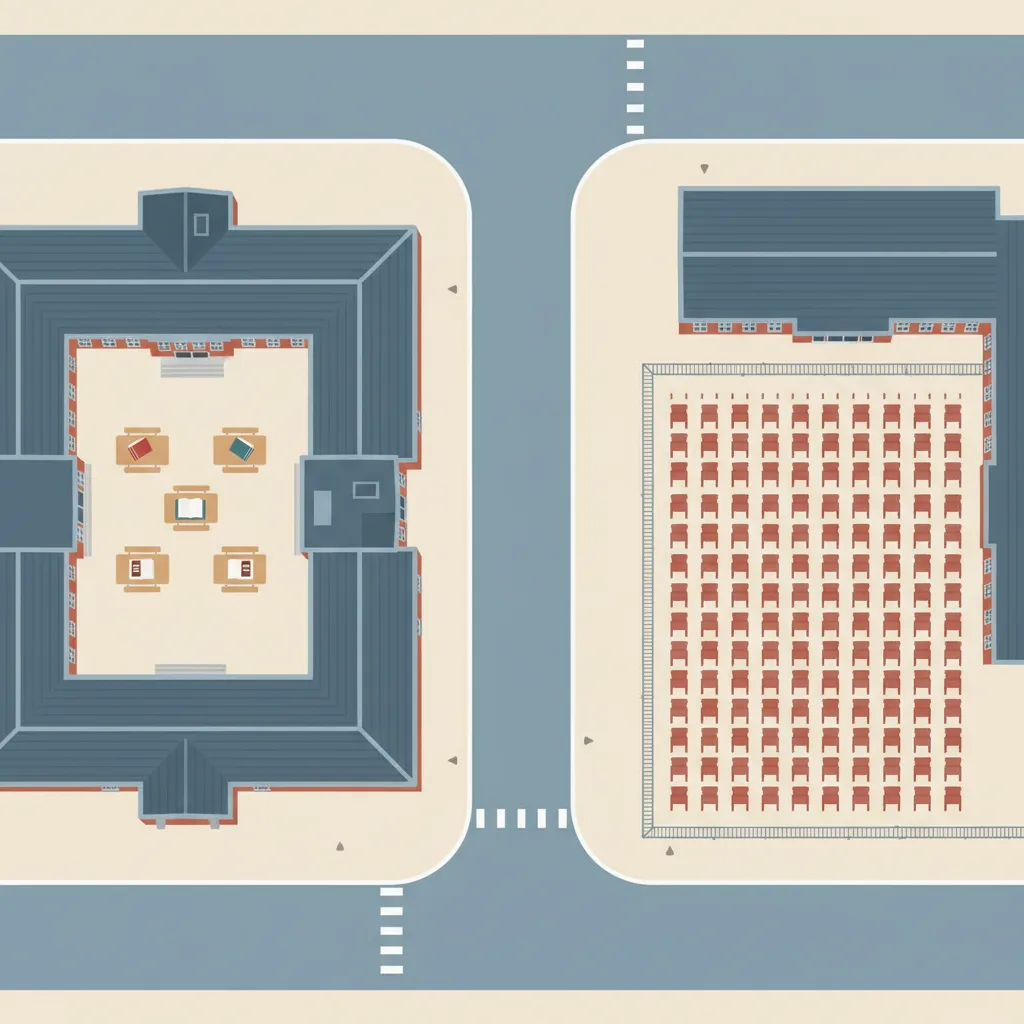
Two school buildings side by side, one with a small class and one with a large crowd, seen from above.

Arrependimento por ação

Escola particular

13%

13% dos pais de escolas privadas não escolheriam a mesma escola novamente (proxy — probabilidade de re-escolha)

Pais nos EUA de estudantes do K-12, nacionalmente representativo

retrospectivo, sem prazo fixo

Arrependimento por omissão

Escola pública

41%

41% dos pais de escolas públicas não escolheriam a mesma escola novamente (proxy — probabilidade de re-escolha)

Pais nos EUA de estudantes do K-12, nacionalmente representativo

retrospectivo, sem prazo fixo

% se arrependem desta escolha

inaction dominates — A inacção domina — a maioria arrepende-se de não ter agido.

Decisões relacionadas

Decisões semanticamente semelhantes — mesmo terreno, compromissos diferentes.

family

Ficar em casa vs trabalhar

% se arrependem desta escolha

A ação predomina

Arrependimento de ação 1.3× maior

family

Atividades vs brincadeira livre

% se arrependem desta escolha

A ação predomina

Arrependimento de ação 2.6× maior

family

Tamanho da família

% se arrependem desta escolha

A inação predomina

Arrependimento de inação 2.6× maior

family

Socorrer vs. deixar resolver

% se arrependem desta escolha

A ação predomina

Arrependimento de ação 1.2× maior

family

Refeições em família

% se arrependem desta escolha

A inação predomina

Arrependimento de inação 6.9× maior

family

Deixar desistir vs. terminar

% se arrependem desta escolha

A inação predomina

Arrependimento de inação 2.3× maior

familyDireta

Acesso da criança às redes sociais

% se arrependem desta escolha

A ação predomina

Arrependimento de ação 5.4× maior

family

Livre vs pais helicóptero

% se arrependem desta escolha

A ação predomina

Arrependimento de ação 2.3× maior

41% of traditional public-school parents say they would not choose the same school again, according to a nationally representative 50CAN/Edge Research survey. Among private-school parents the figure is only 13% — more than three times lower. Pew Research corroborates the gap from a different angle: 79% of private-school families report high satisfaction with educational quality, compared with 55% of public-school families. Neither instrument measures regret directly, but the consistency across surveys and constructs suggests the asymmetry is real, not an artifact of question wording.

The demand-side data makes the inaction story sharper. EdChoice’s 2024 Schooling in America survey found that 36% of parents would prefer private school, yet only 9% actually enroll — a 4:1 gap driven almost entirely by tuition costs and geographic access. That gap complicates the Gilovich framing: most public-school “inaction” is involuntary, constrained by money rather than by indecision. A parent who cannot afford private school and later wishes they could have is experiencing frustrated aspiration, not the freely-chosen inaction that typically intensifies over time in the regret literature.

Selection bias is the largest confounder. Private-school families are wealthier, more likely to have two parents in the household, and more educationally engaged on every metric NCES tracks. Their higher satisfaction may reflect resources and involvement rather than anything intrinsic to private schooling. Randomized voucher studies (e.g., Milwaukee, DC Opportunity Scholarship) show modest academic gains and higher parental satisfaction, but the effect sizes are far smaller than the raw satisfaction gap implies. The directional finding — parents who chose private school regret it less — holds up; the magnitude should be read with the income gradient firmly in mind.

Fontes: acção

Registro de evidências

Cada número abaixo é o que cada fonte relatou, com a citação literal em que nos baseamos e como chegamos ao nosso valor. Clique em qualquer link para verificar diretamente.

2/2 fontes verificadas de forma independente palavra por palavra em relação à fonte citada

  1. [1] 50CAN / Edge Research — The State of Educational Opportunity in America Verificado
    The State of Educational Opportunity in America
    Estatística
    87% of private-school parents would choose the same school again, vs 59% of traditional public-school parents
    Trecho
    “"87 percent of private school parents and 82 percent of parochial/religious school parents would make the same choice, while the number drops to 59 percent for traditional public school parents." ”
    Dados da fonte de
    2024-10-15
    Acessado
    2026-04-26
    Verificação
    Trecho obtido novamente de forma independente e confirmado palavra por palavra em relação à fonte citada durante nossa auditoria de fundamentação.
    Cálculo
    50CAN / Edge Research national survey. We derive action-regret as 1 − 0.87 = 0.13 (13% would not choose the same school). This is a proxy for regret — "would not choose again" conflates dissatisfaction, changed circumstances, and active regret.
  2. [2] Pew Research Center — Parents differ sharply by party over what their K-12 children should learn in school Verificado
    Parents differ sharply by party over what their K-12 children should learn in school
    Estatística
    79% of private-school parents report high satisfaction with the quality of their child's education, vs 55% of public-school parents
    Trecho
    “"About eight-in-ten parents answering about a child in private school (79%) express high levels of satisfaction with the quality of education their child is receiving, compared with a narrower majority (55%) of those answering about a child who is in public school." ”
    Dados da fonte de
    2022-10-26
    Acessado
    2026-04-26
    Verificação
    Trecho obtido novamente de forma independente e confirmado palavra por palavra em relação à fonte citada durante nossa auditoria de fundamentação.
    Cálculo
    Pew Research Center survey of U.S. parents of K-12 children (fielded Oct 2022). The 79% vs 55% satisfaction gap corroborates the 50CAN "would choose again" differential but measures a different construct (satisfaction vs hypothetical re-choice).

Fontes: inacção

Registro de evidências

Cada número abaixo é o que cada fonte relatou, com a citação literal em que nos baseamos e como chegamos ao nosso valor. Clique em qualquer link para verificar diretamente.

1/2 fontes verificadas de forma independente palavra por palavra em relação à fonte citada

  1. [1] 50CAN / Edge Research — The State of Educational Opportunity in America
    The State of Educational Opportunity in America
    Estatística
    Only 59% of traditional public-school parents would choose the same school again
    Trecho
    “"87 percent of private school parents would make the same choice, while the number drops to 59 percent for traditional public school parents." ”
    Dados da fonte de
    2024-10-15
    Acessado
    2026-04-26
    Cálculo
    Inaction-regret derived as 1 − 0.59 = 0.41. The 41% includes parents who would switch to private, charter, magnet, or homeschool — not exclusively to private school. This overstates the "wish I'd gone private" sentiment specifically.
  2. [2] EdChoice — Beyond Enrollment: What Parents Really Want from Their Children's Education Verificado
    Beyond Enrollment: What Parents Really Want from Their Children's Education
    Estatística
    36% of parents would most like to enroll in private school, but only 9% actually do
    Trecho
    “"The most popular schooling option was private schooling, with over a third of parents (36%) stating they would most like to enroll their children that way. This is four times the rate of students enrolled in private schools (9%)." ”
    Dados da fonte de
    2024-08-01
    Acessado
    2026-04-26
    Verificação
    Trecho obtido novamente de forma independente e confirmado palavra por palavra em relação à fonte citada durante nossa auditoria de fundamentação.
    Cálculo
    EdChoice 2024 Schooling in America Survey, n = 2,319 parents. The 4:1 ratio between stated preference and actual enrollment signals a large pool of constrained inaction — parents who want private school but face cost, location, or admissions barriers. This contextualizes but does not directly measure regret.

Ressalvas

Both sides draw on the same 50CAN/Edge Research survey, so the regret-rate comparison is internally consistent, but the question "would you choose the same school again" conflates regret with changed circumstances — a parent who moved neighborhoods may answer "no" without regretting the original decision. The Pew Research satisfaction data (79% vs 55%) uses a different instrument and year (2022 vs 2024), so the two datasets corroborate the direction but not the exact magnitude. Selection bias is the elephant: families who pay private-school tuition are wealthier and more educationally engaged; their higher satisfaction may reflect income and involvement, not school type alone. The EdChoice 36%-want-vs-9%-enrolled gap suggests cost is the primary barrier, meaning inaction here is often involuntary — a departure from Gilovich's framework, which assumes the agent could have acted.

Dados brutos: /api/decisions.json

Vistos recentemente neste dispositivo