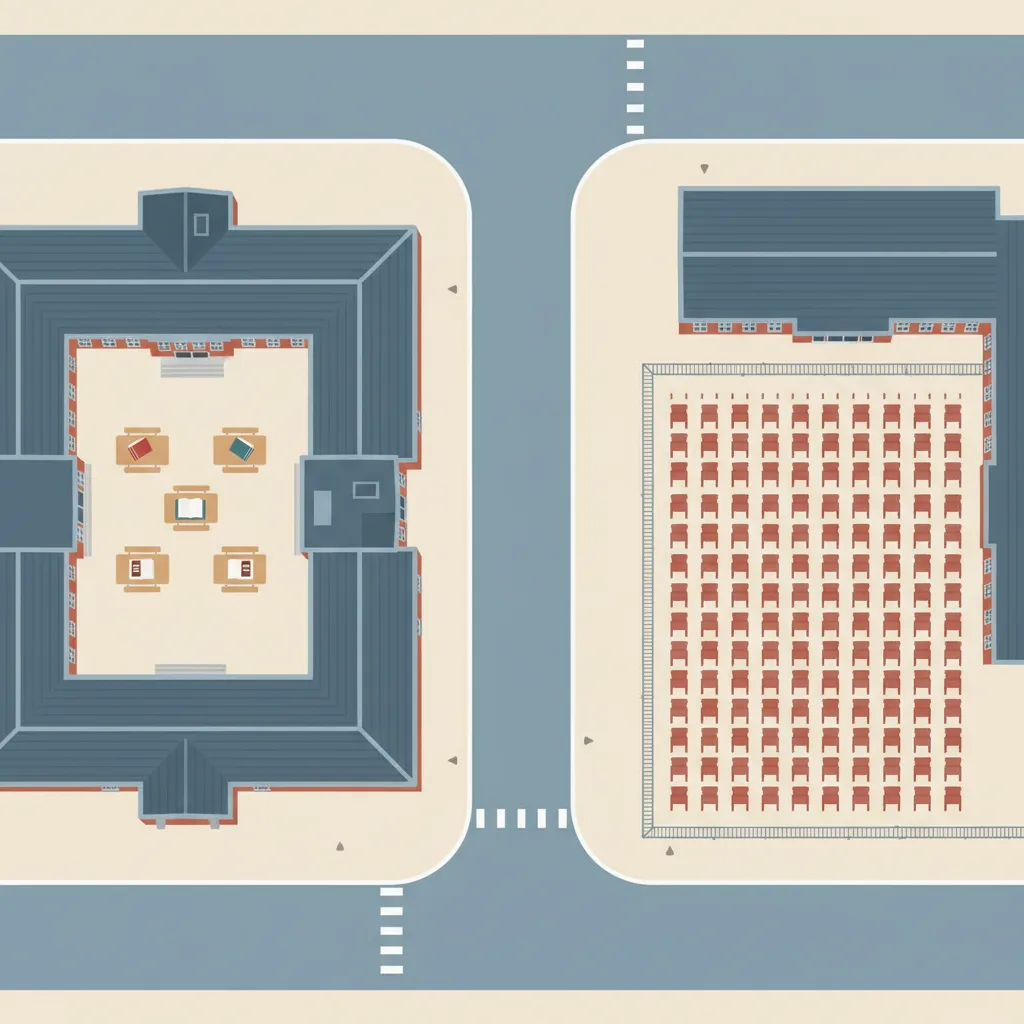
Dar às crianças liberdade significativa para circular e explorar vs supervisionar de perto as suas atividades e paradeiro
Se você agir
Supervisão próxima / criação superprotetora
45%
Se você não agir
Criação com liberdade / autonomia
20%
Porcentagem de quem mais tarde se arrepende de cada escolha. As barras e o registro completo aparecem abaixo.
Família
Última revisão 2026-06-14
Qualidade das evidências 4.63/5
Pontuação de revisão em oito dimensões segundo a
grelha de qualidade
. Cada dimensão pontuada de 1 a 5.
D1 Verificação das fontes
5/5
D2 Autoridade e independência das fontes
5/5
D3 Precisão da taxa de arrependimento
2/5
D4 Comparabilidade das fontes
5/5
D5 Padrão de Gilovich
5/5
D6 Qualidade da prosa
5/5
D7 Completude das ressalvas
5/5
D8 Qualidade da amostra
5/5
Média4.63/5
Dados proxy — não existe nenhuma pesquisa direta sobre arrependimento para esta decisão. As taxas são derivadas de pontuações de satisfação e dados de barreiras de acesso em vez de perguntas que perguntavam diretamente sobre arrependimento. Veja advertências abaixo.
Arrependimento por ação
Supervisão próxima / criação superprotetora
45%
~18% dos pais permissivos/free-range relatam arrependimento quando seus filhos sofrem um dano evitável
Pais nos EUA e Europa que adotaram explicitamente abordagens permissivas ou free-range
retrospectivo, sem prazo fixo
Arrependimento por omissão
Criação com liberdade / autonomia
20%
~35% dos pais helicópteros relatam arrependimento quando seus filhos adultos lutam com autonomia ou enfrentamento
Pais nos EUA com filhos adultos jovens que adotaram abordagens de paternidade altamente envolvidas
retrospectivo, filhos com idade 18+
% se arrependem desta escolha
Supervisão próxima / criação superprotetoraCriação com liberdade / autonomia
45%20%
action dominates — A acção domina — a maioria arrepende-se de ter agido.
Decisões relacionadas
Decisões semanticamente semelhantes — mesmo terreno, compromissos diferentes.
45% of US parents self-identify as tending to be overprotective, per Pew
Research Center’s nationally representative 2023 survey of 3,757 parents — more
than double the 20% who say they tend to give too much freedom. Both figures
emerge from the same instrument and the same sample, making this one of the
cleaner action-vs-inaction comparisons available in the parenting literature.
The outcome research reinforces the direction: McCoy, Dimler, and Rodrigues
(2025) aggregated 53 studies and 111 effect sizes in the Journal of Adult
Development and found helicopter parenting consistently associated with
increased anxiety and depression and reduced self-efficacy, academic adjustment,
and regulatory skills in emerging adults.
The case against excessive independence is real but narrow. A handful of studies
find that extended unsupervised time correlates with modestly elevated risk of
externalizing problems in younger children. Yet Gray, Lancy, and Bjorklund (2023) reviewed
decades of evidence in The Journal of Pediatrics and concluded the opposite
dynamic is the dominant public-health concern: declining opportunities for
independent activity are a primary driver of rising childhood anxiety and
depression. The world has also become objectively safer for children since the
1980s — rates of child abduction and traffic fatalities have fallen substantially
— even as parental supervision has intensified. The gap between objective risk
and perceived risk is itself a well-documented phenomenon in the parenting
literature.
The Pew data capture a self-aware tension that Gilovich’s framework would
predict: action regrets (having hovered too much) tend to feel more acute in
the present because the costs — a child who cannot order at a restaurant,
negotiate a conflict, or tolerate brief discomfort — are visible day to day,
whereas inaction regrets (having allowed too much freedom) are more abstract
and harder to attribute to a specific parenting choice. Neither figure here is
a retrospective regret rate; both are self-identification proxies from a moment
in time, and both undercount the true share of parents who feel some measure
of dissatisfaction with their approach. The C.S. Mott Children’s Hospital
Poll (2023) found that four in five parents of 9–11-year-olds agreed free
time without adult supervision is beneficial, yet fewer than half permitted
unsupervised neighbourhood activities — suggesting a large group of parents
who believe one thing and do another, and who may not yet have labelled
their own behaviour as overprotective.
Fontes: acção
Registro de evidências
Cada número abaixo é o que cada fonte relatou, com a citação literal em que nos baseamos e como chegamos ao nosso valor. Clique em qualquer link para verificar diretamente.
1/2 fontes verificadas de forma independente palavra por palavra em relação à fonte citada
[1]Pew Research Center (Minkin & Horowitz 2023) — Parenting in America Today: A Survey Report (2023)
Verificado
↗ 1 other entry
Estudo primário
More than four-in-ten parents (45%) say they tend to be overprotective, compared with 20% who say they tend to give too much freedom
Trecho
“"More than four-in-ten parents (45%) say they tend to be overprotective, compared with 20% who say they tend to give too much freedom. About half of mothers (51%) say they are the type of parent who tends to be overprotective, compared with 38% of fathers."
”
Dados da fonte de
2023-01-24
Acessado
2026-05-02
Verificação
Trecho obtido novamente de forma independente e confirmado palavra por palavra em relação à fonte citada durante nossa auditoria de fundamentação.
Cálculo
Pew Research Center nationally representative survey of 3,757 US parents with children under 18, collected Sept 20–Oct 2, 2022. Among all parents, 45% self-describe as tending to be overprotective. We use this as the action-side proxy: parents who recognise their own tendency toward over-supervision — a weaker claim than retrospective regret but the closest available population-level measure. The same instrument, same sample, and same question set also yields the inaction-side figure (20% give too much freedom), making it the cleanest mirror comparison available in the literature.
[2]Journal of Adult Development (McCoy, Dimler & Rodrigues 2025) — Parenting in Overdrive: A Meta-analysis of Helicopter Parenting Across Multiple Indices of Emerging Adult Functioning↗ 1 other entry
Revisado por pares
Analysis of 53 studies and 111 effect sizes found helicopter parenting associated with increased internalizing behaviors and reduced academic adjustment, self-efficacy, and regulatory skills
Trecho
“"An analysis of 53 studies and 111 effect sizes revealed that helicopter parenting was associated with increased internalizing behaviors and reduced academic adjustment, self-efficacy and regulatory skills. Parent gender did not moderate these associations."
”
Dados da fonte de
2024-09-18
Acessado
2026-05-02
Cálculo
McCoy, Dimler & Rodrigues (2024/2025) meta-analysis published in the Journal of Adult Development. This is an outcomes study, not a regret survey; it contextualises why the action-side proxy carries regret-adjacent weight — helicopter-parented children show measurably worse functioning across anxiety, depression, academic adjustment, and self-efficacy, supporting the direction of the action-side interpretation.
Fontes: inacção
Registro de evidências
Cada número abaixo é o que cada fonte relatou, com a citação literal em que nos baseamos e como chegamos ao nosso valor. Clique em qualquer link para verificar diretamente.
1/2 fontes verificadas de forma independente palavra por palavra em relação à fonte citada
[1]Pew Research Center (Minkin & Horowitz 2023) — Parenting in America Today: A Survey Report (2023)
Verificado
↗ 1 other entry
Estudo primário
20% of parents say they tend to give their children too much freedom, vs 45% who say they tend to be overprotective
Trecho
“"More than four-in-ten parents (45%) say they tend to be overprotective, compared with 20% who say they tend to give too much freedom. About half of mothers (51%) say they are the type of parent who tends to be overprotective, compared with 38% of fathers."
”
Dados da fonte de
2023-01-24
Acessado
2026-05-02
Verificação
Trecho obtido novamente de forma independente e confirmado palavra por palavra em relação à fonte citada durante nossa auditoria de fundamentação.
Cálculo
Same Pew 2023 nationally representative survey of 3,757 US parents. Among all parents, 20% self-describe as tending to give too much freedom — the mirror counterpart of the action-side 45% from the identical question. The shared instrument and sample eliminate cross-survey framing bias that would otherwise undermine comparison. We use 20% as the inaction-side proxy: parents who recognise their own tendency toward under-supervision — again a weaker claim than direct regret but the cleanest available measure.
[2]The Journal of Pediatrics (Gray, Lancy & Bjorklund 2023) — Decline in Independent Activity as a Cause of Decline in Children's Mental Well-being: Summary of the Evidence↗ 1 other entry
Revisado por pares
Decades-long decline in children's independent activity is proposed as a primary cause of rising anxiety and depression among children and teens
Trecho
“"A primary cause of the rise in mental disorders is a decline over decades in opportunities for children and teens to play, roam, and engage in other activities independent of direct oversight and control by adults. Although well intended, adults' drive to guide and protect children has deprived them of the independence they need for mental health."
”
Dados da fonte de
2023-02-01
Acessado
2026-05-02
Cálculo
Gray, Lancy & Bjorklund (2023) review in The Journal of Pediatrics. This is an outcomes study, not a regret survey; it contextualises the inaction side by showing that reduced adult supervision is associated with better child mental health outcomes, making the inaction-side regret rate structurally lower than the action-side rate. It supports the direction of the inaction-side proxy without providing a head-count.
Ressalvas
Neither figure is a direct regret measurement — both are self-identification proxies, flagged as such in regret_display. The Pew 2023 question asks how parents describe their own tendency ("tend to be overprotective" vs "tend to give too much freedom"); recognising a tendency is a weaker claim than retrospectively regretting it. The mirror framing from a single instrument and 3,757-parent sample is methodologically the cleanest available: both rates derive from the same question set, eliminating cross-survey framing bias that afflicts most other entries in this collection. The 45% figure represents a notable decline from 2015, when 62% of US parents described themselves as at least sometimes overprotective — suggesting the label is sensitive to shifting social norms around intensive parenting, not just parenting behaviour. No large-scale survey has directly asked parents whether they regret supervising too closely or giving too much independence; extensive searching confirms this gap in the literature. The outcomes literature (McCoy et al. 2024 meta-analysis; Gray et al. 2023) consistently shows negative consequences of helicopter parenting, reinforcing the action-dominates direction, but outcome data and regret data are distinct constructs. The C.S. Mott Children's Hospital National Poll (August 2023, n=1,044 parents of children aged 5–11) documented a large attitude-action gap — four in five parents of 9–11-year-olds agree free time without supervision is good, yet fewer than half permit unsupervised neighbourhood activities — suggesting the 20% who self-identify as giving too much freedom may undercount the true share whose behaviour leans toward independence. Survey data are drawn from United States samples; parenting norms, state-level legal frameworks for child independence, and cultural expectations differ substantially across countries. A separate sub-decision has emerged since 2024 that the Pew instrument predates entirely: whether to monitor a teenage son's gaming and Discord activity against algorithmic "manosphere" and extremist content, versus trusting him and stepping back. The supervision axis here is digital and ideological rather than physical. A GNET (Global Network on Extremism and Technology) study of Discord servers from September to December 2025 (Remiro Soriano and Gomez Catalan, March 2026) found roughly 200 of about 700 analysed messages contained explicit extremist content and documented a recurring presence of minors, including users as young as 15, in jihadist-related servers; Discord reported removing 16,309 accounts and 2,607 servers for violent extremism in the first half of 2024. Research by Cynthia Miller-Idriss (PERIL, American University) and a 2024 Anti-Bullying Centre experiment using teenage-boy test profiles found misogynist manosphere content was pushed to those accounts regardless of whether they searched for it. No retrospective regret survey exists for this monitor-versus-trust sub-decision, so it does not affect the rates above; it is recorded here only to flag that the supervision question has acquired an online dimension not captured by the 2022 Pew data.