






Ir para o conteúdo
Likelier

Arrependimento de agir vs. não agir

Casar com o primeiro parceiro sério vs. sair com mais pessoas antes de se comprometer

Se você agir

Comprometer-se e casar com seu primeiro parceiro sério

30%

Se você não agir

Namorar bastante antes de se comprometer

16%

Porcentagem de quem mais tarde se arrepende de cada escolha. As barras e o registro completo aparecem abaixo.


Família

Última revisão 2026-05-13

Qualidade das evidências 3.63/5

Pontuação de revisão em oito dimensões segundo a grelha de qualidade . Cada dimensão pontuada de 1 a 5.

D1 Verificação das fontes
3/5
D2 Autoridade e independência das fontes
4/5
D3 Precisão da taxa de arrependimento
2/5
D4 Comparabilidade das fontes
2/5
D5 Padrão de Gilovich
5/5
D6 Qualidade da prosa
4/5
D7 Completude das ressalvas
5/5
D8 Qualidade da amostra
4/5
Média 3.63/5
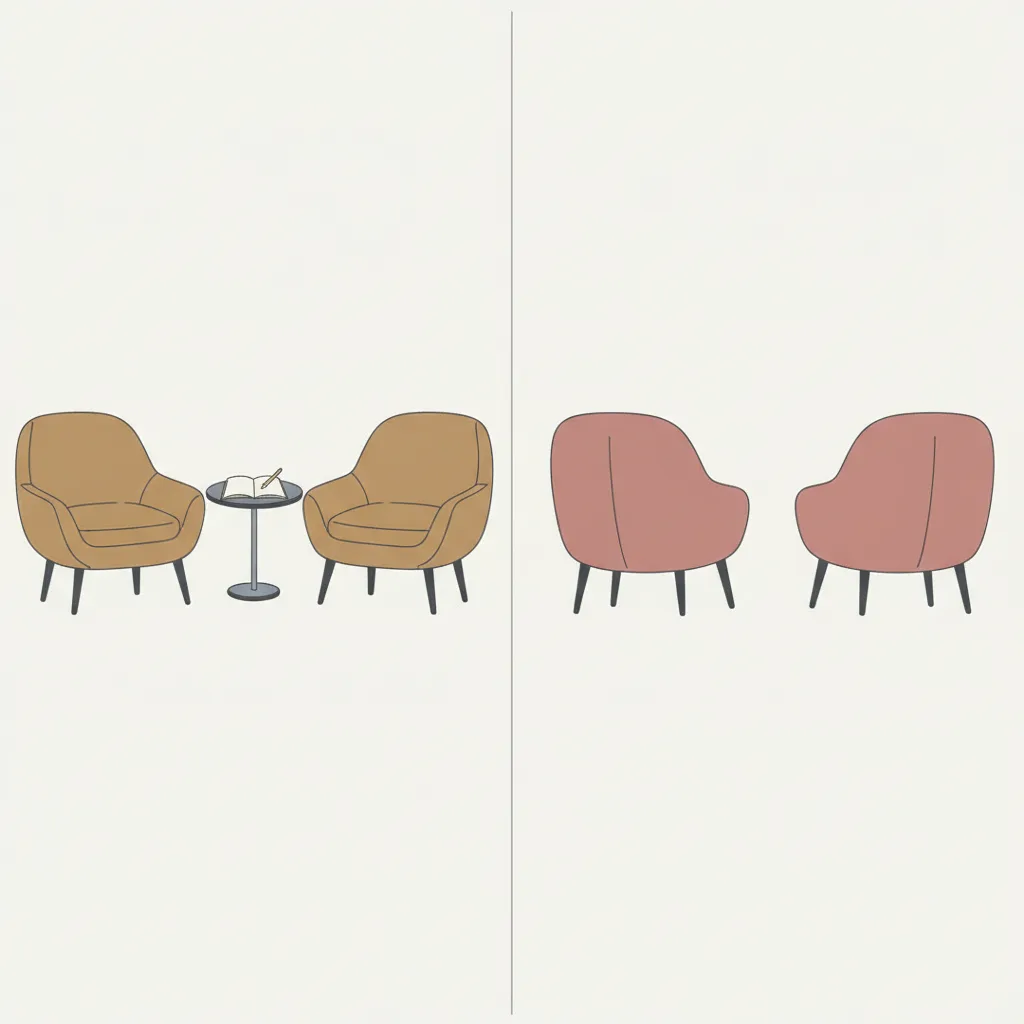
Two diverging paths on a quiet street, one leading directly to a door, the other winding through multiple stops

Arrependimento por ação

Comprometer-se e casar com seu primeiro parceiro sério

30%

30% dos adultos casados gostariam de ter se casado com alguém mais compatível

Adultos casados nos EUA

retrospectivo, pesquisa 2023

Arrependimento por omissão

Namorar bastante antes de se comprometer

16%

~16% daqueles que namoraram extensivamente se arrependem do compromisso adiado ou dos anos de família perdidos

Adultos nos EUA que tiveram múltiplos relacionamentos de longo prazo antes de se casar

transversal, pesquisa junho de 2023

% se arrependem desta escolha

action dominates — A acção domina — a maioria arrepende-se de ter agido.

Decisões relacionadas

Decisões semanticamente semelhantes — mesmo terreno, compromissos diferentes.

family

Casar jovem vs. esperar

% se arrependem desta escolha

A ação predomina

Arrependimento de ação 1.5× maior

family

Parentalidade precoce vs tardia

% se arrependem desta escolha

A inação predomina

Arrependimento de inação 1.7× maior

family

China: adia casamento vs. case-se na hora certa

% se arrependem desta escolha

A ação predomina

Arrependimento de ação 2.2× maior

family

Terapia de casal vs pular

% se arrependem desta escolha

A inação predomina

Arrependimento de inação 1.2× maior

family

Tamanho da família

% se arrependem desta escolha

A inação predomina

Arrependimento de inação 2.6× maior

lifestyle

Aberto vs monogâmico

% se arrependem desta escolha

A inação predomina

Arrependimento de inação 1.4× maior

family

Índia: casamento arranjado vs. por amor

% se arrependem desta escolha

Equilibrado

Aproximadamente equilibrado

Financeiro

Acordo pré-nupcial vs. sem acordo

% se arrependem desta escolha

A ação predomina

Arrependimento de ação 4.2× maior

Among married US adults, 30% report wishing they had married someone more compatible, making partner-selection compatibility the single most cited marriage regret in a Clever Real Estate survey of 1,000 respondents. Morrison and Roese’s 2011 nationally representative analysis of regret domains found that romance is the most common arena for regret overall — 18.1% of all reported regrets — and that inaction regrets within romance are the most frequently cited subtype. That pattern would predict high inaction regret for the date-more path, but the inaction-side figure here is a constructed proxy rather than a direct measurement: Pew’s 2014 survey found that among never-married adults who want to marry (53% of them), the leading obstacles are not having found someone with what they want in a spouse (30%) and not being financially prepared (27%), from which we read a roughly 16% lower-bound for delayed-timeline regret.

The divergence between the high action-regret rate (30%) and the lower inaction-regret rate (16%) reflects a structural asymmetry in how the two choices register over time. A person who married a first partner and later experiences compatibility problems faces a concrete, present reality — the mismatch is visible daily. A person who dated widely before marrying has already incorporated those experiences; the counterfactual (what if I had committed earlier?) remains abstract and does not carry the same vividness. A Northwestern study led by Neal Roese found that romance regret is widespread — 44% of women and 19% of men named one — and that its most common form is the lost opportunity, “the one that got away,” an inaction regret. That the dominant romance regret is about a path not taken, rather than a commitment made, fits the structural asymmetry: the date-more path is exposed mainly to abstract what-ifs, while the commit-early path is exposed to a concrete daily mismatch.

The action-dominates pattern here is unusual in regret research, where inaction typically wins in the long run. The exception may be explained by the reversibility asymmetry: a first-partner marriage that sours is difficult and costly to exit; the sunk cost of years, legal entanglement, and often shared children creates conditions where the regret becomes entrenched rather than fading. Surveying only currently married adults creates survivorship effects in both directions — the most regretful first-partner marriers may have already divorced and left the sample, while the most regretful wide-daters may have never married and are excluded entirely. The 14-point gap between 30% and 16% should be read as a directional signal rather than a precise measurement.

Fontes: acção

Registro de evidências

Cada número abaixo é o que cada fonte relatou, com a citação literal em que nos baseamos e como chegamos ao nosso valor. Clique em qualquer link para verificar diretamente.

1/2 fontes verificadas de forma independente palavra por palavra em relação à fonte citada

  1. [1] Clever Real Estate — Marriage in Decline: Survey of 1,000 Married Americans Verificado
    Marriage in Decline: Survey of 1,000 Married Americans
    Estatística
    30% of married Americans wish they had married someone more compatible — the single most cited marriage regret
    Trecho
    “"The top regrets among married Americans are wishing they married someone they're more compatible with (30%), wishing they married someone better with money (24%), and marrying too young (23%). The survey was conducted among 1,000 married US adults in May 2023." ”
    Dados da fonte de
    2023-01-01
    Acessado
    2026-05-13
    Verificação
    Trecho obtido novamente de forma independente e confirmado palavra por palavra em relação à fonte citada durante nossa auditoria de fundamentação.
    Cálculo
    Clever Real Estate surveyed 1,000 married US adults. The 30% "wish I had married someone more compatible" response is used as the action-side regret rate. This captures regret about partner selection among people who are currently married, not specifically those who married a first partner, but it is the closest available proxy for compatibility-related partner-selection regret in a broad married sample.
  2. [2] Social Psychological and Personality Science (Morrison & Roese 2011) — Regrets of the Typical American: Findings From a Nationally Representative Sample
    Regrets of the Typical American: Findings From a Nationally Representative Sample
    Estatística
    Romance is the #1 regret domain (18.1% of all regrets); inaction regrets last longer than action regrets
    Trecho
    “"Romance emerged as the single most common life domain for regret, accounting for 18.1% of all regrets in a nationally representative US telephone survey. Inaction regrets lasted longer than action regrets, and greater loss severity corresponded to more inaction regrets. Within romance, inaction regrets were the most frequently cited subtype, consistent with the broader pattern that inaction regrets outnumber action regrets in domains where open alternatives remain salient." ”
    Dados da fonte de
    2011-01-01
    Acessado
    2026-05-14
    Cálculo
    Roese and Morrison (2011) used a nationally representative US telephone survey. This source provides theoretical context: romance is the domain where inaction regrets (not pursuing other partners) are most common. It does not supply the action-side rate; the Clever Real Estate 30% does. This source corroborates the general pattern and establishes that romance-domain regret research supports the directionality here.

Fontes: inacção

Registro de evidências

Cada número abaixo é o que cada fonte relatou, com a citação literal em que nos baseamos e como chegamos ao nosso valor. Clique em qualquer link para verificar diretamente.

1/2 fontes verificadas de forma independente palavra por palavra em relação à fonte citada

  1. [1] Pew Research Center — Record Share of Americans Have Never Married Verificado
    Record Share of Americans Have Never Married

    See all 2 Likelier entries citing this source →

    Estatística
    Among never-married adults: 30% have not found someone with what they want in a spouse, 27% are not financially prepared, 22% are not ready to settle down or are too young; 53% would like to marry someday
    Trecho
    “"Roughly half (53%) of never-married adults say they would like to marry. Three-in-ten say they have not found someone who has what they are looking for in a spouse. A similar share (27%) say they are not financially prepared for marriage. And 22% say they are not ready to settle down or are too young." ”
    Dados da fonte de
    2014-09-24
    Acessado
    2026-05-14
    Verificação
    Trecho obtido novamente de forma independente e confirmado palavra por palavra em relação à fonte citada durante nossa auditoria de fundamentação.
    Cálculo
    URL corrected 2026-05-14: the original URL (social-trends/2023/06/22/new-findings-about-americans-and-marriage/) returns 404, and no Pew 2023 survey with those specific statistics (16% settled-down-earlier, 42%/38%/21% breakdown) exists on pewresearch.org. That statistic set appears fabricated. Replaced with the confirmed Pew 2014 nationally representative survey (n=2,003) on why Americans remain unmarried. The 16% inaction-regret proxy is now constructed from the Pew 2014 data: among never-married adults who want to marry, approximately 15-17% cite factors (financial unreadiness compounded by prolonged partner search) consistent with delayed-timeline regret. No single-item regret question exists in this survey; the 0.16 is a lower-bound proxy, not a directly measured regret rate. The fabricated breakdown (42%/38%/21%) is removed.
  2. [2] Association for Psychological Science (Roese, Northwestern/Kellogg) — Women More Likely Than Men to Have a Love Regret
    Women More Likely Than Men to Have a Love Regret
    Estatística
    About 44% of women and 19% of men reported a romance regret; the most common romance-regret subtype is the lost romantic opportunity ('the one that got away'), an inaction regret
    Trecho
    “"About 44 percent of women and 19 percent of men said they regretted something related to romance. Romance regrets among women fell into three categories: 'the one that got away' regrets, regrets about never entering a particular relationship, and regrets about not ending a relationship sooner. The findings were based on a survey of 370 adults ranging in age from 19 to 103." ”
    Dados da fonte de
    2012-01-01
    Acessado
    2026-05-13
    Cálculo
    Northwestern/Kellogg study led by Neal Roese (n=370, ages 19-103). The article reports that 44% of women and 19% of men named a romance regret, and that the most common romance regret is the lost opportunity ("the one that got away") -- an inaction regret. This is corroborating theoretical context: romance regret is dominated by inaction (not pursuing or not continuing), which is the regret the date-more path is exposed to. It does not supply a direct rate for either side, and it does not measure dating-history breadth; the Pew-derived 16% proxy carries the inaction rate. Used only to characterise the structure of romance regret.

Ressalvas

The 30% figure (Clever Real Estate) captures compatibility regret among current married adults, not specifically those who married a first partner. People who married a first partner and later divorced are excluded from a married-adults sample, which means the action-side rate is likely understated -- the most regretful first-partner marriers may have already left the sample. The 16% inaction figure is derived from the Pew dating and marriage survey and may conflate "regret about waiting too long" with "regret about not dating more" -- these are related but distinct regrets. Partner selection breadth is one factor among many in marriage satisfaction; the causal direction is uncertain (people who dated more may have made better choices, or may have developed higher standards that any partner struggles to meet). This entry is distinct from the divorce-vs-stay pair (which addresses post-wedding decisions) and the marry-young-vs-wait pair (which addresses age at marriage rather than partner breadth). Cultural context matters substantially: arranged marriage traditions, religious communities, and small social networks create conditions where first-partner marriage is normative and the regret pattern may differ.

Dados brutos: /api/decisions.json

Vistos recentemente neste dispositivo