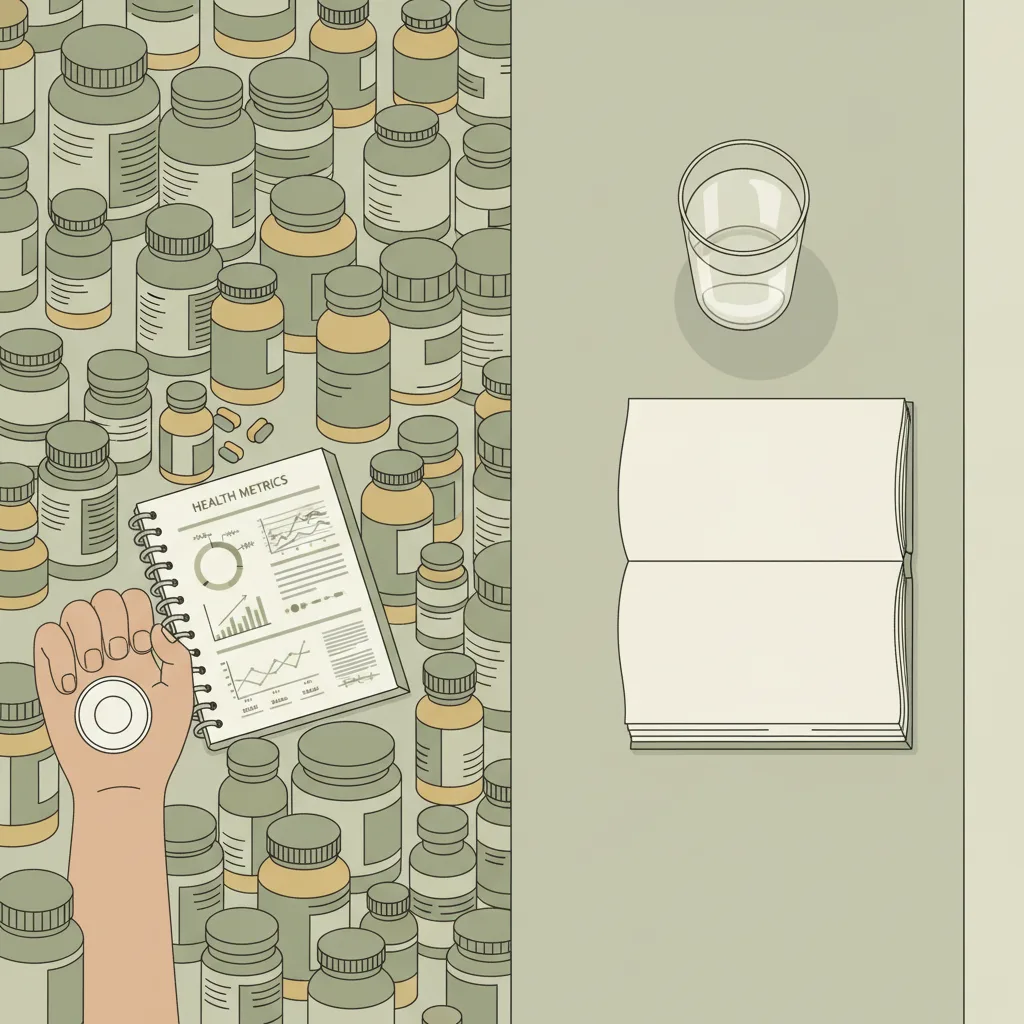
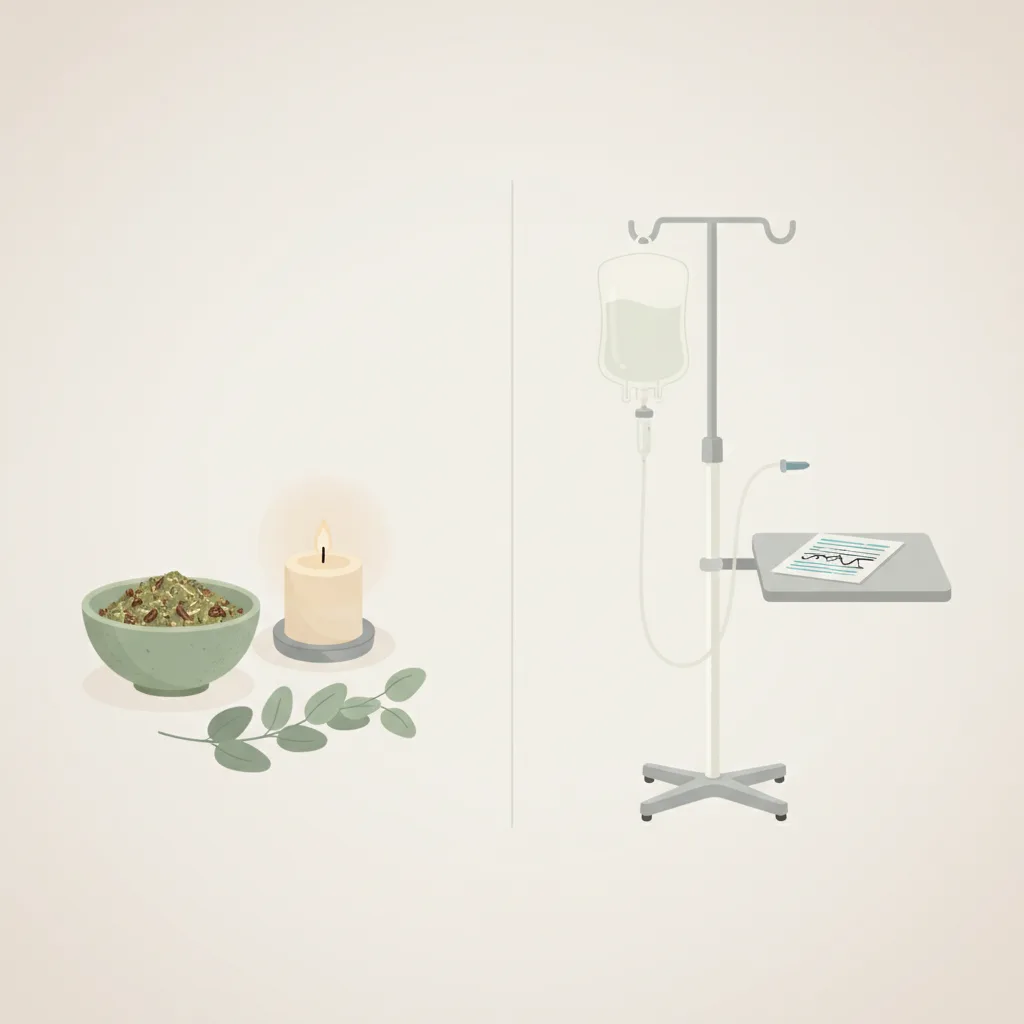
Recusar o tratamento oncológico convencional; recorrer apenas à medicina alternativa (sem cirurgia, quimioterapia, radioterapia ou hormonoterapia)Aceitar o tratamento oncológico convencional (cirurgia, quimioterapia, radioterapia, hormonoterapia conforme o estágio)
Among 449 young breast cancer survivors, 25.2% regretted inactions
specifically — not seeking information sooner, not getting second opinions,
not being more proactive about their own care (Friedman et al. 2011). That
figure is the inaction-specific rate: 42.5% of the sample expressed any
regret, and of those, 59.2% pointed to inactions (42.5% × 59.2% = 25.2%).
Brewer et al.’s meta-analysis of 81 studies (N = 45,618) across vaccination,
screening, and other health domains confirmed the direction: anticipated
inaction regret correlated with actual health behavior at r = 0.29 and with
intentions at r = 0.52.
On the action side, a meta-analysis of 14 studies covering 17,883 localized
prostate cancer patients found that 20% reported significant decision
regret about their treatment choice, measured with the validated Decision
Regret Scale (Fanshawe et al. 2023). The regret clusters around side effects —
sexual dysfunction, urinary incontinence, bowel problems — that follow
aggressive treatment of cancers that may never have become life-threatening.
Active surveillance patients reported the lowest regret (13%), while surgery
and radiotherapy patients hovered near 18–19%. A separate 15-year follow-up
of 934 men in the population-based Prostate Cancer Outcomes Study put the
overall figure at 14.6% (Hoffman et al. 2017). This is the best-quantified
cost of early diagnosis: roughly one in five to one in seven patients wish,
in retrospect, they had chosen differently.
The gap is narrower than it first appears. Prostate cancer screening is the
single most contested domain in the overdiagnosis debate — roughly 60% of
PSA-detected cancers may be overdiagnosed — so the 20% action-regret
figure is arguably an upper bound for early diagnosis in general. The
corrected inaction-specific rate (25.2%, not the previously stated 42.5%)
comes from a sample of young women with an aggressive cancer subtype, where
the consequences of delay are stark and visible. The revised delta (-0.052)
indicates a slight tilt toward inaction regret rather than a dramatic 2:1
ratio. For genuinely indolent conditions detected only by screening, the
calculus may reverse entirely. The directional finding — that health
inaction generates more long-term regret than health action — is supported
across the literature, but the magnitude depends heavily on what you are
being screened for and how likely the disease is to matter.
Fontes: acção
Registro de evidências
Cada número abaixo é o que cada fonte relatou, com a citação literal em que nos baseamos e como chegamos ao nosso valor. Clique em qualquer link para verificar diretamente.
3/3 fontes verificadas de forma independente palavra por palavra em relação à fonte citada
[1]European Urology Open Science — Decision Regret in Patients with Localised Prostate Cancer: A Systematic Review and Meta-analysis
Verificado
Revisado por pares
Pooled 20% (95% CI 16–23%) of patients reported significant decision regret across 14 studies
Trecho
“"Significant decision regret was present in a pooled 20% (95% confidence interval 16–23) of patients across 14 studies and 17,883 patients. Regret was lower in active surveillance (13%), with little difference between radiotherapy (19%) and prostatectomy (18%)."
”
Dados da fonte de
2023-03-01
Acessado
2026-04-26
Verificação
Trecho obtido novamente de forma independente e confirmado palavra por palavra em relação à fonte citada durante nossa auditoria de fundamentação.
Cálculo
Fanshawe et al. 2023 meta-analysis of 14 studies using the Decision Regret Scale. The 20% pooled estimate captures regret from overdiagnosis, overtreatment, and side effects (sexual dysfunction, urinary incontinence) following early detection via PSA screening. Used as proxy for the broader cost of early diagnosis and aggressive treatment.
[2]Journal of Clinical Oncology — Treatment Decision Regret Among Long-Term Survivors of Localized Prostate Cancer: Results From the Prostate Cancer Outcomes Study
Verificado
Revisado por pares
14.6% expressed treatment decision regret at 15 years
Trecho
“"Overall, 14.6% expressed treatment decision regret: 8.2% of those whose disease was managed conservatively, 15.0% of those who received surgery, and 16.6% of those who underwent radiotherapy."
”
Dados da fonte de
2017-07-12
Acessado
2026-04-26
Verificação
Trecho obtido novamente de forma independente e confirmado palavra por palavra em relação à fonte citada durante nossa auditoria de fundamentação.
Cálculo
Hoffman et al. 2017. Prostate Cancer Outcomes Study, population-based cohort of 934 men followed for 15 years. The 14.6% overall figure is lower than the meta-analytic pooled 20%, likely because the longer follow-up selects survivors who have had time to rationalize their decision.
[3]Reviews in Urology / Andriole et al. — Overdiagnosis of Prostate Cancer
Verificado
Revisado por pares
Using ERSPC (European Randomized Study of Screening for Prostate Cancer) data, Welch and Black estimated that 60% of PSA screen-detected prostate cancers were overdiagnosed
Trecho
“"Using ERSPC data, Welch and Black estimated that 60% of such screen-detected cancers were overdiagnosed."
”
Dados da fonte de
2012-09-01
Acessado
2026-07-03
Verificação
Trecho obtido novamente de forma independente e confirmado palavra por palavra em relação à fonte citada durante nossa auditoria de fundamentação.
Cálculo
Andriole GL et al., Reviews in Urology 2012;14(3-4) (PMC3540879), reviewing Welch HG & Black WC, "Overdiagnosis in Cancer," J Natl Cancer Inst 2010;102(9):605-613. The 60% figure is the upper end of published PSA-detected prostate cancer overdiagnosis estimates (other estimates in the literature range from ~20% to 50%); cited here as context for why the 20% action-side decision-regret figure (Fanshawe et al. 2023) is plausibly an upper bound rather than an underestimate for early diagnosis in general. Not used in regret_rate arithmetic.
Fontes: inacção
Registro de evidências
Cada número abaixo é o que cada fonte relatou, com a citação literal em que nos baseamos e como chegamos ao nosso valor. Clique em qualquer link para verificar diretamente.
[1]Psycho-Oncology / PMC — Post-Treatment Regret Among Young Breast Cancer Survivors
Revisado por pares
42.5% of 449 young breast cancer survivors expressed regret; of those, 59.2% regretted inactions
Trecho
“"The majority (59.2%) of participants who expressed regret did so over inactions ('I wish I had…', 'I would have…') as opposed to actions. Many women wished they had been more proactive in their care with respect to seeking information and having a better understanding of long-term effects and side effects of their treatment options."
”
Dados da fonte de
2011-01-01
Acessado
2026-04-26
Cálculo
Friedman et al. 2011. Study of 449 young breast cancer survivors. 42.5% (191 of 449) expressed any regret. Of those who expressed regret, 59.2% regretted inactions (delayed screening, not seeking information sooner) rather than actions. Inaction-specific rate: 42.5% × 59.2% = 25.2% of the full sample regretted inactions. The prior entry incorrectly used 42.5% (total regret) as the inaction rate; the correct inaction-specific figure is 25.2%.
[2]Health Psychology — Anticipated Regret and Health Behavior: A Meta-Analysis
Revisado por pares
Anticipated inaction regret predicted health behavior (r = 0.29, p < .001) and intentions (r = 0.52) across 81 studies
Trecho
“"Greater anticipated regret from not engaging in a behavior (i.e., inaction regret) predicted stronger intentions and behavior. Anticipated inaction regret has a stronger and more stable association with health behavior than previously thought."
”
Dados da fonte de
2016-09-01
Acessado
2026-04-26
Cálculo
Brewer et al. 2016 meta-analysis of 81 studies (N = 45,618). Demonstrates that across vaccination, screening, and other health domains, anticipated inaction regret consistently exceeds action regret. The correlation with actual health behavior is r = 0.29 (not r = 0.52, which is the correlation with intentions). The r = 0.29 figure is the relevant behavioral predictor; r = 0.52 applies to intention formation only. Both are statistically significant (p < .001).
Ressalvas
Os números de ação e inação vêm de populações clínicas diferentes: uma meta-análise de pacientes com câncer de próstata localizado (principalmente homens mais velhos) versus um estudo de jovens sobreviventes de câncer de mama. O número de 20% de arrependimento por ação é específico de arrependimento de decisão de tratamento após câncer detectado por PSA — provavelmente superestima o arrependimento por diagnóstico precoce em geral, já que o rastreio de câncer de próstata é a área mais contestada do debate de sobrediagnóstico. A taxa específica de inação (25,2%) é derivada de Friedman et al.: 42,5% da amostra expressou qualquer arrependimento, e 59,2% desses arrependimentos foram sobre inações (42,5% × 59,2% = 25,2%). A entrada anterior usou incorretamente o total de 42,5% como a taxa de inação. A meta-análise Brewer mostra que o arrependimento antecipado de inação correlaciona com o comportamento real de saúde em r = 0,29 (não r = 0,50, que é a correlação de intenções), fornecendo evidência convergente de que a direção é robusta entre comportamentos de saúde. O delta revisado (−0,052) sugere que a diferença entre arrependimento por ação e inação é mais estreita do que afirmado anteriormente — o diagnóstico precoce carrega custos de arrependimento significativos (efeitos colaterais de sobre-tratamento) que parcialmente compensam o arrependimento por inação. Pessoas com condições genuinamente indolentes — detectadas apenas por causa do rastreio — podem experimentar dano líquido do diagnóstico precoce sem um contrafactual de arrependimento por inação correspondente.